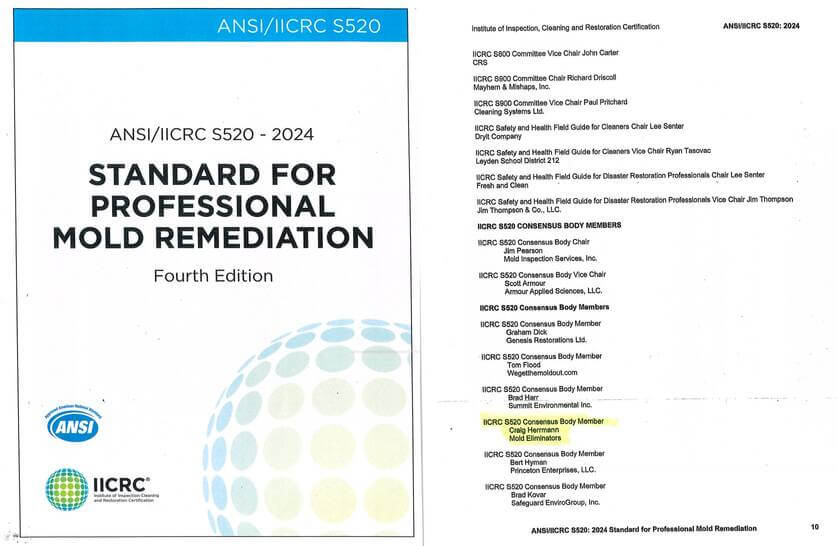
The ANSI/IICRC S520 is the definitive standard for professional mold remediation. It defines assessment protocols, contamination classifications, containment requirements, worker safety, and post-remediation verification. Every restoration company operating in Nevada is required to follow it. Craig Herrmann, owner of Mold Eliminators, spent six years in weekly collaborative meetings to co-author the 4th Edition, published in 2024.
Before the S520: The Wild West
Before the S520 existed, mold remediation had no consistent standard. Companies sprayed products on mold and called it remediation. Others removed far more material than necessary. Some wore full hazmat suits for minor bathroom mold to alarm homeowners. Others handled serious contamination without basic respiratory protection. Insurance companies did not know what to pay for. Property owners could not evaluate contractor bids. Workers lacked clear safety guidance. The S520 ended that, and Craig was part of the group that wrote the replacement.
The Three Contamination Conditions
The S520 establishes three contamination conditions that drive every remediation decision. Condition 1 is normal fungal ecology comparable to outdoor air samples, the goal of all remediation work. Condition 2 is elevated airborne spore concentration or settled contamination beyond normal levels, which may show no visible growth but still requires professional remediation. Condition 3 is visible mold growth requiring immediate containment and source removal. Condition classification is determined by testing, not by visual inspection alone.
What It Requires in Practice
The standard requires that source removal comes first. Dead mold still causes allergic reactions and mycotoxins remain active after the colony is killed, so surface treatments alone are never sufficient on porous materials. Containment with negative air pressure is required for significant remediation to prevent cross-contamination. Post-remediation verification by an independent accredited laboratory is required before work is declared complete. Visual inspection alone does not confirm success.
Why It Matters That Craig Wrote It
Craig has served on the IICRC Board of Directors since October 2015 and is one of only three Master Certified Flood Experts in Southern Nevada. His S520 documentation uses the language and format insurance adjusters recognize, which consistently reduces friction in claims. When a remediation report from Mold Eliminators arrives at an insurance carrier, it does not need to be translated or questioned. It speaks the language the industry agreed on, because the person who wrote it is the person doing your job. Learn about our remediation process or request a free inspection.
← Back to All FAQs