Structural Drying in Las Vegas
The water’s been extracted, the standing puddle is gone, and the floor looks dry. So why does the air still feel heavy, and why is there a faint musty edge starting to build behind the baseboards? Here’s the part most homeowners never hear: a wet structure that looks dry is still soaked on the inside, and that hidden moisture is exactly what mold needs to bloom. Structural drying is the step that decides whether your water problem ends here or quietly becomes a mold problem in three weeks.
Structural drying is the engineering bridge between a water emergency and a clean, mold-free home, and it’s where most restoration jobs are won or lost. It’s a core part of full water damage restoration, and at Mold Eliminators it’s done by people who hold the credential for it: our founder Craig Herrmann carries the IICRC Applied Structural Drying (ASD) certification, on top of helping author the national mold standard. So the drying isn’t guesswork with a few fans, it’s a measured process with a documented finish line.

What structural drying actually is
Structural drying is the controlled process of removing trapped moisture from the building materials a water event soaked, the drywall, framing, subfloor, insulation, and concrete, and bringing them back down to a normal, documented dry standard. The key word is materials. Extracting standing water is the easy, visible part; it’s the water that has already wicked up into the wall cavity and down into the subfloor that does the real damage, and that water doesn’t evaporate on its own fast enough to matter.
This is what the industry calls Applied Structural Drying, or ASD, a formal discipline with its own IICRC certification because doing it correctly takes more than pointing a fan at a wet wall. ASD treats a flooded room as a closed system of air, materials, and moisture that has to be balanced deliberately: you control the humidity, the air movement, and the temperature together so that water is pulled out of the structure as fast as the materials can safely release it. Done right, you save the drywall, the flooring, and the framing instead of demolishing them. Done wrong, or skipped, and the moisture sits inside the structure feeding the next problem.
And that next problem is almost always mold. This is the single most important thing to understand about why drying matters: mold spores are present in every building, harmlessly, all the time, and they only bloom into a colony when they find a wet surface to feed on. A water-damaged structure that isn’t dried to standard is a buffet. That’s why structural drying is the true bridge that prevents mold after water damage, get the materials dry fast enough, and the spores never get their meal. Leave them damp, and you’ve simply scheduled a mold remediation job for next month. We treat the water and the mold risk as one continuous job, because physically they are.
Need help now?
Talk to a Las Vegas expert
In-house certified crews. One-hour emergency response across the valley, 24/7.
Why the first 24 to 72 hours decide everything
There’s a clock on water damage, and it’s not generous. Mold can begin to colonize wet organic materials, and most of your home is organic, from paper-faced drywall to wood framing, within roughly 24 to 48 hours of getting wet. After about 72 hours, the conversation shifts from “dry it and save it” to “remove it and remediate.” That window is the whole reason structural drying is treated as an emergency, not a scheduled appointment.
This is why drying can’t wait for business hours, and why the first call matters so much. The faster a controlled drying environment is set up, extraction, dehumidification, and air movement working together, the more material you save and the lower the mold risk drops. A flood left sitting overnight because “we’ll deal with it tomorrow” can turn a salvageable floor into a tear-out. If water is actively spreading right now, the right move is our 24/7 emergency line, where we stabilize the water first and start drying immediately.
Las Vegas adds its own wrinkles to that clock. Our extreme summer heat can actually drive moisture deeper into cool wall cavities through condensation, and the desert’s dramatic day-night swings make “it’ll air-dry” a dangerous assumption. Slab-on-grade construction is common here, and concrete slabs hold water far longer than people expect, a slab that feels dry on top can stay saturated underneath for weeks. None of this is visible to the eye, which is exactly why drying has to be measured, not guessed.
Signs your structure is still wet, even when it looks dry
The cruel thing about trapped moisture is that the surface dries first. The carpet feels fine, the wall looks normal, and everyone relaxes, while the subfloor and the framing stay soaked. Knowing the real signs of a structure that hasn’t finished drying helps you catch a problem before it turns into a colony.
A lingering musty or damp smell. This is the most reliable warning that moisture is still hiding somewhere. That damp-basement odor is the early signature of microbial growth getting started in a cavity you can’t see, the smell is the problem, not just stale air.
Cool, clammy spots and persistent humidity. A wall or floor that feels cooler or damper than its surroundings, or a room that just stays muggy, usually means evaporation is still pushing moisture out of the structure, which means the structure is still wet inside.
Warping, cupping, or staining that appears days later. Hardwood that cups, baseboards that swell, tile grout that darkens, or a faint stain that surfaces a week after the “dry-out”, all signs that water was never fully removed and the materials are reacting to it.
Buckled flooring or soft drywall. Flooring lifting at the seams or drywall that feels soft or bowed at the base means moisture is still sitting in the assembly. Cosmetic damage is the visible tip of a wet iceberg.
The honest truth is that none of these signs are necessary for a structure to be dangerously wet, plenty of soaked cavities give no surface clue at all. That’s why the only way to know is to measure, and why a job that included real moisture verification is the difference between “we hope it’s dry” and “we have data showing it’s dry.” If a previous water event was never properly verified, free inspection for homeowners and property owners is the calm, factual way to find out whether moisture left anything behind.
Moisture mapping: how we find the water you can’t see
You can’t dry what you haven’t found, and you can’t prove something is dry without a baseline. That’s where moisture mapping comes in, the diagnostic step that turns drying from guesswork into engineering. Before a single fan is placed, we map exactly how far the water traveled and how wet each material is, then use that map to aim the equipment and to define the dry target we’re driving toward.
This is the part a company chasing a quick invoice skips, because it takes equipment, training, and time. But it’s also the part that makes drying honest. When we say a wall is dry, we can show you the number, the location, and the day it got there, the same way our remediation work is verified by an independent lab rather than declared by a technician. Measure first, dry to the data, then prove it.
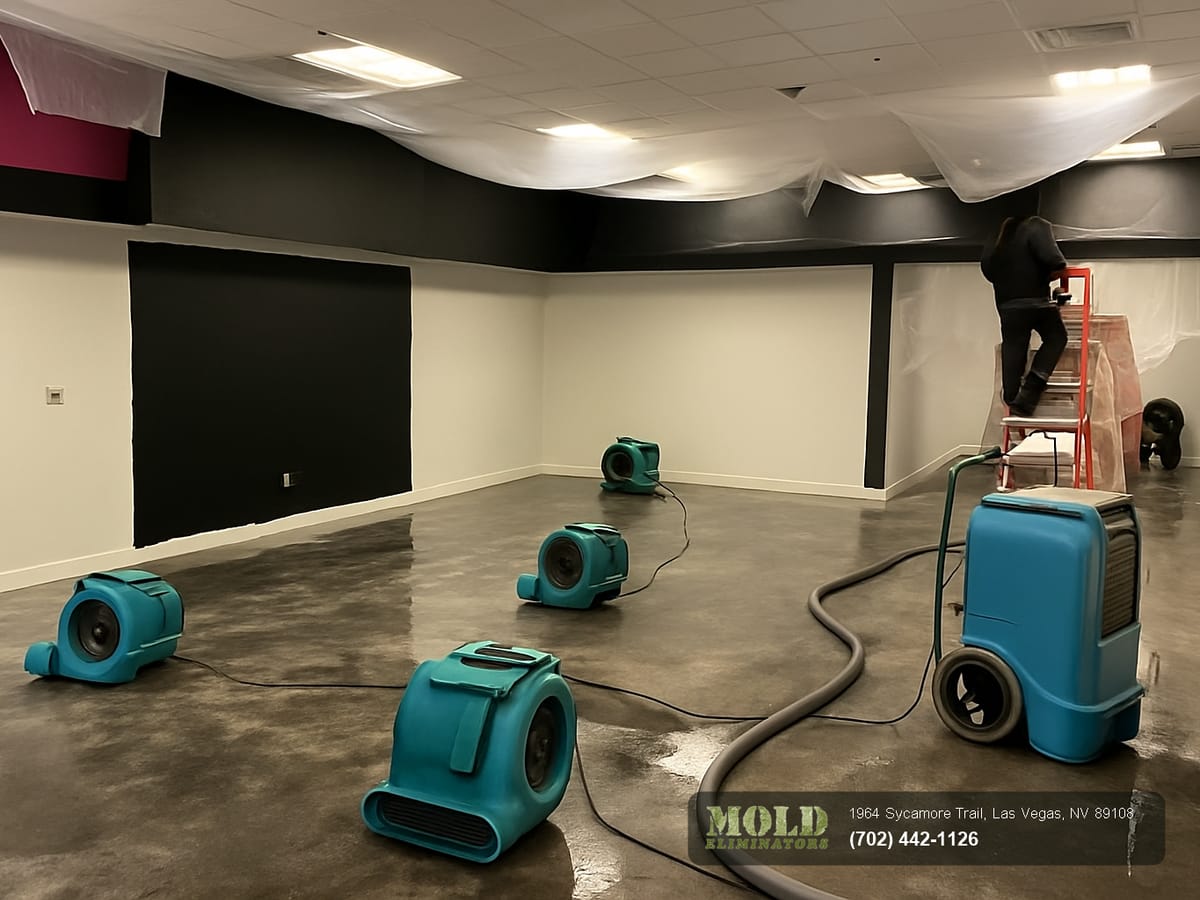
Our structural drying process, step by step
Drying done to standard follows a deliberate sequence, the Applied Structural Drying method Craig is certified in, from the first reading to the final verified dry target.
- Extraction. Before drying can begin, every bit of standing and absorbed water is physically extracted, pulling water out is dramatically faster than evaporating it, and it protects the materials underneath.
- Moisture mapping & baseline. We map the affected area with meters and thermal imaging, log starting moisture levels, and set the documented dry target for each material.
- Dehumidification. Commercial dehumidifiers pull water vapor out of the air so the room stays drier than the wet materials, the engine that actually keeps moisture leaving the structure.
- Air movement. High-velocity air movers are placed by design, not at random, to sweep moisture off surfaces and into the air where the dehumidifiers can capture it.
- Temperature control. We manage the heat in the space, because warmer air holds and releases moisture faster, a lever the desert climate makes especially powerful when used correctly.
- Daily monitoring. Every day, moisture readings are taken and logged, and the equipment is adjusted to keep drying on pace toward the target, the data drives the schedule, not the calendar.
- Drying to verified targets. Equipment comes out only when readings confirm every material has hit its dry standard. That verified-dry result is the finish line, and the proof that mold has nothing left to feed on.
When drying alone isn’t enough
Structural drying saves a lot of homes from demolition and remediation, but only when it starts in time and the water was clean. There are situations where drying is one part of a bigger job, and an honest restorer tells you which one you’re in rather than selling a one-size package.
If the water sat too long before drying began, or it came in already contaminated, drying isn’t the whole answer. Water from a sewage backup or a ground flood is Category-3, it carries bacteria and biohazard, and the porous materials it touched usually have to be removed, not just dried. That’s where structural drying overlaps with flood restoration and specialized cleanup: contain it, remove what can’t be salvaged, dry what can, and verify the result. And if mold already had time to take hold before anyone started drying, the job becomes a containment-and-removal remediation with drying built into it, not drying alone.
The advantage of handling all of this under one roof is accountability. We don’t dry your structure and then hand you off to a separate mold company that points fingers when something was missed. One in-house W-2 crew owns the water, the drying, and the mold risk from the first reading to the final verified-dry target, one chain of responsibility, one standard, start to finish.
Cost, insurance, and how long drying takes
The honest answer on cost is that it depends on scope, how much area got wet, how deeply the water penetrated, what materials are involved, and how many days of equipment it takes to reach the dry targets. A small, quickly-caught spill is a modest job; a flood that traveled through framing, subfloor, and a concrete slab is a larger one. We map the actual problem and quote it before work begins, so the number you hear is the number you understand.
On insurance: structural drying after a sudden, accidental water event, a burst pipe, a failed water heater, an appliance line that let go, is frequently covered, and the documented moisture map is exactly what an adjuster wants to see. We log readings, photos, and scope from the first visit and work directly with your carrier. Because we dry fast and prove it with data, we’re also documenting the very thing that keeps a covered water claim from becoming a disputed mold claim later.
On timeline: most residential drying runs roughly three to five days, the materials release water at their own pace, and the daily readings tell us when each one is done. The drying portion is genuinely time-bound and shouldn’t be rushed or padded: we won’t leave equipment running longer than the numbers call for, and we won’t pull it early to free up a machine. The verified dry target is the finish line, and it’s not ours to move.
Drying rarely stays a private homeowner matter for long, either. Property managers, HOAs, and high-rise condo boards call us when water intrusion crosses unit lines and the question of whose responsibility it is rides on a credible, documented account of what got wet and what got dried. Realtors reach us when a past water event needs a clean, on-the-record dry-out before a deal can close. Whatever the stakes, the answer is the same: map it honestly, dry to verified targets, and keep the documentation an adjuster, a board, or an underwriter will accept. You can see exactly where we serve across Clark County, or just reach us directly, no call center in between.
Why Las Vegas trusts Mold Eliminators to dry it right
Certified to the standard
Craig Herrmann holds the IICRC Applied Structural Drying certification and helped author the national mold standard. Your structure is dried by the rulebook, to documented targets, not to “feels dry.” Read more about Craig’s credentials.
Measured, not guessed
Moisture mapping with meters and thermal imaging defines a real dry target, and daily readings prove we hit it. The drying ends on the data, never early to free a machine, never late to pad a bill.
In-house accountability
No subcontractors, every technician is a certified W-2 employee, with one-hour emergency response, 24/7, across the valley. One crew owns the water, the drying, and the mold risk, start to finish.
That’s the whole difference. Where a franchise drops a few fans and hands your job off, we map the moisture, dry to a verified standard, and document the result, the same way our restoration work is held to the rulebook from the first reading to the last. Dry it right, and mold never gets its chance.
Structural drying in Las Vegas, common questions
- How long does structural drying take?
- Most residential jobs run about three to five days, but the materials set the pace, drywall, framing, subfloor, and concrete each release moisture at their own rate. We take daily readings and pull the equipment only when every material hits its verified dry target. Rushing it leaves moisture behind; padding it wastes your money. The data decides, not the calendar.
- Can’t I just dry it myself with fans and open windows?
- For a tiny, quickly-caught spill on a hard surface, sometimes. But household fans and Las Vegas’s dry desert air can’t pull water out of a soaked wall cavity or subfloor fast enough to beat mold’s 24-to-72-hour clock, and open windows in summer can actually drive humid air in. Without dehumidification and moisture readings, you’re guessing whether it’s dry, and guessing is how mold gets started.
- Why does structural drying prevent mold?
- Mold spores are everywhere, harmlessly, all the time, they only bloom into a colony when they find a wet surface to feed on. Drying the structure to a verified dry standard, fast, removes the moisture before spores can colonize. That’s why drying is the bridge that prevents mold after water damage: no water, no mold. Leave the structure damp and you’ve simply scheduled a remediation for next month.
- How do you know when the structure is actually dry?
- We measure it. Moisture meters and thermal imaging give each material a real number, and we compare it against unaffected reference areas to set a dry target. The equipment comes out only when daily readings confirm every material has hit that target, and it’s all logged, so you and your insurer see the structure going from wet to verified-dry on the record, not on our word.
- Does my insurance cover structural drying?
- Often, yes, when the water came from a sudden, accidental event like a burst pipe or failed water heater, drying is frequently covered as part of water damage restoration. The documented moisture map is exactly what an adjuster needs. We log readings, photos, and scope from the first visit and work directly with your carrier, and the same documentation helps keep a covered water claim from turning into a disputed mold claim later.
- What if mold already started before you got here?
- Then the job becomes containment-and-removal mold remediation with drying built into it, not drying alone, and if the water was contaminated, it may also involve flood restoration or biohazard cleanup. We handle all of it as one accountable job rather than sending you to three companies, and an independent lab verifies the result. Free inspection tells us exactly where you stand before any work begins.
Service areas
Structural Drying across the Las Vegas valley
We provide structural drying in every major Las Vegas community. Find your neighborhood:
Water damage? Dry it right before mold gets its chance, free inspection.
Free, no-pressure assessment and independent lab testing. One-hour emergency response, 24/7, across the Las Vegas valley. We dry to verified targets and prove it, so the water problem ends here, not in three weeks.