Mold Inspection in Las Vegas
Mold inspection in Las Vegas answers two questions before you spend a dollar on cleanup: do you actually have mold, and where is the water feeding it. Here is how it works. We walk the property, pull moisture readings behind walls and under floors, trace the source, and hand you a straight plan instead of a sales pitch. The inspection is free, and if you do not need us, we say so. Same-day appointments, and for an active leak we are on site within the hour, 24/7.
You smell something musty that won’t quit, or you’ve found a stain you can’t explain, and now you’re staring at the wall wondering what’s really behind it. Before anyone tears into your home, and before you spend a dollar on cleanup, you need to know two things for certain: do you actually have mold, and where is the water feeding it? That’s the entire job of a mold inspection. It’s the calm, measured first step that turns a scary unknown into a known, fixable problem.
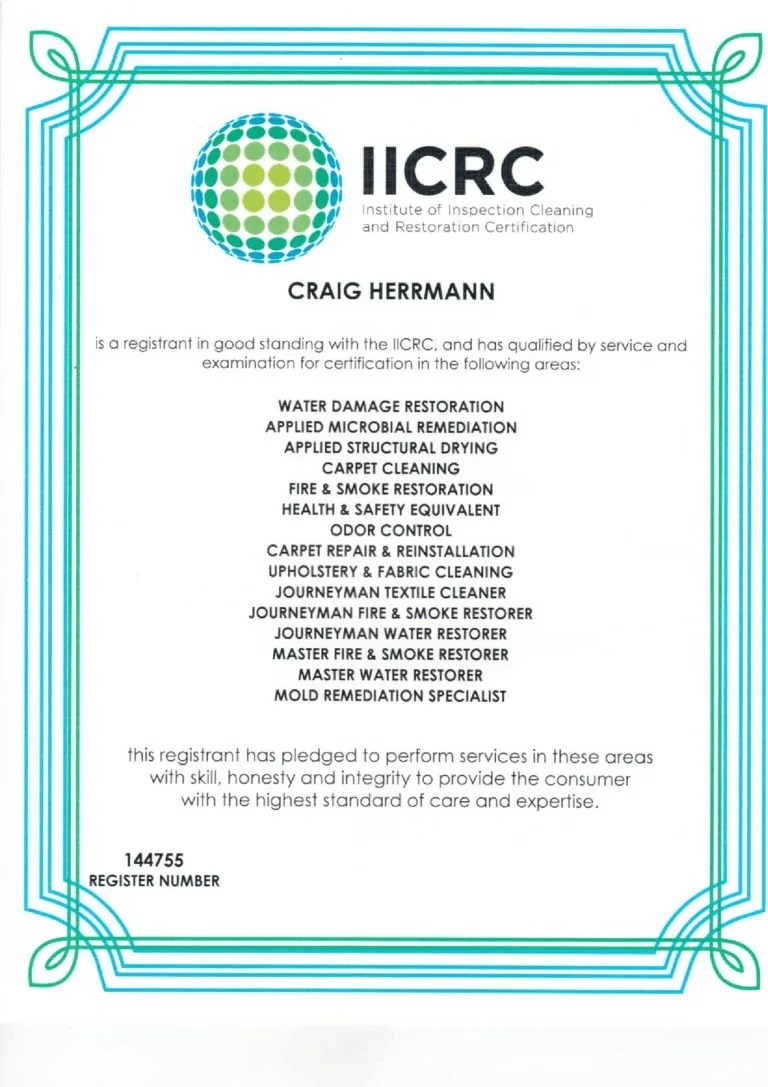
A proper mold inspection is the front end of every honest mold remediation project, you can’t remediate what you haven’t found, and you shouldn’t pay to remove what isn’t there. Mold Eliminators has inspected and remediated more than 255 Las Vegas properties since 1996. Our founder, Craig Herrmann, helped author the ANSI/IICRC S520 standard, the national rulebook for mold work, and holds IICRC Master Restorer credentials. So when our inspection says your home is clean, or pinpoints exactly where it isn’t, that’s a verifiable finding measured against the document the whole industry follows, not a sales pitch.
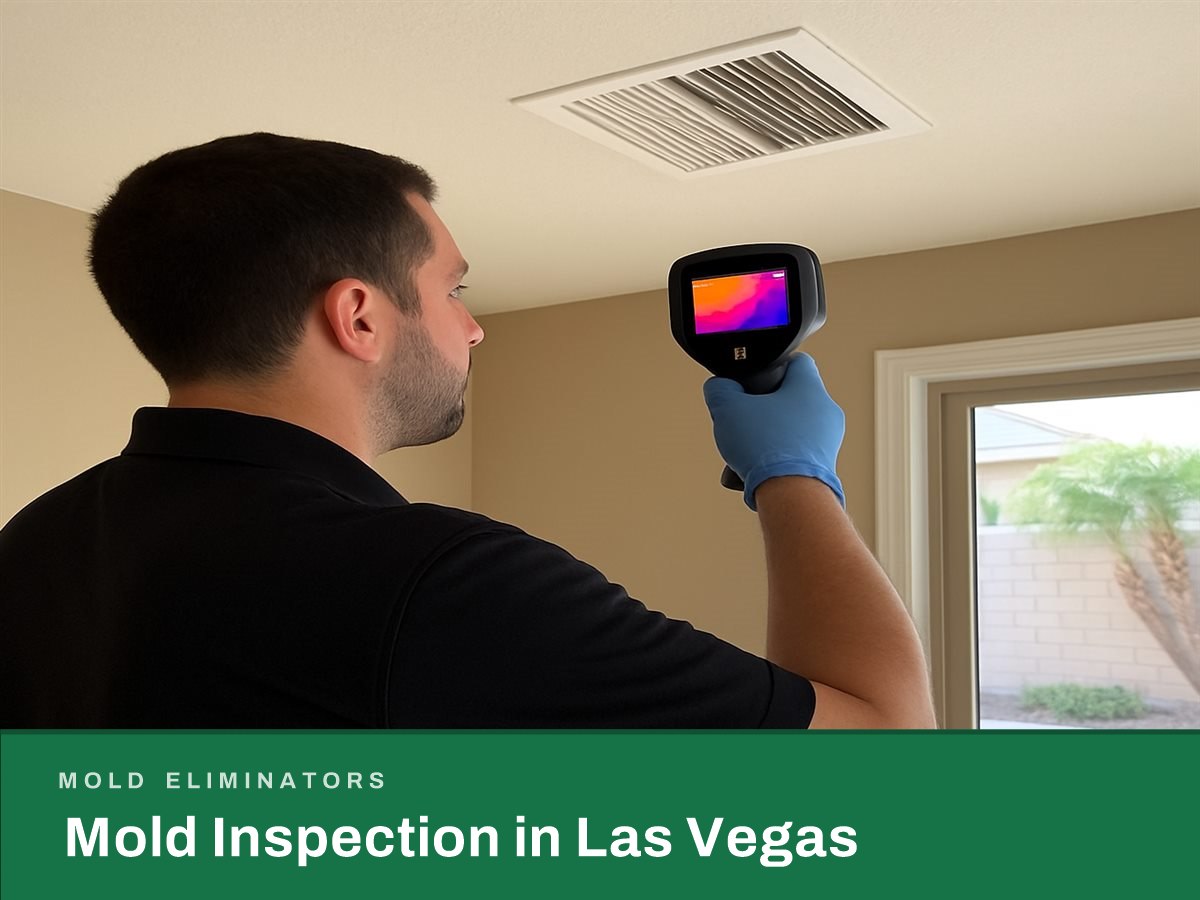
What a mold inspection actually is
A mold inspection is a systematic investigation of a building to answer three questions: is there mold growth, where is it, and what moisture source is causing it. That’s it, and getting all three right is harder than it sounds, which is why a real inspection is a diagnostic process and not a quick walk-through with a flashlight. The goal is not to find a reason to sell you work; the goal is to give you an accurate picture of what’s actually happening inside your walls so you can make a calm, informed decision.
The single most important thing to understand is that an inspection is fundamentally about moisture, not just mold. Mold spores exist in every building on earth, harmlessly, all the time. They only bloom into a colony when they find a wet surface to feed on. So a skilled inspector doesn’t just look for black spots, they hunt for water, because the water is the cause and the mold is only the symptom. Find and fix the moisture, and you’ve solved the real problem. Treat the stain and ignore the leak, and the mold simply reschedules itself for next season.
That’s also why an inspection is distinct from mold testing, even though the two often happen together. An inspection is the visual and instrument-based investigation, the moisture meters, the thermal camera, the trained eye following a smell to its source. Testing is the lab analysis of air and surface samples that confirms what species are present and at what concentration. The inspection tells us where and why; the lab test tells us what and how much. A thorough job uses both, and uses them in that order, because sampling air at random without first finding the moisture source is how you get an inconclusive report and a homeowner who’s no better off than before.
Done right, the inspection ends with something concrete: a documented map of the moisture and any contamination, photographs, meter readings, and a clear, honest scope of what, if anything, actually needs to be done. That document is what protects you. It’s the difference between a company guessing and a company that can show you, with data, exactly what it found and why.
Need help now?
Talk to a Las Vegas expert
In-house certified crews. One-hour emergency response across the valley, 24/7.
Why inspecting for mold in Las Vegas takes local knowledge
Everyone assumes the desert is too dry for mold, and that assumption is exactly why valley mold problems hide for so long. Nobody’s looking, so the colony grows behind drywall or under flooring for weeks before a stain or a smell finally gives it away. An inspector who doesn’t know how Las Vegas homes actually fail will look in the wrong places, so knowing where the water comes from is half the job.
Slab leaks. A large share of valley homes sit on concrete slabs, and the supply lines running through them corrode or shift with our expansive soils. A slab leak wets the underside of flooring and the base of walls for months, surfacing only as a warm spot, a high water bill, or a faint musty edge in the air. A good inspection traces that signal down to the slab instead of just swabbing the baseboard.
Swamp coolers. Evaporative coolers are everywhere here, and by design they pump water across pads on your roof. A stuck float or a cracked pan sends a slow trickle down through ceilings and wall cavities, so an inspector who knows the valley always checks the cooler and the ceiling path below it.
Monsoon intrusion. For a few weeks each summer, violent rain hits flat roofs and parapet walls that are bone-dry the rest of the year. Water finds the seams, soaks the structure, and the heat that follows incubates mold fast in cavities that were never designed to get wet.
High-rise condensation. In the towers near the Strip and the valley’s denser condo stock, the gap between heavily air-conditioned interiors and 110-degree exteriors drives condensation inside wall assemblies, a multi-unit, shared-liability situation that needs an inspector who understands desert high-rise construction, not a generalist with a flashlight.
The common thread is that Las Vegas mold almost always hides, and almost always traces back to one of these specific moisture paths. That’s why a thorough inspection that follows the water to its source, rather than treating the spot on the wall, is the single most valuable step a homeowner can take before any cleanup begins. It’s also why so many mold cases here turn out to be tangled up with water damage the owner never knew about.
Signs you need a mold inspection
Because Las Vegas mold hides, most people sense a problem before they see one. Knowing the real warning signs, and which mean “call now” versus “keep an eye on it”, helps you act at the right moment instead of panicking or ignoring it until it spreads.
A musty, earthy smell you can’t source. This is the most reliable early warning and the one people most often talk themselves out of. That damp-basement, old-book odor is the gas an active colony gives off. If a room smells musty and you can’t find why, the source is usually inside a wall or under a floor, exactly what an inspection is built to find.
Visible spots or discoloration. Black, green, gray, even orange or pink patches on walls, ceilings, grout, or baseboards. Mold isn’t always black, and the pattern matters more than the color, it tends to spread in irregular, fuzzy clusters rather than a clean stain. Visible growth is a clear reason to get it inspected before disturbing it.
Any past water event. A burst pipe, a roof leak, an overflowed tub, an appliance line that let go, if water sat for more than a day or two, mold may have taken hold in the drywall or framing whether you can see it or not. An inspection after water damage is the only way to know the structure dried clean.
Warping, bubbling, or peeling. Paint that’s blistering, wallpaper lifting at a seam, drywall that’s soft or bowed, these point to moisture inside the material, and where there’s sustained moisture, mold is usually close behind.
A real-estate transaction. Buying or selling a Las Vegas home and mold turned up, or you simply want to rule it out before closing. A documented, lab-backed inspection is the credible paper a realtor, a buyer, and a lender will all accept.
If any of these ring true, the right next step is rarely demolition and never panic, it’s a measured look. And because our inspection includes free inspection for homeowners and property owners, finding out the truth costs you nothing but a phone call.
How our mold inspection works, step by step
Every inspection follows the standard, not a script designed to sell. This is the sequence we run from the first phone call to a written finding you can act on with confidence.
- Conversation & history. Before we touch a wall, we ask what you’ve noticed, when it started, and whether there’s any history of leaks or floods. Your story usually points straight at the moisture source.
- Visual assessment. A trained walk-through of the affected areas and the usual hiding spots, under sinks, behind appliances, along baseboards, around the swamp cooler path, looking for staining, warping, and growth.
- Moisture mapping. Moisture meters and thermal imaging let us see wet material behind intact surfaces, so we can trace dampness to its source without opening every wall. This is where local knowledge of slab leaks and cooler drips pays off.
- Sampling, if warranted. When the picture calls for it, we collect air and surface samples for independent lab analysis, not on every job, only when data will actually change the answer.
- Independent lab results. A third-party accredited lab identifies what’s present and at what level. We don’t grade our own homework, the lab does, which is the only way the result means anything.
- Written findings & honest scope. You get a clear report with photos, readings, and a plain-English scope of what actually needs to happen, or, just as often, confirmation that it doesn’t. If your home is clean, we’ll prove it and leave.
What a thorough inspection covers
A real inspection scopes itself to the property and the symptoms rather than running everyone through the same checklist. Broadly, these are the areas and questions a complete Las Vegas mold inspection addresses, recognizing yours helps you understand what the visit will involve.
One scenario deserves a special note, because it’s where fear does the most damage to wallets: so-called “toxic black mold.” The phrase usually refers to Stachybotrys, a real organism worth taking seriously. But an inspection treats it the same disciplined way it treats any colony, locate it, measure it, document it. The color of the mold doesn’t change the data. Companies that open with “toxic black mold will poison your family” are usually softening you up for an inflated bill. We don’t do that. If what you have is concerning, we’ll tell you plainly and show you the lab numbers; if it’s harmless surface mildew, we’ll tell you that too, and we won’t charge you to find out, because the inspection is free.
Cost, timing, and what to expect
The honest answer on cost is that, for homeowners and property owners, the testing portion of a Las Vegas mold inspection is free, that’s the entire point of our model. We profit from fixing real mold, not from charging you to find out whether you have it. A standard residential inspection takes an hour or two depending on the size of the home and how many areas show symptoms; larger properties, multi-unit buildings, and high-rise units take longer because there’s more to trace.
What you walk away with is a clear, documented finding: where the moisture is, whether there’s contamination, what the lab confirmed, and an honest scope of what, if anything, needs to be done. If the answer is “nothing,” that’s exactly what we’ll tell you, in writing. If remediation is warranted, that same documentation becomes the foundation of the cleanup plan and, when a sudden water event caused it, the record your insurance adjuster will want to see.
If your situation is an active emergency, a flood, a sewage backup, water actively spreading, the inspection isn’t the first call; stabilizing the water is. Reach our 24/7 emergency line and we’ll stop the spread first, then inspect and document once the structure is stable. One crew, one chain of accountability, start to finish, we don’t hand you off to a second company mid-job, and we serve every corner of the valley you can see on our service areas map.
Why Las Vegas trusts our inspections
Standards, not shortcuts
Every inspection is measured against the S520 standard Craig helped author. We trace moisture to its source and document the findings, not eyeball a stain and write a quote.
Independent truth
A third-party accredited lab confirms what’s present, and the inspection is free for homeowners and property owners. We profit from fixing real mold, never from inventing it. If your home is clean, we’ll prove it and leave.
In-house accountability
No subcontractors, every inspector is a certified W-2 employee, with one-hour emergency response, 24/7, across the valley. If our name is on the report, our people did the work.
That’s the whole difference. Where a franchise sends whoever’s available and self-certifies its own findings, we send our own people and let an independent lab grade the result. When the inspection points to real work, it flows straight into remediation done to standard, same crew, same accountability. Have a question first? Just reach us directly, with no call center in between.
Real estate and pre-purchase mold inspections
Buying or selling a home in the valley? We provide fast, documented mold inspections for real estate transactions, the kind of clear, lab-verified report a buyer, seller, agent, or lender will accept. When a deal is on the line, we prioritize a quick turnaround so mold does not hold up your closing.
A knowledgeable, expert team
“Very professional team, they were very kind and patient with me during the inspection. They were also very knowledgeable and it was easy to tell they were experts.” David M., Google
Where mold hides in a Las Vegas home
In a valley of slab foundations and no basements, mold rarely starts where you would look first. We check the desert culprits: the AC condensate line sweating in the attic, the swamp cooler dumping humidity into the ceiling, the slab leak wicking up into a baseboard, and the stucco seam a monsoon storm found last July. It is why a real inspection uses moisture meters, not just eyes, from Summerlin and Centennial Hills to Henderson and Green Valley.
Areas we serve across the Las Vegas valley
We serve homeowners and property owners throughout Las Vegas and the surrounding valley, including Summerlin, Henderson, Paradise, Spring Valley, and North Las Vegas, along with all of Clark County. One-hour emergency response, 24/7. Call (702) 442-1126 any time.
Mold inspection in Las Vegas, common questions
- What’s the difference between a mold inspection and mold testing?
- An inspection is the investigation, the visual assessment, moisture meters, and thermal imaging that find where mold is and why it’s growing. Testing is the independent lab analysis of air and surface samples that confirms what species are present and at what concentration. A thorough job uses both, in that order, find the moisture first, then sample where it matters.
- How much does a mold inspection cost in Las Vegas?
- For property owners, the testing portion is free, that’s our whole model. We make our living fixing real mold, not charging you to discover whether you have it. A standard residential inspection takes an hour or two; larger and multi-unit properties take longer because there’s more to trace.
- Do I really need an inspection if I can already see mold?
- Often, yes, because the visible spot is usually the tip of the iceberg. The inspection finds the moisture source feeding it and reveals how far it has spread inside the cavity, which is what determines the actual scope of any remediation. Cleaning the visible patch without finding the water just lets it grow back in the same place.
- Should I get an inspection after water damage even if I dried everything?
- Yes. Mold can take hold inside drywall and framing within a day or two, and surface-drying the visible area doesn’t prove the cavity dried clean. An inspection with moisture meters confirms whether the structure is truly dry or whether hidden water damage is quietly incubating mold.
- Can you inspect a home for a real-estate sale or purchase?
- Absolutely, transaction inspections are a large part of what we do. You get a documented, lab-backed finding that a realtor, buyer, lender, and underwriter will all accept. Fast, credible, third-party clearance is exactly what keeps a deal from falling apart over an unanswered mold question.
- What happens if the inspection finds mold?
- You get a written report with photos, moisture readings, and an honest scope of what needs to happen, nothing more. If remediation is warranted, that documentation becomes the cleanup plan, handled by the same in-house crew. If your home turns out to be clean, we’ll say so in writing and you owe us nothing for finding out.
A job like yours
An inspection is worth having even when the answer is no. Read the case study where two companies said mold and the testing said no.
What an inspection does not cover, and what comes next
What an inspection needs from you, and what it costs
Nothing up front. The on site mold inspection is free for homeowners and property owners, and a standard residential visit takes an hour or two. You get a plain English explanation on the spot rather than a sales sheet, and if there is no remediation problem we will tell you so and leave.
The inspection goes faster when the technician can reach the places water actually collects. That usually means the laundry room and the washer connections, the water heater and its pan, the cabinets under sinks, the area around a swamp cooler, and the attic hatch. If an occupant has limited mobility, or a health condition that makes dust a problem, say so when you book and the visit is planned around it. Weekend and same day appointments are available.
What the inspection costs, and what testing costs
These are two different things, and conflating them is how people end up overpaying. The inspection is the visit: someone comes to your property, finds the moisture, and assesses the problem. Testing is sending physical samples to a laboratory for identification and spore counts. Many companies charge a flat fee in the range of a few hundred dollars just to show up and do the first one.
Ours is free. Not a discounted rate, not free with conditions attached, free. A certified technician walks the property, reads the moisture, and tells you what is actually going on.
Laboratory analysis is not free, and it should never be folded into a single price as though it were automatic. If sampling will genuinely answer a question your situation raises, samples go to an independent third-party lab and you are billed what the lab charges. We do not mark it up and we do not bundle it into the visit to inflate the number. You find out whether the free inspection was enough before any paid testing is ordered, and the decision is yours.
Be careful with anyone advertising free lab testing. Sending air or surface samples to a laboratory costs money. A company promising it for nothing is usually either folding that cost into an inflated remediation bill, or running a sample-and-scare routine to justify work you may not need.
Why a credible company can afford to give the inspection away
It is a fair thing to wonder about. The answer comes down to who is doing the assessing and what they are incentivized to find. When the same company decides whether you have a problem and also gets paid to fix it, the incentive runs the wrong way. We would rather tell you that you do not need remediation than charge you a few hundred dollars to hear it, and that is exactly why the visit costs nothing and why lab work stays optional and billed at cost. If there is nothing here, you will be told there is nothing here, and we will leave.
Not sure what’s behind that wall? Let’s find out the truth, free.
Free, no-pressure on-site inspection, with independent lab testing available if you want it for Las Vegas property owners. One-hour emergency response, 24/7, across the valley. We profit from fixing real mold, never from inventing one.