Smoke and Odor Removal in Las Vegas
Las Vegas Odor Removal
Get rid of the smell by getting rid of what’s making it
Odor removal in Las Vegas is a source problem, not a fragrance problem. Musty mold, stale smoke, sewage, pet accidents: every stubborn smell is your home telling you something physical is still there. So we find the source and remove it, then neutralize what is left with hydroxyl or ozone treatment and seal any surface still holding the smell. Masking it with a plug-in only buys a few days. We assess for free, and for active problems we respond within the hour, 24/7.
Since 1996, Mold Eliminators has worked more than 255 Las Vegas properties where the real complaint started as “we just can’t get rid of this smell.” Most of the time the odor was the early-warning system for hidden moisture or microbial growth behind a wall. That’s why our odor work is rooted in the same building science behind professional water damage restoration, you treat the cause, not the symptom. Craig Herrmann, who co-authored the national S520 mold remediation standard, sets the playbook here: measure, locate, remove, verify.
Understanding the problem
Why odors happen, and why air fresheners fail
Smells are airborne molecules. A musty odor is literally microbial volatile organic compounds (mVOCs), gases that mold and bacteria release as they digest the material they’re growing on. A smoke smell is tar and combustion residue that has bonded to porous surfaces. A sewage smell is bacterial breakdown of organic waste, often producing hydrogen sulfide. A pet smell is uric acid crystals that reactivate every time the humidity rises. In each case the odor is being continuously generated or re-released by a physical source. Spraying perfume over it does nothing to the source, it just adds a second smell on top of the first.
Las Vegas adds its own wrinkles. Our swamp coolers pull humid air across pads that, if neglected, become a breeding ground for musty growth. Slab leaks and monsoon-season intrusions soak drywall and subfloor where you can’t see them. Tightly sealed high-rise condos near the Strip trap odors with little fresh-air exchange. So the same smell that would air out in a humid climate often lingers here because the source stays wet, warm, and undisturbed inside the structure.
The takeaway is simple: if a smell keeps coming back, the source is still in the building. That’s good news, actually, it means there’s something specific to find and remove, not a mystery to chase forever. Our job is to locate it with instruments rather than guesswork, which is the same discipline that drives a credible mold inspection.
Need help now?
Talk to a Las Vegas expert
In-house certified crews. One-hour emergency response across the valley, 24/7.
Signs & symptoms
How to read what your nose is telling you
Different odors point to different sources, and the pattern of when and where you smell them is a useful diagnostic. Pay attention to these clues, they tell us where to point the moisture meter and the thermal camera before we open up a single wall.
The smell is strongest after it rains or when humidity rises
This is the classic signature of microbial growth and pet contamination. Both reactivate with moisture. A musty smell that spikes during monsoon season or after running the swamp cooler usually means there’s wet material feeding active growth, a textbook reason to bring in professional mold remediation rather than another bottle of spray.
The odor is worse near a specific wall, vent, or floor section
Localized smells point to a localized source: a slab leak under that section of floor, a roof or window leak in that wall cavity, or residue concentrated in the ductwork. We map the hot spot before we demo, so we remove exactly what needs removing and nothing more.
You smell rotten egg, sulfur, or raw sewage
Stop and treat this as a health issue. A sewage smell means contaminated water or waste is present, and that is a biohazard requiring containment and proper sewage cleanup, not a deodorizer. Sealing the smell in without removing the contamination only hides an active hazard.
The smell came back days after a treatment “worked”
This is the single most common call we get. An ozone or fogging treatment knocked the smell down for a few days, then it returned. That’s the proof that the source was never removed, it was only masked. The molecules off-gassing from the untouched source simply rebuilt the odor.
If two or more of these sound familiar, the source is still in the structure. Lingering musty odor in particular is often the first detectable sign of a moisture problem you can’t yet see, which is exactly why we offer free inspection to confirm whether growth is behind that smell before anyone commits to demolition.
Our solution & process
Source removal first, then neutralize, in that order
Real odor elimination is a sequence, and the order is non-negotiable. You cannot neutralize your way past a source that’s still generating the smell. Here is how Mold Eliminators works an odor job, using in-house W-2 technicians on every step, no subcontractors handed your home.
Removal, not masking
If the fix is “spray and pray,” it isn’t a fix. We extract the physical source so the smell has nothing left to come from. That’s the whole difference.
Built on water science
Most musty odors trace back to moisture. Our crews run odor work on the same standards-based foundation as our restoration jobs, so the cause gets solved too.
Independent verification
When mold is the source, third-party labs confirm the air is clean. We’re paid to fix the problem, never to invent one.
For sudden events, a sewage backup, a flood, a fire, speed protects the structure and limits how deep the odor sets in. Acting fast keeps porous materials from absorbing odor permanently, which is why our 24/7 emergency response gets a certified technician on site within about an hour, any hour.
Common questions
Las Vegas odor removal FAQ
- Will an ozone machine or air freshener get rid of the smell for good?
- No. Ozone and fresheners only mask or temporarily knock down odor molecules, they do nothing to the physical source still releasing them. Once the treatment fades, the smell returns. Permanent results require removing the source first, then neutralizing what’s left.
- Why does my musty smell keep coming back?
- A recurring musty odor almost always means active mold growth fed by hidden moisture. The source is still in the structure, off-gassing mVOCs. Until that material is removed and the area dried, no surface treatment will hold. We confirm the cause before any demolition.
- Is a sewage smell dangerous?
- Yes, it can indicate hydrogen sulfide and the presence of bacteria-laden waste, which is a genuine biohazard. It needs proper containment and removal, not a deodorizer. Treat any persistent sewage odor as a reason to call professionals promptly.
- Can you remove smoke odor without tearing out my walls?
- Sometimes. If smoke residue is limited to surfaces and ductwork, cleaning plus hydroxyl treatment may be enough. If soot has saturated porous materials like carpet pad or drywall, those have to come out, otherwise the smell rebuilds. We assess first and remove only what’s necessary.
- Do you charge to find out where the odor is coming from?
- When the suspected source is mold, our on-site inspection is free and lab-verified. If your “mold” turns out to be soap scum or something harmless, we’ll tell you and we won’t invent work that isn’t needed.
Next steps
Find the source. Lose the smell.
If a smell in your home keeps coming back, something physical is still producing it, and that something is findable. Mold Eliminators will locate the source with instruments, remove it cleanly, neutralize what’s left, and verify the result with an independent lab when mold is involved. No masking, no upsell, no subcontractors. Have questions before you commit, or want a technician to take a look? Reach out through our contact page or speak directly with Craig Herrmann, who literally helped write the standard your job will be measured against.
Timing, cost, and what to expect at home
Treatment time, occupancy, and what you pay
The assessment costs nothing up front and the treatment plan is written down before equipment is placed. Odor work is measured in treatment cycles rather than one visit, and you are told how many to expect instead of finding out as you go.
Some treatments run best with the space empty for a few hours, so scheduling is the part worth planning carefully. Tell us about pets, birds especially, about anyone with a respiratory condition, and about anyone who cannot easily leave the property, and the cycles get scheduled around them. Evening and weekend runs are often the easiest way to fit treatment around a working household.
Odor still there? Let’s fix the cause.
Call Mold Eliminators, (702) 442-1126
24/7 emergency response across Las Vegas, Henderson, North Las Vegas, Spring Valley, Paradise, and Summerlin. Certified W-2 technicians, independent lab verification, no upsell.
Easy to understand, quick, and professional
“Oliver came and met with me and explained in full detail what they would be doing. He made it easy to understand and they did my project quick and professional, and did not disrupt my home.” allison b., Google
The smells Las Vegas homes call us about most
In this valley the top offenders are predictable. Swamp coolers breed a musty, earthy smell and blow it through the whole house. Summer heat bakes cigarette smoke and pet odor deep into drywall and subfloor. And after a monsoon leak, that wet-cardboard smell usually means mold has already started. Each one has a different fix, and guessing wrong just wastes your money.
Smoke smell, and why it keeps coming back
Smoke odour is the hardest smell to get rid of because the smell is not the problem. Smoke particles are extremely fine, so they settle into porous material and get pulled through the air handler into rooms nowhere near the source. Treating the air while that material stays in place buys you a few days.
What the smoke came from changes what it takes to remove. A kitchen fire produces protein residue, an almost invisible greasy film that varnishes onto surfaces and smells strongly when warmed. A slow smouldering fire leaves wet soot, which is sticky and smears into a surface if it is wiped rather than lifted. A fast, hot fire leaves dry soot, which is powdery and easier to remove but travels further. Cigarette smoke is its own category: nicotine and tar build up over years, bond to walls and ceilings, and re-emerge through fresh paint if the surface was not treated first.
The pattern in all of them is the same. Find where the residue actually is, remove or treat that material, address the HVAC system that spread it, and only then deal with the air. Doing it in the other order is why so many smoke jobs come back.
What we handle, and what we do not
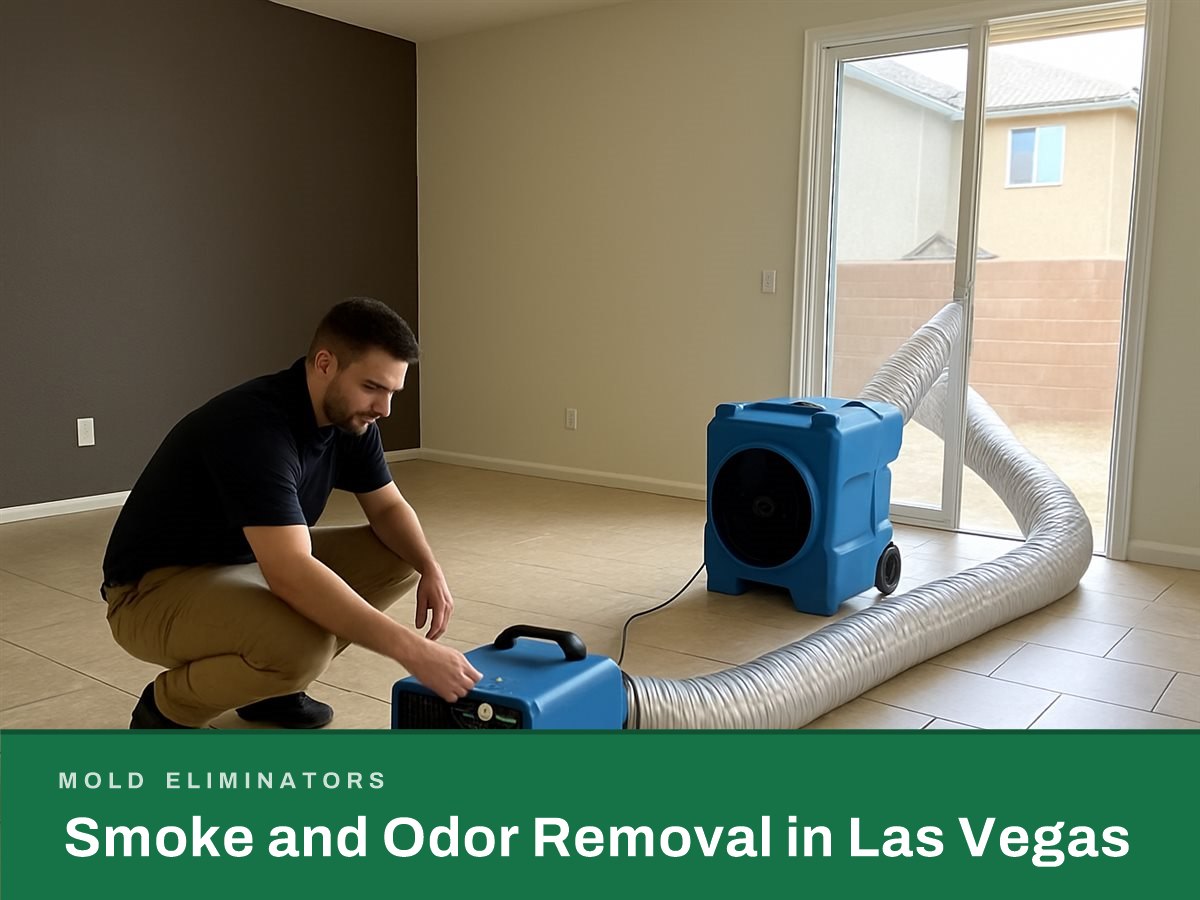
We are an odour and decontamination company, so we handle smoke odour: identifying where residue is holding the smell, treating or removing the affected material, decontaminating the air handling system, and neutralising with hydroxyl generators and air scrubbers rather than masking with fragrance. That covers cigarette odour in a rental turnover, lingering smells after a small kitchen fire, and wildfire smoke that has worked its way into a house through the AC.
What we do not do is full fire restoration. If a structure has burned, needs contents pack-out, structural repairs or a rebuild, that is a fire restoration contractor’s job and we will say so rather than take the work. Where firefighting water is involved, the drying and moisture side is ours.
Areas we serve across the Las Vegas valley
We serve homeowners and property owners throughout Las Vegas and the surrounding valley, including Summerlin, Henderson, Paradise, Spring Valley, and North Las Vegas, along with all of Clark County. One-hour emergency response, 24/7. Call (702) 442-1126 any time.