Flood Restoration in Las Vegas
Water Damage · Las Vegas, NV
A August monsoon cell parked over the valley, a wash overtopped its banks, and an inch of muddy runoff pushed under your garage door and across the living room floor, or a flash flood backed storm water up through a drain and into a finished basement. Take a breath. Flood damage is recoverable, the first 24 to 48 hours decide how much of your home you keep, and a measured, standard-driven response gets you back to dry and clean without months of guesswork.
Mold Eliminators has restored more than 255 Las Vegas properties since 1996. Flood restoration is a specialized branch of water damage restoration, same physics, higher stakes, because flood water is almost never clean. Our founder, Craig Herrmann, helped author the ANSI/IICRC S520 standard and holds IICRC Master Restorer credentials, so the drying and sanitization targets we work to aren’t guesses, they’re the rulebook the whole industry follows.
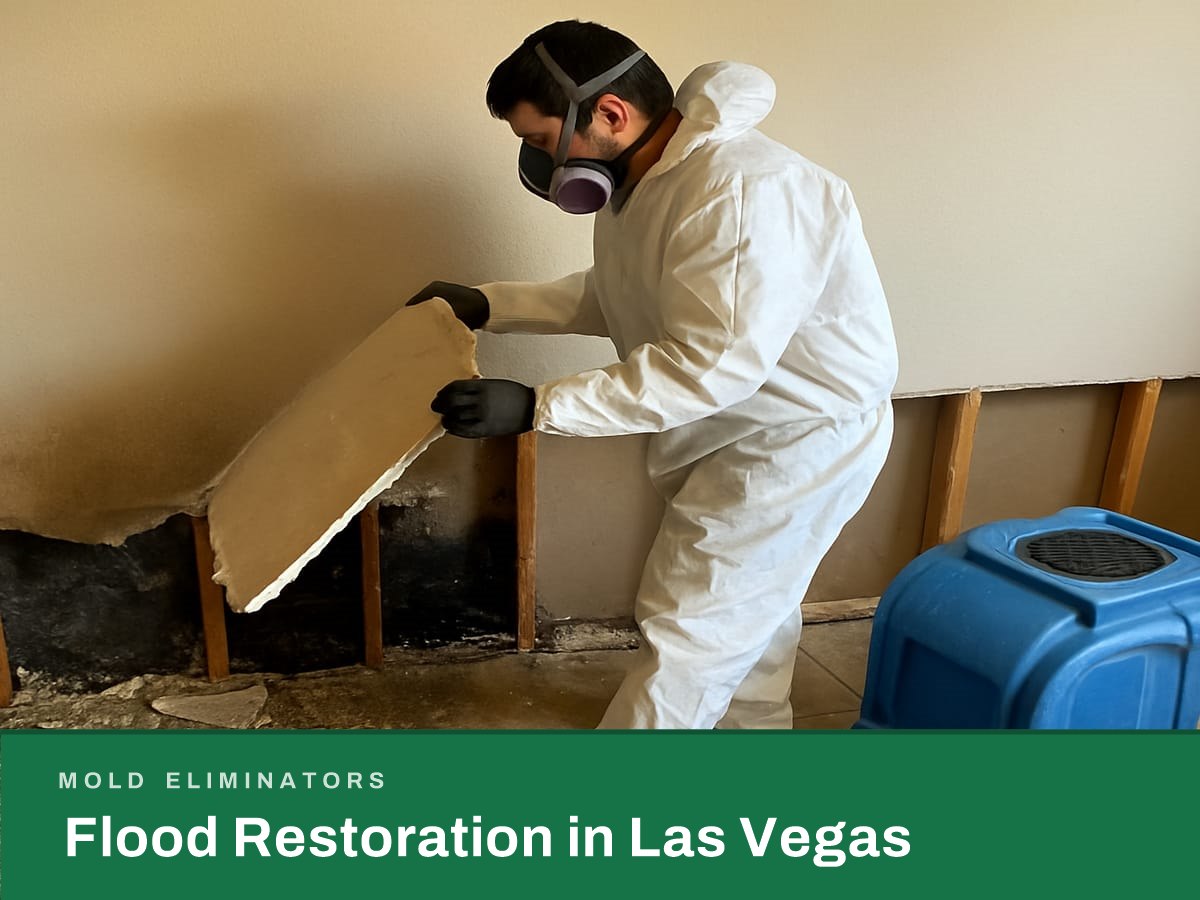
What flood restoration actually is, and why Las Vegas is different
Flood restoration is the disciplined process of removing flood water, decontaminating everything it touched, drying the structure to a measured standard, and verifying the home is clean and safe before the job is called done. It overlaps with ordinary water damage restoration, but it is not the same job, the defining difference is contamination. A burst supply line spills clean water; a flood delivers water that has run across the desert floor, through storm drains, and sometimes mixed with sewage. That changes everything about how the work is done.
People assume a desert doesn’t flood. The opposite is true. Las Vegas sits in a bowl ringed by mountains, and the same hard-baked soil that makes the valley dry also makes it shed water instead of absorbing it. When the summer monsoon arrives, typically July through September, a single thunderstorm can drop an inch of rain in an hour over ground that can’t soak it up. The result is flash flooding: water sheets across roads, fills the washes, overwhelms storm drains, and finds the low point of your property in minutes. That low point is often a garage, a ground-floor entry, or a slab edge.
Because flood water has traveled, it carries what it picked up along the way, silt, road oil, lawn chemicals, animal waste, and bacteria. Under the S520 and S500 standards, that puts most flood water into Category 2 (gray) or Category 3 (black) water. The category isn’t a formality; it dictates what gets cleaned, what gets removed, and what must be discarded. Treating Category 3 flood water like a clean spill is exactly how a flood becomes a mold problem, or a health hazard, weeks later.
Here is the part homeowners miss: with flood water, drying alone is never enough. With a clean-water loss you can often dry materials in place and move on. With a contaminated flood, you have to decontaminate first, then dry, then verify, and porous materials that soaked up Category 3 water usually can’t be saved no matter how well you dry them. That sequence, and the honesty about what can and can’t be salvaged, is what separates real flood restoration from a wet-vac and a box fan.
Las Vegas construction adds its own wrinkles. Most valley homes are built on concrete slabs, and a slab is both a blessing and a trap during a flood: it stops water from sinking into a crawlspace, but it also turns the floor into a shallow pan that holds water against the bottom of every wall. Flood water that reaches a slab edge wicks straight up into the drywall and into the bottom plate of the framing, and it pools under any flooring that isn’t sealed to the slab, laminate, engineered wood, vinyl plank, and the pad under carpet. Newer suburbs in the southwest and the north valley sit on graded pads that channel storm runoff toward low points, while older neighborhoods near the historic washes flood from water that has run a long way and picked up the most contamination. Two homes a mile apart can face very different flood jobs depending on age, elevation, and how close they sit to a wash.
Timing matters as much as construction. The S520 and S500 standards recognize that water degrades over time, clean water that sits long enough turns gray, and gray turns black as bacteria multiply. A flood that started as muddy storm runoff is already gray or black on arrival, so the clock isn’t about whether contamination happens, it’s about how deep it travels and how much mold gets a head start while the water waits. That is why a fast, documented response isn’t upselling, it is the single biggest lever on what your flood ends up costing, both in dollars and in lost belongings.
Need help now?
Talk to a Las Vegas expert
In-house certified crews. One-hour emergency response across the valley, 24/7.
Where flood water hides in a Las Vegas home
The puddle on the floor is the part you see. The damage that grows mold and rots framing is the water that traveled into materials you can’t see, and with a flood, that water is contaminated. These are the spots that fool homeowners:
Flood water doesn’t just sit where it pooled. It wicks sideways and upward through porous materials by capillary action, climbing several inches up a sheet of drywall, and it follows the path of least resistance down wall cavities and along framing until it finds somewhere to settle. With clean water, that hidden travel is a drying problem. With Category 2 or 3 flood water, every inch it traveled is now contaminated, which is why mapping the full footprint with moisture meters and thermal imaging, before a single fan is set, decides whether the job is done right or done twice.
The honest part of this work is telling you what can’t be saved. Drywall, carpet pad, and insulation that absorbed black water generally have to be removed to standard, not because we want to demo your home, but because you cannot decontaminate the inside of a porous material you can’t reach. Where the source is a backed-up drain or sewer line, that crosses into sewage cleanup territory, with its own containment and disposal rules. We’ll always show you the moisture readings and explain exactly why a material stays or goes.
Non-porous and semi-porous materials are a different story, and this is where experience pays off. Tile, sealed concrete, finished hardwood, solid-wood trim, and metal can often be cleaned, sanitized, and saved, even after contact with Category 3 water, because the contamination stays on the surface where it can be reached and removed. Specialized drying systems can pull water out of a hardwood floor or a wall cavity in place, before warping and delamination set in, provided we reach them in the first day or two. The skill of flood restoration is drawing that line correctly: removing only what truly has to go, saving everything that safely can, and proving the difference with a meter rather than a guess. Removing too much wastes your money; removing too little leaves contamination behind to fester.
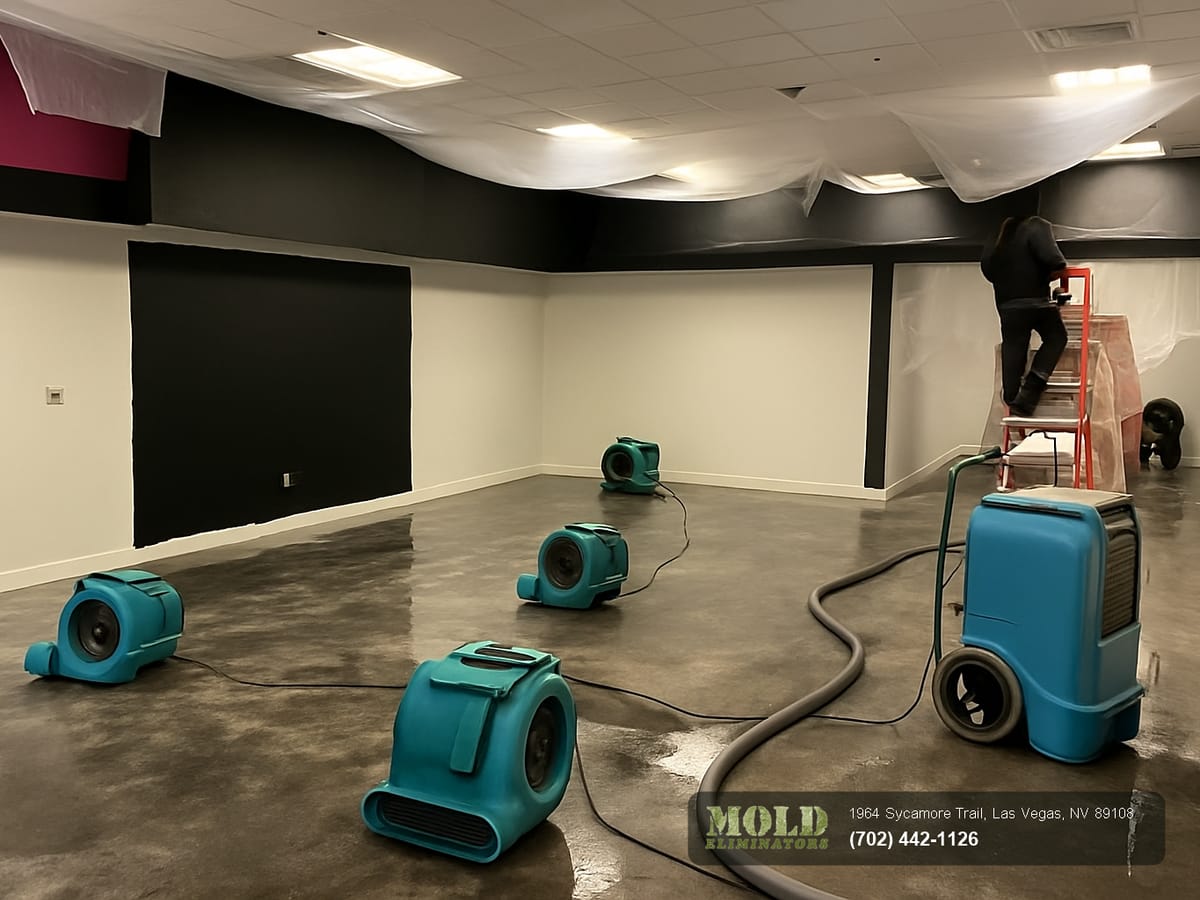 Air scrubbers and dehumidifiers running during flood restoration drying in a Las Vegas property
How Mold Eliminators handles a flood, step by step
Flood restoration follows a strict order because the contamination has to be controlled before anything else happens. Skip a step and you spread the problem instead of fixing it. Here is exactly what our in-house technicians do:
- Emergency response & safety assessment. We answer 24/7 with one-hour emergency response, stop the intrusion where possible, identify the water category, and map moisture with meters and thermal imaging to find the true extent.
- Water extraction. Standing flood water comes out fast with truck-mounted and portable extraction, the single biggest factor in what can be saved and how far the contamination spreads.
- Controlled demolition & disposal. Porous materials soaked with Category 2 or 3 water, carpet pad, saturated drywall, insulation, are removed and disposed of to standard, with documentation for your insurer.
- Cleaning & sanitization. Every surface the flood water touched is HEPA-cleaned and treated with EPA-registered antimicrobials, so we’re drying a clean structure, not sealing contamination inside the wall.
- Structural drying. Calibrated air movers and dehumidifiers dry the structure to documented moisture targets, not “looks dry,” but measured dry against a known reference.
- Verification & clearance. We re-read moisture to confirm dry standard, and where contamination warrants it, follow with independent lab testing so your clearance is proven by a third party, not self-certified.
Why Las Vegas trusts Mold Eliminators after a flood
Standards, not shortcuts
Every flood is graded against the S520 and S500 standards Craig helped author. We classify the water category honestly, decontaminate to that standard, and dry to documented targets, not by eye.
Independent truth
Third-party labs verify the structure is clean, and the inspection is free for homeowners and property owners. We profit from fixing the flood, never from inventing problems after it. If your home is clean, we’ll prove it and leave.
In-house accountability
No subcontractors, every technician is a certified W-2 employee, with one-hour emergency response, 24/7, across the valley. If our name is on the flood job, our people did the work.
That’s the whole difference. Where a franchise subcontracts a flood to whoever’s available and self-certifies its own results, we send our own people and let an independent lab grade the outcome. See exactly where we serve across Clark County, from the older washes near downtown to the newer slabs in the suburbs, or just reach us directly, no call center in between.

Flood restoration in Las Vegas, common questions
- How fast do I need to act after a flood?
- Immediately. Mold can begin growing within 24 to 48 hours, and contaminated flood water keeps spreading bacteria the longer it sits. The first day is when the most materials are savable and the cost is lowest, which is why we answer 24/7 and aim for a one-hour emergency response across the valley.
- Is flood water dangerous to clean up myself?
- Often, yes. Monsoon and flash-flood water is usually Category 2 (gray) or Category 3 (black), it has run across the ground, through storm drains, and sometimes mixed with sewage, carrying bacteria and contaminants. DIY cleanup risks both your health and spreading contamination deeper into the structure. When the source is a drain or sewer backup, it becomes a sewage cleanup job with strict handling rules.
- What is the difference between Category 2 and Category 3 water?
- Category 2 (gray) water is significantly contaminated and can cause illness, think washing-machine overflow or ground-surface storm runoff. Category 3 (black) water is grossly contaminated, including sewage and rising flood water from outside, and is treated as a health hazard. Both require decontamination and usually removal of porous materials, not just drying. The category determines the entire scope of the job.
- Will my homeowner’s insurance cover flood damage?
- It depends on the source. A standard homeowner’s policy covers many sudden internal water losses but typically excludes rising flood water from outside, which usually needs separate flood insurance. We document moisture readings, photos, and scope from the first visit and work directly with your adjuster either way, so you know exactly what’s covered before work begins.
- Do I need mold testing after a flood?
- Often, yes, more so than with a clean-water loss. If contaminated water sat, or you smell something musty after drying, independent mold remediation may be needed, and lab testing is the honest way to know. It’s free for homeowners and property owners, and we test rather than guess so your clearance is proven.
Buildings, coverage and rebuilding after a flood
Getting to you, and what it costs to start
Monsoon flooding arrives all at once and usually out of hours, which is why the phone is answered 24/7 and response runs about an hour across the valley. There is nothing to pay up front to get an assessment, and the scope and the number are written down before equipment is left running.
When the street or the driveway is still holding water, tell the dispatcher what the access looks like so the crew brings the right equipment the first time. If anyone at the property has limited mobility, clearing a safe route becomes the first job rather than the last. Weekend work is normal here, because floods do not wait for Monday.
Flooded by the monsoon? Call now, the first day decides everything.
Free, no-pressure assessment and independent lab testing. One-hour emergency response, 24/7, across the Las Vegas valley.