Mold Testing & Lab Analysis in Las Vegas
Mold Testing & Lab Analysis · Las Vegas, NV
Mold testing in Las Vegas turns a hunch into a number. We take air and surface samples, send them to an accredited independent lab, and hand you a result you can put in front of a realtor, a lender, or an insurer. That independence is the whole point: the people reading your sample have no stake in selling you a cleanup. Testing pairs with your free inspection, results come back fast, and if the number says you are clean, we are glad to tell you so.
Maybe a home inspector flagged a spot during a sale. Maybe there’s a musty smell you can’t place, or someone in the house keeps getting congested. Or maybe a remediation company just handed you a bill and you’re wondering, how do I actually know it’s gone? Testing is how you replace worry with a number. Done right, it turns “I think there’s mold” into a lab result you can hand to a realtor, a lender, or an insurer, and it’s the one step that keeps everyone honest, including us.
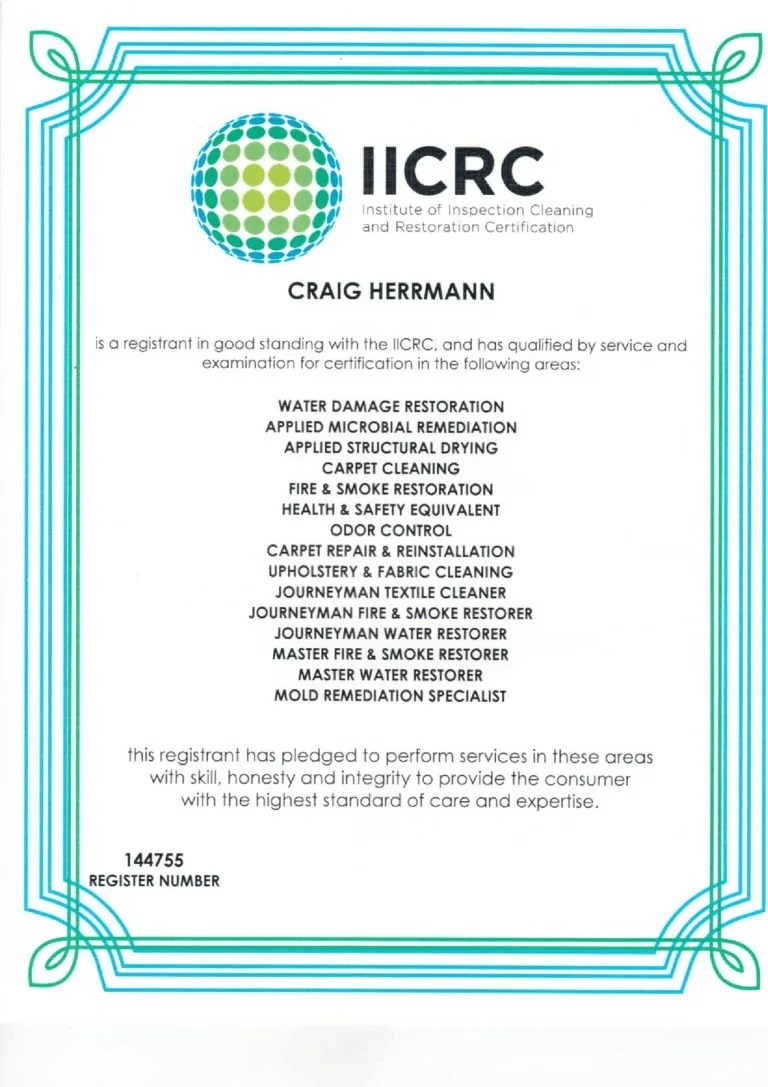
Mold Eliminators has tested and remediated more than 255 Las Vegas properties since 1996. Our founder, Craig Herrmann, helped author the ANSI/IICRC S520 standard, the national rulebook for mold remediation, and holds IICRC Master Restorer credentials. So when a result says a space is clean, that isn’t our opinion talking; it’s an objective measurement, graded against the document the whole industry follows and verified by a lab that has no stake in your invoice.
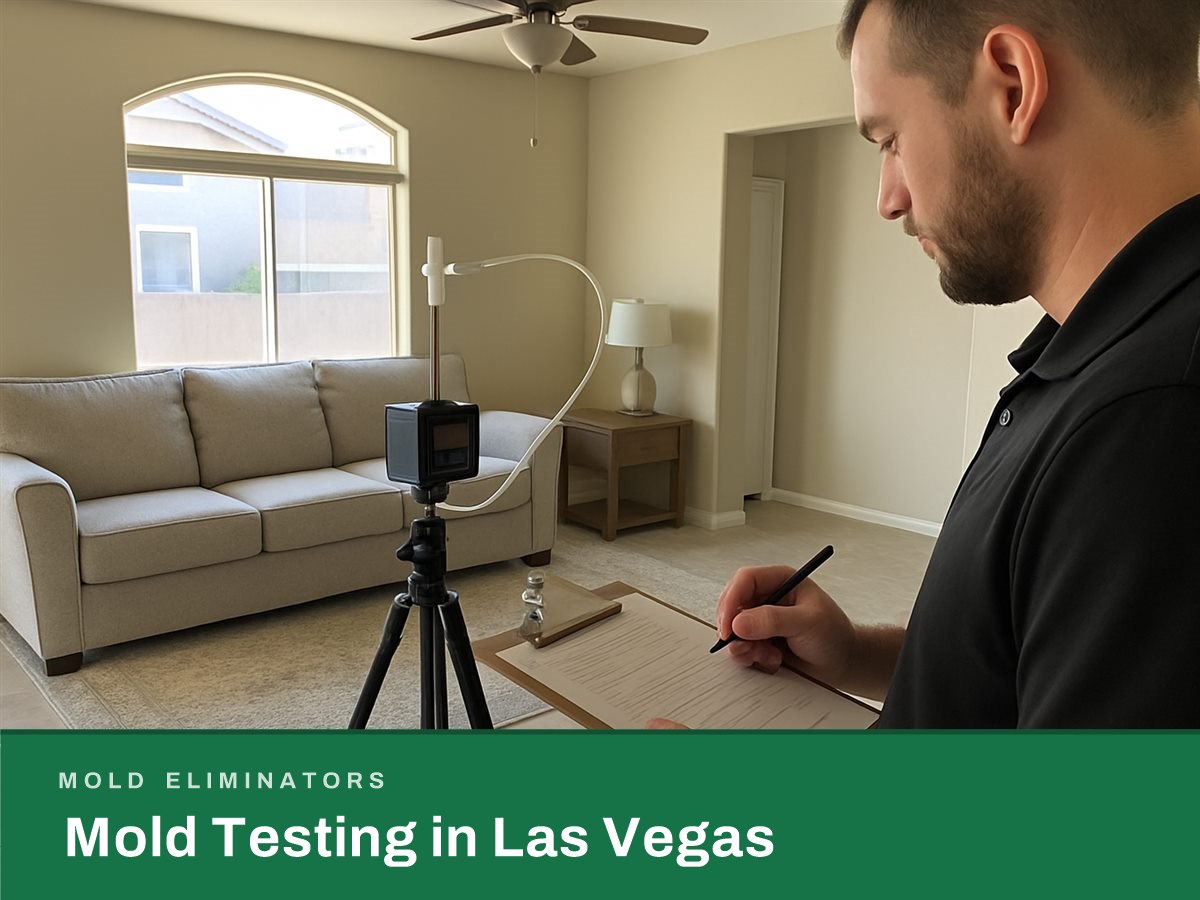
What mold testing actually measures
Mold testing is the part of this business most prone to smoke and mirrors, so let’s be precise about what it is and what it isn’t. Testing is the act of collecting samples, of the air, of a surface, or of a piece of material, and sending them to a laboratory that identifies and counts what’s present. It answers three questions a naked eye cannot: what kind of mold is here, how much of it is in the air, and whether those levels are normal or elevated compared to a clean reference. A test is not a fix and it is not a guess; it is data.
The reason that matters comes down to a hard truth about spores. Mold spores exist in every building on earth, all the time, harmlessly, you cannot get a reading of “zero,” and any company promising one is selling you a fantasy. The entire point of testing is comparison: a trained sampler takes an outdoor air sample as a baseline, then indoor samples, and the lab compares them. Indoor levels at or below the outdoor baseline, with a normal mix of species, means normal fungal conditions. Indoor levels far above outdoor, or a spike of water-loving species that don’t belong indoors, means you have an active problem. Without that baseline, a spore count is just a number with nothing to lean on.
This is also where the conflict of interest lives, and it’s worth naming out loud. When the same company that wants to sell you remediation also “tests” your home and grades its own work, the incentive runs exactly the wrong way, finding a problem (or declaring one solved) puts money in their pocket either way. We refuse to play both sides of that table. Sampling goes to an independent, accredited third-party lab with no relationship to the outcome and nothing to gain from the result. That separation is the whole point. It’s the difference between a test that’s evidence and a test that’s a sales prop.
Need help now?
Talk to a Las Vegas expert
In-house certified crews. One-hour emergency response across the valley, 24/7.
Air sampling vs. surface sampling, and when each is right
There isn’t one “mold test.” There are different sampling methods that answer different questions, and a good tester picks the method that fits your situation instead of running everything to pad the invoice. Naming yours helps you understand what the lab can and can’t tell you.
In practice, a thorough mold inspection usually combines methods: air samples to read the rooms, plus a surface sample to confirm a specific stain. The inspection is the diagnosis; the lab analysis is the evidence behind it. One without the other is half a job, an inspector who never samples is guessing, and a lab result with no inspection has no context. We do both, and we let the lab, not us, write the verdict.
Why testing matters more than people think in Las Vegas
Everyone assumes the desert is too dry for mold, and that assumption is exactly why testing here catches problems people never see coming. Because nobody’s looking, valley mold tends to grow hidden, behind walls, under slabs, inside the roof, and surfaces only as a smell or a stain long after it started. A test is often the first hard evidence a homeowner has that the dry-desert assumption was wrong.
Slab leaks feed mold you’ll never see. Supply lines running through concrete slabs wet the underside of flooring and the base of walls for months. There’s no visible stain to sample, only an air test reads the elevated spores drifting up from a cavity you can’t open.
Swamp coolers and monsoon intrusion. Evaporative coolers trickle water through ceilings; summer monsoons soak flat roofs that are bone-dry the rest of the year. Both grow mold in spaces a flashlight never reaches, which is precisely where air sampling earns its keep.
High-rise condensation near the Strip. In the valley’s denser condo stock, the gap between heavily air-conditioned interiors and desert heat breeds condensation inside wall assemblies, the kind of hidden moisture that only a measured air sample, baselined against the outdoors, will reliably flag. Whatever the source, the pattern is the same: the problem hides, and the test is what brings it into the open.
Signs it’s time to test, and when it isn’t
Testing isn’t always necessary, and we’ll be the first to tell you so. If you can see a small patch of mildew on a hard bathroom surface and you know exactly why it’s there, you may not need a lab to confirm the obvious, you may just need to clean it and fix the ventilation. The point of this list isn’t to talk you into a test; it’s to help you tell a real reason from a false alarm.
A persistent musty smell with no visible source. Odor without a stain almost always means hidden moisture and hidden mold. An air test is the calm, factual way to find out whether your nose is right before anyone opens a wall.
Recurring symptoms that ease when you leave home. Congestion, headaches, or worsened allergies and asthma that improve away from the house can point to indoor air quality. We don’t diagnose health conditions and we won’t use your family’s health to scare you, but a test is the honest way to rule mold in or out.
A real-estate transaction with a deal on the line. When mold is suspected during a sale, the parties need documented, lab-verified answers fast. A handshake won’t close escrow; a third-party lab result will.
After any significant water event. A burst pipe, a slab leak, or a past flood that sat too long warrants testing even after it dries, mold can take hold inside materials you’ve already dried. If you’ve had water damage, testing closes the loop. When water is still active, the right first call is 24/7 emergency response to stop it, then we test once the structure is stable.
And when a test isn’t warranted, we say so plainly. If what you’re looking at is soap scum, efflorescence, or harmless surface mildew, we’ll tell you, and because the inspection is free for homeowners and property owners, finding out the truth costs you nothing but a phone call.
How our testing process works
Good testing is a disciplined sequence, not a wave of a wand. Here’s exactly how a Mold Eliminators test runs, built so the result is defensible to a lab, a realtor, and an insurer alike.
- Walk-through & moisture mapping. We start with a mold inspection, meters and thermal imaging to trace the moisture, because a sample with no context is just a number.
- Outdoor baseline. We take an outdoor air sample first. Every indoor reading is judged against it; without a baseline, no result means anything.
- Targeted sampling. Air samples in the rooms in question, surface or bulk samples on suspect spots, chosen to answer your actual question, not to inflate the count.
- Chain of custody to an accredited lab. Samples are sealed, labeled, and sent to an independent, AIHA-accredited third-party lab, never “analyzed” by us in a van.
- Lab analysis & identification. The lab counts spores and identifies species, comparing indoor to outdoor and flagging anything elevated or out of place.
- Plain-English report. You get the lab’s raw data and a clear explanation of what it means, whether you have a problem, how big it is, and what (if anything) to do next.
Post-remediation clearance, the test that actually proves it worked
This is the test that matters most, and the one most often skipped or faked. After mold is removed, clearance testing is the only honest way to confirm the job worked, an independent air sample, run after the cleanup, that proves fungal conditions are back to normal. Without it, “it’s clean” is just a technician’s say-so, and a technician with a financial stake in the answer is exactly who shouldn’t be grading the result.
That’s why we hand clearance to a third party. The crew that did the remediation never grades its own homework. An accredited lab samples the air and surfaces, compares them to the outdoor baseline, and issues the pass or fail. If it passes, you have documentation a realtor, lender, and insurer will all accept. If it doesn’t, we go back and finish the work, on us, before anyone calls it done. That’s what independence buys you: a result that’s evidence, not a marketing claim. A company that clears its own work is asking you to trust the fox’s headcount of the henhouse, and we won’t put you in that position.
Real-estate testing, fast, documented, deal-ready
When mold turns up during a transaction, the clock is the enemy and credibility is everything. A buyer’s agent, a listing agent, a lender, and an inspector all need the same thing: documented, lab-verified answers that no one can dismiss as self-serving. A test run by the company hoping to win the remediation contract carries an obvious asterisk, an independent lab result doesn’t.
We handle transaction testing the way the stakes demand: rapid scheduling, methodical sampling, third-party analysis, and a clean report you can drop straight into the file. If the home is clear, we’ll say so and walk away, we don’t manufacture a problem to win a job, and on a real-estate deal that restraint is exactly what protects the transaction. If there’s a real issue, you’ll have the data to scope it, price it, and resolve it before closing. Either way, the verdict comes from the lab, not from the company that stands to profit from it.
Why Las Vegas trusts our testing
Independent truth
Every sample goes to an accredited third-party lab with no stake in the result, and the inspection is free for homeowners and property owners. We profit from fixing real mold, never from inventing one, and never from grading our own work.
Standards, not shortcuts
Sampling, baselines, and clearance follow the S520 standard Craig helped author. Results are measured against the rulebook the whole industry uses, documented and defensible, not eyeballed.
In-house accountability
No subcontractors, every technician who collects a sample is a certified W-2 employee, with one-hour emergency response, 24/7, across the valley. If our name is on the report, our people took the sample.
That’s the whole difference. Where a franchise tests its own work and self-certifies the result, we let an independent lab grade the outcome. You can see exactly where we serve across Clark County, or just reach us directly, no call center in between, and no incentive to find a problem that isn’t there.
Clear answers, no upselling
“Oliver was incredibly kind, professional, and clearly knowledgeable about his work. He explained everything clearly and did not try to upsell or exaggerate the issue. That level of integrity builds real trust.” Lasko L., Google
Why Las Vegas air needs a same-day outdoor baseline
Spore counts mean nothing without something to compare them to, and in the desert that baseline swings hard. Outdoor mold is low through the dry months, then climbs during monsoon humidity, so a reading that looks alarming in February can be ordinary in August. We pull a same-day outdoor control on every test for exactly that reason, whether the property is a high-rise near the Strip or a single story in Spring Valley.
Areas we serve across the Las Vegas valley
We serve homeowners and property owners throughout Las Vegas and the surrounding valley, including Summerlin, Henderson, Paradise, Spring Valley, and North Las Vegas, along with all of Clark County. One-hour emergency response, 24/7. Call (702) 442-1126 any time.
Mold testing in Las Vegas, common questions
- How much does mold testing cost?
- For property owners, our on-site inspection is free, we’d rather earn your trust with an honest result than charge you to find out you don’t have a problem. If lab analysis is warranted, it goes to an independent third-party lab and is billed at cost, so any verdict you get is objective, not a sales pitch. When a transaction or insurer requires a formal documented report, we’ll walk you through any lab fees up front, in writing.
- What’s the difference between air sampling and surface sampling?
- Surface sampling lifts a sample off a visible stain to confirm whether it’s mold and which species, but it says nothing about the air. Air sampling pulls a measured volume of air through a spore trap and, compared against an outdoor baseline, tells you whether the room you’re breathing in is normal or elevated. Health questions and clearance need air sampling; confirming a specific stain needs a surface sample. A good test often uses both.
- Can’t the remediation company just test its own work?
- They can, but you shouldn’t accept it. When the company that did the removal also grades the result, the incentive runs the wrong way, they profit from declaring success either way. That’s why we send clearance samples to an independent, accredited lab with no stake in the outcome. The crew never grades its own homework, and the report comes from a third party a realtor or insurer will actually accept.
- Do I need clearance testing after remediation?
- Yes, it’s the only honest proof the job worked. An independent air sample after the cleanup confirms fungal conditions are back to normal, measured against the outdoor baseline. If it passes, you have documentation a lender and insurer will accept; if it doesn’t, the remediation isn’t finished. Skipping clearance means trusting someone’s word instead of a lab’s data.
- Is at-home mold test kit from the hardware store reliable?
- Not really. Petri-dish kits will grow something from any home’s air, spores are everywhere, so they almost always read “positive” and tell you nothing useful. They have no outdoor baseline, no calibrated air volume, and no species identification. If you want an answer you can act on, an accredited lab analysis with a proper baseline is the only reliable route, and for homeowners and property owners, the free on-site inspection tells you whether you even need it.
- Do you test for mold during a home sale?
- Yes, and it’s one of our most common calls. Transaction testing needs to be fast, methodical, and, above all, independent, because a self-interested test carries an asterisk no agent wants in the file. We sample, send it to a third-party lab, and hand you a clean report you can drop straight into the deal. If the home is clear, we’ll say so and walk away rather than manufacture a problem.
Turnaround, limits, and what testing cannot tell you
Booking a test, and what you pay for what
The on site visit costs you nothing up front. What is billed separately is the independent laboratory analysis, and we say that plainly rather than folding a paid service into a free visit to make a quote look better. You see the price of the lab work before anyone collects a sample.
Sampling is quick, but it needs the property in a settled state, so it helps to tell us in advance about pets, open windows, a running swamp cooler, or anyone in the home with a respiratory condition. Say so at booking and the visit is scheduled around it. Results come back as a written report with the lab findings explained in plain English, not a page of spore counts left for you to interpret.
Indoor air quality testing in Las Vegas
Indoor air quality testing is the airborne half of what we do here: instead of swabbing a surface you can see, we measure the spores you are actually breathing and compare them against an outdoor baseline taken the same day. It is the right test in a specific set of situations, and the wrong one in others, so it is worth knowing which you are in before you pay for anything.
When measuring the air is the right call
Symptoms that track the building rather than the season. If the congestion, headaches or irritation ease off when someone leaves the house for a few days and return within hours of coming back, that is a building pattern, not an allergy calendar. The air is worth measuring.
A musty smell with nothing visible. That damp, earthy odor is microbial volatile organic compounds, the gases mold gives off while it grows. Smelling it without finding it usually means the colony is behind something.
After a leak has been dried out. Air sampling is the verification step that tells you the drying actually worked rather than just looking finished.
When the air handler makes it worse. If the smell or the symptoms intensify while the system is running, the ductwork may be distributing spores around the house. Sampling at the registers confirms whether the system itself needs attention before you commit to having it cleaned.
Why the outdoor baseline decides everything
Spores are outdoors all the time, so a raw indoor count on its own means very little. The comparison is what carries the information. There is one useful exception: certain water damage indicator genera, Stachybotrys and Chaetomium among them, do not normally drift around outdoors in any quantity. Finding them indoors is meaningful almost regardless of the count, because they point to sustained wetness inside the building rather than to whatever blew in through a door.
We read borderline results conservatively and say plainly what the numbers do and do not prove. A count is cross-checked against the moisture readings, the visible conditions and the history of the building, because the honest question is never just what the lab said. It is whether the air result agrees with what we can see and measure.
What drives indoor air quality in a valley home
The recurring culprits here are local: attic mounted air handlers and their condensate lines, swamp cooler humidity with nowhere to go, construction and valley dust pulled through the returns, and hidden moisture from a slab leak. High rise and condo units add their own version, with shared walls, stacked units, shared ventilation, and a tenant who often cannot open a wall to look.
A desktop air quality monitor is not a substitute for any of this. Those devices read particulates and volatile compounds in general terms. They cannot identify a species, they cannot give you a spore count against an outdoor control, and they cannot tell you where the water is.
Booking, access, and what it costs
The on-site inspection is free. Laboratory analysis, if it is warranted, is billed at what the independent lab charges. Sampling itself is quiet and takes minutes per location, and same day and weekend slots are usually available. If an occupant is elderly, immune compromised, or has limited mobility, say so when you book and the visit gets planned around them.
One note on insurance: carriers generally pay for the cause and the remediation rather than for investigative sampling, although testing tied to a covered loss can be a different conversation.
Guided every step, same-day response
“From my first call they sent someone over the same day. From the air quality tests, to the swabs, to the recommendations afterward, he guided us every step of the way. Not once did anyone try to upsell me. The most honest and efficient company I have worked with in years.”
Heather Z., Google review
Not sure if it’s mold? Start with a free on-site inspection, no pressure and no invented problems.
Free, no-pressure on-site inspection by an S520-trained team. If lab analysis is warranted, samples go to an independent third-party lab, billed at cost. One-hour emergency response, 24/7, across the Las Vegas valley. We profit from fixing real mold, never from inventing one, and never from grading our own work.