Structural Drying in North Las Vegas, NV
Structural Drying · North Las Vegas, NV
The water is extracted, the carpet feels dry, and the room looks fine. Inside the wall cavity and down in the subfloor, though, the structure can still be soaked. Structural drying is the measured step that decides whether a North Las Vegas water event ends cleanly or quietly becomes a mold problem in three weeks.
Across North Las Vegas, from the newer master-planned streets of Aliante up by the 215 and Aliante Parkway to the older blocks of central NLV around Las Vegas Boulevard North, we see the same pattern: a structure that looks dry on the surface while moisture sits trapped in the materials. Getting it back to a documented dry standard is the work, and it is a core part of full water damage restoration and the service pillar behind it, structural drying. We are minutes from the 89030 to 89086 ZIP codes, so we set up the drying environment fast, before the clock runs out.
 Structural drying equipment monitoring moisture in a North Las Vegas home
How the structural drying problem shows up in North Las Vegas
North Las Vegas is really two cities when it comes to water damage, and the difference matters for drying. The Aliante and Eldorado master-planned builds north of the 215 went up fast in the 2000s on slab-on-grade foundations. Those homes are now hitting the age where slab leaks and pinhole copper failures start, a slow supply-line drip under the slab or inside a wall that saturates framing and subfloor long before anyone sees a stain. By contrast, the older central NLV neighborhoods near Las Vegas Boulevard North and the Craig Ranch area carry aging galvanized and early copper plumbing, where the failures tend to be sudden: a supply line that lets go, a water heater that splits.
The growth corridors along Tropical Parkway and Centennial Parkway sit on the same young slabs as Aliante, so the same pinhole and slab-leak pattern follows them. A slab holds water far longer than people expect. A concrete pad that feels dry on top can stay saturated underneath for weeks, which is exactly why drying here has to be measured rather than assumed. Then there is the monsoon. When summer storms dump on the Las Vegas Wash and its tributary washes that thread through North Las Vegas, the low-lying lots and garages near those wash zones take on stormwater that arrives muddy and contaminated, a different drying problem than a clean burst pipe.
None of this is visible to the eye. A wet slab, a soaked bottom plate, a saturated subfloor under intact tile, all of it reads as dry to a homeowner. That is the whole reason structural drying is an engineering step and not a guess, and why the wrong response, a few box fans and an open window in 110 degree heat, leaves the moisture in place to feed the next problem.
Need help now?
Talk to a Las Vegas expert
In-house certified crews. One-hour emergency response across the valley, 24/7.
The first 24 to 72 hours decide the outcome
There is a clock on water damage and it is not generous. Mold can begin to colonize wet organic materials, and most of a North Las Vegas home is organic, from paper-faced drywall to wood framing, within roughly 24–48 hours of getting wet. After about 72 hours the conversation shifts from dry it and save it to remove it and remediate. That window is why drying is treated as an emergency, not a scheduled appointment.
The faster a controlled drying environment goes in, extraction, dehumidification, and air movement working together, the more material is saved and the lower the mold risk drops. A slab leak in Aliante left to sit overnight because the family planned to deal with it tomorrow can turn a salvageable floor into a tear-out. Because our headquarters on Sycamore Trail sits just minutes south of North Las Vegas, our crews reach the 89030 to 89086 ZIP codes quickly, which is the practical difference between catching a structure inside the window and missing it. If water is actively spreading right now, the right move is our 24/7 emergency response, where we stabilize the water first and start drying immediately.
The desert adds its own wrinkles to that clock. Extreme summer heat can drive moisture deeper into cool wall cavities through condensation, and the dramatic day-night swings make it will air-dry a dangerous assumption. With slab-on-grade construction so common across North Las Vegas, the slab itself becomes a reservoir that no amount of surface airflow will clear on its own.
Moisture mapping: finding the water you cannot see
You cannot dry what you have not found, and you cannot prove something is dry without a baseline. Moisture mapping is the diagnostic step that turns drying from guesswork into engineering. Before a single fan is placed, we map how far the water traveled and how wet each material is, then use that map to aim the equipment and define the dry target we are driving toward.
This is the part a company chasing a quick invoice skips, because it takes equipment, training, and time. It is also the part that makes drying honest. When we say a wall or a slab is dry, we show you the number, the location, and the day it got there.
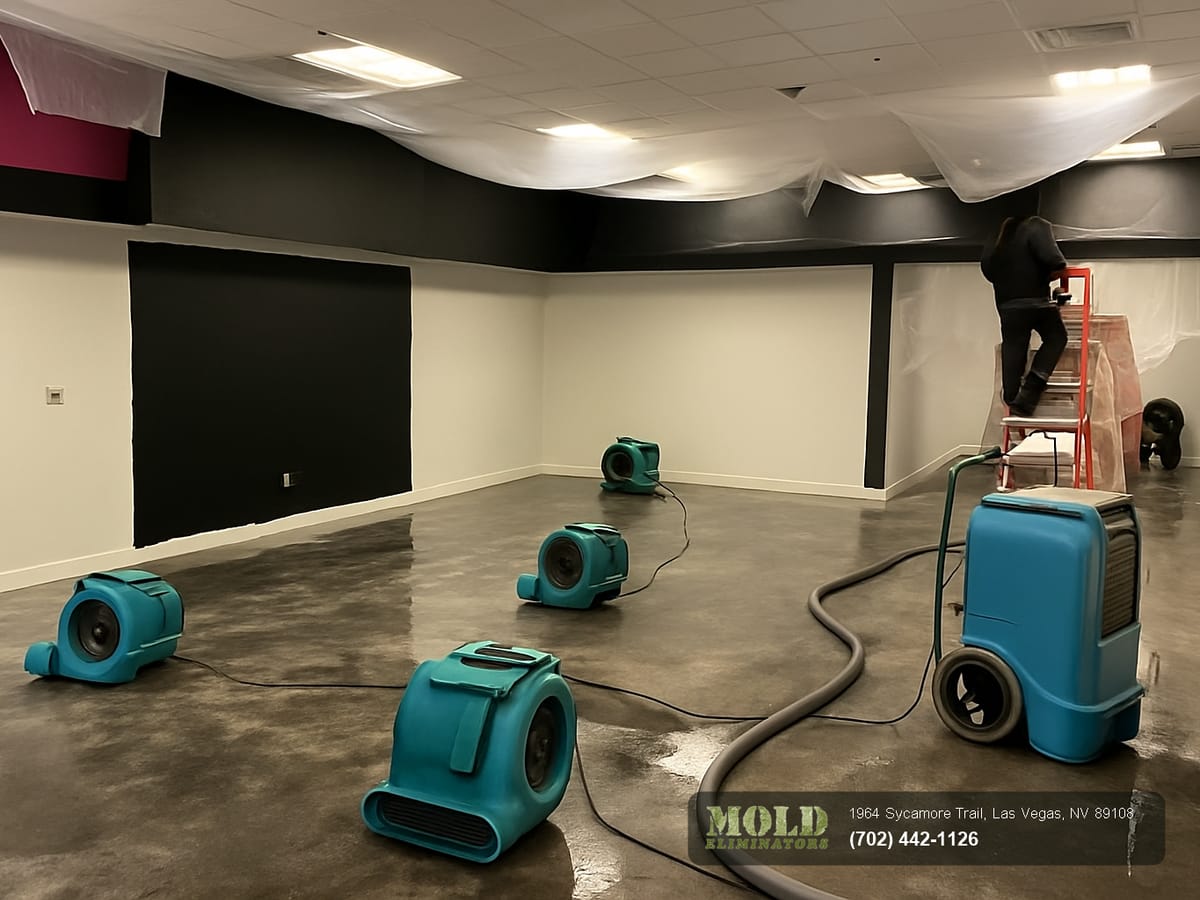 Applied structural drying with dehumidifiers and air movers in a North Las Vegas property
Our structural drying process, step by step
Drying done to standard follows a deliberate sequence, the Applied Structural Drying method, from the first reading to the final verified dry target.
- Extraction. Before drying begins, every bit of standing and absorbed water is physically extracted. Pulling water out is dramatically faster than evaporating it, and it protects the materials underneath.
- Moisture mapping and baseline. We map the affected area with meters and thermal imaging, log starting moisture levels, and set the documented dry target for each material.
- Dehumidification. Commercial dehumidifiers pull water vapor out of the air so the room stays drier than the wet materials, the engine that keeps moisture leaving the structure.
- Air movement. High-velocity air movers are placed by design, not at random, to sweep moisture off surfaces and into the air where the dehumidifiers can capture it.
- Temperature control. We manage the heat in the space, because warmer air holds and releases moisture faster, a lever the desert climate makes especially powerful when used correctly.
- Daily monitoring. Every day, moisture readings are taken and logged, and the equipment is adjusted to keep drying on pace toward the target. The data drives the schedule, not the calendar.
- Drying to verified targets. Equipment comes out only when readings confirm every material has hit its dry standard. That verified-dry result is the finish line, and the proof that mold has nothing left to feed on.
Why local, no subcontractors, and an independent lab matter here
Structural drying is held to the ANSI/IICRC S520 standard, the national rulebook for mold and moisture work. Our founder, Craig Herrmann, co-authored that standard and is IICRC Master Certified, so a North Las Vegas structure is dried by the people who helped write the rules, to documented targets rather than to feels dry. You can read more about Craig and the S520 standard and why that credential changes the work.
Local matters for a simple reason: response time inside the 24 to 72 hour window. From our Sycamore Trail headquarters we reach Aliante, Eldorado, Craig Ranch, and central NLV in minutes, not the hour-plus a valley-wide franchise dispatch can take. The North Las Vegas hub page lays out the full North Las Vegas service area we cover.
No subcontractors means one accountable crew. Every technician is a certified W-2 employee, so the same people own the water, the drying, and the mold risk from the first reading to the final verified-dry target. There is no handoff to a separate mold company that points fingers when something was missed. And when verification is needed, we use an independent third-party lab. If lab analysis is warranted, samples go to an outside lab and are billed at cost, so the result is not graded by the company that did the drying. That is the anti-upsell posture we have held since 1996 across 255+ properties: we tell you when you do not need us.
When drying alone is not enough
Structural drying saves a lot of North Las Vegas homes from demolition, but only when it starts in time and the water was clean. There are situations where drying is one part of a bigger job, and an honest restorer tells you which one you are in rather than selling a one-size package.
The monsoon wash zones along the Las Vegas Wash are a clear example. Stormwater that backs into a low garage near a wash is Category-3 water: it carries mud, bacteria, and biohazard, and the porous materials it touched usually have to be removed, not just dried. That is where drying overlaps with flood restoration and specialized cleanup: contain it, remove what cannot be salvaged, dry what can, and verify the result. If mold already had time to take hold before drying started, the job becomes a containment-and-removal mold remediation with drying built into it, not drying alone. Handling all of it under one roof means one chain of responsibility, one standard, start to finish.
Structural drying in North Las Vegas: common questions
- How long does structural drying take in a North Las Vegas home?
- Most residential jobs run about three to five days, but the materials set the pace. Drywall, framing, subfloor, and the concrete slab common in Aliante and the Tropical Parkway corridor each release moisture at their own rate. We take daily readings and pull the equipment only when every material hits its verified dry target. The data decides, not the calendar.
- My Aliante home has a slab leak. Why does the floor still read wet after extraction?
- Slab-on-grade foundations hold water far longer than people expect. A slab that feels dry on top can stay saturated underneath for weeks, so surface airflow alone will not clear it. We read the concrete directly with moisture meters, set a documented dry target against an unaffected reference area, and dry to that number. If you want to confirm whether a past leak left moisture behind, a free inspection is the calm way to find out. Lab analysis, if it is warranted, is a paid add-on billed at cost.
- How fast can you get to North Las Vegas after a water emergency?
- Quickly. Our headquarters on Sycamore Trail sits just south of North Las Vegas, so our crews reach the 89030 to 89086 ZIP codes, including Aliante, Eldorado, Craig Ranch, and central NLV, in minutes. Because the mold clock is measured in hours, that response time is the practical difference between saving the structure and tearing it out. For an active emergency, call (702) 442-1126 or reach us directly.
Water damage in North Las Vegas? Dry it right before mold gets its chance.
Free on-site inspection, no pressure. One-hour emergency response, 24/7, minutes from Aliante, Eldorado, Craig Ranch, and central NLV. We dry to verified targets and prove it, so the water problem ends here, not in three weeks.