Monsoon & Storm Flood Damage in Las Vegas
Water & Flood · Las Vegas
Las Vegas gets only about four inches of rain a year, but the desert has a cruel way of delivering a big share of it in a single afternoon. When a summer monsoon cell parks over the valley, a season’s worth of rain can fall in under an hour, and the ground simply cannot absorb it. The result is flash flooding that fills garages, swamps ground floors, and pushes contaminated storm water into homes that were dry twenty minutes earlier.
This page explains why monsoon flooding behaves the way it does here, what category storm water actually is, and how a fast, standards-based response protects your home from the slow disaster that follows the fast one: mold. It sits within our broader water damage restoration work, and when an entire ground floor goes under, it overlaps with full-scale flood restoration. If you are reading this with water already in your house, call (702) 442-1126 now and keep reading after.
Why a desert floods so fast
The Las Vegas monsoon runs roughly from late June through September, when moisture pushes up from the south and builds into towering afternoon thunderstorms. These cells are intense and localized. One neighborhood can take two inches of rain in forty minutes while a subdivision a few miles away stays bone dry. That intensity is the whole problem.
Desert ground does not behave like a lawn in a wetter climate. Decades of sun bake the soil into a hard, sun-crusted surface, and the caliche layer beneath it is nearly as watertight as concrete. Instead of soaking in, rain sheets across the surface and races downhill. The valley’s washes, streets, and storm channels were built to move that water, but during a strong cell they fill faster than they can drain.
That is how you get a “100-year” flow down a street that was dusty an hour ago. Water finds the low point, and in a built-out valley the low point is often a driveway, a window well, or a garage. By the time the sky clears, the damage is already inside.
 Storm clouds building over the Las Vegas valley during monsoon season
Need help now?
Talk to a Las Vegas expert
In-house certified crews. One-hour emergency response across the valley, 24/7.
Where the water gets in
Flash flooding does not need a river. In Las Vegas it exploits the ordinary geometry of a house: the points that sit lowest, slope inward, or open at ground level. A few common entry paths show up again and again on our calls.
What these have in common is speed and volume. This is not a slow drip from a supply line. It is a large amount of dirty water arriving all at once, which is why the cleanup is a different animal from a routine indoor leak and why structural drying has to start before the materials can begin to break down.
Storm water is Category 3: treat it as a biohazard
Not all water damage is equal, and the difference is not about how much arrived. It is about what is in it. The ANSI/IICRC S520 standard, which our owner Craig Herrmann co-authored, classifies water into three categories by contamination level. Monsoon flood water is the worst of them.
Category 1 is clean water from a broken supply line. Category 2 (“gray water”) carries some contamination, like an overflowed washing machine. Category 3 (“black water”) is grossly contaminated and can carry bacteria, sewage, chemicals, and other harmful agents. Storm and flood water from the ground outside is Category 3 by definition, because of what it picks up on the way to your door.
Think about the path that water took: across roads coated in oil and brake dust, through landscaping treated with fertilizer and pesticide, past trash and animal waste, and often backing up out of overwhelmed storm drains. When a flood overwhelms a sewer line, you also get genuine sewage mixed in. That is why we do not “dry out” a flooded garage the way we would dry a clean leak. Category 3 water means porous materials that soaked it up, such as carpet pad, saturated drywall, and particleboard, generally have to be removed and discarded, not just dried, and the surfaces underneath have to be cleaned and disinfected.
Treating storm water as a biohazard is not fear-mongering. It is the standard doing its job: it tells us, before anyone’s opinion enters the room, that this water is contaminated and the response has to match.
The clock that actually matters: rapid response and drying
The most damaging thing about flood water is not the first hour. It is the next seventy-two. Wet building materials in a warm Las Vegas home are an ideal environment for microbial growth, and mold can begin colonizing damp drywall and framing within 24 to 48 hours. Every hour water sits, it migrates further into the structure and wicks higher up the walls.
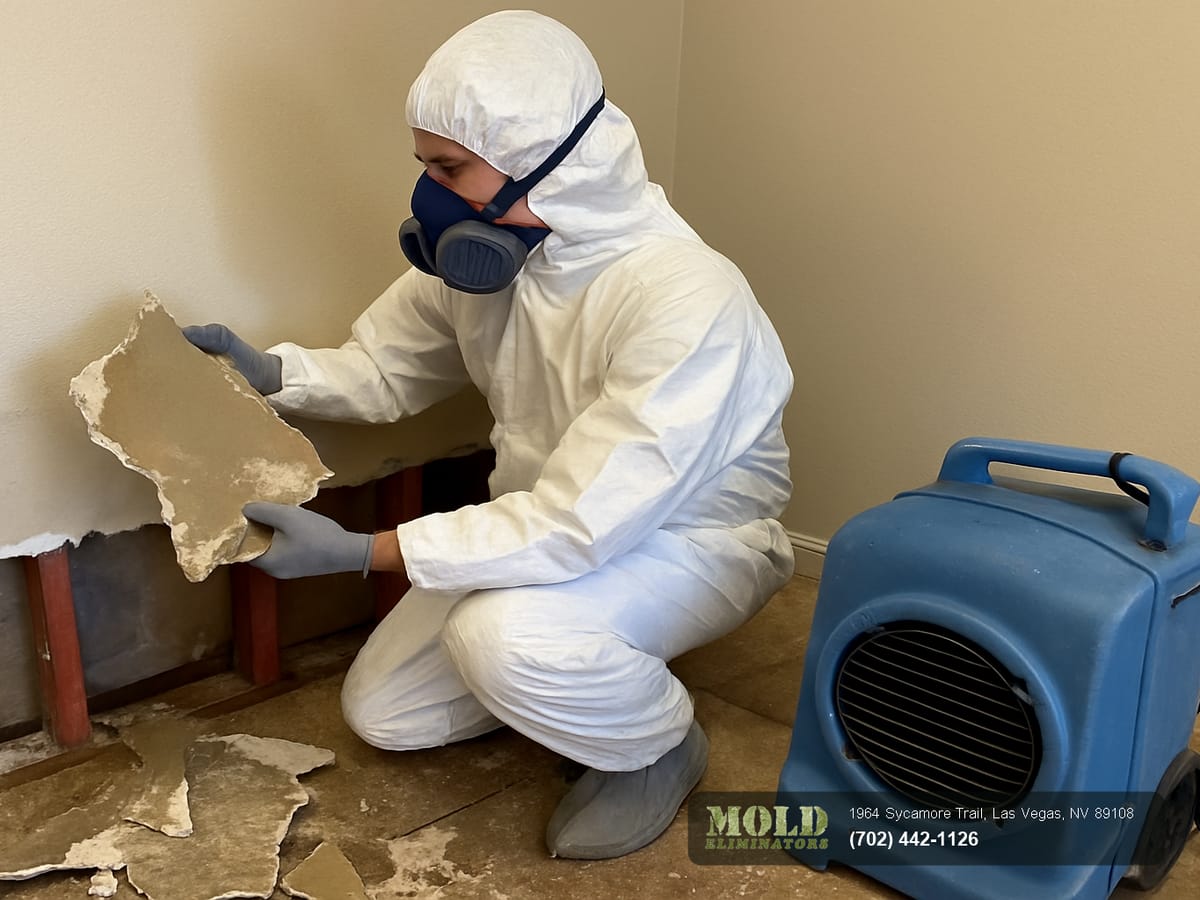
That is why response speed is the single biggest lever on the final cost and disruption of a flood. Our certified W-2 technicians, never subcontractors, respond around the clock with a target of one hour on the road, because the difference between a same-day extraction and a next-morning one is often the difference between drying your home and demolishing part of it.
A proper flood response moves in a deliberate order:
- Extract first. Truck-mounted and portable extractors pull standing water out fast. The less water sitting on the slab, the less it can wick into walls and subfloor.
- Remove what cannot be saved. Category 3 contamination means saturated carpet pad, swollen baseboards, and wet drywall come out. We cut drywall above the wick line, not at random, so the wall cavity can dry.
- Clean and disinfect. Every surface the contaminated water touched is cleaned with appropriate antimicrobials. This is the step that separates restoration from a wet-vac and a fan.
- Dry to a measured target. Air movers and commercial dehumidifiers run until materials read dry on a moisture meter, not until they feel dry. Proper structural drying verified with instruments is what actually stops mold from returning.
- Document and verify. We log moisture readings daily so there is proof the structure reached a dry standard before walls get closed back up.
Preventing mold after the flood
The reason we are so insistent about measured drying is that the flood is the visible disaster and mold is the invisible one that arrives a week or two later. Homeowners who hire a quick clean-out crew, or who try to handle it with rental fans, often find dark staining and a musty smell creeping out of the baseboards a month down the road. The water was gone; the moisture inside the wall was not.
If drying is incomplete, the only honest fix is mold remediation, which is more invasive and more expensive than the drying that would have prevented it. The whole point of doing the flood response correctly is to never need that second visit.
Because we use an independent third-party lab rather than grading our own homework, you do not have to take our word that a flooded home is dry and clear. If you are worried mold already took hold, our free inspection tells you the truth either way, and we are just as willing to tell you that you are fine as to tell you that you are not. We profit from solving real problems, not inventing them.
Monsoon-season prep for Las Vegas homeowners
You cannot stop a monsoon cell, but you can change where its water goes. A weekend of low-cost preparation before the season ramps up moves the odds firmly in your favor.
If the worst happens anyway, speed beats everything. The faster contaminated water is extracted and the structure is drying, the smaller the job stays. We serve homeowners across the valley, including North Las Vegas, Spring Valley, Paradise, Henderson, and Summerlin; you can see the full list of service areas we cover.
- Is monsoon flood water really dangerous, or just dirty?
- It is genuinely contaminated. Storm water is Category 3 under the S520 standard because it carries bacteria, chemicals, and often sewage from overwhelmed drains. That is why a flooded garage is handled as a biohazard, with removal and disinfection, rather than simply dried. For the broader picture, see our water damage restoration overview.
- How fast do I need to act after a flood?
- Within hours, not days. Mold can begin growing on wet materials in 24 to 48 hours, and water keeps migrating the whole time it sits. Our 24/7 emergency team targets one hour on the road for exactly this reason.
- Can I just dry it out myself with fans?
- Rental fans dry surfaces, not the moisture trapped inside walls and subfloor, and they do nothing about Category 3 contamination. Incomplete drying is the leading cause of the mold that shows up weeks later, which then requires full mold remediation. Measured, instrument-verified drying is what prevents that.
- What if mold already started before you arrived?
- Then we find out honestly. Our free inspection uses an independent lab, so the answer is not our opinion. If you are clear, we will tell you, and we will not charge you to hear it.
Monsoon flooding FAQ
Flooded by a Las Vegas storm? We respond around the clock.
The faster contaminated storm water comes out and the structure starts drying, the smaller the damage stays. Get a fast, honest response from a team that uses certified in-house technicians and an independent lab, led by the co-author of the national S520 standard.