Structural Drying in Summerlin, NV
A slab leak under a newer custom home in The Ridges, or monsoon runoff pushing in along a Red Rock-adjacent foundation, leaves a structure that looks dry on the surface and stays soaked underneath. In Summerlin that hidden moisture is the real risk: extract the visible water, walk away, and three weeks later a musty edge starts building behind the baseboards. Structural drying is the step that decides whether your water problem ends now or quietly becomes a mold problem in a home where documentation matters for resale.
Mold Eliminators handles structural drying across Summerlin to the ANSI/IICRC S520 standard, the national mold standard our founder Craig Herrmann co-authored. So the drying here is not a few rented fans pointed at a wet wall. It is a measured process with a documented finish line, run by an in-house W-2 certified crew that knows the construction styles and the climate pressures specific to this side of the valley.
How water damage shows up in Summerlin
Summerlin reads differently from older parts of Clark County, and that changes how a structure gets wet and how it has to be dried. Much of the housing stock here is newer slab-on-grade custom and semi-custom construction, from the gated streets of The Ridges and Red Rock Country Club to The Vistas, The Trails, and the master-planned villages around Downtown Summerlin. Those slabs are exactly where the most common drying call originates: a slab leak, where a pressurized copper or PEX line under the foundation gives way and pushes water up through the concrete into flooring, baseboards, and framing. The slab feels barely damp on top while it stays saturated underneath for days.
The second pressure is geography. Summerlin sits right against the Red Rock escarpment, and during monsoon season the runoff coming off that higher terrain moves fast. Homes in the western 89135 and 89138 zips, closest to the conservation area, see sheet flow and debris-laden water find its way to side yards, garages, and the low edge of a foundation in minutes. What enters that way is rarely clean, which changes the job from simple drying to contained removal plus drying.
There is also an age split worth naming. Sun City Summerlin, the established 55-plus community in 89134, has homes that have been through twenty-five-plus years of swamp coolers, water heaters, and supply lines that are now well past their service life. A failed water heater or a slow under-slab leak in a Sun City home presents very differently from a burst manifold in a three-year-old Vistas custom, and the drying plan has to account for that.
Need help now?
Talk to a Las Vegas expert
In-house certified crews. One-hour emergency response across the valley, 24/7.
Why the first 24 to 72 hours decide the outcome
There is a clock on water damage and it is not generous. Mold can begin to colonize wet organic materials, and most of a Summerlin home is organic, from paper-faced drywall to wood framing, within roughly 24–48 hours of getting wet. After about 72 hours the conversation shifts from dry it and save it to remove it and remediate. That window is the whole reason structural drying is treated as an emergency rather than a scheduled appointment.
This is where local response actually matters. We run a 1-hour emergency response, 24/7, and being established in the valley since 1996 means a crew reaches the western villages, Sun City, and Downtown Summerlin without waiting on a call center to dispatch from out of state. When a slab leak is found at 11pm or a monsoon cell hits during a holiday weekend, the right move is our 24/7 emergency line, where we stabilize the water first and start drying immediately.
The desert adds its own wrinkles to that clock. Summerlin sits at higher elevation against Red Rock, so day to night swings are dramatic, and extreme summer heat can drive moisture deeper into cool wall cavities through condensation. Slab-on-grade concrete holds water far longer than people expect: a slab that feels dry on top can stay wet underneath for weeks. None of this is visible to the eye, which is exactly why drying here has to be measured, not guessed.
Moisture mapping: finding the water you cannot see
You cannot dry what you have not found, and you cannot prove something is dry without a baseline. Before a single fan is placed in a Summerlin home, we map exactly how far the water traveled and how wet each material is, then use that map to aim the equipment and define the dry target we are driving toward. This is the diagnostic step that turns drying from guesswork into engineering.
In Summerlin, where strict HOAs and resale scrutiny mean documented S520-standard work carries real weight, that paper trail is not a formality. When we say a wall is dry, we can show you the number, the location, and the day it got there. Measure first, dry to the data, then prove it.
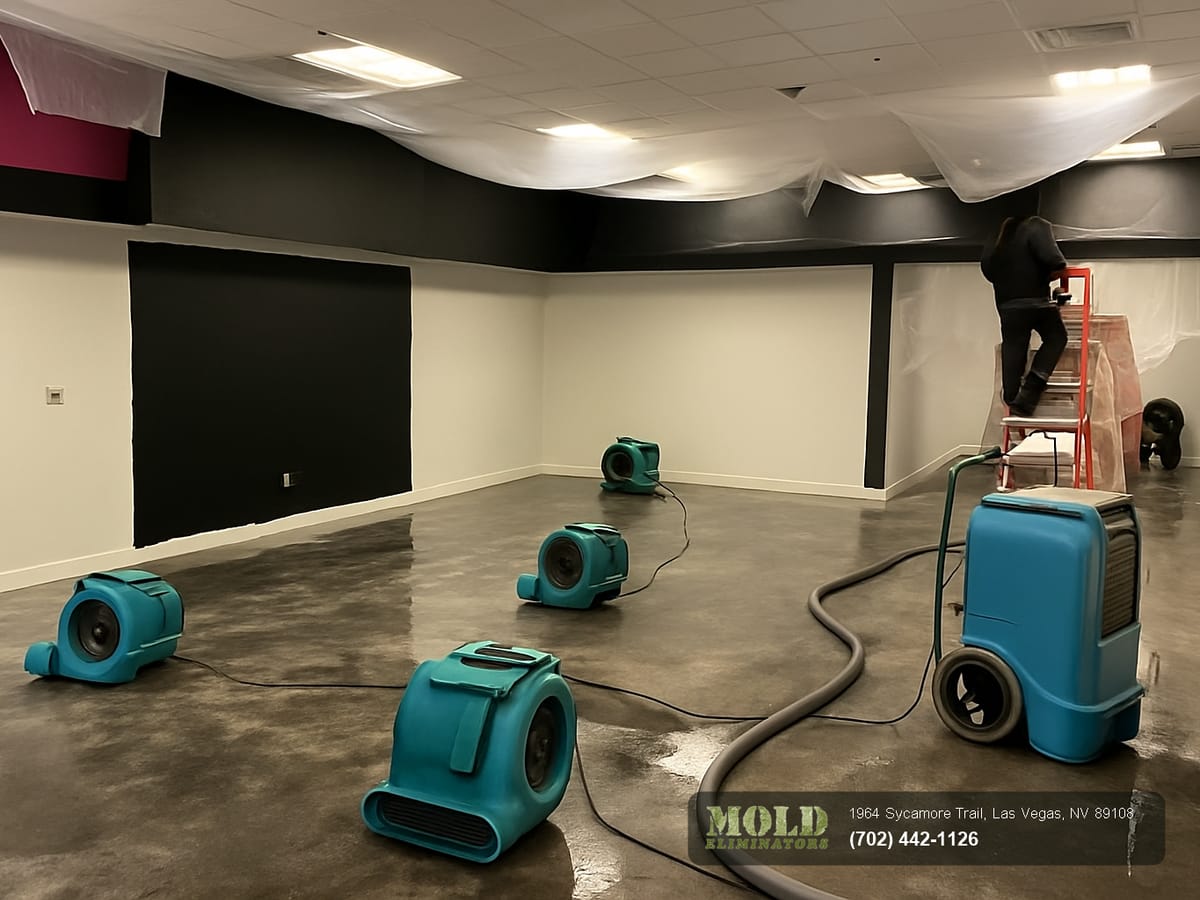 Applied structural drying equipment running in a Summerlin slab-on-grade home
Our structural drying process, step by step
Drying done to the S520 standard follows a deliberate sequence, the Applied Structural Drying method, from the first reading to the final verified dry target.
- Extraction. Before drying begins, every bit of standing and absorbed water is physically extracted. Pulling water out is dramatically faster than evaporating it, and it protects the materials underneath.
- Moisture mapping and baseline. We map the affected area with meters and thermal imaging, log starting moisture levels, and set the documented dry target for each material.
- Dehumidification. Commercial dehumidifiers pull water vapor out of the air so the room stays drier than the wet materials, the engine that keeps moisture leaving the structure.
- Air movement. High-velocity air movers are placed by design, not at random, to sweep moisture off surfaces and into the air where the dehumidifiers can capture it.
- Temperature control. We manage the heat in the space, because warmer air holds and releases moisture faster, a lever Summerlin’s high-desert climate makes especially powerful when used correctly.
- Daily monitoring. Every day, moisture readings are taken and logged, and the equipment is adjusted to keep drying on pace toward the target. The data drives the schedule, not the calendar.
- Drying to verified targets. Equipment comes out only when readings confirm every material has hit its dry standard. That verified-dry result is the finish line, and the proof that mold has nothing left to feed on.
Why local, no subcontractors, and an independent lab matter here
In a Summerlin neighborhood, the people who do the work matter as much as the work itself. We use no subcontractors. Every technician on your property is a certified W-2 employee, which means one accountable crew owns the water, the drying, and the mold risk from the first reading to the final verified-dry target. For discreet service inside a gated community like The Ridges or Red Rock Country Club, that matters: the same vetted people are in the home each day, not a rotating cast of day-labor crews.
It matters for documentation too. When mold testing is warranted, samples go to an independent third-party lab, billed at cost, and the result is verified by data rather than declared by the technician who would profit from saying you need more work. That independence is the backbone of our anti-upsell promise: we tell you when you do not need us. In a market where an HOA board or a future buyer’s inspector may read the file, a clean, third-party-verified record is worth more than a reassuring word.
And it matters for the standard. Craig Herrmann is IICRC Master Certified and co-authored the ANSI/IICRC S520 standard the rest of the industry follows. Your Summerlin structure is dried by the rulebook, to documented targets, by the people who helped write it. If a past water event was never properly verified, a free inspection on site is the calm, factual way to find out whether moisture left anything behind before it affects a sale.
Cost, insurance, and how long drying takes
The honest answer on cost is that it depends on scope: how much area got wet, how deeply the water penetrated, what materials are involved, and how many days of equipment it takes to reach the dry targets. A quickly caught supply-line leak is a modest job. A slab leak that traveled through framing, subfloor, and a concrete slab in a larger Vistas or Ridges custom is a bigger one. We map the actual problem and quote it before work begins, so the number you hear is the number you understand.
On insurance: structural drying after a sudden, accidental water event, a burst pipe, a failed water heater, an appliance line that let go, is frequently covered, and the documented moisture map is exactly what an adjuster wants to see. We log readings, photos, and scope from the first visit and work directly with your carrier. Because we dry fast and prove it with data, we are also documenting the very thing that keeps a covered water claim from becoming a disputed mold claim later, which is exactly the kind of clean file that keeps a Summerlin resale on track.
On timeline: most residential drying runs roughly three to five days. The materials release water at their own pace, and the daily readings tell us when each one is done. We will not leave equipment running longer than the numbers call for, and we will not pull it early to free up a machine. The verified dry target is the finish line, and it is not ours to move. You can see the rest of what we cover on our Summerlin service page, or just reach us directly, with no call center in between.
Structural drying in Summerlin: common questions
- I have a slab leak in The Ridges. Can the floor be saved or does it all come out?
- Often it can be saved, if drying starts in time. We extract, then dry the slab and the affected flooring and framing to verified targets using mat systems and dehumidification rather than demolishing first. The deciding factor is how long the water sat. That is why a fast call to our 24/7 line matters more here than almost anywhere, because slab-on-grade concrete holds water for weeks if it is not driven out deliberately.
- Monsoon runoff got into my garage and side yard near Red Rock. Is that the same as a clean drying job?
- Not always. Runoff coming off the escarpment is rarely clean water, so the job may shift from simple drying to contained removal of porous materials plus drying of what can be salvaged, with the result verified by an independent third-party lab. We handle both under one in-house crew rather than handing you off, and a free inspection tells us exactly where you stand before any work begins.
- My HOA wants documentation. Will I get a record the board and a future buyer accept?
- Yes. Every reading is logged by location and date, and the work is done to the ANSI/IICRC S520 standard that Craig Herrmann co-authored. You get a documented moisture map showing the structure going from wet to verified-dry, the kind of clean, third-party-backed file an HOA board, an adjuster, or a resale inspector will accept.
Water damage in Summerlin? Dry it right before mold gets its chance.
Free on-site inspection, no pressure. One-hour emergency response, 24/7, across The Ridges, The Vistas, The Trails, Sun City, and Downtown Summerlin. We dry to verified targets and prove it, so the water problem ends here, not in three weeks.