Structural Drying in Spring Valley, NV
An upstairs neighbor’s supply line lets go on a Saturday, and by Sunday the water has already crossed a shared wall and shown up as a brown ring on the ceiling of the unit below. In Spring Valley, that scenario plays out constantly, because so much of this part of the valley is stacked living: condos off Spring Mountain Rd, townhomes in Peccole Ranch, apartment blocks near the Chinatown corridor. The standing water gets mopped up, the surface looks dry, and everyone assumes it is over. It is not.
Structural drying is the engineering step that decides whether a water event ends cleanly or quietly turns into a mold problem behind the drywall. It is a core part of full structural drying and water restoration work, and at Mold Eliminators it is run to a measured, documented standard rather than by pointing a few fans at a wet wall. Our founder, Craig Herrmann, co-authored the ANSI/IICRC S520 mold standard, so the drying here is not guesswork. It has a documented finish line.
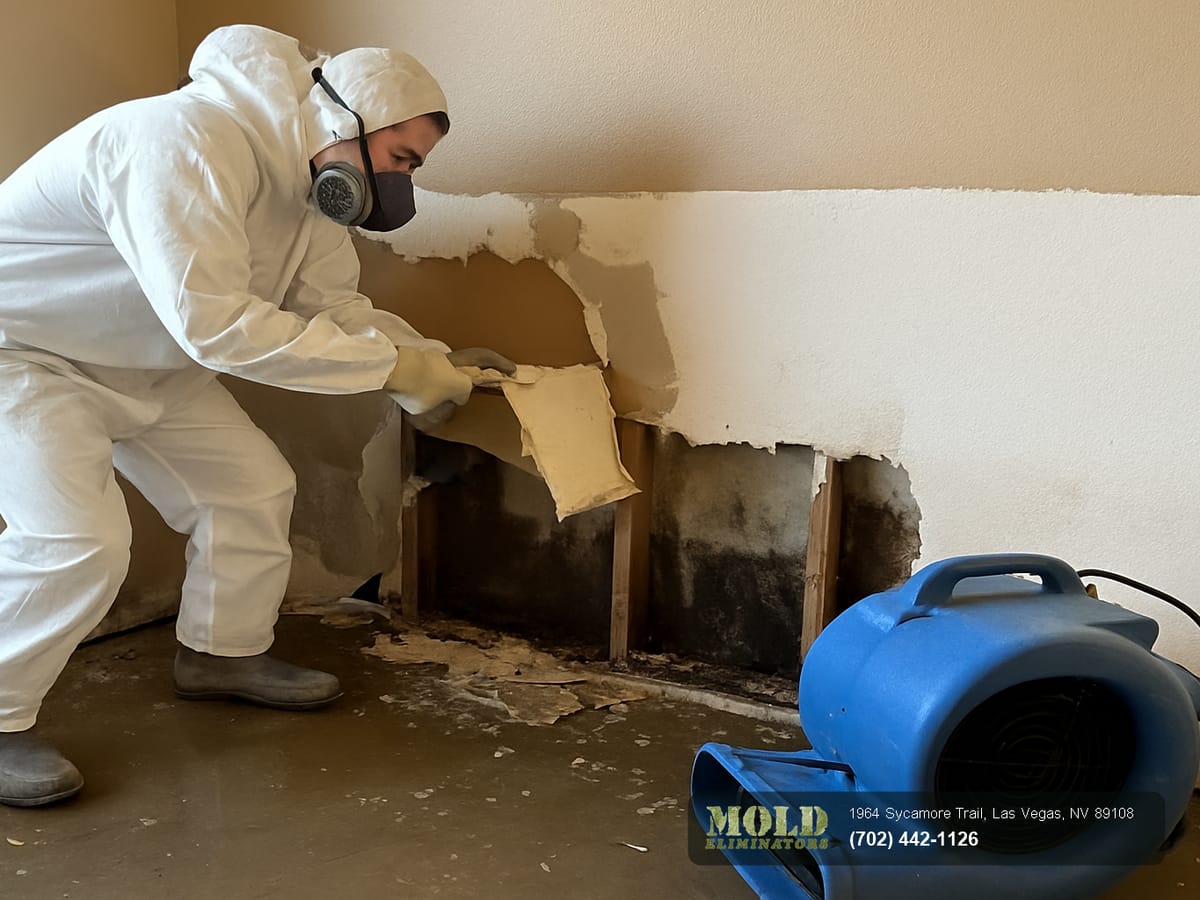
 Structural drying equipment set up in a Spring Valley condo after an upstairs water leak
How wet structures show up in Spring Valley
Spring Valley is one of the densest residential pockets in the valley, and that density changes the shape of every water problem. Across zips 89117, 89146, 89147, and 89148, you have a heavy mix of condos, townhomes, and apartments where units share walls, floors, and ceilings. When a water heater fails in an upstairs unit near Spring Mountain Rd, the water does not stay in that unit. It travels along the floor assembly, drops through the ceiling cavity, and becomes a downstairs neighbor’s soaked drywall and insulation. One leak becomes two damaged units, and sometimes three.
The construction here makes it worse. Many of the older complexes off the Chinatown corridor and through the apartment stretches of 89146 use shared wall cavities and wood-framed floor systems that wick water sideways far beyond the visible stain. In the newer master-planned sections such as Peccole Ranch and Rhodes Ranch, slab-on-grade construction is common, and a concrete slab holds water far longer than people expect. A slab that feels dry on top can stay saturated underneath for weeks, feeding moisture up into baseboards and bottom plates the whole time.
Then there are swamp coolers. A lot of Spring Valley rooftops still run evaporative coolers, and a leaking cooler line or a failed float can drip into a ceiling cavity for days before anyone notices, because the water arrives quietly from above rather than as an obvious flood. By the time it shows on the ceiling, the framing and insulation in that bay are already soaked. None of this dries on its own fast enough to matter, which is exactly why measured drying exists.
Need help now?
Talk to a Las Vegas expert
In-house certified crews. One-hour emergency response across the valley, 24/7.
Why the first 24 to 72 hours decide everything
There is a clock on water damage, and in shared-wall housing it runs fast. Mold can begin to colonize wet organic materials, and most of a building is organic, from paper-faced drywall to wood framing, within roughly 24 to 48 hours of getting wet. After about 72 hours the conversation shifts from dry it and save it to remove it and remediate. That window is the whole reason structural drying is treated as an emergency rather than a scheduled appointment.
In a Spring Valley condo or townhome, the clock is even less forgiving, because the water is often hidden in a shared floor or ceiling assembly that you cannot open from one side. Water that crossed from an upstairs unit may have been wicking through the assembly for hours before the downstairs owner saw a single drop. The faster a controlled drying environment is built, with extraction, dehumidification, and air movement working together, the more material is saved and the lower the mold risk drops. If water is actively spreading across a ceiling or wall right now, the right move is our 24/7 emergency response, with a one-hour response across the valley, so the water is stabilized before it claims a second room.
The desert adds its own wrinkle. Spring Valley summers are brutal, and that heat can drive moisture deeper into cool wall cavities through condensation. The dry outside air fools people into thinking it will just air out, while a soaked slab or a wet shared wall stays wet inside. None of that is visible to the eye, which is why drying here has to be measured, not assumed.
Moisture mapping: finding the water you cannot see
You cannot dry what you have not found, and you cannot prove something is dry without a baseline. That is where moisture mapping comes in, the diagnostic step that turns drying from guesswork into engineering. In a dense Spring Valley building, this matters double, because the water you can see in one unit is rarely the full extent of what got wet. Before a single fan is placed, we map how far the water traveled, including across shared assemblies, and set the dry target we are driving toward.
This is the part a company chasing a quick invoice skips, because it takes equipment, training, and time. It is also the part that makes drying honest, and in a shared-wall dispute it is the part that protects you. When we say a wall is dry, we can show you the number, the location, and the day it got there. Measure first, dry to the data, then prove it.
 Dehumidifiers and air movers running an S520 structural drying process in a Spring Valley townhome
Our structural drying process, step by step
Drying done to standard follows a deliberate sequence, the Applied Structural Drying method built on the S520 standard Craig helped author, from the first reading to the final verified dry target.
- Extraction. Before drying can begin, every bit of standing and absorbed water is physically extracted. Pulling water out is dramatically faster than evaporating it, and it protects the materials underneath.
- Moisture mapping and baseline. We map the affected area with meters and thermal imaging, log starting moisture levels, and set the documented dry target for each material.
- Dehumidification. Commercial dehumidifiers pull water vapor out of the air so the room stays drier than the wet materials, the engine that keeps moisture leaving the structure.
- Air movement. High-velocity air movers are placed by design, not at random, to sweep moisture off surfaces and into the air where the dehumidifiers can capture it.
- Temperature control. We manage the heat in the space, because warmer air holds and releases moisture faster, a lever the desert climate makes especially powerful when used correctly.
- Daily monitoring. Every day, moisture readings are taken and logged, and the equipment is adjusted to keep drying on pace toward the target. The data drives the schedule, not the calendar.
- Drying to verified targets. Equipment comes out only when readings confirm every material has hit its dry standard. That verified-dry result is the finish line, and the proof that mold has nothing left to feed on.
Shared walls, HOAs, and who is responsible
In Spring Valley, a water event is rarely a private matter for long. When water crosses from an upstairs unit into a downstairs ceiling, or moves through a wall shared by two owners, the question of whose responsibility it is rides on a credible, documented account of what got wet and what got dried. HOA boards, property managers, and condo associations across 89117 and 89148 call us precisely because we produce that record. A documented moisture map turns a finger-pointing argument into a factual one.
If the water sat too long or arrived contaminated, drying alone is not the whole answer. Water from a sewage backup or a ground-level flood is Category-3. It carries bacteria, and the porous materials it touched usually have to be removed, not just dried. That is where structural drying overlaps with water damage restoration and specialized cleanup: contain it, remove what cannot be salvaged, dry what can, and verify the result. If mold already took hold before anyone started drying, the job becomes containment-and-removal remediation with drying built into it.
The advantage of handling all of this under one roof is accountability. We do not dry your structure and then hand you to a separate mold company that points fingers when something was missed. Every technician here is an in-house W-2 certified employee, no subcontractors, so one crew owns the water, the drying, and the mold risk from the first reading to the final verified-dry target. That single chain of responsibility is exactly what an HOA board or an underwriter wants to see, and it is what keeps a covered water claim from turning into a disputed mold claim later. When verification is needed, samples go to an independent third-party lab so the result is not just our word.
Why Spring Valley trusts Mold Eliminators to dry it right
Certified to the standard
Craig Herrmann is IICRC Master Certified and co-authored the ANSI/IICRC S520 standard. Your structure is dried by the rulebook, to documented targets, not to feels dry. Read more about Craig’s credentials.
Local and fast
We have served the valley since 1996 and across 255+ properties, with one-hour emergency response, 24/7. For dense Spring Valley housing, where a leak crosses unit lines fast, response time is the difference between one wet room and three.
In-house accountability
No subcontractors. Every technician is a certified W-2 employee, and verification runs through an independent third-party lab. One crew owns the water, the drying, and the mold risk, start to finish, and we tell you when you do not need us.
That is the whole difference. Where a franchise drops a few fans and hands your job off, we map the moisture, dry to a verified standard, and document the result. You can see the full Spring Valley service area we cover, or just reach us directly, with no call center in between. Dry it right, and mold never gets its chance.
Structural drying in Spring Valley, common questions
- An upstairs unit leaked into my Spring Valley condo. Whose responsibility is the drying?
- That depends on your HOA documents and where the failure originated, but the practical answer is the same either way: you need a documented account of what got wet and what got dried before anyone can settle it fairly. We map the moisture across the shared assembly, dry to verified targets, and log every reading by location and date, so the board, the adjuster, and both owners are working from facts rather than guesses. Our structural drying documentation is built to stand up in exactly these disputes.
- How long does structural drying take in a townhome or apartment?
- Most residential jobs run roughly 3–5 days, but the materials set the pace, and shared-wall assemblies and concrete slabs common in Peccole Ranch and Rhodes Ranch can hold moisture longer. We take daily readings and pull the equipment only when every material hits its verified dry target. Rushing it leaves moisture behind, and padding it wastes your money. The data decides, not the calendar.
- Is the inspection free, and what does it cover?
- Yes. The on-site mold inspection is a free, no-pressure assessment for homeowners and property owners. We map the moisture and tell you honestly what you are dealing with. If lab analysis is warranted, samples go to an independent third-party lab, billed at cost, so testing is never something we mark up. You can book that free inspection any time, and if you do not need us, we will tell you.
Water crossing your walls in Spring Valley? Dry it right before mold gets its chance.
Free on-site inspection, no pressure. One-hour emergency response, 24/7, across Spring Valley and the wider valley. We dry to verified targets and prove it, so the water problem ends here, not in three weeks.