How We Work: Standards, Not Shortcuts
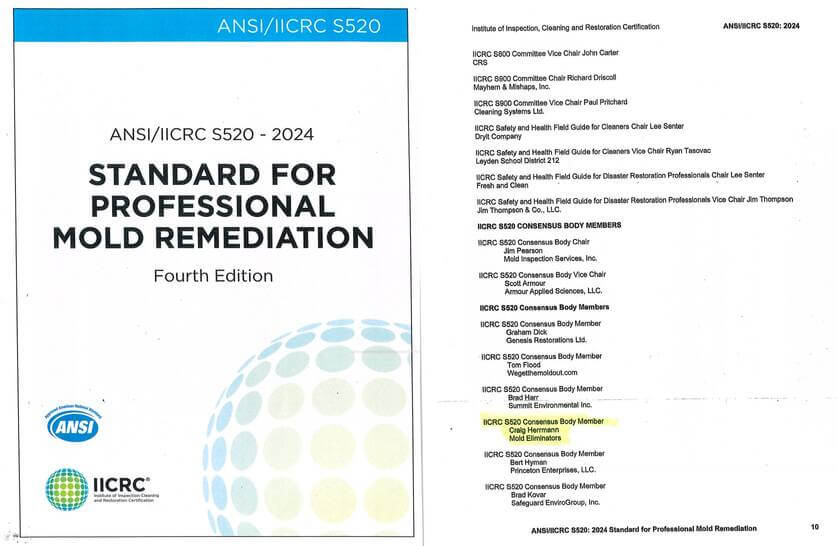
Most mold companies will tell you they follow “the standard.” Very few can tell you which standard, what it actually requires, or who wrote it. We can, because our founder helped write it. The ANSI/IICRC S520 is the national standard for professional mold remediation, and Craig Herrmann is a co-author of its current edition. What follows is not a sales pitch dressed up as a process. It is that standard, applied to your home, step by step, with the corners that other crews quietly cut put back in.
Here is the promise behind every step below: standards, not shortcuts. We do not let the same crew that performs the work also grade the work. We do not declare a job “clean” because it looks clean. And we never skip the unglamorous parts, the moisture mapping, the source repair, the independent clearance, that decide whether the mold actually stays gone. This page walks you through exactly how a Mold Eliminators job runs, from the first free on-site inspection to the plain-English report you keep when we leave.
What “the S520 standard” actually means for your home
The S520 exists because mold remediation used to be the Wild West. One company would spray bleach and call it done; another would tear out half a house that never needed touching. The standard fixed that by defining what a competent, defensible mold job actually looks like: contain the work area, remove what is contaminated, correct the moisture that caused it, and verify the result with data instead of opinion. It is the difference between a crew that hopes the mold is gone and a crew that can prove it.
Because Craig sits on the IICRC body and helped author the 4th edition of that standard, our process is not an interpretation of someone else’s rulebook. It is the rulebook, run by the person who helped write the chapters. You can read more about Craig and his S520 work, or see the full list of our certifications. What matters to you is simpler: the same principles that govern remediation companies nationwide are being applied to your specific home, by the people who set them, without the franchise telephone game in between.
The seven steps below are how that standard becomes a real job in a real Las Vegas house. Each one exists for a reason, and skipping any one of them is exactly how mold comes back. We will walk through every step honestly, including the part most companies hate to talk about: who is allowed to say the job is finished.
Need help now?
Talk to a Las Vegas expert
In-house certified crews. One-hour emergency response across the valley, 24/7.
Our mold remediation process, step by step
This is the full S520-based sequence we run on every job, in order. None of it is optional, and none of it is padded. Each step has a clear purpose, a clear finish, and documentation behind it.
- Free on-site inspection and moisture mapping. Every job starts with a free on-site inspection at no cost to the homeowner or property owner. A certified technician walks the property, then maps moisture the way you cannot do by eye: pin and pinless moisture meters read the actual water content inside drywall and framing, and thermal imaging traces cool, wet zones hidden behind walls and under floors. The goal is to find every place water traveled, not just where the stain shows. This is also where we tell you honestly if you do not have a remediation problem at all. A thorough mold inspection is the foundation everything else stands on, because you cannot remediate what you never found.
- Identify and fix the moisture source. Mold is a symptom. Water is the disease. If we kill the colony but leave the leak, the swamp cooler line, the slab seepage, or the condensation problem feeding it, the mold simply returns, and you have paid for nothing. So before we remove a single contaminated material, we identify exactly where the moisture is coming from and make sure it gets corrected. In a Las Vegas home that might be a slab leak under a tiled floor, a failing swamp cooler pan, or monsoon intrusion at a roof line. Fixing the source is what separates remediation that holds from a cosmetic cleanup that buys you three weeks.
- Containment, negative air, and HEPA filtration. Disturbing mold without containment is how a problem in one closet becomes a problem in five rooms. Before any removal begins, we seal the work area with physical barriers and put it under negative air pressure, so spores are pulled into HEPA filtration instead of drifting into your clean living space. This is the step that protects the rest of your home, and your family’s air, while the messy work happens. It is invisible in the final photos, which is exactly why a cut-rate crew skips it.
- Removal of affected materials, per S520. Now the actual remediation. Following the standard, we remove the porous materials that mold has colonized and cannot be cleaned, the soaked drywall, the contaminated insulation, the unsalvageable flooring, while preserving everything that can be safely saved. The S520 is specific about what comes out and what stays, and we follow it rather than over-demolishing to inflate an invoice. The aim is to remove the contamination completely and conservatively, not to gut a house for the sake of the bill.
- Drying to standard with Applied Structural Drying. A clean cavity that is still wet is just a future colony. Once contaminated materials are out, we dry the remaining structure to a documented standard using Applied Structural Drying: commercial dehumidification, engineered air movement, and daily moisture readings that prove each material is reaching its target. Proper structural drying is what guarantees the mold has nothing left to feed on once we are gone. We pull the equipment when the numbers say dry, not when the calendar is convenient.
- Independent third-party lab clearance testing. This is the step that defines us, and it is the one we refuse to compromise. The crew that did the work never grades its own homework. When we believe the area is clean, an independent third party performs clearance testing, and the samples go to an accredited lab for analysis. That lab testing is a paid, separate step, and it is worth every dollar, because it removes us from the role of judging our own results. If the lab says it is clean, it is clean, on the record, by someone with no reason to flatter our work. You can read how independent clearance testing works and why we insist on it.
- Plain-English documentation. When the job is done, you do not get a shrug and an invoice. You get a clear record: where the moisture was, what we removed, the drying data, and the independent lab clearance result, written so a homeowner, an insurance adjuster, an HOA board, or a future buyer can actually read it. That documentation is what turns “trust us” into proof. It is also exactly what protects you if anyone ever questions whether the work was done right.
Why the order matters as much as the steps
Plenty of companies can list these steps. Fewer run them in the right sequence, and the sequence is half the science. Map before you remove, or you miss the water hiding three feet past the visible damage. Fix the source before you remediate, or you remediate the same wall twice. Contain before you disturb, or you spread the problem you were hired to contain. Dry before you clear, or the lab tests a cavity that is still feeding the next colony. Each step sets up the one after it, which is the whole reason the remediation standard prescribes an order at all.
The most common failure we get called in to fix is not a company that did nothing. It is a company that did the visible steps and skipped the invisible ones: removed the moldy drywall, never found the slab leak, never contained the work, never had an outside party verify the result. The house looked fixed. Three weeks later the smell came back. By running the full sequence, in order, every time, the result holds, because nothing that mold needs to return was left behind.
 Independent third-party inspector collecting an air sample for accredited lab clearance testing
The crew never grades its own work
If you remember one thing from this page, make it this one. The single most abused moment in mold remediation is the ending, where the same company that cashed the check also decides whether the job passed. That is a conflict of interest, plain and simple, and it is how families end up paying twice.
We designed our process to make that impossible. The clearance step uses an independent third party and an accredited lab, so the verdict on our work comes from someone with no financial stake in the answer. The lab analysis is a paid step, billed honestly as what it is, and we would rather charge for real verification than hand you a free guess. It is the same philosophy that runs through our credentials: a standard only means something if someone outside the room is allowed to hold you to it.
What makes this process different in Las Vegas
Written, not borrowed
The standard we run is the one Craig Herrmann helped author. Your home is remediated by the rulebook, applied directly by the people who set it. See Craig’s background.
One in-house crew
No subcontractors. Every technician is a certified W-2 employee, so one accountable team owns the inspection, the removal, the drying, and the documentation, start to finish, with one-hour emergency response available 24/7.
Verified by outsiders
The job is not done when we say so. It is done when an independent lab confirms it. That is the clearance step other companies skip, and the reason ours holds up.
The desert adds its own twists to every step: slab-on-grade homes that hold water for weeks, swamp coolers that breed moisture, monsoon intrusion that hides behind stucco. Our process is built for those realities, not copied from a humid-climate franchise manual. If water is actively spreading right now, our 24/7 emergency response stabilizes it first, then the same standard takes over from there.
Common questions about how we work
- Is the inspection really free?
- Yes. The on-site inspection is free for homeowners and property owners. A certified technician comes out, maps the moisture, and tells you honestly whether you have a remediation problem. What is not free is the lab analysis later in the process: clearance testing is a paid step performed by an independent third party, because real verification has a real cost. We would rather charge for honest lab work than offer a free guess. Schedule a free inspection anytime.
- Why does an outside lab have to test the work?
- Because the crew that did the work has every incentive to say it passed. Independent clearance testing removes that conflict of interest. An outside party collects the samples and an accredited lab analyzes them, so the verdict on our work comes from someone with no stake in the result. If the lab says clean, it is clean, on the record.
- Why fix the moisture source instead of just removing the mold?
- Mold is a symptom of water. If we remove the colony but leave the leak, the seepage, or the condensation feeding it, the mold comes back and you have paid for nothing. Identifying and correcting the source, then drying the structure with proper structural drying, is what makes the result hold. Remove the mold without fixing the water and you have only scheduled the next job.
- How do you decide what to remove and what to save?
- The S520 standard is specific about it, and so are we. Porous materials that mold has colonized and cannot be cleaned come out; everything that can be safely saved stays. We do not over-demolish to inflate an invoice, and we do not leave contaminated material to cut a corner. The inspection and moisture map tell us exactly where the line is.
- What do I actually receive when the job is done?
- Plain-English documentation: where the moisture was, what was removed, the drying data, and the independent lab clearance result, written so you, an adjuster, an HOA, or a future buyer can read it. It turns “trust us” into proof, and it protects you if the work is ever questioned. See how the full remediation comes together.
What sits just outside the process
The seven steps above are the remediation itself. Four questions come up on nearly every job that sit just outside them, and they deserve a plain answer too.
Who rebuilds what we removed
We do. Remediation ends with the contaminated material gone and the cavity dry, which means there is an open hole where your wall used to be. Our own crew puts the drywall, texture, paint and flooring back, so you are not managing a second contractor on a second schedule after the plastic comes down. See a mold removal and drywall restoration job.
Whether you can stay in the house
Most of the time, yes. Containment and negative air keep the work area sealed off from the rest of the home. A large job, work in the only bathroom, or an occupant who is immune compromised, pregnant or elderly can change the answer, and we raise it before we start rather than after. Here is when you should leave your home during mold remediation.
What the process costs
The on site inspection and the moisture map are free, so there is nothing to pay up front to find out where you stand. Independent lab clearance is a separate paid step, and the remediation itself is priced from what the inspection actually finds, in writing, before anyone opens a wall. See the mold removal cost ranges for Las Vegas.
What the documentation is for
Adjusters, HOA boards and future buyers all ask for the same thing, which is proof. The moisture map, the scope of what was removed, the drying log and the independent clearance result are written so somebody outside this company can read them. That record is what a mold claim stands on. Read whether homeowners insurance covers mold.
Standards, not shortcuts. Start with a free inspection.
A certified technician maps the moisture, tells you honestly where you stand, and runs the same S520 process its co-author helped write. One-hour emergency response, 24/7, across the Las Vegas valley. Independent lab clearance, so the work is verified by someone other than us.