Soggy Baseboards in Las Vegas
If you are seeing soggy baseboards, the trim that meets your floor feeling soft, swollen, or darkened at the bottom, your home is telling you something important: water is sitting where it should not be, and the baseboard is just the first place it became visible. Baseboards are the low point of a wall, so they are usually the first material to show moisture that has been wicking through the structure for days or weeks. The soft trim is rarely the real problem. It is the messenger.
The honest reality in a Las Vegas home is that a soggy baseboard almost always means water has already reached the drywall behind it and the subfloor beneath it. By the time the trim swells, moisture has had time to travel. That is why the right response is not to caulk it, paint over it, or wait and see. It is to find the source, measure how far the water went, and dry the structure back to a documented standard before mold gets its window.
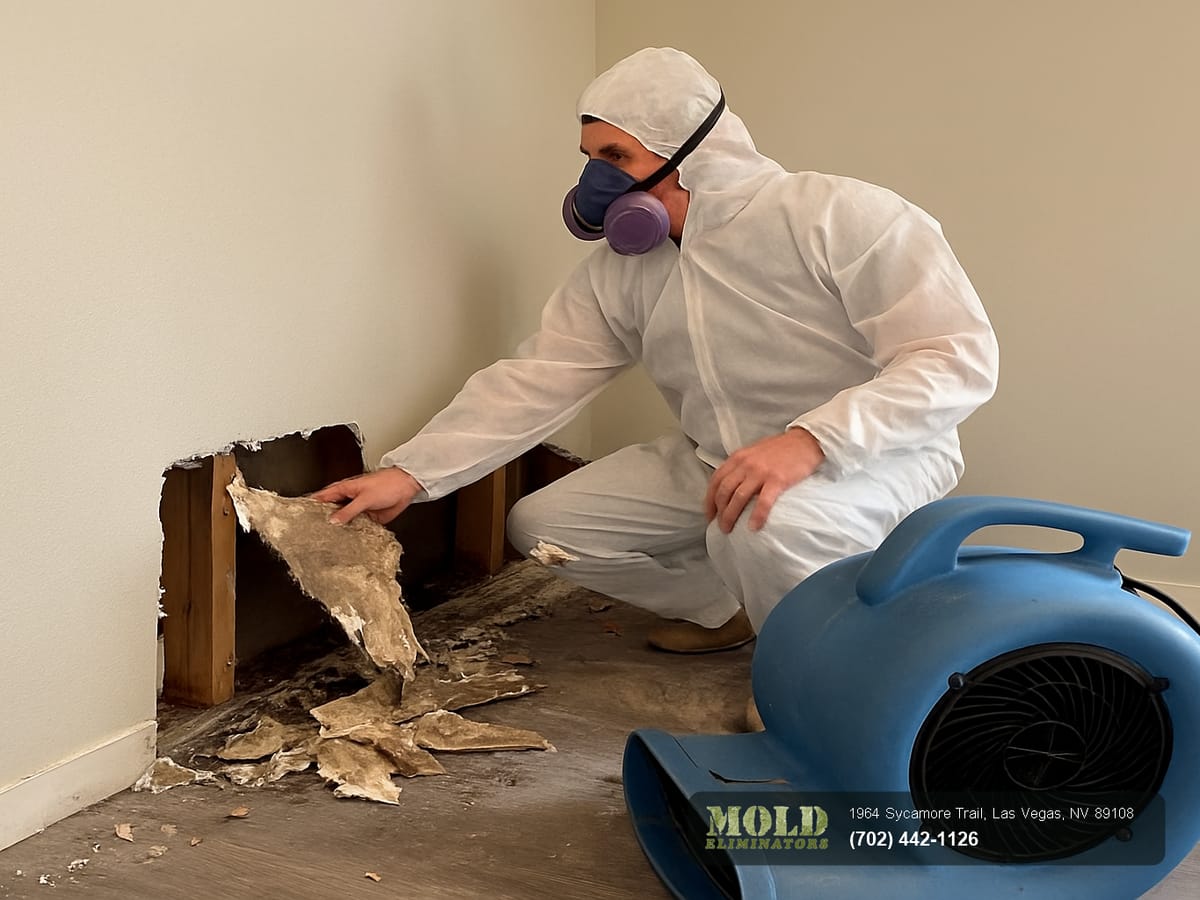 Swollen, water-stained baseboard pulling away from the wall at floor level in a Las Vegas home
What soggy baseboards usually mean in a Las Vegas home
A baseboard goes soft because the bottom edge of the wall has been wet long enough for the wood or MDF to absorb water and swell. The question is where that water is coming from, and in the desert the answer is rarely rain. Several common Las Vegas sources produce exactly this symptom, and an honest diagnosis starts by naming the likely ones rather than guessing.
A hidden plumbing or slab leak. Much of the valley is built slab-on-grade, and a supply line running through or under that concrete can weep for weeks before anything shows on the surface. The water travels along the slab, wicks up into the bottom plate and drywall, and the first visible sign is a soggy baseboard, often with no puddle anywhere in sight.
Air conditioning condensation. Our cooling season is long and brutal, and a clogged AC condensate line, an overflowing drain pan, or sweating ductwork can drip steadily inside a wall or closet. That slow, hidden drip is a classic cause of trim that swells near an air handler or along an interior wall.
A swamp cooler issue. Many older Las Vegas homes still run evaporative coolers. A leaking water line, an overflowing reservoir, or condensation around the unit can run down through a wall and surface at the baseboard well away from the cooler itself.
Water heater, appliance, or fixture leaks. A failing water heater, a dishwasher or washing machine line, or a slow toilet seal can release water that migrates to the nearest low point. The baseboard in the next room sometimes shows the damage before the leak room does.
Monsoon intrusion. During summer monsoon storms, wind-driven rain finds gaps around doors, windows, and grade-level penetrations. Even a brief desert downpour can push water into a wall cavity, and the trim is where it shows up.
Because so many of these sources are hidden, the soft trim itself does not tell you which one you have. That is why the first step is always to measure, not assume. Confirming the source and the moisture path is exactly what a proper water damage restoration assessment is built to do.
Need help now?
Talk to a Las Vegas expert
In-house certified crews. One-hour emergency response across the valley, 24/7.
Why soggy baseboards are urgent, not cosmetic
It is tempting to treat swollen trim as a small repair, a piece to pry off and replace later. The problem is that the baseboard is the visible tip of a wet wall. The same moisture that softened the trim has almost certainly reached the paper-faced drywall above it and the subfloor below, and both of those are organic materials that mold feeds on.
There is a clock on this. Mold can begin to colonize wet building materials within roughly 24 to 48 hours, and after about 72 hours the conversation shifts from drying and saving the structure to removing and remediating it. A baseboard that has been soggy for a while means that window may already be open. The musty smell some homeowners notice near the floor is not stale air. It is often the early signature of growth starting inside a cavity you cannot see.
The desert adds its own complications. Our extreme summer heat can drive moisture deeper into cooler wall cavities through condensation, and the day-to-night temperature swings make it easy to assume a wall has air-dried when the inside is still saturated. Concrete slabs hold water far longer than people expect, so a slab that feels dry on top can stay wet underneath for weeks. None of this is visible, which is exactly why a soggy baseboard deserves a measured look rather than a wait-and-see. If water is actively spreading right now, our 24/7 emergency response stabilizes the source first and starts drying immediately.
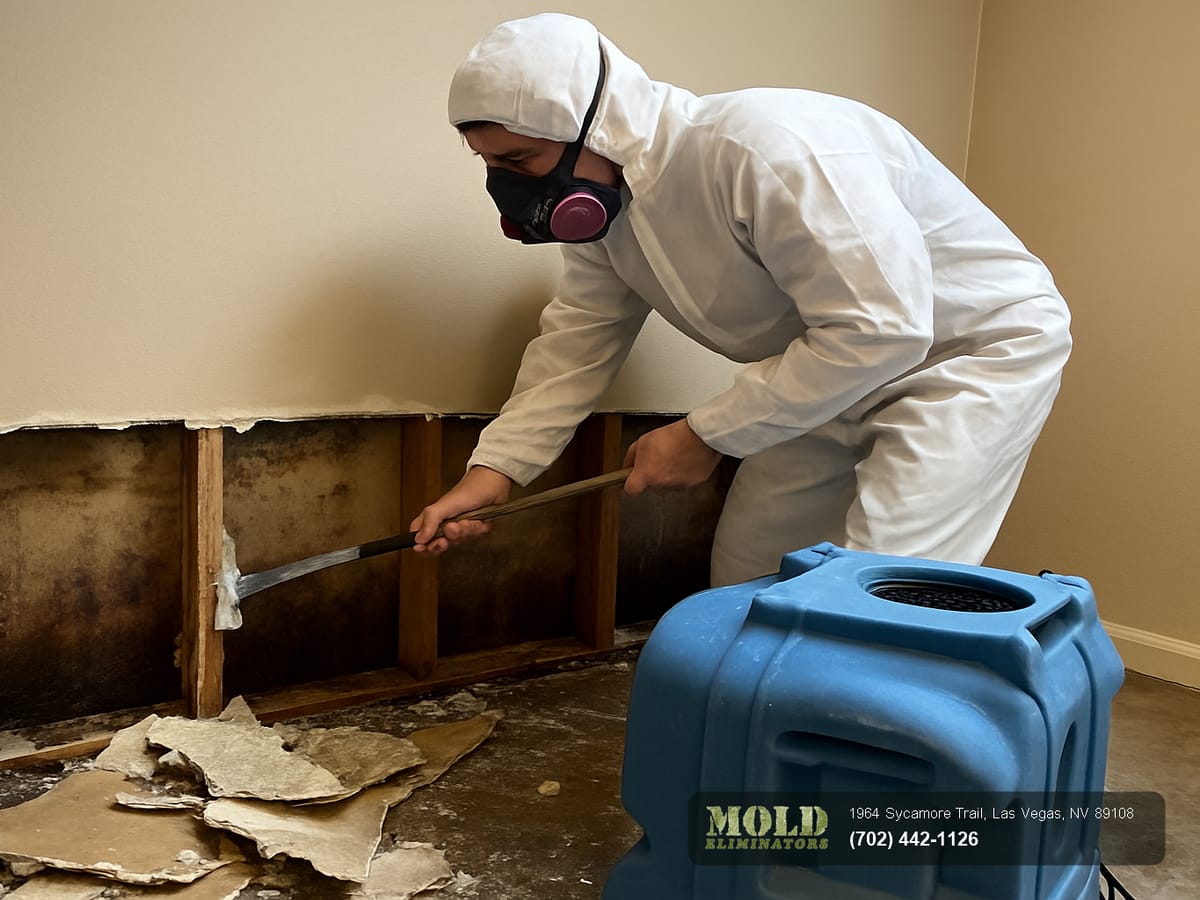 Technician taking a moisture reading at the base of a wall to trace water behind soggy baseboards
What the proper fix involves
Done to the ANSI/IICRC S520 standard, fixing soggy baseboards is not a trim swap. It is a sequence that finds the water, controls it, and proves the structure is dry before anything is closed back up. Here is how Mold Eliminators handles it.
- Free on-site inspection. We start with a free inspection at your home, reading the actual moisture content of the trim, drywall, and subfloor with meters and thermal imaging so we know how far the water traveled before we touch anything.
- Find the source. A baseboard cannot be fixed until the leak feeding it is found and stopped, whether that is a slab leak, an AC condensate line, a swamp cooler, or a fixture. We trace it to the source rather than treating the symptom.
- Contain the area. If mold is present or likely, we contain the work zone so spores and moisture do not spread to clean parts of the home while we work.
- Remove what cannot be saved. Materials too far gone to dry safely, saturated baseboard, swollen drywall, ruined insulation, are removed under containment rather than dried in place and hoped for.
- Dry the structure. Commercial dehumidification and targeted air movement bring the framing, subfloor, and remaining drywall back down to a documented dry target. Proper structural drying is what stops the moisture from feeding a future mold problem.
- Independent lab clearance. When mold was involved, the result is verified by an independent third-party lab, not declared by the technician who did the work. You get data showing the structure is clean and dry, not a verbal all-clear.
Why Las Vegas homeowners call Mold Eliminators
Built to the standard
Our founder Craig Herrmann is IICRC Master Certified and co-authored the ANSI/IICRC S520 mold standard. Your home is handled by the rulebook, to documented targets, not to feels dry. Read more about Craig and the S520 standard.
No subcontractors, no upsell
Every technician is an in-house W-2 certified employee, working in the valley since 1996 across 255+ properties. We are anti-upsell: we tell you when you do not need us, and we measure rather than guess.
Independent verification
Clearance comes from an independent third-party lab, with a 1-hour emergency response available 24/7. One crew owns the source, the drying, and the mold risk from the first reading to the verified-dry result.
That is the whole difference. Where a franchise pries off the trim and moves on, we trace the water to its source, dry the structure to a verified standard, and document the result. A soggy baseboard is a small symptom of a problem worth taking seriously, and we treat it that way. If you want a calm, factual answer about what is behind your trim, start with a free inspection.
Soggy baseboards in Las Vegas, common questions
- Can I just replace the soggy baseboard myself?
- You can replace the trim, but if you do not find and stop the source, the new baseboard will swell too, and the drywall and subfloor behind it stay wet. The trim is the symptom, not the leak. A proper water damage assessment traces the water to its source and confirms whether the structure behind the wall is dry before anything is replaced.
- How do I know if there is mold behind the baseboard?
- A musty smell near the floor, dark staining, or trim that swelled days after a leak are warning signs, but plenty of wet cavities give no surface clue at all. The only way to know is to measure. We start with a free on-site inspection and, when needed, verify with an independent lab. Optional lab analysis is a paid add-on, but the inspection itself is always free.
- Is this an emergency, or can it wait?
- If the baseboard is actively wet or you can see water spreading, treat it as urgent. Mold can begin colonizing wet materials within 24 to 72 hours, so a fast response protects more of your home. Our 24/7 emergency line stabilizes the source first and starts drying immediately, and proper structural drying keeps the water problem from becoming a mold problem.
Soggy baseboards? Find the source before mold gets its chance.
Start with a free on-site inspection from a team that measures, traces the water to its source, dries to a verified standard, and proves it with an independent lab. One-hour emergency response, 24/7, across the Las Vegas valley.