Sewage Cleanup in Spring Valley, NV
A sewage backup in a Spring Valley condo rarely stays in one unit. A line backs up on an upper floor near Spring Mountain Road, and within an hour the problem is a stained, sagging ceiling in the unit below, with contaminated water tracking along the shared wall between them. That is the call we get most often from this part of the valley, and it is exactly the kind of job that gets worse the longer it waits.
Sewage is not ordinary water damage. It is Category 3, the most contaminated classification under the national standard, and it carries bacteria, viruses, and other biohazards that make a quick mop-and-dry dangerous rather than just inadequate. Mold Eliminators handles sewage cleanup across Spring Valley to the ANSI/IICRC S520 standard, the same standard our founder Craig Herrmann helped write, with one in-house certified crew from the first containment step to the final verified-clean result.
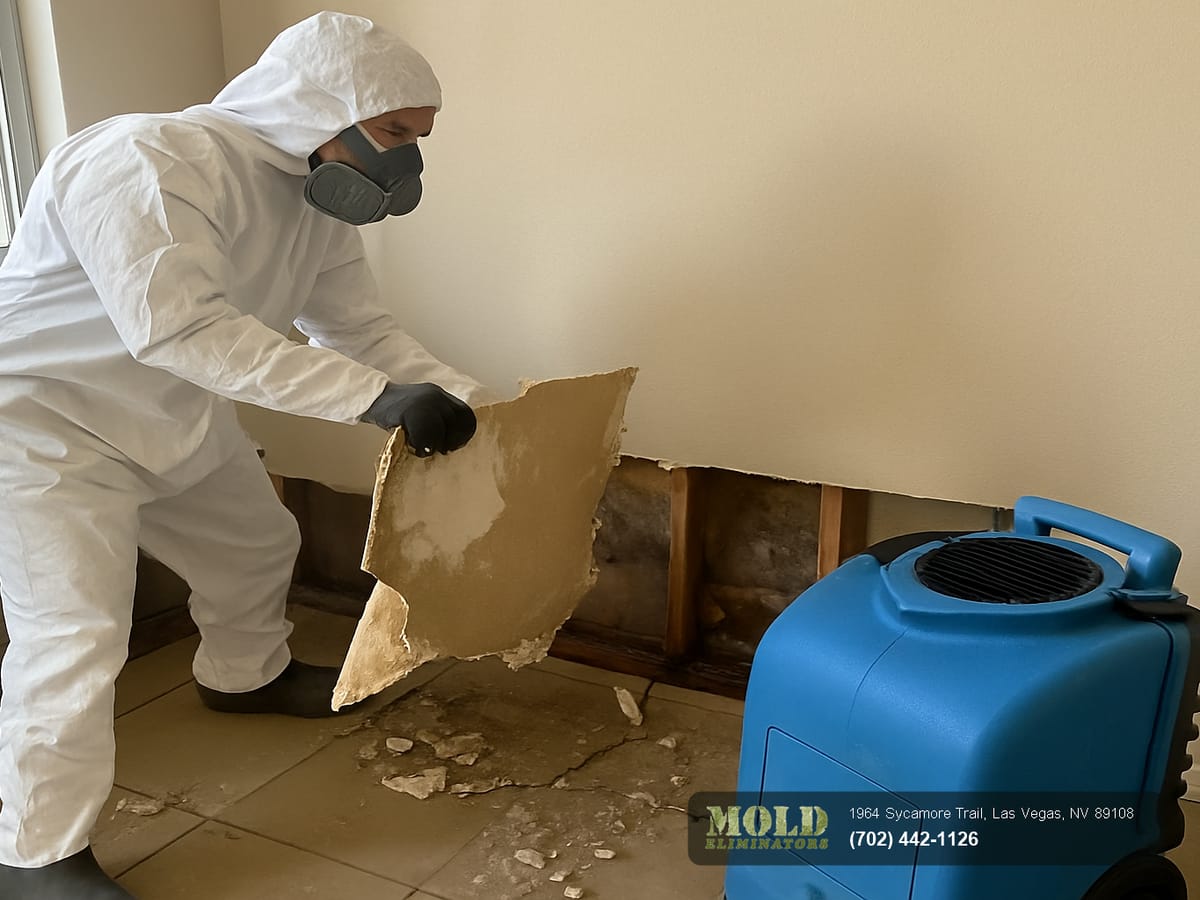 Sewage cleanup and containment in a Spring Valley condominium
How sewage backups show up in Spring Valley
Spring Valley is one of the densest residential zips in the valley, and the housing stock here shapes the kind of sewage problems we see. The neighborhoods around the Spring Mountain Road and Chinatown corridor, through Peccole Ranch and out to Rhodes Ranch, are heavy on condos, townhomes, and apartment buildings where units stack vertically and share walls, ceilings, and drain stacks. In a single-family home a sewage backup is one owner’s problem. In a 89117 or 89147 condo it is almost always two units, sometimes three.
The common scenario plays out like this: a shared sewer stack or a lateral line clogs, and waste water has nowhere to go but back up through the lowest fixture on the system, often a ground-floor or downstairs unit’s toilet, tub, or shower drain. The owner upstairs may not notice anything wrong. The owner below is standing in contaminated water, and it is already wicking into the bottom of the shared wall and the subfloor. Because the water moved through a wall cavity that belongs to neither unit cleanly, the question of who is responsible gets tangled fast.
Two local factors make it worse. First, the older garden-apartment and townhome construction common across 89146 and 89148 was built with shared plumbing that concentrates several units onto a single stack, so one blockage affects many homes. Second, swamp coolers, which are everywhere in Spring Valley, add humidity to wall cavities and attic spaces year round, so any sewage water that soaks into framing has a head start on becoming a mold problem. A Category 3 loss left damp in a swamp-cooled building is the fastest route to secondary microbial growth we see.
Need help now?
Talk to a Las Vegas expert
In-house certified crews. One-hour emergency response across the valley, 24/7.
The HOA responsibility dispute, and why documentation matters here
The single most stressful part of a Spring Valley sewage backup is usually not the cleanup itself. It is the argument over who pays. When contaminated water crosses from an upstairs unit into a downstairs ceiling, or backs up from a shared stack the HOA maintains, the boundary between unit-owner responsibility and association responsibility is genuinely unclear, and three insurance carriers can end up pointing at each other.
We cannot settle that dispute for you, and we will not pretend to. What we can do is give every party a credible, documented account of exactly what was contaminated, how far it traveled, and what it took to make it clean again. From the first visit we log moisture readings, photograph the source and the migration path, and define the affected area with thermal imaging, the same record an HOA board, a property manager, or an adjuster needs to assign responsibility on facts rather than guesses. When the cleanup is verified by an free inspection and, where warranted, independent third-party lab analysis, no one can wave the result away as the contractor’s say-so.
That independence is the point. We are not the HOA’s vendor or the upstairs owner’s vendor. We are an anti-upsell remediation company that documents the truth of the loss and lets the responsible parties sort out the bill with real evidence in hand.
 Containment and S520-standard sewage remediation in a Spring Valley townhome
How we handle a sewage loss to the S520 standard
Sewage cleanup done right follows a deliberate sequence built around the fact that the water is biohazardous, not just wet. This is the Category 3 protocol under the standard Craig co-authored.
- Containment first. Before anything is touched, we isolate the affected area with containment barriers so contaminated air and water do not spread into clean units or up the shared stack to other floors.
- Source control and extraction. We stop the active intrusion where we can, then physically extract the standing sewage rather than letting it soak in further.
- Remove the unsalvageable. Porous materials that absorbed Category 3 water, soaked drywall, carpet, pad, insulation, get removed, not dried in place. This is the step a cut-rate cleanup skips, and it is the one that determines whether the problem comes back.
- Clean and disinfect. Every affected surface and cavity is cleaned and treated with appropriate antimicrobials to kill the bacterial load sewage leaves behind.
- Structural drying. What stays gets dried to a documented target with dehumidification and air movement, so no hidden moisture is left to feed mold. This overlaps with full structural drying when the water traveled far.
- Verify and document. We confirm the area is clean and dry by measurement, with independent lab analysis where it is warranted, and hand over the record.
Why local, in-house, and independent matters for Spring Valley
One crew, no subcontractors
Every technician on your Spring Valley job is a W-2 certified Mold Eliminators employee, not a day-labor sub. In a multi-unit building with a responsibility dispute already brewing, one accountable crew that owns the work start to finish keeps the documentation clean and the finger-pointing out.
Written to the standard
Craig Herrmann co-authored the ANSI/IICRC S520 standard and is IICRC Master Certified. Your Category 3 loss is handled by the rulebook, not improvised. Read more about Craig’s credentials.
Independent verification
When lab analysis is warranted, samples go to an independent third-party lab, billed at cost, never our own in-house say-so. For an HOA board or three insurers, that independence is what makes the result hold up.
Local matters here for a practical reason: sewage is an emergency, and the clock that turns a Category 3 loss into a mold job runs in hours, not days. We hold a one-hour emergency response, 24/7, so a backup discovered overnight in a Peccole Ranch condo does not sit until morning soaking into the shared wall. If sewage is spreading right now, the right move is our 24/7 emergency line. This is part of our full sewage cleanup service, and you can see the rest of what we cover on the Spring Valley service page.
Sewage cleanup in Spring Valley, common questions
- The backup came from the unit above mine. Who is responsible for the cleanup?
- That depends on your HOA’s governing documents and where the failure occurred, a shared stack the association maintains versus a fixture inside one unit, and it is genuinely a dispute we cannot settle for you. What we do is document exactly what was contaminated and how far it spread, so the responsible party is decided on evidence. We work directly with property managers, boards, and adjusters, and a free inspection gives everyone a factual starting point.
- Why can’t I just mop it up and run a fan like a normal water leak?
- Because sewage is Category 3 water: it carries bacteria, viruses, and biohazards, so the porous materials it soaked usually have to be removed and the area disinfected, not just dried. In a swamp-cooled Spring Valley building, any sewage moisture left in a wall cavity is also a fast track to mold. Treating it like a clean leak is how a containable loss becomes a remediation job a month later.
- How fast can you get to Spring Valley?
- We hold a one-hour emergency response, 24/7, across the valley, including the 89117, 89146, 89147, and 89148 zips around the Spring Mountain corridor, Peccole Ranch, and Rhodes Ranch. Sewage is an emergency precisely because the contamination and the moisture both get worse by the hour, so call our emergency line the moment you find it rather than waiting until business hours.
Sewage backup in Spring Valley? Get it contained and verified clean.
Free on-site inspection, no pressure, no upsell. One-hour emergency response, 24/7, across Spring Valley and the rest of the valley. We handle Category 3 losses to the S520 standard with one in-house certified crew and independent verification. Or reach us directly, no call center in between.