Emergency Water Removal in Paradise, NV
A supply line lets go on the 19th floor of a Paradise high-rise at 2 a.m., and by the time the night manager finds it, water has already found the elevator shaft, the corridor carpet, and three units below. In the resort corridor and the condo towers off Harmon and Flamingo, water emergencies are rarely a single wet room. They cascade. The job is to stop the spread, pull the water out fast, and dry to a documented standard before mold gets a foothold.
Mold Eliminators handles emergency water removal across Paradise, NV, the unincorporated heart of the valley that holds the Las Vegas Strip, UNLV, and Harry Reid International. We have run the towers and the back-of-house mechanical floors here long enough to know how Paradise water behaves: vertical, fast, and unforgiving of slow response. Our founder Craig Herrmann co-authored the ANSI/IICRC S520 standard, and that same discipline drives every extraction and dry-out we run in the 89109 and 89169 corridor.
 Emergency water extraction equipment staged in a Paradise high-rise corridor
How water emergencies actually show up in Paradise
Paradise is not a neighborhood of single-story ranch homes. It is high-rise condo towers, resort properties, mid-rise apartment complexes off Maryland Parkway, and the dense commercial corridor that feeds the Strip. That building stock changes the physics of a water loss. When a pipe fails on an upper floor of a tower near Koval Lane or Paradise Road, gravity carries that water through floor assemblies, light fixtures, and shared wall cavities into units the original leak never touched. A loss that starts as one bathroom can register on four floors before anyone gets eyes on it.
The causes here are specific to the area. Hospitality and tower plumbing runs hard, around the clock, with domestic hot water loops, fire-suppression lines, and rooftop cooling systems that all carry pressurized water above occupied space. Aging high-rise risers off the 89109 corridor are a recurring culprit. So are after-hours appliance and HVAC failures in the apartment density around UNLV and the 89119 and 89169 zips near the airport, where a unit can sit undiscovered until the tenant returns. Add the valley’s slab-on-grade ground-floor retail and you get a second pattern: ground-level intrusion that wicks into concrete and stays hidden for weeks.
None of that is hypothetical for a Paradise property manager. The real emergency is rarely the water you can see in the puddle. It is the water already moving inside the structure, down the shaft, and across the demising walls while the clock runs. Fast, controlled extraction is what keeps a contained loss from becoming a building-wide one, and it is the front half of every water damage restoration job we run.
Need help now?
Talk to a Las Vegas expert
In-house certified crews. One-hour emergency response across the valley, 24/7.
Why the first hours decide the outcome here
Mold can begin to colonize wet organic materials within roughly 24–48 hours, and after about 72 hours the conversation shifts from dry it and save it to remove it and remediate. In a Paradise tower that window is even tighter, because the same water is feeding multiple units at once and every hour of delay multiplies the affected square footage. This is why emergency water removal is treated as a true emergency, not a scheduled appointment.
Access is the second clock that is unique to this area. A high-rise loss after midnight means coordinating with building security, freight elevators, and HOA or property management before a single hose gets staged. Strip-corridor and resort properties add controlled service entrances and tight after-hours loading windows. We plan for that. Our crews are built to mobilize into towers and commercial properties with the elevator and access logistics already worked out, because a one-hour response only matters if the equipment can actually reach the 22nd floor. If water is moving right now, the right move is our 24/7 emergency line, where we stabilize the loss first and start extraction immediately.
Paradise also carries the rest of the valley’s desert wrinkles. Extreme summer heat drives moisture deeper into cool wall cavities through condensation, and concrete slabs on ground-floor commercial space hold water far longer than people expect. A slab that feels dry on top can stay saturated underneath for weeks. None of that is visible to the eye, which is exactly why extraction and drying have to be measured, not guessed.
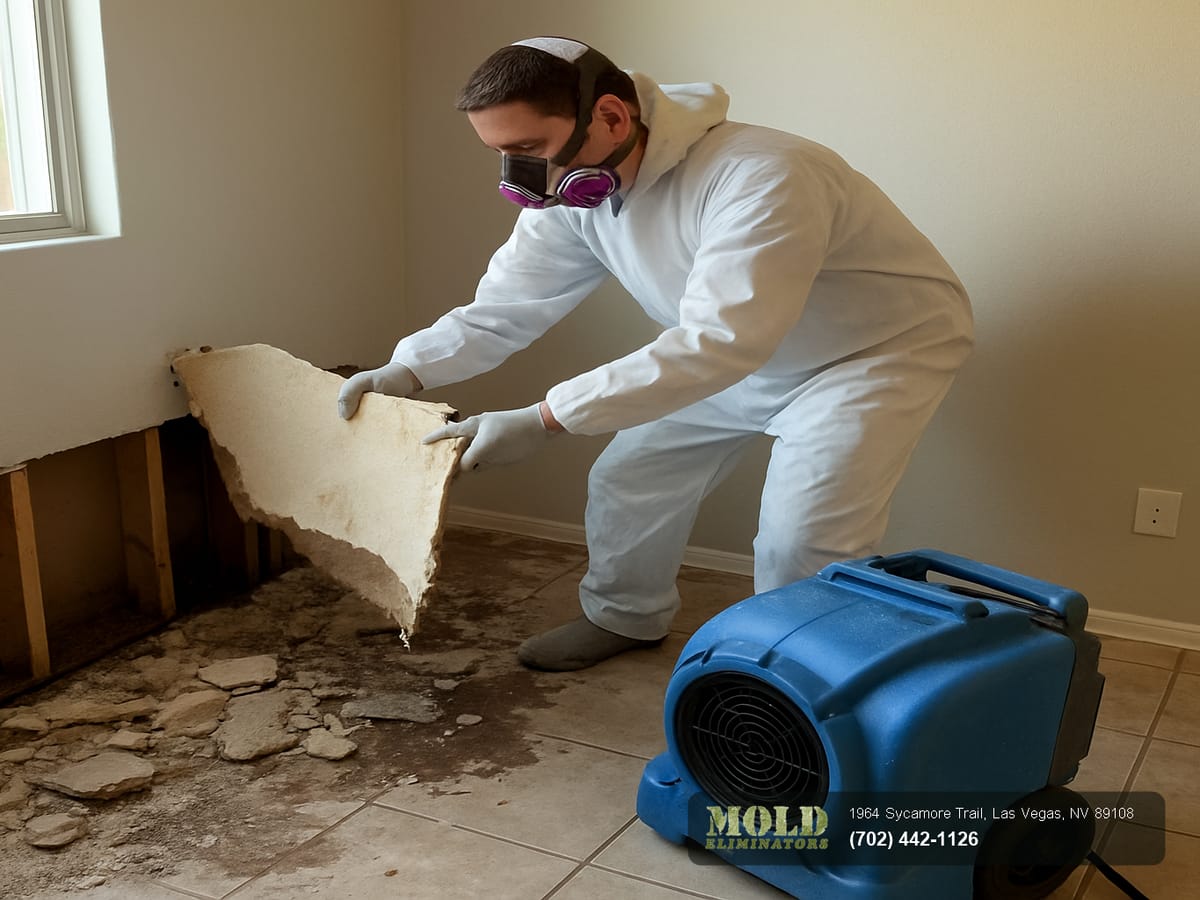 Mold Eliminators crew running extraction and dehumidification to the S520 standard in a Paradise property
How we run an emergency water removal to the S520 standard
Emergency removal done to standard follows a deliberate sequence, from the first call to a documented dry result. Because Craig co-authored the ANSI/IICRC S520 standard, the same rulebook governs every job, whether it is a single condo or a flooded mechanical floor.
- Stabilize and contain. First we stop the spread: shut down the source where we can, contain the active flow, and protect the units and corridors the water is heading for. In a tower that means getting ahead of the cascade before it reaches another floor.
- Extraction. Standing and absorbed water is physically pulled out with truck-mount and portable extractors. Removing water mechanically is dramatically faster than evaporating it, and it protects the materials underneath.
- Moisture mapping. We map the affected area with meters and thermal imaging, trace how far the water migrated through wall cavities and floor assemblies, and log a baseline reading for every wet material.
- Dehumidification and air movement. Commercial dehumidifiers and air movers are placed by design, not at random, so the room stays drier than the wet structure and moisture keeps leaving it.
- Daily monitoring. Readings are taken and logged every day the equipment runs, and the setup is adjusted to keep drying on pace toward the target. The data drives the schedule, not the calendar.
- Verified dry target. Equipment comes out only when readings confirm every material has hit its documented dry standard. That verified result is the finish line and the proof mold has nothing left to feed on.
The water you cannot see is the water that matters
You cannot dry what you have not found, and you cannot prove something is dry without a baseline. That is the part a company chasing a quick invoice skips, and it is the part that matters most in a Paradise tower where water travels through hidden assemblies between units.
Why local, no subcontractors, and an independent lab matter in Paradise
Built for towers
Craig Herrmann brings high-rise and Strip-corridor expertise, holds IICRC Master Certified credentials, and co-authored the ANSI/IICRC S520 standard. Your loss is handled by the rulebook, to documented targets, not to feels dry. Read more about Craig’s credentials.
No subcontractors
Every technician is an in-house, certified W-2 employee, working since 1996 with one-hour emergency response, 24/7. In a multi-unit loss that means one crew owns the water, the access logistics, and the mold risk, start to finish, with no finger-pointing between trades.
Independent third-party lab
When verification is warranted, samples go to an independent third-party lab, billed at cost. We do not grade our own homework, and our anti-upsell approach means we tell you when you do not need us.
That accountability is the whole difference in a property that crosses ownership lines. When water moves between a tower’s units, whose responsibility it is rides on a credible, documented account of what got wet and what got dried. We keep the kind of record an HOA board, a property manager, or an adjuster will accept, the same way our broader emergency water removal service is held to the standard from the first reading to the last. You can confirm we cover your building on the Paradise service area page or just reach us directly, with no call center in between.
Documentation, insurance, and multi-unit losses
Emergency water removal after a sudden, accidental event, a burst riser, a failed water heater, an appliance line that let go, is frequently covered, and the documented moisture map is exactly what an adjuster wants to see. We log readings, photos, and scope from the first visit and work directly with your carrier. Because we extract fast and prove the dry-out with data, we are also documenting the very thing that keeps a covered water claim from becoming a disputed mold claim later.
In Paradise that documentation does double duty. A loss that crosses unit lines in a condo tower or apartment complex turns into a question of which policy and which party is responsible, and that question is settled by records, not memory. Property managers, HOA boards, and resort engineering teams call us precisely because we hand them a clean, on-the-record account of the event. If a past water intrusion in your building was never properly verified, a free inspection is the calm, factual way to find out whether moisture left anything behind before it becomes a colony.
Emergency water removal in Paradise: common questions
- How fast can you reach a high-rise in the Paradise resort corridor?
- We target one-hour emergency response, 24/7, across the valley, and Paradise is core to our service area. For a tower near Paradise Road, Koval, or the 89109 corridor, the real variable is building access, so we coordinate freight elevators and security on the way in rather than after we arrive. If water is actively spreading, our 24/7 emergency line is the fastest way to get a crew moving.
- Water reached the units below mine in our condo tower. Is that one job or several?
- We handle it as one accountable job. Because every technician is an in-house W-2 employee and not a subcontractor, the same crew maps and dries every affected unit, traces where the water crossed demising walls and floor assemblies, and documents all of it together. That single chain of responsibility is exactly what an HOA board or adjuster needs when a loss crosses ownership lines.
- Is the inspection really free, and what about lab testing?
- The on-site inspection is genuinely free, with no pressure. Lab analysis is a separate, paid step. If lab analysis is warranted, samples go to an independent third-party lab and are billed at cost. We will tell you plainly when testing is not needed, because our approach is anti-upsell. The free inspection tells us where you stand before any work or cost begins.
Water moving in your Paradise property? Stop the spread and dry it right.
Free on-site inspection, no pressure. One-hour emergency response, 24/7, across Paradise and the Las Vegas valley, with the tower and access logistics handled. We extract fast, dry to verified targets, and prove it, so the water problem ends here instead of becoming a mold problem in three weeks.