Flood Restoration in Spring Valley, NV
In Spring Valley, a flood rarely stays in the room where it started. The valley is packed with stacked condos, townhomes and garden apartments off Spring Mountain Road, and when a second-floor water heater lets go or a supply line bursts upstairs, the water does not just pool. It runs down through the floor assembly and shows up as a sagging, brown-ringed ceiling in the unit below, sometimes two doors over, across a shared wall the owner never knew connected the two homes.
That is the flood restoration problem unique to this part of the valley: density. A burst line in one Peccole Ranch townhome can soak three units, and the question of who is responsible turns into an HOA dispute before anyone has even pulled a baseboard. Mold Eliminators handles flood restoration in Spring Valley the way the national standard says it should be handled: extract the water, find every wet cavity with instruments, dry the structure to a documented target, and verify the result before anyone closes the wall. We work the 89117, 89146, 89147 and 89148 zips daily, and we own the whole job in house from the first reading to the last.
How a flood shows up in Spring Valley
Spring Valley is one of the densest corners of Clark County, and the housing reflects it: row after row of attached townhomes around Rhodes Ranch, mid-rise apartment blocks along the Spring Mountain Road and Chinatown corridor, and tightly spaced condos in Peccole Ranch where one roof covers a dozen families. That construction changes what a flood does. In a detached house, water spreads sideways. Here it spreads down and through, following the shared floor and wall assemblies that tie units together.
The most common Spring Valley call we get is the upstairs leak that becomes a downstairs ceiling problem. A failed angle stop under an upstairs sink, a cracked water heater pan on a second floor, or an overflowing washing machine sends water into the floor cavity, and gravity carries it into the ceiling of the unit below. By the time the lower owner sees the brown ring, the wall cavity between the two units is already wet, and the paper face of the drywall is already feeding spores.
Swamp coolers add a second, quieter cause. Plenty of older Spring Valley townhomes and apartments still run evaporative coolers on the roof, and a stuck float valve or a failed roof line can leak for days, soaking the ceiling and the top of a shared wall before anyone notices the stain. Slab leaks under ground-floor units round out the list. The pattern is always the same here: the water you can see is a fraction of the water that has already moved into the structure.
 Spring Valley townhome ceiling stained by an upstairs flood reaching the unit below
Need help now?
Talk to a Las Vegas expert
In-house certified crews. One-hour emergency response across the valley, 24/7.
How we restore a Spring Valley flood to the S520 standard
Flood restoration is not a matter of dropping a few fans and leaving. It is a measured discipline, and we run it to the national mold standard, the ANSI/IICRC S520, that our founder Craig Herrmann helped write. That credential matters most in a dense Spring Valley building, because the difference between a wall that is dry and a wall that merely feels dry is the difference between a closed claim and a mold colony spreading down a shared cavity.
- Stop the source and assess the category. Before drying, we confirm the leak is shut off and we grade the water. A clean supply line is one thing. A flood that came up from the ground, or sat for days, or carried sewage is Category 3, and the porous materials it touched usually have to be removed, not dried. We tell you which situation you are in honestly.
- Extract every bit of standing and absorbed water. Pulling water out mechanically is far faster than evaporating it, and in a stacked unit it stops the water from migrating further into the floor assembly below.
- Map the moisture. Pin and pinless meters and thermal imaging trace exactly how far the water traveled, including up the shared wall between units and across the ceiling of the lower home. Each material gets a real number and a documented dry target.
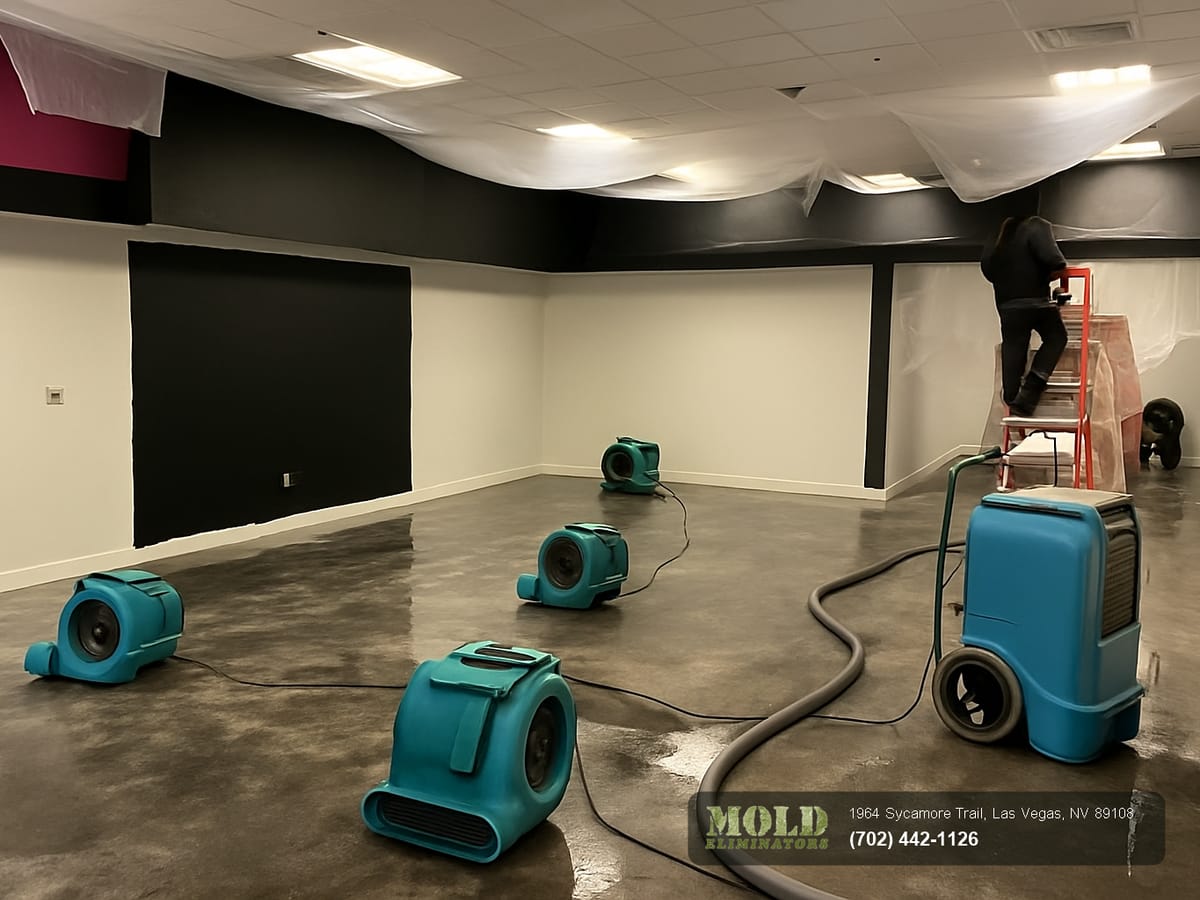
- Dry to verified targets. Commercial dehumidifiers and air movers are placed by design, then daily readings drive the schedule. Equipment comes out only when every material hits its target, never early to free a machine, never late to pad a bill.
- Verify and document. We log readings, photos and scope from the first visit, the record an adjuster or an HOA board needs to settle who pays and to prove the structure is genuinely dry.
This is core flood restoration work, and the drying portion is the same applied discipline that keeps a water problem from quietly becoming a mold problem three weeks later. If the water sat long enough that mold already took hold, the job becomes containment and removal with drying built into it, handled by the same crew rather than a handoff to a second company.
 Certified Mold Eliminators technician taking moisture readings after a Spring Valley flood
Why local, in house, and an independent lab matter here
In a Spring Valley building, the restorer who shows up has to understand the question that always follows a flood across unit lines: whose responsibility is it. HOA governing documents, the upstairs owner, the downstairs owner and the carrier all have a stake, and the only thing that settles it cleanly is a credible, documented account of what got wet and what got dried. We build that record on every job, which is why property managers and condo boards in the 89147 and 89148 zips call us by name.
Because we serve the valley directly, our crews reach the Spring Mountain Road corridor fast. A flood is on a clock: mold can begin colonizing wet drywall and framing within roughly 24–72 hours, so a one hour emergency response at any hour is not a luxury, it is what saves the floor and the shared wall. We are not dispatching a subcontractor from across town.
Every technician on your job is a certified W‑2 employee, not a subcontractor, so one crew owns the water, the drying and the mold risk from start to finish, with one chain of responsibility. And when the question is whether mold is actually present, samples go to an independent third‑party lab rather than being declared clean by the person who did the work. That separation is the whole point of our S520 approach: the people who dry the structure do not get to grade their own homework.
Why Spring Valley trusts Mold Eliminators
Certified to the standard
Craig Herrmann co-authored the ANSI/IICRC S520 standard and is IICRC Master Certified, working the valley since 1996 across 255+ properties. Your flood is dried by the rulebook, to documented targets. Read more about Craig’s credentials.
No subcontractors
Every technician is a certified in house W‑2 employee, with one hour emergency response, 24/7, across Spring Valley and the wider valley. One crew owns the water, the drying and the mold risk.
Anti-upsell, independent lab
We tell you when you do not need us. Drying ends on the data, and any lab analysis goes to an independent third‑party lab, billed at cost. No padding, no fear-mongering, no inflated invoice.
If a past Spring Valley water event was never properly verified, a free inspection for property owners is the calm, factual way to find out whether moisture left anything behind a shared wall. The on-site inspection is free. If lab analysis is warranted, samples go to an independent third-party lab, billed at cost.
Flood restoration in Spring Valley, common questions
- An upstairs unit flooded and it is coming through my ceiling. Whose responsibility is it?
- That depends on your HOA governing documents and where the failure happened, and it is exactly the kind of dispute that turns on documentation. Our job is to stabilize the water, map what got wet across both units, and produce a dated record of readings and photos that the boards and carriers can use to sort out responsibility. The faster you call our 24/7 line, the smaller the damage and the cleaner the record. We also offer a free inspection so you know what you are dealing with before any work begins.
- My swamp cooler leaked and stained the ceiling. Is that a flood job?
- It can be. Roof-mounted evaporative coolers are common on older Spring Valley townhomes and apartments, and a stuck float or a failed line can soak a ceiling and the top of a shared wall for days. Even though the volume is small, the structure is wet inside, which is what mold needs. We map the moisture, dry the cavity to a verified target, and confirm it is genuinely dry rather than just dry on the surface, the same way we approach full flood restoration.
- How fast can you reach Spring Valley?
- We run a one hour emergency response, 24/7, and we serve the Spring Valley area directly, from the Spring Mountain Road and Chinatown corridor through Peccole Ranch and Rhodes Ranch across the 89117, 89146, 89147 and 89148 zips. We are not dispatching a subcontractor from another part of the county. You can see the full Spring Valley service area or reach us directly, with no call center in between.
Flooded in Spring Valley? Start with a free inspection.
Free, no-pressure on-site inspection. One hour emergency response, 24/7, across Spring Valley and the Las Vegas valley. We dry to verified targets and document the result, so the water problem ends here, not in three weeks. If lab analysis is warranted, samples go to an independent third-party lab, billed at cost.