Water Damage Restoration in Paradise, NV
A supply line lets go on the 19th floor of a Strip-corridor condo tower at 2 a.m., and by the time anyone notices, the water has already found the path every high-rise leak finds: down. It rides the plumbing chase, sheets across the post-tension slab, and shows up three units below as a stained ceiling and a smell nobody can place. In Paradise, water damage is rarely a single wet room. It is a vertical problem, and how fast it gets stabilized decides whether you are drying one unit or four.
Mold Eliminators handles water damage restoration across Paradise to the ANSI/IICRC S520 standard, the same standard our founder Craig Herrmann helped write. That matters most here, in a community built on high-rise towers, resort properties, and aging garden-style apartments off Maryland Parkway, because the water you can see is almost never the whole job. We map the moisture, dry to documented targets, and prove the structure is dry before mold gets a chance to start.
 High-rise condo tower in the Paradise, NV resort corridor where cascading water leaks are common
What water damage looks like in Paradise
Paradise is not a typical suburb, and its water problems are not typical either. This is the unincorporated township that holds the heart of the Las Vegas Strip resort corridor, the high-rise condo towers along Harmon and Flamingo, the UNLV campus and the rental density off Maryland Parkway, and the constant churn of properties near Harry Reid International Airport. Across the 89109, 89119, 89120, and 89169 zips, the buildings are taller, the plumbing runs longer, and the occupancy almost never stops. When water gets loose, it has a lot of structure to travel through.
The signature Paradise event is the cascading vertical leak. A failed angle stop, a burst riser, or an overflowing tub on an upper floor sends water down through the plumbing chases and post-tension slabs of a high-rise, and a single failure on one floor can wet drywall, insulation, and subfloor across several units below. Hospitality and tower plumbing carries pressure and volume that a single-family home never sees, so a leak that would be a nuisance in a ranch house becomes a multi-unit emergency in a tower off the Strip.
Then there is access, which in Paradise is its own discipline. Many of these buildings only permit restoration work after hours so guests and residents are not disrupted, equipment has to come up through a single freight elevator on a reserved time block, and a building engineer or HOA has to coordinate entry to occupied units. We have run drying jobs that hinged less on the water and more on getting air movers staged before the elevator window closed. None of that is in a generic playbook. It is Paradise.
Need help now?
Talk to a Las Vegas expert
In-house certified crews. One-hour emergency response across the valley, 24/7.
Why the first 24 to 72 hours decide everything
There is a clock on water damage, and it does not pause for after-hours access rules. Mold can begin to colonize wet organic materials, and most of a building is organic from paper-faced drywall to wood and subfloor, within roughly 24–48 hours of getting wet. After about 72 hours the conversation shifts from dry it and save it to remove it and remediate. That window is the whole reason we treat restoration as an emergency, not a scheduled appointment.
In a Paradise high-rise that clock runs faster than the building wants to move. A tower leak discovered at midnight cannot wait for the next reserved elevator block at 6 a.m., because the water sitting in the slab and the ceiling cavities of the units below is colonizing the entire time. This is exactly why our 24/7 emergency response is built for one-hour arrival across the valley: we stabilize the water, contain the spread between units, and start a controlled drying environment before the building’s own logistics have a chance to lose you days.
The desert adds its own wrinkle. Las Vegas heat can drive moisture deeper into cool wall cavities through condensation, and the day-night temperature swings make it’ll air-dry a dangerous assumption. Post-tension and slab-on-grade concrete, common throughout the towers and pads near the airport, holds water far longer than people expect. A slab that feels dry on top can stay saturated underneath for weeks, which is why drying here has to be measured, not guessed.
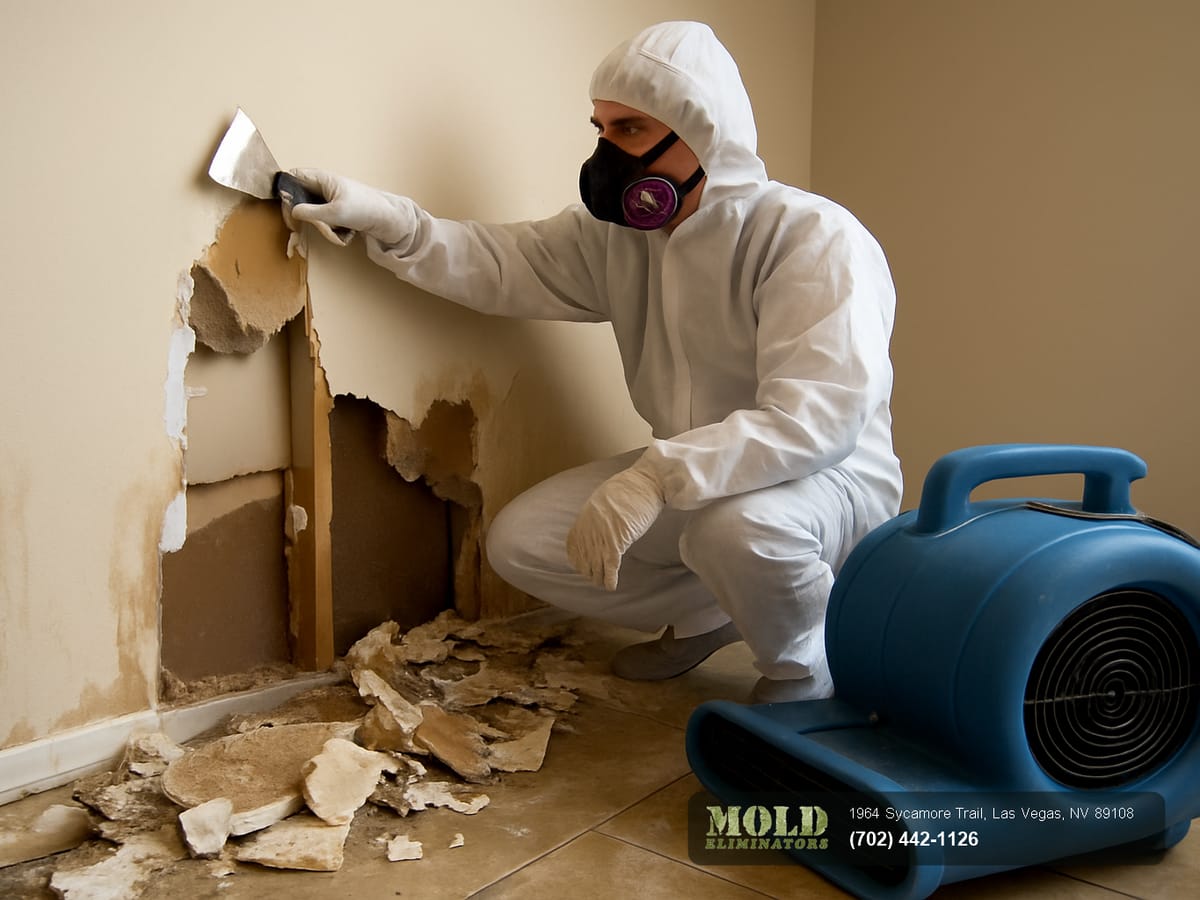 Structural drying equipment staged in a Paradise high-rise unit during water damage restoration
How we restore it, to the S520 standard
Restoration done to standard follows a deliberate sequence, the discipline written into the ANSI/IICRC S520 standard Craig co-authored, from the first moisture reading to the final verified dry target.
- Stabilize and contain. We stop the active source, then contain the spread between units and floors so a one-unit leak does not become a four-unit loss while access is being arranged.
- Extraction. Standing and absorbed water is physically extracted first, because pulling water out is dramatically faster than evaporating it and it protects the materials underneath.
- Moisture mapping. Meters and thermal imaging map how far water traveled down through chases and slabs, log starting levels, and set a documented dry target for each material.
- Dehumidification and air movement. Commercial dehumidifiers and air movers are placed by design, keeping the room drier than the wet materials so moisture keeps leaving the structure.
- Daily monitoring. Readings are taken and logged every day, and the equipment is adjusted to the data, so the schedule is driven by the numbers, not the calendar.
- Verified dry. Equipment comes out only when readings confirm every material has hit its dry standard. That verified-dry result is the proof mold has nothing left to feed on.
Why local crews, no subcontractors, and an independent lab matter here
A cascading tower leak crosses unit lines, and the moment it does it becomes a question of accountability. Whose unit, whose responsibility, whose insurance. That question rides entirely on a credible, documented account of what got wet and what got dried. A franchise that drops a few fans and hands the job to a separate mold company leaves you with finger-pointing exactly when an HOA board or an adjuster needs one clean story.
We never subcontract. Every technician on your job is an in-house, certified W-2 employee, so one crew owns the water, the drying, and the mold risk from the first reading to the last, with one chain of responsibility and one standard. In an occupied Paradise tower where strangers should not be wandering reserved floors at odd hours, that in-house accountability is also a security and trust matter, not just a quality one.
And when the question is whether anything was left behind, we do not grade our own homework. If lab analysis is warranted, samples go to an independent third-party lab, billed at cost, so the verification comes from a party with no stake in the answer. That is the anti-upsell promise Craig has run on since 1996 across 255+ properties: we tell you when you do not need us, and we prove the result with data an adjuster, a board, or an underwriter will accept. The on-site inspection itself is free; if a previous tower leak was never properly verified, a free inspection is the calm way to find out where you stand before any work begins.
Why Paradise property owners trust Mold Eliminators
High-rise and Strip-corridor expertise
Craig Herrmann brings IICRC Master Certified experience to the towers, resorts, and condos of the Strip corridor, where cascading leaks and after-hours elevator access demand a crew that has done it before. Read more about Craig’s credentials.
Measured, not guessed
Moisture mapping with meters and thermal imaging defines a real dry target, and daily readings prove we hit it. Drying ends on the data, never early to free a machine, never late to pad a bill.
In-house accountability
No subcontractors. Every technician is a certified W-2 employee, with one-hour emergency response, 24/7, across Paradise and the valley. One crew owns the job start to finish.
That is the whole difference. We map the moisture, dry to a verified standard, and document the result the same way our broader restoration work is held to the rulebook. You can see exactly where we work across the township on the Paradise service area page, or reach us directly any hour.
Water damage restoration in Paradise: common questions
- Do you handle high-rise and condo tower leaks in the Strip corridor?
- Yes. Cascading vertical leaks through tower plumbing chases and post-tension slabs are the most common water job we run in Paradise, across the 89109, 89119, and 89169 zips. We contain the spread between units, coordinate after-hours and freight-elevator access with your building engineer or HOA, and dry every affected unit to a verified target. Craig’s high-rise and Strip-corridor experience is the reason these jobs go smoothly.
- How fast can you reach a property near the airport or UNLV after hours?
- Our 24/7 emergency line is built for one-hour response across the valley, including the 89119 and 89120 areas near Harry Reid International and the rentals off Maryland Parkway. We stabilize the water and start a controlled drying environment immediately, because a leak left sitting until the next elevator window can turn a salvageable floor into a tear-out.
- Is the inspection really free, and what about lab testing?
- The on-site inspection is free for property owners. If we find moisture or suspect microbial growth and lab analysis is warranted, samples go to an independent third-party lab and are billed at cost, never marked up. You can book a free inspection any time, or reach us directly with no call center in between.
Water damage in Paradise? Dry it right before mold gets its chance.
Free on-site inspection, one-hour emergency response 24/7 across the Strip corridor and the wider valley. We dry to verified targets and prove it, so the water problem ends here, not in three weeks.