Water Damage Restoration in Spring Valley, NV
Water Damage Restoration · Spring Valley, NV
A pipe lets go on the second floor of a Peccole Ranch townhome, and twenty minutes later the problem isn’t upstairs anymore. It’s the neighbor’s ceiling, the shared wall between the units, and a question nobody wants to answer: whose responsibility is this. Spring Valley is built dense, condos, townhomes, and apartments stacked close together, and that changes how water damage behaves here. A leak rarely stays in one room or even one unit.
Mold Eliminators restores water-damaged homes and buildings across Spring Valley to the ANSI/IICRC S520 standard, the national mold standard our founder Craig Herrmann helped write. We map the water, dry the structure to documented targets, and verify the result, so a sudden leak ends as a clean repair instead of a slow mold problem behind the drywall. This page is the local companion to our valley-wide water damage restoration service, focused on the streets, builds, and zip codes of Spring Valley itself.
 Water-damaged ceiling in a Spring Valley condo from an upstairs unit leak
How water damage shows up in Spring Valley
Spring Valley sits west of the Strip, wrapped around the Spring Mountain Road and Chinatown corridor and stretching out to master-planned pockets like Peccole Ranch and Rhodes Ranch. The zip codes we work in most, 89117, 89146, 89147, and 89148, cover a mix of older apartment stock near Spring Mountain Rd and newer attached housing further south and west. What ties them together is density. A lot of Spring Valley lives in shared-wall construction, and that single fact drives most of the water calls we take here.
In a detached house, a supply line failure soaks the room it happened in. In a stacked Spring Valley condo or townhome, that same failure becomes a downstairs ceiling problem within the hour. Water finds the path of least resistance, runs along the joists, crosses the shared wall assembly, and surfaces in a unit the owner upstairs has never set foot in. By the time the lower unit notices a brown stain spreading across the ceiling, the cavity above it has already been wet for a while.
The local causes are specific too. Older Spring Valley apartments and condos still run evaporative swamp coolers on the roof, and a swamp cooler that overflows or has a failed float valve will quietly feed water down through the ceiling for days before anyone connects the stain to the unit above. Add aging galvanized and polybutylene supply lines in the pre-2000 builds, second-floor laundry hookups, and water heaters tucked into upstairs closets, and you get the Spring Valley pattern: an upstairs leak that becomes a downstairs disaster across a shared wall, often tangled up in an HOA responsibility dispute before the drywall is even open.
Need help now?
Talk to a Las Vegas expert
In-house certified crews. One-hour emergency response across the valley, 24/7.
Why the first hours decide everything
Water damage runs on a clock, and it is not generous. Mold can begin to colonize wet drywall, framing, and subfloor within roughly 24–48 hours of getting wet. After about 72 hours the question shifts from “dry it and save it” to “remove it and remediate.” In a dense Spring Valley building, that clock is harder to beat, because the water is often hiding inside a ceiling assembly or a shared wall where nobody can see it until the cosmetic damage breaks through.
That is why the first call matters so much. The faster a controlled drying environment goes in, extraction, dehumidification, and air movement working together, the more material we save and the lower the mold risk drops. A ceiling left wet overnight because two owners are still arguing about whose insurance pays can turn a salvageable assembly into a tear-out. If water is actively spreading right now, our 24/7 emergency response stabilizes the source first and starts drying immediately, with a one-hour response target across the valley.
The desert adds its own wrinkle. Spring Valley summers drive heat into cool wall and ceiling cavities, where condensation can push moisture deeper instead of out, and the dry daytime air fools people into thinking a wet ceiling has “aired out” when the cavity above it is still saturated. Concrete slab-on-grade construction is common in the newer Rhodes Ranch and south Spring Valley builds, and a slab holds water far longer than people expect. None of this is visible to the eye, which is exactly why drying here has to be measured, not guessed at.
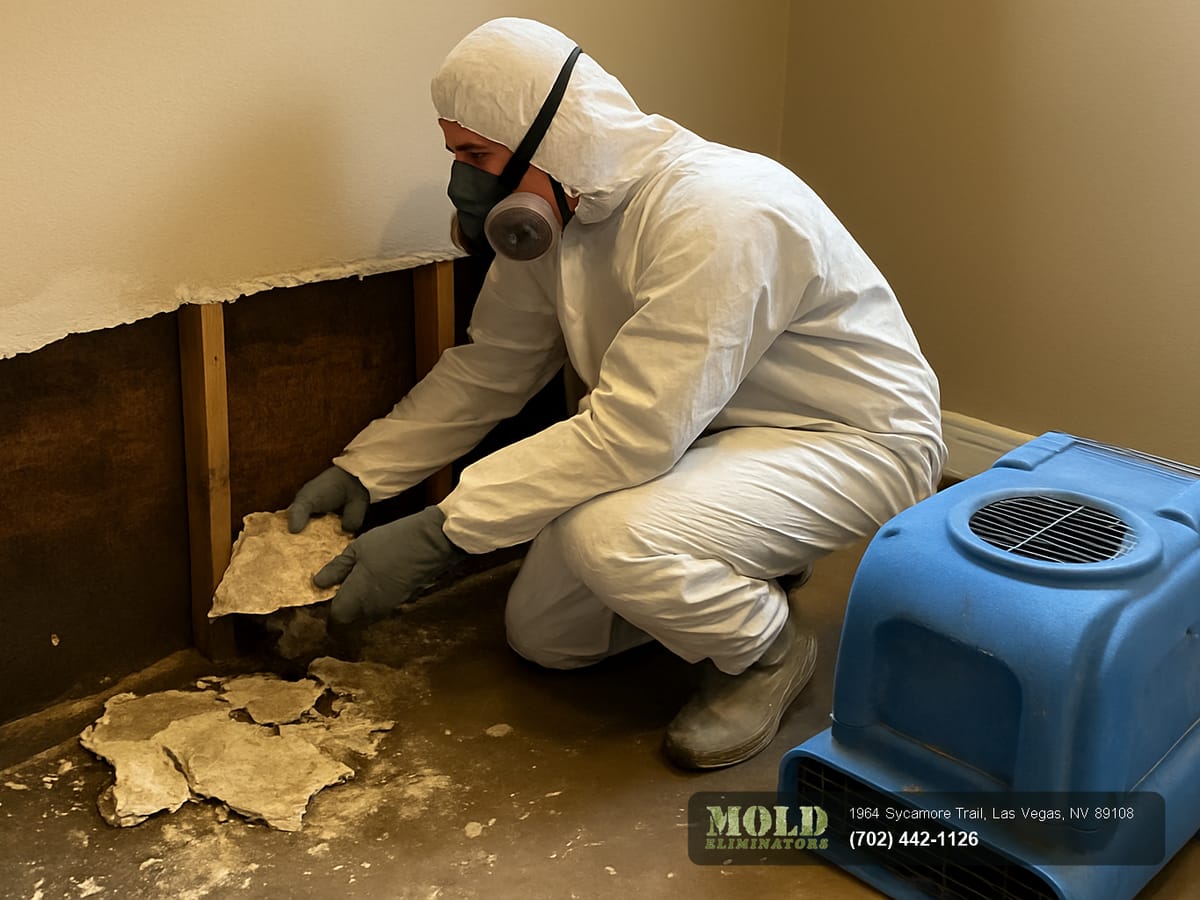 Moisture mapping equipment set up to dry a Spring Valley shared-wall assembly
How we restore it, to the S520 standard
Restoration done to standard follows a deliberate sequence, the same one Craig Herrmann helped codify in the S520 standard, from the first reading to the final verified-dry target.
- Stabilize the source. Before anything dries, we stop the water. In a shared-wall Spring Valley unit that often means coordinating access to the unit above, because the leak and the damage are rarely in the same place.
- Extraction. Every bit of standing and absorbed water is physically pulled out. Removing water is far faster than evaporating it, and it protects the materials underneath the surface.
- Moisture mapping. We map the affected area with meters and thermal imaging, tracing how far water traveled across joists and through the shared wall, and log a documented dry target for each material.
- Dehumidification and air movement. Commercial dehumidifiers and air movers are placed by design, keeping the room drier than the wet materials so moisture keeps leaving the structure.
- Daily monitoring. Readings are taken and logged every day, and equipment is adjusted to the data. The numbers drive the schedule, not the calendar.
- Verified dry. Equipment comes out only when readings confirm every material has hit its dry standard. That verified-dry result is the proof that mold has nothing left to feed on.
When restoration is more than drying
Drying saves a lot of Spring Valley units from demolition, but only when it starts in time and the water was clean. If water sat behind a ceiling for days during an HOA dispute, or it came in already contaminated, drying is one part of a bigger job, and an honest restorer tells you which situation you are in instead of selling a one-size package.
Water from a sewage backup or a ground flood is Category 3. It carries bacteria, and the porous materials it touched usually have to be removed, not just dried. That is where restoration overlaps with flood restoration and proper structural drying: contain it, remove what cannot be salvaged, dry what can, and verify the result. If mold already took hold before drying began, the work becomes a containment-and-removal job with drying built in, not drying alone, and an independent third-party lab verifies the outcome.
The advantage of handling all of this under one roof is accountability, which matters more in Spring Valley than almost anywhere, because shared-wall water damage so often becomes a question of whose responsibility it is. We use no subcontractors. Every technician is an in-house W-2 certified employee, and one crew owns the water, the drying, and the mold risk from the first reading to the last. When an HOA, a property manager, or two condo owners need a credible account of exactly what got wet and what got dried, that single chain of responsibility, backed by a free inspection and independent lab results, is what settles the dispute.
Why local, in-house, and independently verified matters here
We know this build
Spring Valley’s shared-wall condos, swamp coolers, and slab construction behave in specific ways. We have restored these assemblies across 89117, 89146, 89147, and 89148, so we know where the water goes before we open a wall.
No subcontractors
Every technician is a certified W-2 employee, not a day-of contractor. In a dispute over a shared wall, one accountable in-house crew owning the whole job from extraction to verified-dry is what an HOA board actually needs.
Independent verification
When a unit is “dry” or “clear,” that is confirmed by an independent third-party lab and a documented moisture record, not by the word of the company that did the work. That is the difference in a responsibility dispute.
Craig Herrmann has been restoring Las Vegas valley properties since 1996, has worked on 255+ properties, and co-authored the standard the rest of the industry follows. That is why we can stand behind a Spring Valley dry-out with documentation an adjuster, a board, or an underwriter will accept. You can see every neighborhood we cover on the Spring Valley service hub, or reach us directly with no call center in between.
Water damage in Spring Valley, common questions
- A leak from the unit above is staining my ceiling. Whose responsibility is it?
- That depends on your HOA’s governing documents and where the failure originated, and disputes are common in Spring Valley’s shared-wall buildings. What settles them is a clear, documented account of exactly what got wet and what got dried. We map the moisture, document the source and the affected materials, and verify the dry-out with independent lab results, so the responsibility conversation runs on facts, not guesses. Start with a free inspection so everyone is working from the same record.
- My swamp cooler overflowed onto the ceiling. Is that water damage I should worry about?
- Yes. A swamp cooler that overflows or has a failed float valve can feed water into a ceiling cavity for days before the stain appears, and that hidden moisture is exactly what mold needs. Because the surface dries first while the cavity stays wet, the only way to know whether it is actually dry is to measure it. If a past cooler leak was never properly verified, our free inspection is the calm way to find out what, if anything, it left behind.
- How fast can you get to Spring Valley?
- We target a one-hour emergency response, 24/7, across the valley, including the 89117, 89146, 89147, and 89148 zips. In a dense building where water is crossing into a neighbor’s unit, that speed is what keeps a salvageable ceiling from becoming a tear-out. We stabilize the source first, then start restoration immediately.
Water damage in Spring Valley? Get a free inspection before mold gets its chance.
Free, no-pressure on-site inspection and a documented dry-out to verified targets. One-hour emergency response, 24/7, across Spring Valley and the Las Vegas valley. If lab analysis is warranted, samples go to an independent third-party lab, billed at cost.