Mold Inspection in Spring Valley, NV
A stain spreads across a downstairs ceiling in a Peccole Ranch townhome, and the owner upstairs swears nothing leaked. Both are partly right, and that is exactly the kind of puzzle a real mold inspection in Spring Valley is built to solve.
Spring Valley is dense with condos, townhomes, and apartment blocks where one unit shares walls, floors, and ceilings with the next. A slow supply-line drip behind an upstairs vanity does not stay upstairs. It travels down through the shared assembly and surfaces as a soft, discolored patch on someone else’s ceiling, often days or weeks later. A proper inspection finds where the water actually came from, how far it moved, and whether anything is growing, before the finger-pointing starts. At Mold Eliminators that inspection is done to the ANSI/IICRC S520 standard by an in-house certified crew, and the on-site visit is free.
 Inspector examining a shared-wall ceiling stain in a Spring Valley townhome
What a mold inspection looks like in Spring Valley
A mold inspection is a diagnostic visit, not a cleaning. The job is to answer three questions honestly: is there active mold growth, where is the moisture feeding it coming from, and how far has it spread. In a single-family house those answers are usually contained inside four walls. In Spring Valley, with its tight grid of attached homes around the Spring Mountain Road and Chinatown corridor, the answers cross unit lines constantly, and that changes how the inspection has to be done.
The common Spring Valley pattern starts with water that moves across a shared assembly. An upstairs leak in a 89117 or 89147 townhome becomes a downstairs ceiling problem next door. A second-floor shower pan in a Rhodes Ranch condo weeps into the framing and surfaces two units over. The visible damage is rarely above the actual source, so an inspection that only looks at the stained drywall misses the point entirely. We trace the moisture back to where it started, which often means reading the wall and ceiling cavity with a meter and a thermal camera rather than guessing from the surface.
The other Spring Valley factor is the swamp cooler. Evaporative coolers are everywhere on these rooftops, and they push a steady stream of humid air into the home all summer. A cooler that is oversized, poorly tuned, or running with a clogged drain line raises indoor humidity enough to grow mold on closet walls and behind furniture, with no plumbing leak anywhere. A good inspection accounts for the cooler as a moisture source, not just the pipes. This is also why an honest mold inspection in this part of the valley starts with finding water, because mold is always a moisture symptom first.
Need help now?
Talk to a Las Vegas expert
In-house certified crews. One-hour emergency response across the valley, 24/7.
When a Spring Valley home or unit needs an inspection
You do not need visible black spots to justify a look. In attached housing, the early signs are usually subtle, and catching them early is the difference between a small fix and a job that involves your neighbor’s unit and your HOA.
If water is actively spreading right now, an inspection is not the first call. Stabilizing the water comes first, and that is what our 24/7 emergency response is for, with a one-hour response window across the valley. Once the water is controlled, the inspection defines the real scope.
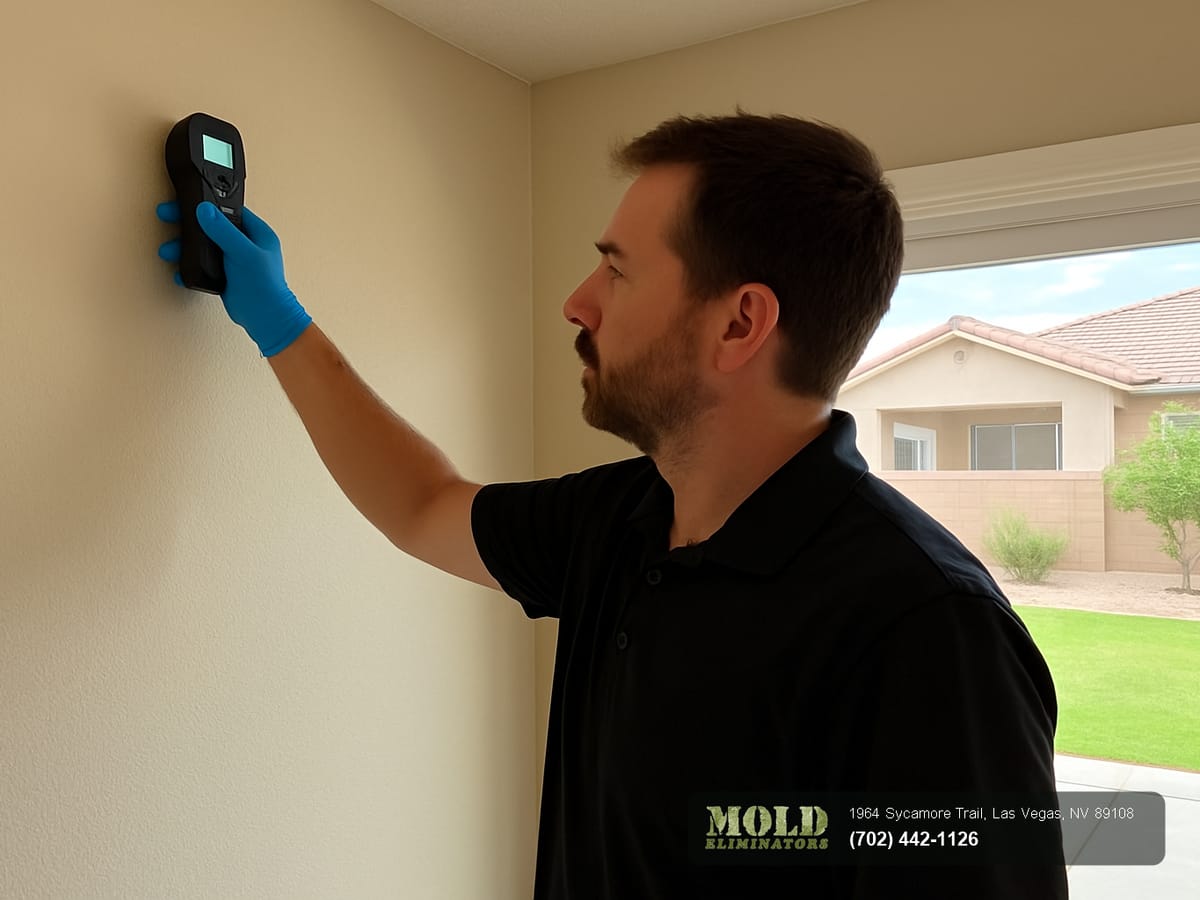 Moisture meter and thermal camera used during a Spring Valley mold inspection
How we inspect to the S520 standard
The national mold standard, ANSI/IICRC S520, was co-authored by our founder Craig Herrmann, so the inspection is run by the rulebook rather than by instinct. The sequence is deliberate.
- Interview and history. We start with what you have seen, when, and which units are involved. In attached Spring Valley housing, the neighbor’s timeline often holds the answer.
- Visual assessment. A trained walk-through of the affected areas, exterior walls, closets, and the swamp cooler ducting that so often feeds humidity into these homes.
- Moisture mapping. Pin and pinless meters give each material a real moisture number, and thermal imaging traces how far the water moved through the shared assembly.
- Source identification. We define where the water is actually coming from, whether that is a plumbing line, a roof or cooler issue, or intrusion from an adjacent unit.
- Sampling, only if warranted. If the situation calls for it, we collect air or surface samples. Lab analysis is a paid add-on, billed at cost.
- Written findings. You receive a clear, documented account of what was found and what it means, the kind of record an HOA board, adjuster, or buyer will accept.
The inspection is free, the lab work is honest about cost
Here is the part many companies blur, so we will be plain about it. The on-site inspection is free. A certified technician comes out, assesses the property, maps the moisture, and tells you what is going on, at no charge. There is no obligation and no pressure to book work afterward.
Lab analysis is separate. If the inspection shows that sampling is genuinely warranted, samples go to an independent third-party lab and are billed at cost. We do not own the lab, so we have nothing to gain by inflating what gets tested. Many Spring Valley inspections never need samples at all, because the moisture reading and the visual assessment already answer the question. We tell you when testing would add real information and when it would just add a line to an invoice. When you are ready to book, you can request your free inspection directly, with no call center in between.
That restraint is the whole point of our anti-upsell approach. Craig built this company in 1996 on telling owners the truth, including when they do not need us. You can read more about Craig’s credentials and his role in writing the standard the rest of the industry follows.
Why local, in-house, and independent matters in Spring Valley
We know the shared-wall problem
Spring Valley’s attached condos and townhomes route water across unit lines in ways a single-family inspector never has to consider. We trace the source through the assembly, not just to the nearest stain, so the right party gets the right answer.
No subcontractors
Every technician is a certified W-2 employee, not a hired gun. The person who inspects your home is accountable for the findings, and the same crew handles any work that follows. One chain of responsibility, start to finish.
Independent third-party lab
When samples are warranted, they go to a lab we do not own, billed at cost. No incentive to over-test, no conflict of interest, just results an HOA board or insurer can trust.
That combination is why Spring Valley owners, property managers, and HOA boards call us when responsibility rides on a credible, documented account of what got wet and what is growing. We serve the whole 89117, 89146, 89147, and 89148 footprint, and you can see the full picture on our Spring Valley service page.
Spring Valley mold inspection, common questions
- My downstairs neighbor has a ceiling stain but I have no leak. Whose problem is it?
- This is the most common Spring Valley scenario, and the answer is exactly what an inspection establishes. Water often travels well past where it started, so the source can be in your unit even when nothing is visible on your side, or it can be a shared roof or cooler issue that belongs to the HOA. We map the moisture back to the actual source and put it in writing, which is usually what settles the responsibility question before it becomes a dispute. The on-site free inspection is the place to start.
- Can a swamp cooler cause mold without any plumbing leak?
- Yes, and it is common in Spring Valley. An evaporative cooler pushes humid air into the home all summer, and if it is oversized, poorly maintained, or draining badly, it can raise indoor humidity enough to grow mold on closet walls and behind furniture with no pipe involved at all. A thorough mold inspection treats the cooler as a possible moisture source, which a plumbing-only check would miss entirely.
- Do I have to pay for lab testing as part of the inspection?
- No. The on-site inspection is free. Lab analysis is only done if it is genuinely warranted, and when it is, samples go to an independent third-party lab and are billed at cost. Many inspections never need samples, because the moisture mapping and visual assessment already answer the question. We will tell you honestly which situation you are in.
Get a clear answer on your Spring Valley property. Free inspection.
A certified, in-house technician comes to you, maps the moisture, and tells you the truth, at no charge. One-hour emergency response, 24/7, across the valley. Independent lab work only if it is warranted, billed at cost.