Water Damage Restoration in Las Vegas
A pipe let go overnight, the dishwasher line failed while you were at work, or a monsoon cell dumped an inch of water through a roof seam, and now there’s water where water should never be. Take a breath. Water damage is fixable, the clock is your friend if you act in the first 24–48 hours, and the right response saves your floors, your walls, and your peace of mind without turning the whole thing into a months-long ordeal.
Mold Eliminators has restored more than 255 Las Vegas properties since 1996. Our founder, Craig Herrmann, helped author the ANSI/IICRC S520 standard and holds IICRC Master Restorer credentials, so the drying targets we work to aren’t guesses, they’re the rulebook the whole industry follows. When a stranger’s water turns into your emergency, you want the person who wrote the book, not a franchise reading from one.
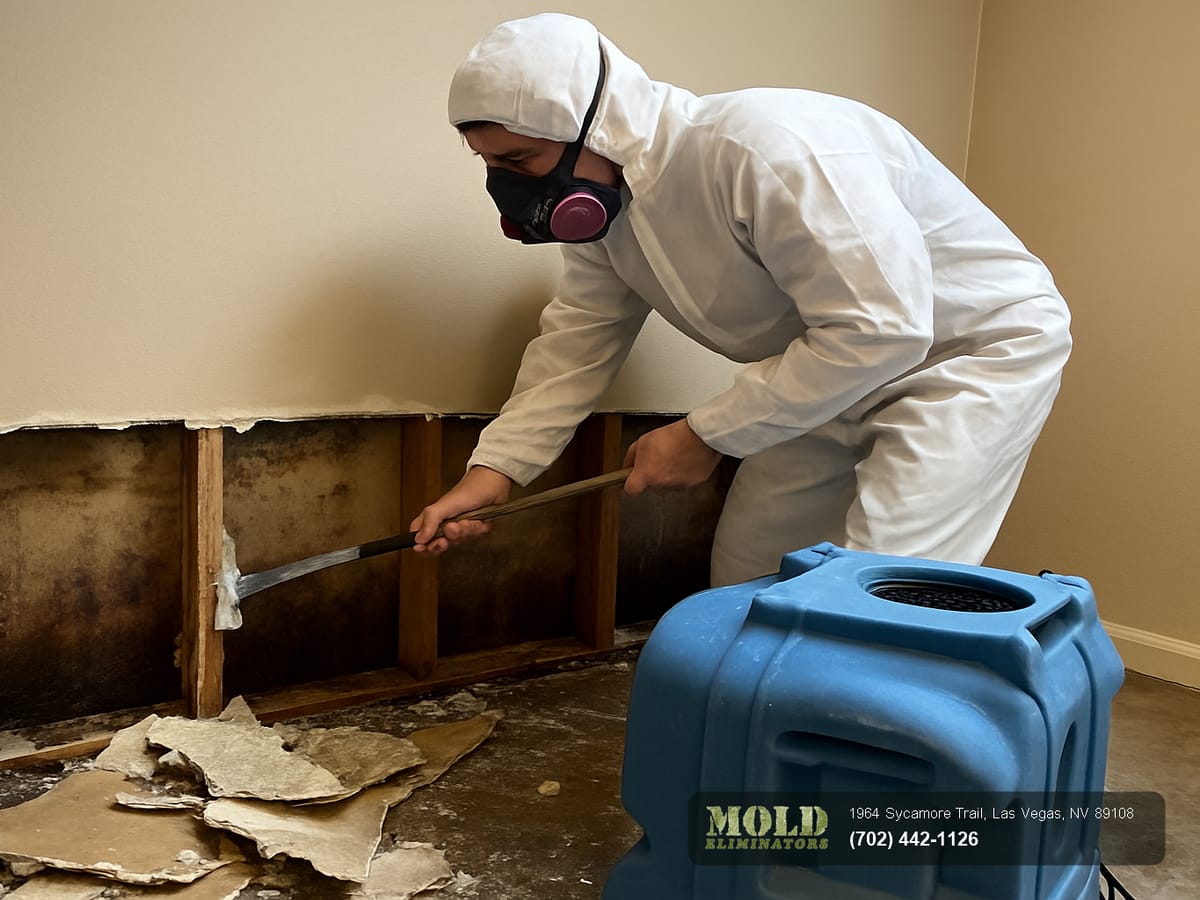
What water damage restoration actually is
Water damage is one of the most common and most misunderstood emergencies a homeowner faces. It rarely announces itself the way a fire does; more often it’s a slow reveal, a spreading stain, a soft spot underfoot, a smell that wasn’t there last week, and by the time it’s undeniable, the damage has been working on your home for a while. Understanding what professional restoration involves is the first step to making good decisions under pressure, so let’s start with what the word actually means.
Restoration is not the same as “cleanup,” and it’s a long way from mopping a floor. Mopping removes the water you can see. Restoration removes the water you can’t, the moisture that has already wicked up inside drywall, soaked into the subfloor, traveled under your baseboards, and saturated the framing behind the wall. Left there, that hidden water does two things: it keeps rotting the structure, and within 24 to 48 hours it starts feeding mold. Restoration is the discipline of getting a building back to a dry, sound, pre-loss condition, measured, not assumed.
The reason it’s a profession and not a chore is the measurement. A trained technician maps moisture with meters and thermal imaging, sets a documented dry standard for each material, runs the right equipment to hit it, and then proves the structure is dry before calling the job done. That verification step is exactly why restoration done to standard doesn’t come back to haunt you as a mold problem three months later. Skip the measurement and you’re just guessing, and guessing is how a water loss quietly becomes a mold loss.
Here’s the part people miss: water and mold are two halves of the same job. Water is the cause; mold is the symptom. If we extract the water but leave the structure damp, we’ve simply set a slower timer. That’s why every restoration we do ends with a dryness verification, and why, when there’s any doubt, we follow it with independent lab testing. We’d rather prove your home is clean than ask you to take our word for it.
There’s also a physics reason restoration has to be measured rather than eyeballed. Materials hold water differently: drywall behaves like a sponge and gives moisture up readily, while a hardwood floor or a framing stud releases it slowly and from deep inside. A surface can feel dry to the back of your hand while the core of the material is still saturated, and that core is exactly where rot and mold take hold. The only honest way to know a material is dry is to read it with a meter calibrated for that material and compare it to a known dry reference elsewhere in the structure. That’s the difference between “it looks fine now” and “it is, in fact, dry to standard.”
Need help now?
Talk to a Las Vegas expert
In-house certified crews. One-hour emergency response across the valley, 24/7.
Why Las Vegas water damage isn’t like anywhere else
Everyone assumes the desert is too dry for water problems. That assumption is exactly what makes them worse here. Because nobody expects water damage in Las Vegas, leaks go unnoticed for weeks, and the valley has its own specific ways of putting water where it doesn’t belong.
Slab leaks. A huge share of valley homes are built on concrete slabs, and the copper or PEX lines running through them eventually corrode or shift with our expansive soils. A slab leak can run for months, surfacing only as a warm spot on the floor, an unexplained water bill, or a faint musty edge to the air.
Swamp coolers. Evaporative coolers are everywhere here, and they live on the roof pumping water by design. A stuck float, a cracked pan, or a failed pump line, and you’ve got a slow, steady flow tracking down through the ceiling into the rooms below.
Monsoon season. For a few weeks each summer, the valley gets violent, fast rain on top of flat roofs and hard ground that can’t absorb it. Roof seams, parapet walls, and door thresholds that are bone-dry eleven months of the year suddenly take on water. When that water gets inside, it becomes a job for flood restoration, not a towel.
High-rise and multi-unit construction. Near the Strip and across the valley’s condos and high-rises, a single failed supply line can cascade through three or four units below, turning one owner’s leak into a building-wide liability question. These jobs need someone who understands shared walls, HOA responsibility lines, and desert high-rise construction.
The low-humidity trap. Las Vegas air is so dry for most of the year that small leaks evaporate at the surface and never form the puddle that would normally tip you off. So instead of a visible spill, water quietly migrates into wall cavities and subfloors where it can’t evaporate, concentrates, and sits. Ironically, the driest city in the country hides water damage better than a humid one would, the warning signs you’d expect simply don’t show up until the damage is already structural.
Soil movement and slab cracking. The valley’s expansive, caliche-heavy soils swell and shrink with what little moisture they get, and that movement stresses both foundations and the pipes buried in them. A hairline slab crack or a stressed pipe joint becomes a slow weep that, over a year, can saturate a surprising amount of structure before anyone connects the warm floor or the rising water bill to a leak underneath. By the time it’s obvious, the question is usually whether restoration alone is enough or whether remediation is now part of the scope too.
The three categories of water, and why it matters
Not all water is equal. The S520 and S500 standards sort it into three categories, and the category drives everything about how the job is handled, what can be dried and saved versus what has to come out.
Category 1, Clean
Water from a broken supply line, an overflowing sink, or a failed water heater. It’s sanitary at the source, and with fast structural drying most materials can be saved, if you act before it degrades.
Category 2, Gray
Water with some contamination, a washing-machine discharge, a dishwasher overflow, or a clean leak that’s been sitting long enough to grow. Some porous materials can be saved; others have to go.
Category 3, Black
Grossly contaminated water: sewage backups, toilet overflows past the trap, or floodwater from outside. This is a sewage cleanup job with strict containment, and most affected porous materials are removed, not dried.
One detail people get wrong: a Category 1 loss doesn’t stay Category 1. Clean water left sitting degrades into gray and then black as it picks up contaminants and grows microbes. The longer it sits, the more aggressive, and expensive, the response has to be. That’s the entire case for calling fast.
The category also drives the honest conversation about what gets saved and what gets removed, which is the part homeowners care about most. With clean water reached quickly, drywall, insulation behind it, hardwood, and cabinetry can often be dried in place and kept. With gray water, the decision is material-by-material: non-porous surfaces clean up, but saturated carpet pad and some drywall usually come out. With black water, the standard is unambiguous, porous materials that contacted contaminated water are removed, because no amount of drying makes them safe again. We don’t bend that rule to pad a bill or to save you a few dollars in the moment, because doing it wrong puts a health risk back inside your walls. Knowing the category up front is what lets us tell you the truth about your floors and walls on day one instead of discovering it the hard way on day four.
Where water hides in a Las Vegas home
Surface water is the part you see; the real damage is in the materials around it. Before any drying plan, we map exactly where the water traveled. These are the spots that fool homeowners:
This is why a moisture meter and thermal camera matter more than a wet/dry vac. The visible wet patch is almost always smaller than the actual saturated area, and the parts you can’t see are the parts that grow mold and rot framing. A proper assessment finds the whole footprint before a single fan is set.
It’s worth understanding how water actually moves through a building, because it explains why the damage shows up where you least expect it. Water travels by gravity first, down through floors and along the tops of framing, but then it wicks sideways and upward through porous materials by capillary action, climbing several inches up a sheet of drywall from a wet floor. It also follows the path of least resistance: down a wall cavity, across a ceiling, along a pipe chase, until it finds somewhere to pool. That’s why a leak in one room can surface as a stain two rooms away, and why mapping the full travel path, not just the obvious wet spot, is the single most important thing a technician does before drying begins. Dry the visible area and miss the cavity it fed, and you’ve left a perfect, hidden incubator for the mold problem that shows up next season.
Free mold inspection for homeowners and property owners. One-hour emergency response across the Las Vegas valley.
Call NowOur process, the S520 way
Every job follows the standard, not shortcuts. Here’s exactly what happens from the first call:
- Emergency response & assessment. We answer 24/7 with one-hour emergency response, stop the source, and map moisture with meters and thermal imaging to find the true extent.
- Water extraction. Standing water comes out fast with truck-mounted and portable extraction, the single biggest factor in what can be saved.
- Controlled demolition (only if needed). Unsalvageable porous materials are removed to standard so the structure can dry, with documentation for your insurer.
- Structural drying. Calibrated air movers and dehumidifiers dry the structure to documented moisture targets, not “looks dry,” but measured dry.
- Cleaning, sanitizing & odor control. Affected areas are HEPA-cleaned and treated; lingering musty smells are handled with professional odor removal rather than masked.
- Dryness verification. Final moisture readings confirm the structure is dry to target, objective proof, with documentation for your records and your claim.
Insurance, timeline, and what to expect
Most sudden-and-accidental water losses, a burst pipe, a failed water heater, an appliance line that let go, are covered by standard homeowner policies. Gradual leaks that were neglected often aren’t, which is one more reason fast documentation matters. We document moisture readings, photos, and scope from the first visit, and we work directly with adjusters so you’re not stuck translating restoration jargon into claim language.
On timeline: extraction happens the same day we arrive. Structural drying typically runs three to five days depending on how far the water traveled and what materials are involved, the equipment runs continuously, and we re-measure daily so it comes off the moment the targets are hit, not a day longer than needed. If demolition and rebuild are required, that extends the back end, but the dry-out itself is the part that’s urgent and time-bound.
One thing we’re careful about is not leaving equipment running longer than the science calls for, because that’s a quiet way some companies inflate a bill. Air movers and dehumidifiers are priced per unit per day, so “a few extra days to be safe” is real money for no benefit once the structure has hit its target. Our daily readings are the check on that: when a material reads dry against the reference, the equipment for that area comes out. You get the documentation showing why, and you don’t pay for fans spinning in an already-dry room. It’s a small thing, but it’s exactly the kind of small thing that tells you whether a restorer is working for you or for the meter.
If there’s any sign mold already took hold, usually because the water sat before anyone called, we’ll recommend a mold inspection and handle remediation as part of the same job rather than sending you to a second company. One crew, one chain of accountability, one standard.
A word on the documentation itself, because it’s where a lot of homeowners get burned. Insurers pay claims based on evidence, not stories. We photograph the source and the affected materials, log moisture readings at the start and every day after, and write the scope in the language adjusters expect, line by line. When the dry-out is verified, that same documentation proves the loss was handled to standard, which protects you if a question ever comes up later about whether the job was done right. You shouldn’t have to become an insurance expert in the middle of an emergency; that’s our job, and we do it so the claim moves and you don’t pay out of pocket for work that should be covered.
What to do in the first hour
If you’re reading this with water on the floor right now, here’s the calm version of what matters before help arrives. None of it requires special tools, it’s about stopping the source and staying safe.
Stop the water if you safely can. Shut off the supply at the fixture, or the main if you’re not sure where it’s coming from. For a slab or roof leak, there may be nothing to shut off, that’s fine, just note it.
Kill the power to wet areas. If water is anywhere near outlets, the panel, or appliances, switch off the affected circuits at the breaker. Don’t walk into standing water that may be energized.
Don’t touch contaminated water. If the source is a sewage backup or outside floodwater, stay out of it, that’s a Category 3 job for trained, protected technicians, not a mop and bucket.
Move what you can, photograph the rest. Lift rugs, electronics, and furniture out of the wet zone if it’s safe, and take photos of everything before you move it, those first images matter for your claim.
Then call. Every hour the water sits is an hour it’s wicking deeper and the category is degrading. We answer 24/7, and the sooner we extract, the more of your home we save.
Why Las Vegas trusts Mold Eliminators
Standards, not shortcuts
Every job is measured against the S520 and S500 standards Craig helped author. The rulebook is the floor we start from, not a marketing line, and our drying targets are documented, not eyeballed.
Independent truth
Third-party labs verify results and the inspection is free for homeowners and property owners. We profit from fixing real problems, never from inventing one. If your structure is dry, we’ll prove it and leave.
In-house accountability
No subcontractors, every technician is a certified W-2 employee, with one-hour emergency response, 24/7, across the valley. If our name is on it, our people did the work.
That’s the whole difference. Where a franchise subcontracts your job to whoever’s available and self-certifies its own results, we send our own people and let an independent lab grade the outcome. You can read more about how we work, see exactly where we serve across Clark County, or just reach us directly, no call center in between.
Water damage restoration in Las Vegas, common questions
- How quickly do I need to act after water damage?
- Fast. Mold can begin growing within 24 to 48 hours, and clean Category 1 water degrades into contaminated gray and black water the longer it sits. The first day is when materials are most savable and the job is cheapest, which is why we answer 24/7 and aim for a one-hour response across the valley.
- How much does water damage restoration cost in Las Vegas?
- It depends on the category of water, how far it traveled, and how long it sat, a small contained Category 1 loss is far less than a sewage backup that saturated a subfloor. Most sudden-and-accidental losses are covered by homeowner insurance, and we document everything for the claim and quote the scope before work begins.
- Will my homeowner’s insurance cover it?
- Usually yes for sudden, accidental events like a burst pipe, failed water heater, or appliance line. Gradual, neglected leaks are often excluded. We document moisture readings, photos, and scope from the first visit and work directly with your adjuster.
- Do I need mold testing after water damage?
- If the water was extracted and the structure dried to target within the first day or two, often not. If the water sat, or you smell something musty afterward, independent lab testing is the honest way to know, and it’s free for homeowners and property owners. We test rather than guess.
- Can you save my hardwood floors and drywall?
- Frequently, yes, if we reach them fast and the water is clean. Specialized drying systems can rescue hardwood and dry wall cavities in place before warping or delamination sets in. The honest answer always depends on the category of water and how long it sat, and we’ll tell you straight which materials are worth saving.
Water where it shouldn’t be? Call now, the clock matters.
Free, no-pressure assessment and independent lab testing. One-hour emergency response, 24/7, across the Las Vegas valley.