Drywall Mold Removal in Las Vegas
Mold knowledge
When mold takes hold inside a wall, the drywall itself is usually part of the problem, not just a surface to wipe down. Because drywall is porous, mold roots into the paper facing and gypsum core where a sponge and bleach can never reach. This page explains why affected drywall has to be cut out, how far past the visible line to cut, how a clean job is contained, and what it costs in a Las Vegas home.
Drywall mold removal sits inside the broader work of mold remediation, the structured process of finding the moisture source, removing contaminated material, and verifying the air is clean again. If you have not yet confirmed what you are dealing with, a mold inspection comes first, because the visible spot on the wall is almost never the full picture.
Here in the desert, drywall mold rarely comes from humidity alone. It comes from a specific water event: a slab leak under the floor, a supply line behind a vanity, a roof that let monsoon rain in, or a swamp cooler line that wept for weeks before anyone noticed. The drywall is the casualty. The water is the cause, and the cause has to be solved or the mold simply returns.
Why drywall is porous and must be cut out, not bleached
Drywall is gypsum pressed between two layers of paper. That paper is organic, and organic material plus moisture is exactly what mold needs to grow. Once spores germinate, they send root-like structures, called hyphae, into the paper and the soft gypsum behind it. The growth you see on the surface is only the visible fraction of a colony that has already worked its way into the board.
This is why bleach is the wrong tool. Bleach is mostly water, and it sits on the surface. It can lighten the stain and kill some of what is on top, but it cannot penetrate into the core where the colony actually lives. You end up with a wall that looks cleaner and is still contaminated. Worse, the water in the bleach feeds whatever survived. Porous material that has been colonized by mold is not cleaned in place. It is removed.
The national standard for this work, ANSI/IICRC S520, is explicit on the point: porous materials with active fungal growth are removed, not surface treated. Our owner, Craig Herrmann, is a co-author of that standard, so on our jobs the rulebook is not a marketing line. It is the floor we measure the work against.
Need help now?
Talk to a Las Vegas expert
In-house certified crews. One-hour emergency response across the valley, 24/7.
How far past the visible line you cut
The black or green patch you can see is the center of the problem, not its edge. Mold spreads outward through the board ahead of the visible staining, and moisture wicks further still. Cutting flush to the visible line leaves colonized material in the wall, which is the most common reason a repaired wall grows mold again a few months later.
The working rule is to cut at least 12 to 18 inches beyond the last point of visible growth, and to keep cutting until the material reads dry and clean. The decision is not guesswork. We use moisture meters to map how far the dampness travels, because the wet zone almost always extends past the stained zone. Where mold is on drywall, the wet area behind it is the real boundary, and confirming the wall is dry is part of proper structural drying.
Cutting on a clean horizontal line, usually at a stud, also makes the eventual repair straightforward and keeps the removed section from crumbling and spreading spores. Neat demolition is not cosmetic. It is containment.
Containment: keeping spores out of the rest of the house
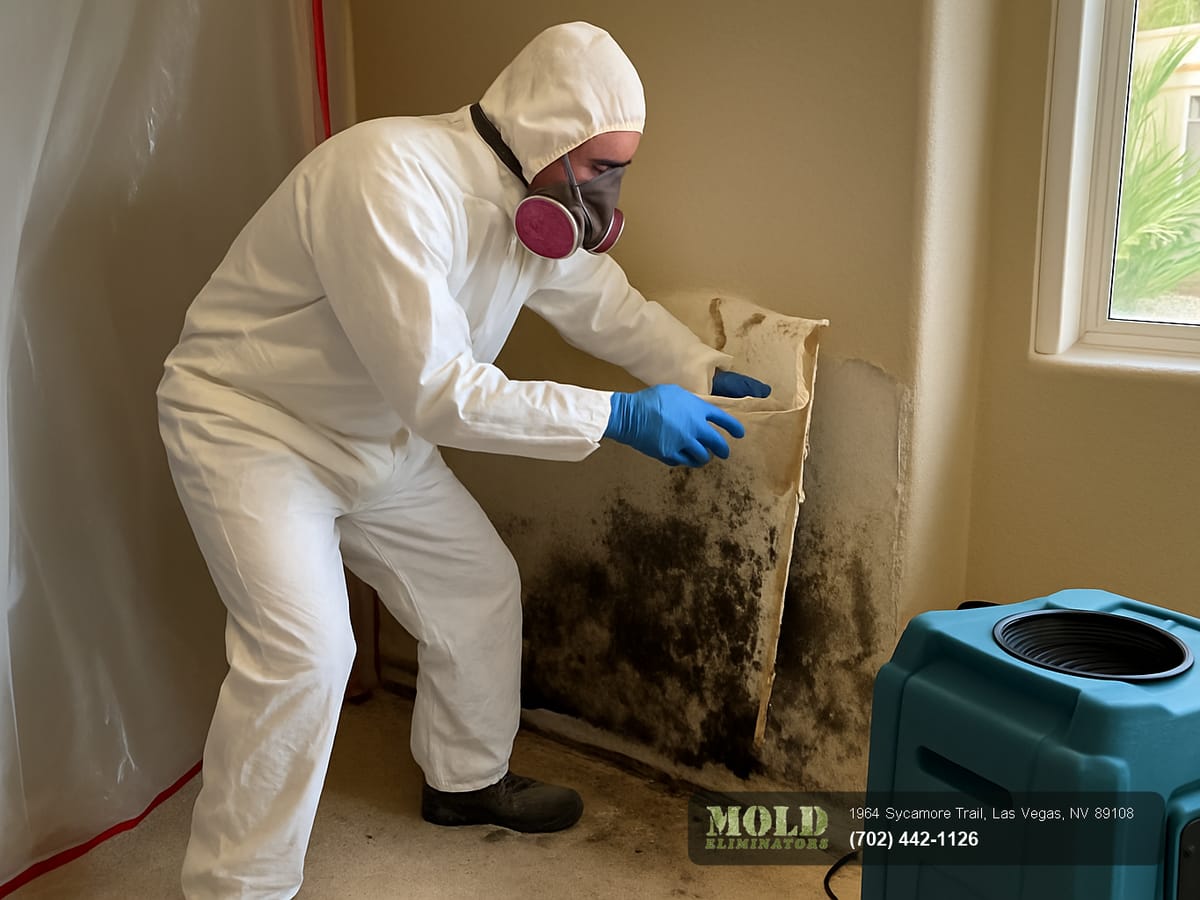
The moment you start cutting moldy drywall, you disturb millions of spores and release them into the air. Without containment, those spores travel on air currents and the cleanup itself becomes the thing that spreads the problem to clean rooms. This is why a proper job seals the work area before any board comes down.
Containment means plastic sheeting taped over doorways and vents, and a negative-air machine running a HEPA filter so the work zone is held at lower pressure than the rest of the home. Air flows into the contained space and out through the filter, never back into your living areas. Technicians wear respirators and disposable suits, and contaminated material is bagged inside the containment before it is carried out.
This is also where the no-subcontractor difference matters. Every technician on the job is a certified W-2 employee, not a stranger brokered in for the day, so the people setting containment are the same people accountable for the result. If your name is on it, our people did it.
- Seal the zone. Plastic sheeting over doors, vents, and openings isolates the work area from the rest of the home.
- Go negative. A HEPA negative-air machine holds the area under lower pressure so spores cannot drift out.
- Protect and remove. Technicians in respirators cut, bag, and remove contaminated drywall inside the containment.
- HEPA clean and dry. Surfaces are HEPA vacuumed and the cavity is dried before anything is rebuilt.
Wet drywall and water damage: the link you cannot skip
 Water staining at the base of a wall pointing to hidden moisture
Drywall mold is a symptom. The disease is water. Mold cannot grow on drywall that stays dry, so wherever you find growth there was, or still is, a source of moisture feeding it: a slab leak, a failed supply line, a roof leak, a leaking shower pan, or condensation off a swamp cooler line. Remove the moldy board, ignore the leak, and you are simply scheduling the next colony.
That is why this work belongs to the same conversation as water damage restoration. We trace the moisture to its source, fix or coordinate the repair, and then dry the structure to a documented standard. Drywall that got wet, even without visible mold yet, often needs to come out anyway, because a colony invisible today becomes a visible one within 24 to 72 hours of staying damp.
If you are still in the active leak or flood, that is an emergency, and the faster the water comes out the less drywall has to. Our 24/7 emergency response reaches most Las Vegas valley homes within an hour, because the timeline between wet and moldy is short.
Replacement: rebuilding the wall the right way
Once the contaminated board is out, the cavity is HEPA vacuumed, the framing is checked and dried, and the area is verified clean, the wall can be rebuilt. Replacement is the easy part, but it should never happen before the cavity is confirmed dry and clear. Closing a wall over damp framing or remaining growth simply hides the problem behind fresh paint.
New drywall is cut to the opening, screwed to the studs, taped, mudded, sanded, and finished to match the surrounding wall. In a kitchen, bathroom, or laundry, mold-resistant board with a fiberglass facing instead of paper is a smart upgrade, since it gives mold nothing organic to feed on if moisture ever returns.
Before the rebuild closes, we confirm the air and surfaces pass, ideally with an independent clearance test. Verification is not optional. Reading the result against an accredited third-party lab is how you know the wall is genuinely clean and not just freshly painted. We offer free inspection, and because the lab has no incentive to oversell, the number you get is the truth, not a sales tool.
What drywall mold removal costs in Las Vegas
Honest answer: it depends, and anyone who quotes a flat figure sight unseen is guessing. A small, contained patch from a single leak, with a few square feet of board removed, is a modest job. A whole wall behind a long-running slab leak, with insulation and framing involved, is a larger one. The honest drivers of cost are how much board is colonized, how far the moisture traveled, how accessible the area is, and whether the underlying leak still needs repair.
Containment, HEPA filtration, certified labor, and verified clearance are what separate a real remediation from a cosmetic patch, and they are reflected in the price. For a full breakdown of what shapes the number, see our guide to mold removal cost. What we will not do is invent square footage. If the affected area is smaller than you feared, the quote reflects that, and we will tell you so.
We serve homes across Las Vegas, North Las Vegas, Spring Valley, Paradise, Henderson, and Summerlin. You can see the full service areas we cover, and for anything specific to your wall, the fastest path to a straight answer is to contact us.
Common questions about drywall mold removal
- Can I just paint over moldy drywall?
- No. Paint, including mold-blocking primer, seals the surface but does nothing to the colony living in the paper and gypsum behind it. The mold keeps growing under the paint and reappears. Colonized drywall is removed, the cause is fixed through proper mold remediation, and only then is a new wall installed.
- How do I know mold is inside the wall and not just on it?
- Common signs are a musty smell that persists after cleaning, staining that returns, bubbling or soft drywall, and a history of leaks in that spot. The reliable way to confirm is a mold inspection with moisture readings, since hidden growth in the cavity often shows almost nothing on the visible surface.
- Will the mold come back after the drywall is replaced?
- Only if the water source was never fixed or the wall cavity went back together still damp. That is why we trace and resolve the moisture, complete structural drying to a documented standard, and verify the area is dry before rebuilding. Solve the water and the mold has nothing to return to.
- Is drywall mold dangerous enough to leave the house over?
- We do not trade in scare tactics. A contained, properly handled removal lets most homeowners stay home while sensitive rooms are sealed off. We will give you a calm, honest read on your specific situation rather than a worst-case sales pitch.
No upsell, no fear-mongering
Not sure how far the mold has spread? Let us look first.
We will test it with an independent lab, tell you exactly what we find, and only remove what truly has to come out. Free mold inspection, certified in-house technicians, and one-hour emergency response across the Las Vegas valley.