Asbestos Testing in Spring Valley, NV
You are mid-remodel in a Peccole Ranch townhome, or a tenant in one of the dense apartment blocks off Spring Mountain Road, and the popcorn ceiling that just came down is older than you expected. Before that dust gets disturbed any further, there is one question worth answering with data rather than a guess: does this material contain asbestos? In Spring Valley, where so much of the housing stock went up in the 1980s and 1990s, that question comes up far more often than people think, and the safe move is testing before demolition, not after.
Asbestos testing is the step that tells you what you are actually dealing with before a saw, a sander, or a swamp cooler retrofit turns a quiet ceiling into airborne fibers. At Mold Eliminators it is handled to the same documented, no-shortcuts standard as our remediation work. Our founder Craig Herrmann is IICRC Master Certified and co-authored the ANSI/IICRC S520 standard, so when we sample a suspect material, the chain of custody and the analysis are done by the book, not improvised on the tailgate.
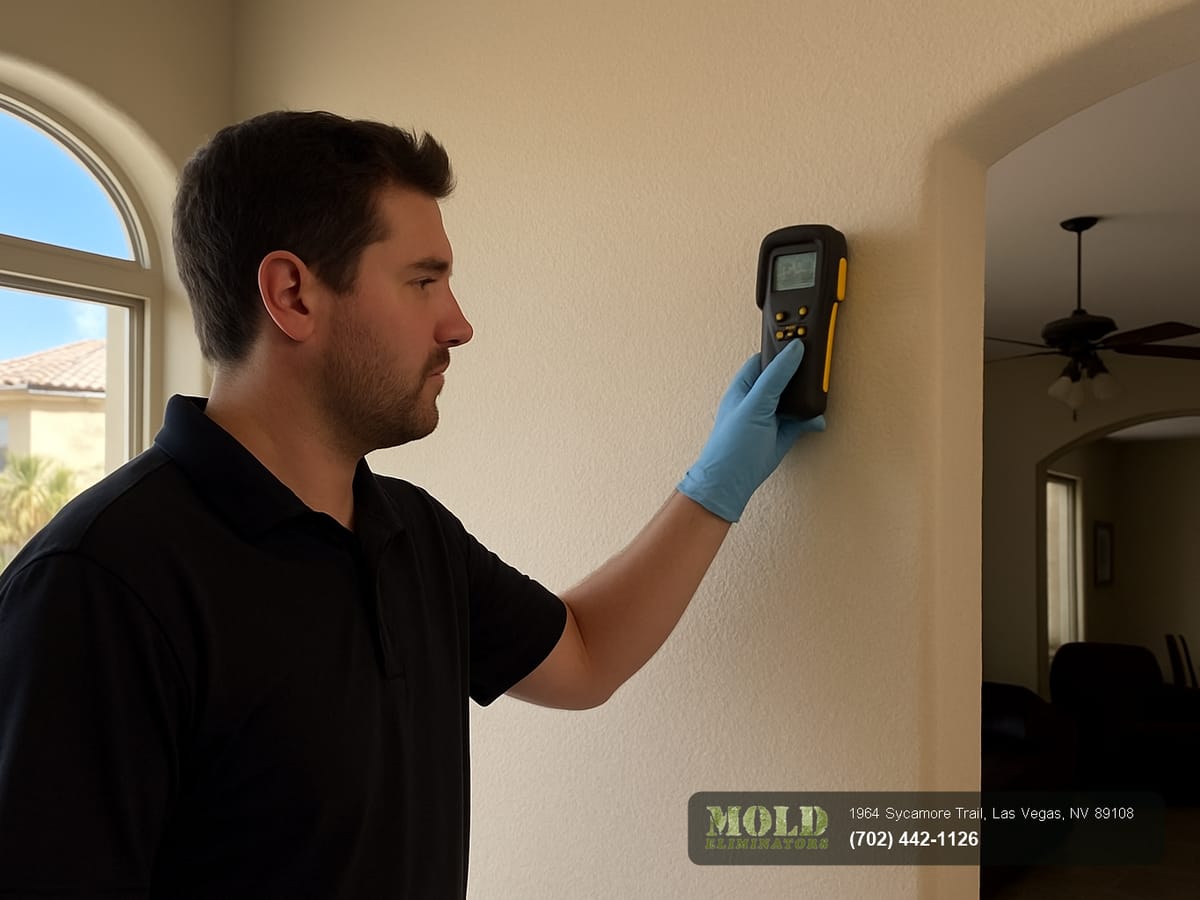 Suspected asbestos-containing ceiling material in a Spring Valley townhome being assessed before demolition
Why asbestos testing comes up so often in Spring Valley
Spring Valley is one of the most densely built parts of the valley, and its building age is exactly the window where asbestos shows up. Across zips 89117, 89146, 89147, and 89148 you have a heavy concentration of condos, townhomes, and apartment complexes built through the 1980s and into the 1990s, the years when asbestos was still legally used in popcorn ceiling texture, vinyl floor tile and the mastic under it, drywall joint compound, and pipe and duct insulation. A single mid-rise complex near the Spring Mountain Road and Chinatown corridor can hold dozens of units that all share the same era of construction materials, which means one suspect material rarely stays one unit’s problem.
The shared-wall density is the part that makes Spring Valley specific. In a detached Summerlin home, disturbing an old ceiling affects one household. Here, an upstairs unit pulling up old floor tile, or a leak that soaks a shared ceiling assembly, can put a downstairs neighbor in contact with the same material across a party wall. We see it constantly in the townhome rows of Peccole Ranch and the planned blocks around Rhodes Ranch: an upstairs leak becomes a downstairs ceiling problem, and the moment that wet, sagging texture has to come out, the asbestos question becomes urgent rather than academic.
Then there is the HOA layer. When a suspect material spans a common assembly, a shared roof, a stack wall, or a building-wide duct run, responsibility for testing and abatement is frequently disputed between the owner and the association. A clear, independently analyzed test result is what settles those disputes, because it replaces opinion with a lab number. Asbestos testing is a close cousin of our asbestos testing work valley-wide, and it pairs naturally with the broader services we run across Spring Valley.
Need help now?
Talk to a Las Vegas expert
In-house certified crews. One-hour emergency response across the valley, 24/7.
The local triggers we see, swamp coolers, leaks, and remodels
Most asbestos exposure does not come from the material sitting quietly. It comes from disturbance, and Spring Valley has its own recurring sources of disturbance worth naming.
The common thread is simple: in Spring Valley’s housing of this age, the safe assumption is that suspect material might contain asbestos until a lab says otherwise. Testing first is cheaper, calmer, and safer than cleaning up after an uninformed demolition. If water damage is part of the picture, our 24/7 emergency response can stabilize the moisture without spreading the very dust you are trying to contain.
 Sampling a suspect ceiling material under controlled conditions in a Spring Valley unit
How we test, to the standard, with no upsell
We treat sampling as a controlled procedure, not a quick scrape. The goal is an accurate answer with a clean chain of custody, gathered without releasing fibers in the process.
- Free on-site inspection. We come out, look at the suspect materials in context, and identify what genuinely needs sampling. The on-site inspection is free. If we can tell you a material does not need testing, we will, because we would rather keep your trust than pad an invoice.
- Controlled sampling. Where lab analysis is warranted, samples are taken under controlled conditions to avoid releasing fibers, then sealed and labeled with a documented chain of custody.
- Independent third-party lab. Samples go to an independent accredited lab, billed at cost, not to an in-house bench with a reason to find work. The lab determines presence and type, so the result is impartial.
- Plain-language findings. You get the lab result and a clear explanation of what it means for your remodel, your tear-out, or your HOA dispute, with no pressure and no scare tactics.
- A safe path forward. If asbestos is present, we lay out the containment and abatement options to the same documented standard. If it is not, you proceed with your project with the paperwork to prove it was checked.
Why local, in-house, and independent lab all matter here
The structure of how a company is run changes the answer you get, and in a place like Spring Valley those structural choices matter more than a logo. Three of ours are worth understanding before you hand anyone a sample.
No subcontractors. Every technician who sets foot in your unit is an in-house W-2 certified employee, not a day-labor sub a franchise dispatched and never met. In a shared-wall building, where a sampling mistake can put a neighbor’s air at risk, accountability cannot be outsourced. One crew owns the visit, the sampling, and the documentation start to finish.
An independent third-party lab. We do not analyze our own samples, because a company that both tests and abates has a built-in incentive to find asbestos. By sending samples to an independent accredited lab, billed at cost, we separate the diagnosis from the work. If lab analysis is warranted, you get an impartial number, and if it is not, you do not pay for a test you did not need. This is the same anti-upsell discipline our founder built into the firm since 1996.
To the S520 standard. Craig Herrmann is IICRC Master Certified and co-authored the ANSI/IICRC S520 standard the industry works to. That is not a marketing line, it is the rulebook. When the testing, documentation, and any follow-on work are run to that standard, an HOA board, an insurer, or a buyer’s inspector can rely on the result. You can read more about Craig’s credentials, and when you are ready, reach us directly with no call center in between.
Why Spring Valley owners and managers call Mold Eliminators
Certified to the standard
Craig Herrmann is IICRC Master Certified and co-authored the ANSI/IICRC S520 standard. Your sampling and documentation are run by the rulebook, not improvised. More about Craig.
Impartial results
Samples go to an independent third-party lab, billed at cost. We separate the diagnosis from the work, so the answer you get is honest, not an excuse to sell abatement.
Local and in-house
No subcontractors. Certified W-2 technicians, 1-hour emergency response 24/7 across Spring Valley, one accountable crew from the first sample to the final result.
That is the whole difference. A franchise sends a sub, tests and abates under one roof, and hands you a result you cannot fully trust. We inspect for free, sample to the standard, and let an independent lab return an impartial number, so a remodel, a tear-out, or an HOA dispute rests on data. The same discipline runs through all our Spring Valley services.
Asbestos testing in Spring Valley, common questions
- Is the inspection really free, or is there a catch?
- The on-site inspection is genuinely free. We come out, look at the suspect materials, and tell you what does and does not need sampling. If lab analysis is warranted, the samples go to an independent third-party lab and are billed at cost, so you pay only for the analysis itself, not a marked-up package. We would rather keep your trust than sell you a test you do not need.
- Our condo association and I disagree on who pays. Can a test settle it?
- Often, yes. In Spring Valley’s dense condos and townhomes off Spring Mountain Road and through Peccole Ranch, responsibility disputes usually hinge on what the material actually is and where it sits. A documented, independently analyzed result replaces opinion with a lab number that both an owner and an HOA board can rely on. We provide the chain of custody and findings in plain language so the conversation moves from argument to fact. If water damage is also involved, our emergency team can stabilize it first.
- An upstairs leak soaked my ceiling. Do I need testing before it comes out?
- If the building dates to the 80s or 90s, which most of the 89117, 89146, 89147, and 89148 stock does, the safe answer is yes. Wet popcorn texture or drywall has to be cut out, and that demolition is exactly what releases fibers if the material is asbestos-bearing. Test first, then remove safely. Booking a free inspection is the fastest way to find out where you stand before anything gets disturbed.
Suspect material in your Spring Valley unit? Get a free inspection first.
Free on-site inspection, no pressure, no upsell. If lab analysis is warranted, samples go to an independent third-party lab, billed at cost. 1-hour emergency response, 24/7, across Spring Valley. Test before you tear out.