Can flood water make me sick?
Yes, flood water can make you sick. Flood water is rarely clean: it can carry sewage, bacteria, chemicals, and the moisture that lets mold bloom indoors within 24–72 hours. The health risk comes less from the water itself and more from what it leaves behind, contaminated materials and a damp structure that grows mold for weeks after the visible water is gone.
If you have been exposed to flood water, the practical question is not just “am I going to get sick today,” it is “what is still in my home that could keep affecting my family.” This is a health question, so the honest answer matters. Below is a plain-English explanation of why flood water carries risk, what to watch for, and the calm, measured steps that actually reduce it.
Why flood water carries a health risk
Restoration professionals classify water by how contaminated it is, a framework built into the ANSI/IICRC standards that govern this work. Our founder, Craig Herrmann, co-authored the ANSI/IICRC S520 mold standard, so this is not a marketing claim, it is the rulebook the industry is held to. Under that framework, flood water from outside almost always counts as the most contaminated category.
Clean water from a snapped supply line is one thing. But flood water that has traveled across the ground, through a yard, or up from a sewer line picks up whatever it touches: soil bacteria, pesticides, fuel and chemical runoff, and human or animal waste. That is why a ground flood or a sewage backup is treated as Category 3 water, water that is grossly contaminated and can carry pathogens. The porous materials it soaks, carpet, drywall, insulation, usually cannot just be dried and saved. They have to be removed.
The second risk is slower and often the one people miss. Even after the standing water is gone, the structure stays wet inside, and a damp building is exactly what mold needs to colonize. Mold spores are present in every home, harmlessly, all the time. They only bloom into a colony when they find a wet surface to feed on. A flooded structure that is not dried to standard becomes that food source, and the mold that follows can keep affecting indoor air long after the flood itself is a memory.
Need help now?
Talk to a Las Vegas expert
In-house certified crews. One-hour emergency response across the valley, 24/7.
What flood-related illness can look like
We are a restoration company, not a medical provider, so please treat any real symptoms as a reason to call your doctor, not us. With that said, here is the plain context homeowners ask for. Illness tied to flood water generally comes from two sources: direct contact or ingestion of contaminated water, and ongoing exposure to mold and damp indoor air afterward.
“Is finding out free?” Here is the honest answer
People often assume that having a flooded home checked for mold means free lab work. It does not, and it is worth being clear, because health decisions should rest on accurate information. The on-site free inspection is the free part: a certified technician comes to your property, looks for moisture and visible growth, and tells you plainly whether there is a problem and how serious it is. There is no charge and no pressure for that visit.
Lab analysis is a separate, paid add-on. If the inspection suggests that air or surface samples are warranted, those samples go to an independent third-party lab and are billed at cost. We use an outside lab on purpose, so the company telling you whether you have mold is not the same company profiting from the result. That separation is the whole point of doing it honestly. If your home does not need testing, we will tell you, that anti-upsell honesty is the reason people call us.
So the accurate way to frame it: the inspection that tells you whether flood water left a health risk behind is free. The lab work that confirms the specifics, if it is even needed, is paid and done by a neutral party. You always know which is which before anything is spent.
What to do next after flood water
The first hours matter. Mold can begin to colonize wet materials within roughly 24–72 hours, so the goal is to reduce exposure and start drying fast, then verify what is actually safe. Here is the calm sequence we walk homeowners through.
- Protect people first. Keep vulnerable family members out of the affected area, avoid skin contact with the water, and ventilate if it is safe to do so. If anyone has real symptoms, call a doctor, not a restoration company.
- Stop the source and stay safe. If water is still entering, shut it off where you safely can, and never touch electrical fixtures in standing water.
- Get it inspected before assuming it is fine. A flooded structure that looks dry on the surface can stay soaked inside for weeks. A free on-site mold inspection measures whether moisture or growth is actually present, instead of guessing.
- Dry and remediate to standard. Clean water gets dried to verified targets. Contaminated flood water means the soaked porous materials usually come out, and any growth is handled by proper mold remediation with independent lab verification at the end.
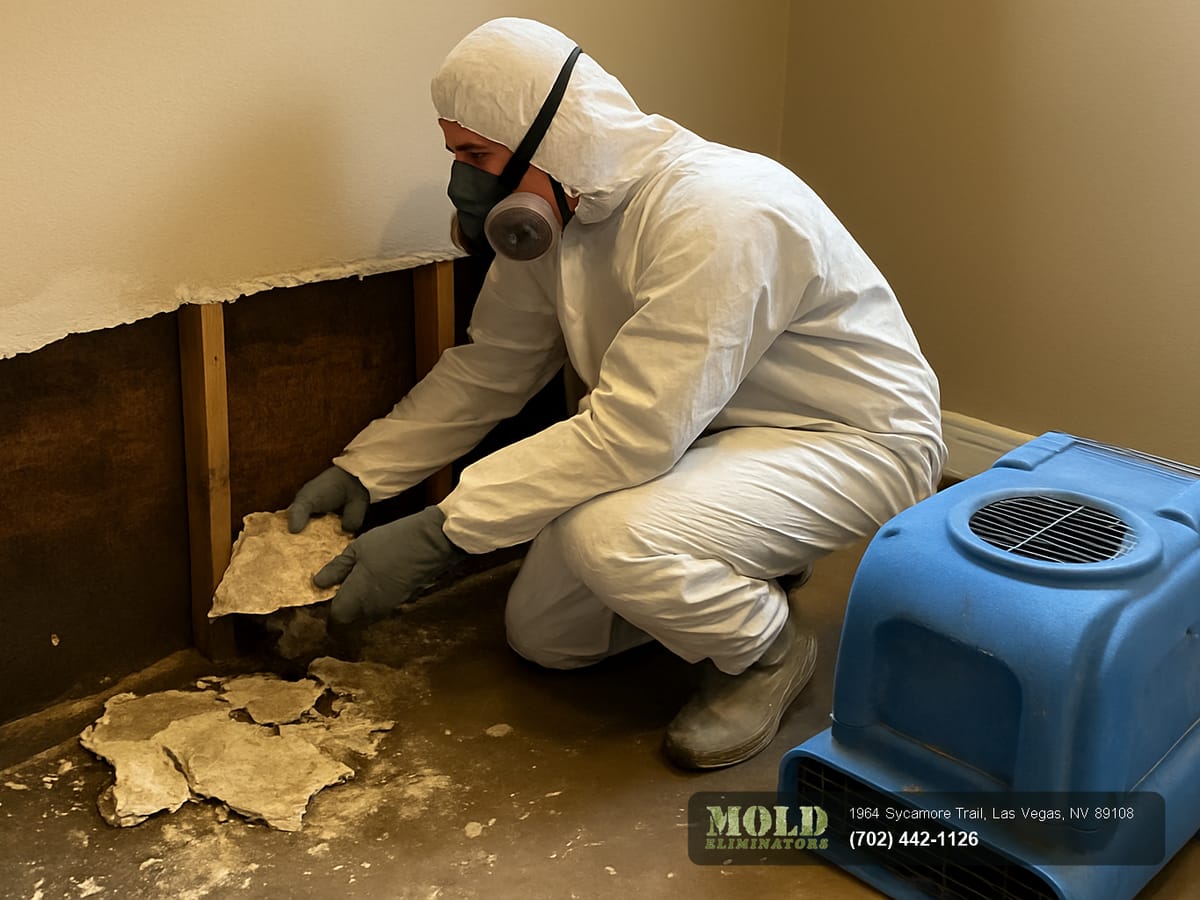 Certified technician inspecting a flood-affected room for moisture and mold
Related questions
- How long after a flood does mold start to grow?
- Mold can begin colonizing wet organic materials, paper-faced drywall, wood framing, within roughly 24–72 hours of getting wet. That is why drying is treated as an emergency, not a scheduled appointment. The faster a structure is dried to a verified standard, the lower the mold risk drops. If a past flood was never properly dried, the most contaminated and persistent growth is often the toxic black mold known as Stachybotrys, which thrives on materials that stayed wet.
- Is black mold from flooding dangerous?
- Mold that takes hold in a flood-damaged home should be taken seriously, especially for people with asthma, allergies, or weakened immune systems. We do not diagnose health conditions, that is a doctor’s role, but we do remove the source. The standards-based answer on what is and is not safe traces back to the ANSI/IICRC S520 work that our founder Craig Herrmann co-authored, which defines how contaminated growth is contained and removed.
- Can I just dry the house myself and skip the inspection?
- For a tiny, quickly-caught clean-water spill on a hard surface, sometimes. But flood water is usually contaminated, and household fans cannot pull moisture out of a soaked wall cavity fast enough to beat mold’s clock. Without moisture readings you are only guessing whether it is dry, and guessing is how a health problem gets missed. A free on-site free inspection measures it instead.
Worried flood water left something behind? Get a free on-site inspection.
A certified technician inspects your property at no charge and tells you plainly whether moisture or mold is a problem. If lab analysis is warranted, samples go to an independent third-party lab, billed at cost. One-hour emergency response, 24/7, across the Las Vegas valley.