Sewage Cleanup in Paradise, NV
Sewage Cleanup, Paradise NV
A sewage backup in Paradise is rarely a quiet, single-room problem. Between the Strip resort corridor, the high-rise condo towers along the airport flight path, and the older garden-apartment blocks near UNLV, a single failed line can push contaminated water across several units, down an elevator shaft, or through a parking podium before anyone smells it. When that happens, you do not have a cleaning job. You have a Category 3 biohazard that has to be contained, removed, and verified to a written standard.
Mold Eliminators handles sewage cleanup in Paradise the way the national standard demands it be handled: contain the contamination, remove what cannot be salvaged, dry what can, and verify the result with an independent lab. Our founder, Craig Herrmann, co-authored the ANSI/IICRC S520 mold remediation standard and carries IICRC Master Certified credentials, so the work follows the rulebook rather than a franchise checklist. We have run sewage and water losses in Strip-corridor towers and Paradise commercial buildings since 1996, across more than 255 properties.
 Contained sewage cleanup work area inside a Paradise NV high-rise corridor
What sewage backups look like in Paradise
Paradise is not a city of single-story tract homes. It is the unincorporated heart of the Las Vegas valley: the resort corridor of the Strip, the condo and timeshare towers stacked along Harmon, Flamingo, and Koval, the campus blocks around UNLV and Maryland Parkway, and the hotel and warehouse districts hugging Harry Reid International. That density changes how sewage failures behave, and it is why a generic cleanup plan written for a suburban slab house tends to miss the real problem here.
In the high-rise condo towers across 89109 and 89169, the common failure is a cascading vertical leak. A blocked stack or a backed-up branch line on an upper floor does not stay on that floor. It follows gravity through the chase walls and ceiling assemblies into the units below, so a single backup can contaminate three or four stacked bathrooms before the owner on the top floor even notices a slow drain. By the time the smell reaches a hallway, the water has already wicked into shared wall cavities and the concrete topping slab between floors.
In the commercial and hospitality buildings nearer the airport in 89119 and 89120, the issue is usually scale and access. Restaurant grease lines, banquet-kitchen floor drains, and aging main laterals under big-footprint buildings back up under load, and the affected area is often a back-of-house corridor or a basement mechanical room that nobody walks through until it is a foot deep. The older garden apartments and fourplexes near Maryland Parkway add a different wrinkle: shared laterals between units, so one tenant’s backup becomes the whole building’s biohazard.
What all of these share is that the contaminated water touches porous materials, drywall, carpet pad, cabinet bases, insulation, that cannot simply be mopped and reused. Category 3 water carries bacteria and pathogens, and the S520 standard is clear that affected porous materials are removed, not just dried. That is the line between a real remediation and a cosmetic cleanup that leaves a hidden colony growing behind a freshly painted wall.
Need help now?
Talk to a Las Vegas expert
In-house certified crews. One-hour emergency response across the valley, 24/7.
How we handle Paradise sewage cleanup to the S520 standard
Sewage is the most contaminated water class a building can take on, so the sequence is not negotiable. Because Craig co-authored the S520 standard, the crew that arrives at your tower or your building runs the same documented process every time, start to finish, with no handoffs to an outside company.
- Assess and contain first. Before anything is touched, we identify the full spread of contamination, often wider than the visible water thanks to vertical migration in high-rises, and seal the work area with containment and negative air so spores and bioaerosols do not travel through corridors, elevator lobbies, or shared HVAC.
- Extract the contaminated water. Standing sewage is physically extracted rather than evaporated, which is faster and keeps the contamination from spreading further into the structure below.
- Remove unsalvageable porous materials. Per S520, drywall, carpet, pad, affected insulation, and cabinet bases that absorbed Category 3 water are cut out and bagged as biohazard, not dried in place and hoped over.
- Clean and disinfect. All salvageable structure and hard surfaces are cleaned and treated with appropriate antimicrobials, then the cavity is opened so the assembly can actually dry.
- Structural drying. Commercial dehumidifiers and air movers bring the remaining framing and slab back to a documented dry target. In tower work this is where the concrete topping slabs between floors matter most, because they hold moisture long after the surface feels dry. See our full sewage cleanup process for the deeper detail.
- Verify with an independent lab. When the work is done, post-remediation samples go to an independent third-party lab, not graded by the technician who did the work, so the clearance is objective.
That last step is the one most companies skip, and it is the one that protects an owner, an HOA board, or a property manager when the question of liability comes up later. A documented, lab-verified result is the difference between “we cleaned it” and “here is the proof it is clean.”
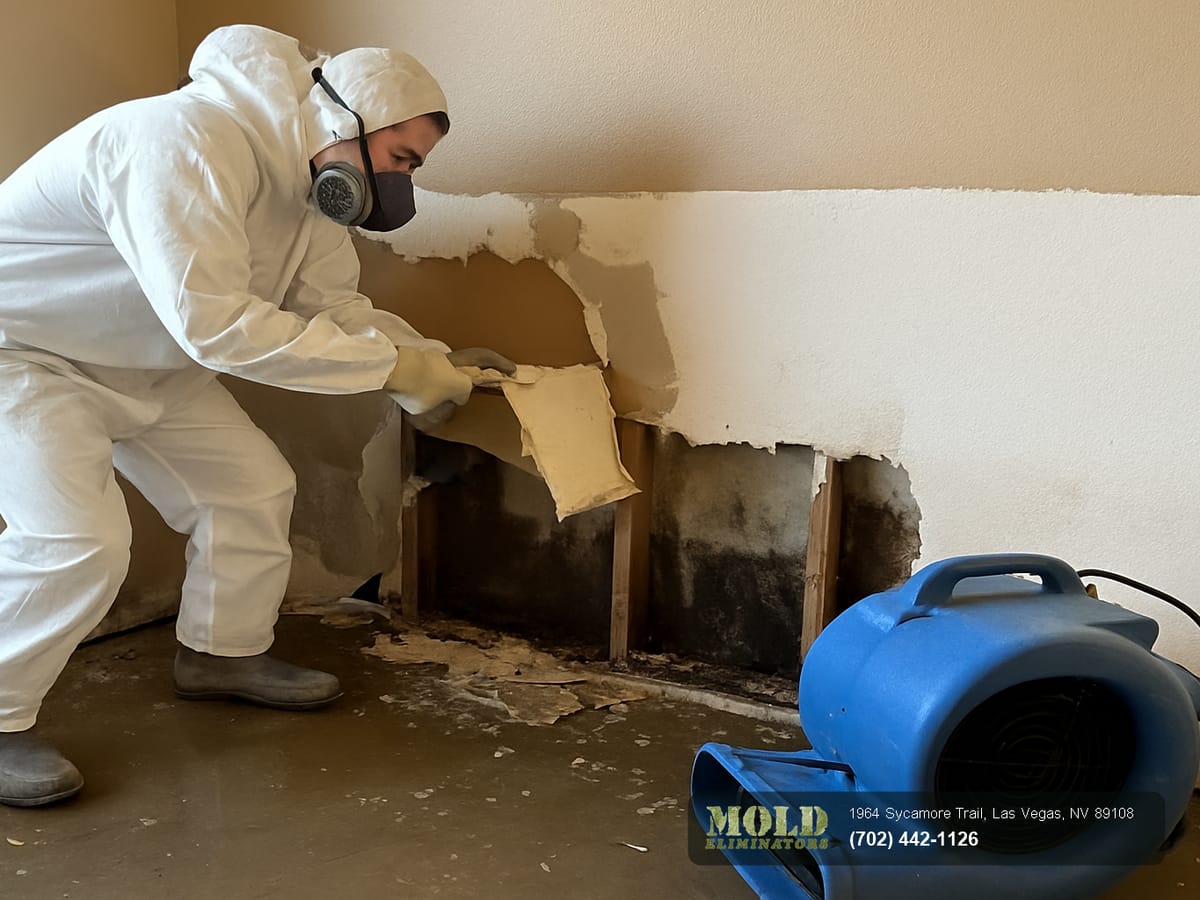 Mold Eliminators technician documenting moisture readings during a Paradise sewage remediation
Why local, in-house, and independently verified matters in Paradise
Paradise’s building stock punishes shortcuts. Tight after-hours access, controlled elevator and loading-dock entry, security desks, and HOA rules mean a crew that does not know how to work a high-rise wastes hours that the contamination uses to spread. We have run Strip-corridor and tower losses for years, so we plan the access, the containment route, and the elevator protection before the trucks arrive.
Just as important: we use no subcontractors. Every technician on your job is an in-house, W-2, certified employee, so there is one chain of responsibility from the first containment wall to the final lab clearance. When a backup crosses unit lines in a condo tower, the last thing an owner or board needs is three companies pointing at each other. One crew owns the whole job.
And the lab that verifies the result is an independent third party, not us. That independence is what lets a documented Paradise sewage cleanup stand up to an insurance adjuster, a property manager, or a buyer’s inspector. We are also deliberately anti-upsell: if a portion of the structure can be saved and verified rather than torn out, we tell you, because the standard, not the invoice, sets the scope.
Why Paradise property owners call Mold Eliminators
Built for towers and the Strip corridor
Craig Herrmann brings high-rise and Strip-corridor expertise to every job. We plan elevator access, containment, and negative air for vertical, multi-unit losses, the way Paradise’s condo towers and hospitality buildings actually fail. Read more about Craig’s credentials.
One in-house crew
No subcontractors. Every technician is a certified W-2 employee, with 1-hour emergency response, 24/7. One crew owns the containment, the removal, the drying, and the clearance from start to finish.
Verified, not declared
Post-remediation samples go to an independent third-party lab. “Clean” means a number on a report an adjuster or HOA board will accept, not a technician’s word.
Working since 1996 across more than 255 valley properties, we hold a Category 3 job to the S520 rulebook from the first containment wall to the final verified clearance. If you are not sure how far a past backup spread, a free inspection is the calm, factual way to find out, or you can reach us directly with no call center in between.
Sewage cleanup in Paradise: common questions
- A backup in an upstairs unit reached my Paradise condo. Whose problem is it?
- In a multi-unit tower the contamination almost always crosses unit lines, which is exactly why a documented, lab-verified cleanup matters. We map the full spread, contain it, remove the affected porous materials per S520, and provide independent lab clearance so an HOA board or insurer can see precisely what was contaminated and what was restored. That record is what keeps a shared-line backup from turning into a finger-pointing dispute.
- How fast can you reach a Strip-corridor or airport-area building after hours?
- We run 1-hour emergency response, 24/7, across Paradise and the wider valley, and we plan the hard part, controlled elevator and loading-dock access, security check-in, and containment routing, on the way in. Sewage is time-sensitive: the longer Category 3 water sits in a wall cavity or a concrete topping slab, the more material has to come out, so the first call should not wait for morning.
- Will you tear out my walls, or can some of it be saved?
- Only the porous materials that actually absorbed contaminated water are removed, and the standard, not the invoice, sets that line. We are anti-upsell by policy: where structure can be cleaned, dried, and verified instead of demolished, we tell you. If lab analysis is warranted, samples go to an independent third-party lab, billed at cost, so the clearance is objective rather than something we grade ourselves.
Sewage backup in Paradise? Contain it right, verify it independently.
Free on-site inspection, no pressure. 1-hour emergency response, 24/7, across the Strip corridor, the tower districts, and the airport-area buildings. We hold the job to the S520 standard from the first containment wall to the independent lab clearance.