Structural Drying in Paradise, NV
A supply line lets go on the 18th floor of a tower off Harborside, or a chiller line weeps behind a resort corridor wall near the Strip, and by the time anyone notices, the water has already traveled three units down. The carpet on the affected floor looks dry within a day. The framing, the gypsum board, and the post-tension slab underneath are still soaked. In a Paradise high-rise that hidden moisture does not just threaten one unit, it crosses unit lines, rides down shafts, and quietly starts a mold problem the whole board ends up arguing about.
Structural drying is the engineering step that decides whether a water event in Paradise ends cleanly or becomes a stacked, multi-unit mold claim. It is the bridge between a water emergency and a verified-dry structure, and in the resort corridor it carries extra weight, because cascading leaks, tight after-hours access, and shared assemblies make every hour count. At Mold Eliminators it is done by an in-house crew led by Craig Herrmann, who co-authored the ANSI/IICRC S520 standard and has spent years working high-rise and Strip-corridor properties. The drying is measured, documented, and driven to a real dry target, not guessed at with a few fans.
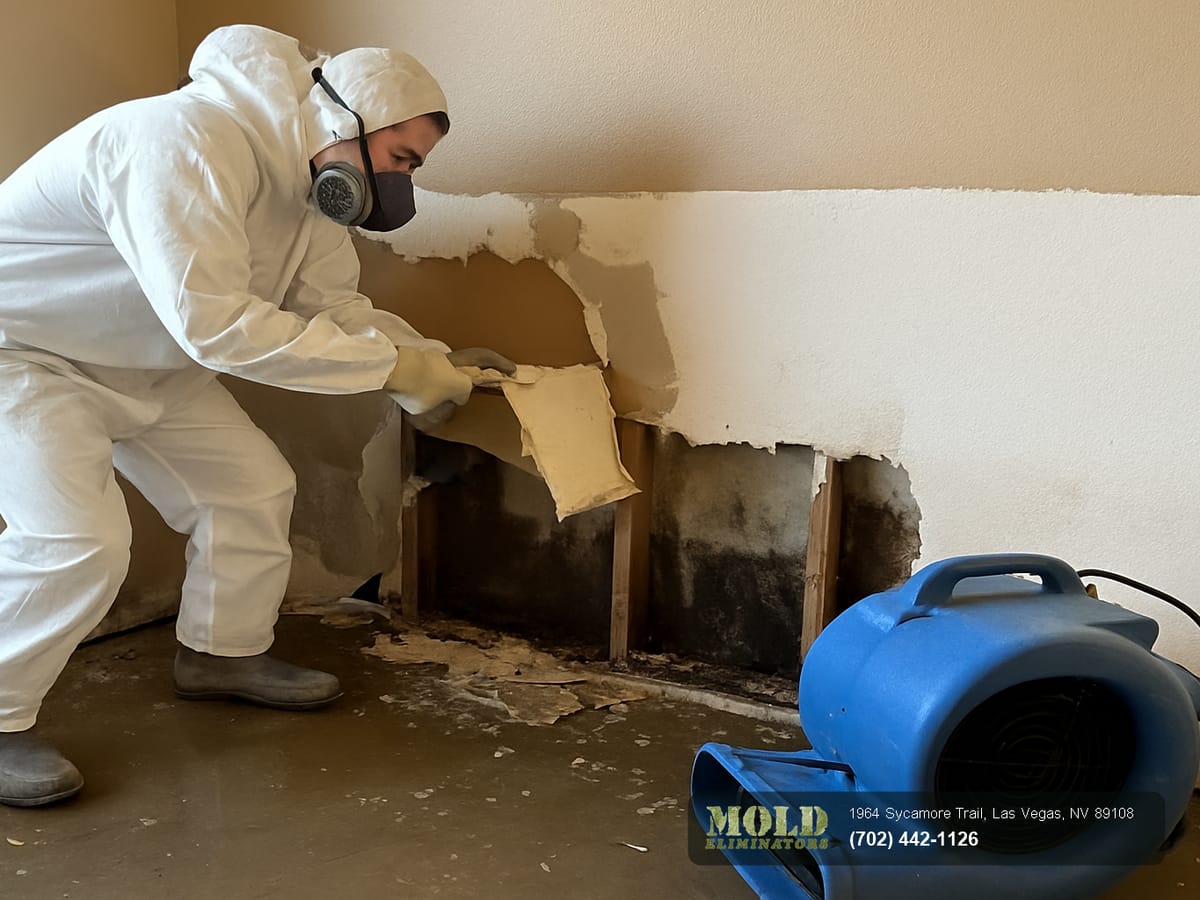 Structural drying equipment running in a Paradise NV high-rise unit after a cascading water leak
How water damage shows up in Paradise
Paradise is not a city of detached homes with a single slab leak to chase. It is the unincorporated heart of the Las Vegas Strip resort corridor, dense with high-rise condo towers, hospitality buildings, and mid-rise complexes around the 89109, 89119, 89169, and 89120 zips. The water events here have a vertical, shared character that changes everything about how drying has to be handled.
The signature Paradise problem is the cascading leak. A failed supply line, a burst fan-coil hose, a sprinkler activation, or a tower plumbing riser that lets go does not stay on one floor. Gravity carries it down through the assembly: into the unit below, then the one below that, soaking shared wall cavities, ceiling assemblies, and the concrete decks between floors. By the time the building engineer reaches the source, the affected area is a vertical column of wet units, not a single room. Around UNLV and Maryland Parkway, the older garden-style and mid-rise rentals add their own version, aging galvanized plumbing and shared attic and joist spaces that let a single unit’s leak travel sideways into neighbors.
The desert adds a quiet twist on top of that. Tenants and unit owners assume the dry Las Vegas air will simply evaporate the problem away, so a soaked wall cavity gets left for days. It will not air-dry on its own. Concrete decks and post-tension slabs in these towers hold water far longer than people expect, and a deck that feels dry on top can stay saturated underneath for weeks, feeding mold in the units on both sides of it. Proper structural drying is what stops that from happening, and in a tower it has to be done as one coordinated job across every wet unit at once.
Need help now?
Talk to a Las Vegas expert
In-house certified crews. One-hour emergency response across the valley, 24/7.
The 24 to 72 hour window, and why Strip-corridor access makes it harder
There is a clock on water damage and it is not generous. Mold can begin to colonize wet organic materials within roughly 24–48 hours, and after about 72 hours the conversation shifts from dry it and save it to remove it and remediate. Most of a building is organic enough to feed it: paper-faced gypsum, wood blocking, cabinetry, and the backing behind the finishes. In a high-rise, that clock runs in every wet unit at the same time, so a delay does not multiply the cost by one room, it multiplies it by a stack of floors.
What makes the resort corridor uniquely hard is access. A Paradise tower is not a house you walk into with a hose. Equipment has to come in through a single service elevator, often only during approved after-hours windows so guests and residents are not disturbed, and a building engineer or HOA manager has to coordinate access to multiple private units before drying can even start. We plan for that. Our crews are set up to stage equipment, work freight-elevator and after-hours access, and move floor to floor so the controlled drying environment goes up across the whole affected column quickly rather than one slow unit at a time. When water is actively spreading through a tower, the right move is our 24/7 emergency response, with a one-hour response target so the column gets stabilized before it grows.
That speed is the whole point. The faster extraction, dehumidification, and air movement are working together in every wet unit, the more material is saved and the lower the mold risk drops across the building. A leak left sitting overnight because the board meets next week can turn a salvageable column of units into a tear-out that closes corridors and racks up special assessments. In the Strip corridor, hours genuinely decide the size of the claim.
Moisture mapping: finding the water that crossed unit lines
You cannot dry what you have not found, and in a high-rise the water rarely stops where the visible damage stops. Before a single fan is placed, we map exactly how far the water traveled, through which wall cavities, ceiling assemblies, and concrete decks, and how wet each material is. That map aims the equipment and defines the verified dry target we drive toward in every affected unit.
This is the part a company chasing a quick invoice skips, because it takes equipment, training, and time. It is also the part that makes drying honest, and in a multi-unit building it is the part that settles who is responsible for what. When we say a unit is dry, we can show the number, the location, and the day it got there. If lab analysis is warranted to confirm what the water left behind, samples go to an independent third-party lab and are billed at cost, never marked up, and never assumed when the readings already answer the question.
 Craig Herrmann directing applied structural drying to the S520 standard in a Paradise condo tower
Our structural drying process, to the S520 standard
Drying done right follows a deliberate sequence, the same one Craig built into the national standard, from the first reading to the final verified dry target across every affected unit.
- Source control and extraction. The active leak is stopped with the building engineer, then standing and absorbed water is physically extracted floor by floor, because pulling water out is far faster than evaporating it.
- Moisture mapping and baseline. We map every wet unit with meters and thermal imaging, log starting moisture levels, and set a documented dry target for each material in each unit.
- Containment. Affected areas are contained so drying air is controlled and so a wet, potentially contaminated assembly does not push problems into clean units or shared corridors.
- Dehumidification. Commercial dehumidifiers pull water vapor out of the air so each room stays drier than its wet materials, the engine that keeps moisture leaving the structure.
- Air movement. High-velocity air movers are placed by design, not at random, to sweep moisture off surfaces and into the air where the dehumidifiers can capture it.
- Daily monitoring. Every day, readings are taken and logged in each unit and the equipment is adjusted to keep drying on pace, the data drives the schedule, not the calendar.
- Drying to verified targets. Equipment comes out of a unit only when readings confirm every material has hit its dry standard. That verified-dry result is the finish line and the proof that mold has nothing left to feed on.
When drying alone is not enough
Structural drying saves a lot of units from demolition, but only when it starts in time and the water was clean. There are situations where drying is one part of a bigger job, and an honest restorer tells you which one you are in rather than selling a one-size package.
If the water sat too long before drying began, or it came in already contaminated, drying is not the whole answer. Water from a sewage backup or a ground-floor flood is Category 3, it carries bacteria and biohazard, and the porous materials it touched usually have to be removed, not just dried. And if mold already had time to take hold across a wet column before anyone started drying, the job becomes a containment-and-removal job built to the S520 standard Craig co-authored, with drying built into it, not drying alone.
The advantage of handling all of this under one roof is accountability, which matters enormously when a leak has crossed unit lines and an HOA needs one credible account of what got wet and what got dried. We do not dry your tower and then hand the board off to a separate mold company that points fingers when something was missed. One in-house W-2 certified crew owns the water, the drying, and the mold risk in every affected unit, from the first reading to the final verified-dry target. There are no subcontractors walking your building, one chain of responsibility, one standard, start to finish.
Why local, no-subcontractors, and an independent lab matter in Paradise
Built for the corridor
Craig Herrmann co-authored the ANSI/IICRC S520 standard, is IICRC Master Certified, and has worked high-rise and Strip-corridor properties for years. Towers near Harborside, Harmon, and the airport at Harry Reid get dried by someone who knows how cascading leaks and post-tension decks behave. Read more about Craig.
No subcontractors
Every technician is a certified W-2 employee, not a day-labor crew handed a badge for your building. In a secured Paradise tower with HOA access rules and after-hours windows, that means one accountable, vetted team coordinating with your engineer, with a one-hour emergency response target, 24/7.
Independent lab, billed at cost
When confirmation is warranted, samples go to an independent third-party lab and are billed at cost. We are anti-upsell, so lab analysis is recommended only when the structure warrants it, never bundled in to inflate a multi-unit invoice.
That is the whole difference. Where a national franchise drops a few fans and hands your building off, we map the moisture across every wet unit, dry to a verified standard, and document the result the same way our broader water damage restoration work is held to the rulebook. You can see how we serve Paradise, or just reach us directly, no call center in between. Dry it right, and mold never gets its chance.
Structural drying in Paradise, common questions
- A leak in our tower hit several units. Can you dry them all at once?
- Yes, and in a high-rise that is the only way it works. A cascading leak soaks a vertical column of units and the shared decks between them, so we map the whole affected area, then run dehumidification and air movement across every wet unit as one coordinated job. We coordinate freight-elevator and after-hours access with your building engineer or HOA, and we log readings unit by unit so the board and the adjuster see each one reach its verified dry target on the record.
- How long does structural drying take in a Paradise high-rise?
- Most jobs run roughly 24–72 hours of active drying per area, but the materials set the pace. Concrete decks and post-tension slabs common in these towers hold water longer than people expect, so we take daily readings and pull equipment from a unit only when every material hits its verified dry target. The data decides, not the calendar, and we will not leave machines running to pad a bill or pull them early to free one up.
- Is the inspection really free, and what about the lab?
- Yes, the on-site inspection is free for property owners, HOAs, and managers, no charge to come out, assess the water event, and tell you where you stand. If lab analysis is warranted to confirm what the water left behind, samples go to an independent third-party lab and are billed at cost, never marked up. We are anti-upsell, so we recommend testing only when the structure warrants it. A free inspection is the calm, factual place to start.
Water moving through your Paradise property? Dry it right before mold gets its chance.
Free on-site inspection for owners, HOAs, and managers. One-hour emergency response target, 24/7, across the resort corridor and the whole Las Vegas valley. We dry every affected unit to verified targets and document it, so the water problem ends here, not three weeks from now.