Mold Testing in Spring Valley, NV
A musty smell in a Spring Valley condo rarely starts where you notice it. The leak is upstairs, the stain shows up on your ceiling, and by the time anyone agrees whose problem it is, mold has had a week to settle into the shared wall between you. Mold testing is how you turn that guesswork into a documented answer: what is growing, where it is hiding, and how far the moisture actually traveled.
Mold testing in Spring Valley is its own kind of problem. This is a neighborhood of dense townhomes, mid-rise apartments, and tightly packed condos off the Spring Mountain Road corridor, where one unit’s plumbing failure quietly becomes the unit below’s ceiling problem. Mold Eliminators tests to the ANSI/IICRC S520 standard, with an owner who co-authored that standard, so the result you get is data an HOA board, an adjuster, or a neighbor can actually trust.
 Mold Eliminators inspector documenting a ceiling moisture stain in a Spring Valley condo
How mold shows up in Spring Valley
Spring Valley packs a lot of people into shared walls. From the condos and apartments along the Spring Mountain Road and Chinatown corridor to the master-planned streets of Peccole Ranch and Rhodes Ranch, a large share of the housing here is attached: townhomes, stacked flats, and mid-rise buildings where your ceiling is someone else’s floor. That construction changes how mold behaves. A supply line that fails in an upstairs unit does not stay upstairs. Water tracks down through the floor assembly and surfaces as a brown ring on the ceiling below, often in zip codes 89117, 89146, 89147, and 89148, and the colony grows inside the cavity long before the stain appears.
Then there is the swamp cooler problem, which is intensely local. Plenty of older Spring Valley homes and rentals still run evaporative coolers, and a unit that overflows or leaks at its roof curb feeds water straight into the ceiling and the top of an interior wall. Because a swamp cooler adds humidity by design, a marginal leak can keep an attic or a closet just damp enough to grow mold for an entire summer without anyone seeing a drip. We test those cavities specifically, because that is where Spring Valley hides its worst surprises.
And almost every multi-unit case here drags in a responsibility dispute. When moisture crosses a unit line, the HOA, the upstairs owner, the downstairs owner, and two insurers all have a stake in what the testing says. An independent, documented mold test is what stops that argument from becoming a stalemate. This is why a credible mold testing result matters so much more in an attached Spring Valley building than it would in a standalone house.
Need help now?
Talk to a Las Vegas expert
In-house certified crews. One-hour emergency response across the valley, 24/7.
What mold testing actually answers
Testing is not the same as a quick look. A visual inspection tells you a wall is stained. Testing tells you whether there is an active mold problem, what type, how concentrated it is compared to the outdoor baseline, and whether the air you are breathing in the unit is affected. In a Spring Valley condo where the visible damage is small but the smell is strong, that distinction decides whether you are dealing with a cosmetic stain or a colony inside a shared cavity.
We start with a free on-site inspection: a trained technician walks the unit, reads moisture with meters and thermal imaging, and traces where the water came from and where it went. If that inspection shows the situation calls for sampling, we collect air and surface samples and, when lab analysis is warranted, send them to an independent third-party lab, billed at cost. That separation matters. The company telling you whether you have a problem is not the same company grading its own homework, which removes the incentive to over-diagnose. Our founder helped write the S520 standard that governs how this is done, so the methodology behind your report is the national rulebook, not a sales script.
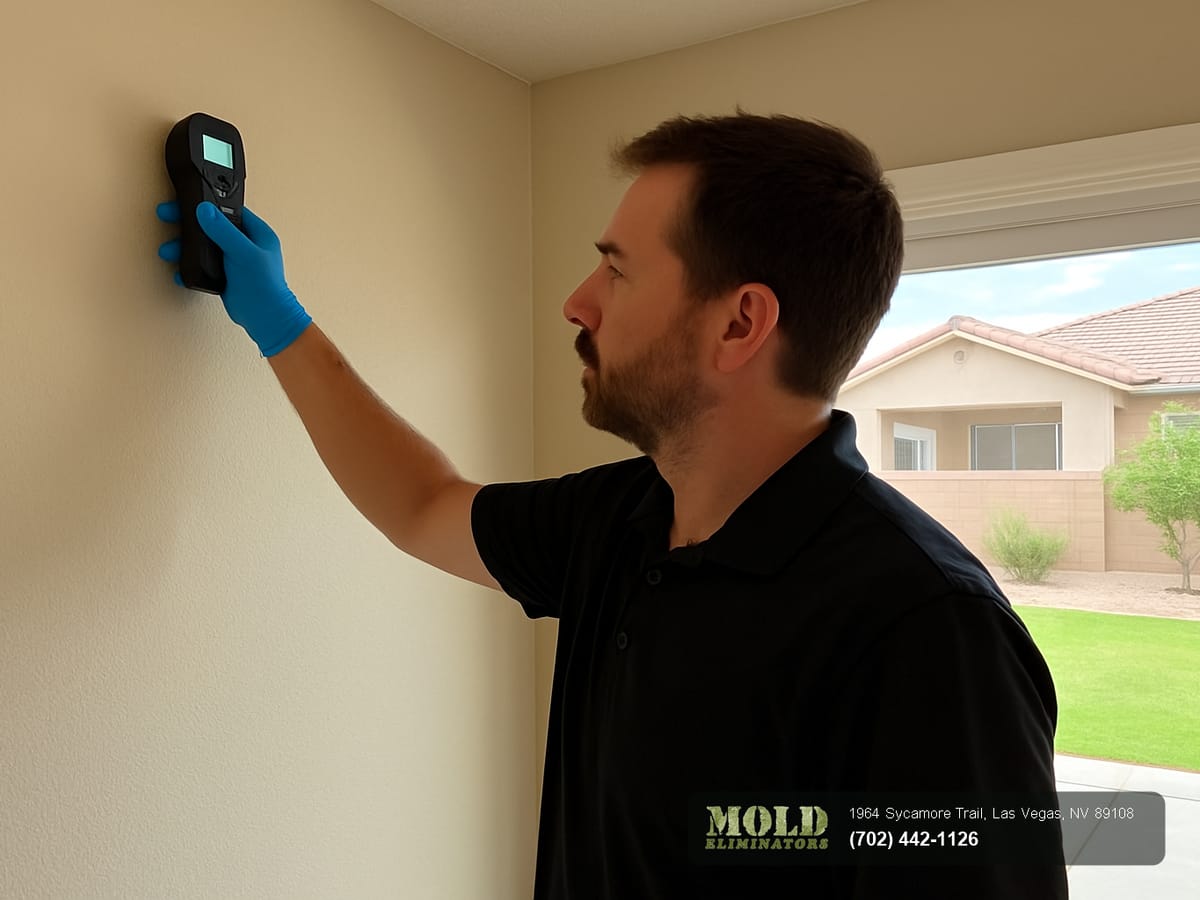 Technician taking an air sample to the S520 standard in a Spring Valley townhome
Our testing process, to the S520 standard
Testing done to the ANSI/IICRC S520 standard follows a deliberate sequence, from the first reading to a report you can stand behind in a responsibility dispute.
- Free on-site inspection. A certified technician walks the unit, listens to the history, and reads moisture with meters and thermal imaging before anyone talks about samples.
- Source tracing. We find where the water actually came from, an upstairs unit, a swamp cooler, a slab leak, so the test targets the real problem, not just the visible stain.
- Sampling, only if warranted. When the inspection shows it is needed, we collect air and surface samples against an outdoor baseline. If lab analysis is warranted, samples go to an independent third-party lab, billed at cost.
- Independent lab analysis. The third-party lab identifies and quantifies what is present, so the verdict is not ours to color.
- A clear written report. You get findings by location and date, in plain language, ready for an HOA, an insurer, or a real estate transaction.
- Honest next steps. If you need remediation, we scope it. If you do not, we tell you that too, because we would rather keep your trust than sell you a job.
Why local, in-house, and independent matters here
Local response that knows the buildings
We work Spring Valley constantly, from Peccole Ranch to the Chinatown corridor, so we know how water moves through an attached townhome and a swamp-cooled rental. One-hour emergency response, 24/7, means a fresh leak gets read before the cavity grows a colony. See our 24/7 emergency response.
No subcontractors
Every technician is a certified W-2 employee, in-house, since 1996. The person testing your unit is the person accountable for the result, not a day-rate contractor who disappears. One crew owns the inspection, the testing, and the report.
An independent lab
Samples go to a third-party lab, billed at cost, so the company describing your problem is not the company grading the sample. In a multi-unit dispute, that independence is exactly what makes the report credible to everyone on the email chain.
That combination is the whole point. Across 255+ properties we have learned that a Spring Valley mold question is usually a people question wearing a moisture costume, and the only thing that resolves it is documentation no party can wave away. We test it honestly, send it to an independent lab when warranted, and hand you a report. If you want to talk it through first, just reach us directly, with no call center in between, or learn more about how we serve Spring Valley.
Mold testing in Spring Valley, common questions
- The leak is from the unit above me. Who is responsible for the testing?
- That depends on your HOA’s CC&Rs and the two insurance policies involved, and it is exactly the kind of fight an independent test settles. We document where the water originated and how far it traveled across the shared assembly, in a report by location and date. That record gives the HOA board and both adjusters the same set of facts, which is usually what breaks the stalemate. We test the situation honestly and stay out of the responsibility argument itself.
- Is the mold inspection really free, and is the lab testing free too?
- The on-site inspection is free: a certified technician comes to your Spring Valley unit, reads moisture, and tells you what you are dealing with at no cost. Lab analysis is a separate, paid step. If sampling is warranted, samples go to an independent third-party lab and are billed to you at cost, with no markup. You can book the free inspection first and decide on lab work only if the inspection shows it is needed.
- My place has a swamp cooler. Could that be causing the mold?
- Often, yes. Evaporative coolers add humidity on purpose, and a leak at the roof curb or an overflow can keep a ceiling, closet, or attic damp all summer without an obvious drip. We test those specific cavities because they are a common and easily missed source in older Spring Valley homes and rentals. Finding the source is half of testing done right, since a sample that ignores the cause only tells you part of the story.
Mold question in Spring Valley? Start with a free inspection.
A certified technician reads your unit on-site at no cost and tells you straight whether you have a problem. If lab analysis is warranted, samples go to an independent third-party lab, billed at cost. One-hour emergency response, 24/7, across the Las Vegas valley.