HVAC & Air Duct Mold Removal in Las Vegas
Mold & Indoor Air
When your air conditioning runs and the first thing you notice is a musty, sock-drawer smell, the problem usually is not the room. It is the system pushing air into the room. In Las Vegas, HVAC equipment, ductwork, and swamp coolers are some of the most common places mold takes hold, and because the system breathes into every room, what starts in one hidden coil can spread house wide within days.
Mold needs three things: moisture, a food source, and time. A desert climate seems like it should starve mold of the first one, and outdoors it largely does. Inside the closed loop of an HVAC system, though, the conditions flip. Cooling equipment pulls humidity out of the air and that water has to go somewhere. Swamp coolers add moisture on purpose. Duct interiors collect fine dust that becomes food. Put those together in a dark, still cavity and you have a small ecosystem that no homeowner ever sees.
This page explains how mold gets into ducts and cooling systems here in the valley, the signs that point to it, how the problem is inspected and tested, and how a duct system is safely cleaned without scattering spores through the rest of the house. It is part of our broader guidance on mold remediation, and if you are reading this because the smell will not quit, the testing that confirms whether you actually have a problem is something we provide at no charge.
How mold gets into HVAC, ducts, and swamp coolers in the desert
Air conditioning works by passing warm household air across a cold evaporator coil. Heat transfers out, and so does water: humidity in the air condenses on the coil exactly the way droplets form on a glass of iced tea. That water is supposed to drain away through a condensate line. When the line clogs with algae or dust, the pan beneath the coil holds standing water, and the cold, wet, dark coil cabinet becomes an ideal nursery for mold. Spores that were harmlessly drifting in the air now have a place to land and grow.
From the coil, the contamination has a delivery system already built for it. Every time the blower runs, it pushes air across the colonized coil and out into the supply ducts, carrying spores and that telltale musty odor into bedrooms, living areas, and closets. Duct interiors are rarely smooth and never truly clean: they collect a film of fine dust, skin cells, and pet dander that is, biologically speaking, food. Add a little moisture from a humid run cycle or a nearby leak and the duct lining itself can support growth.

Evaporative coolers, the swamp coolers found on so many older Las Vegas homes, are a different animal with the same outcome. They cool by drawing outside air through wet pads, so by design they introduce both water and humidity into the home. The pads stay damp, the reservoir holds standing water all season, and the ducting downstream carries moist air. Left unmaintained over a summer, a swamp cooler becomes a continuous source of both humidity and airborne spores. When monsoon season spikes the outdoor humidity in July and August, even a well-kept evaporative system can tip the indoor moisture balance toward mold.
Two desert-specific wrinkles make this worse. First, many valley homes sit on slab foundations, and a slow slab leak can wick moisture into return-air chases and duct boots without ever showing on the floor. Second, high-rise condos near the Strip pack mechanical systems into tight interior closets with little airflow, so a small condensate problem concentrates fast. In every one of these cases the duct network does what it was built to do: it distributes. Unfortunately, it distributes the contamination right along with the conditioned air.
Need help now?
Talk to a Las Vegas expert
In-house certified crews. One-hour emergency response across the valley, 24/7.
Signs your air system, not your house, is the source
Mold in ductwork announces itself differently than mold on a wall. You often smell it before you ever see a spot, and the timing is the giveaway. If the musty odor appears or intensifies the moment the air conditioner or cooler kicks on and fades when the system is off, that pattern points hard at the equipment rather than the room. A wall colony smells steadily. A duct colony pulses with the blower.
The health picture is real but it is not cause for panic. Most duct-borne mold provokes ordinary allergy and irritation responses rather than anything exotic, and we are careful never to overstate it. The honest framing is this: if the air your family breathes for hours every night is passing over an active colony, the people most sensitive to it will feel it first and most. That is a reason to test, not a reason to fear. The right next step is to confirm what is actually happening, which is exactly what an independent mold inspection is for.
Inspection and testing: confirming the source before anyone touches it
The cardinal rule of duct mold is do not clean blind. Running a cleaning crew through a contaminated system before you know what you are dealing with can aerosolize spores and spread the problem rather than solve it. So the work starts with finding the source and measuring it, not with a fan and a brush.
A proper inspection traces the moisture. We check the condensate pan and drain line, the evaporator coil and cabinet, the blower compartment, and the first runs of supply and return duct. We look at the swamp cooler pads and reservoir if the home has one. We read moisture levels in the surrounding chases and walls, because duct mold is frequently downstream of a hidden leak that has to be fixed or the mold simply returns. That part of the work overlaps with our approach to structural drying, where the goal is always to remove the water source first.
- Visual and moisture survey. Inspect coil, pan, drain line, blower, accessible duct, and cooler components; map any elevated moisture that could be feeding growth.
- Air and surface sampling. Collect air samples at supply registers and a comparison sample outdoors, plus surface swabs or tape lifts from suspect spots, so the lab can compare what is inside the ducts to the baseline outside.
- Independent lab analysis. Samples go to a third-party accredited lab, not an in-house reader, so the result has no incentive attached to it. The lab identifies the mold types and concentration.
- Findings and scope. You get a plain-English report of what was found and where, plus a defined cleaning scope, or an honest all-clear if the system is fine.
Independent testing matters most here because duct cleaning is an industry with a long history of selling work that was never needed. Using a third-party lab with no stake in the outcome is how you separate a real problem from a sales pitch. If the sampling comes back clean, we will tell you the smell is something else and you will not pay us to find that out. You can learn more about how this sampling works on our mold testing page, and the testing itself is part of our free inspection offer.
Safe remediation of a contaminated duct system
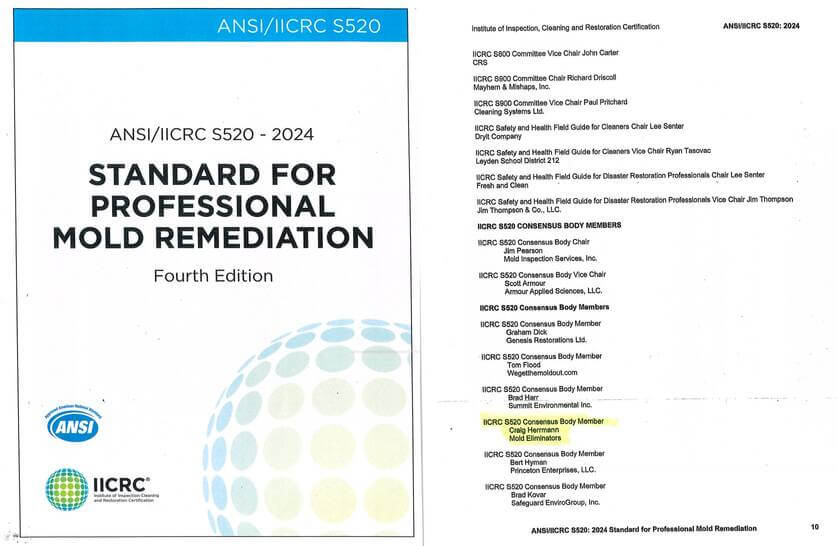
Once testing confirms an active source, the cleaning is governed by one principle: contain it, then remove it, without letting spores escape into the living space. Every step is measured against the ANSI/IICRC S520 standard, the national rulebook for professional mold remediation that our owner Craig Herrmann co-authored. That is not a marketing line. It means the work on your ducts is judged against the exact document the rest of the industry is supposed to follow.
The first move is to shut down and isolate the system so the blower cannot push contamination further while work is underway. Affected sections are placed under containment and negative air pressure, so air flows into the work zone and through HEPA filtration rather than out into your rooms.
From there the source is addressed at its origin. The evaporator coil, condensate pan, and drain line are cleaned and cleared, because leaving the moisture problem in place guarantees the mold comes back. Hard duct interiors are mechanically cleaned and treated; porous components that cannot be reliably cleaned, such as saturated insulation or fiberglass duct liner, are removed and replaced rather than painted over, which is what the standard calls for. On swamp-cooler systems, pads and standing water are cleared and the unit is sanitized before it is allowed to run again.
Crucially, the people doing this are our own W-2 certified technicians, not a subcontracted crew of strangers brought in for the day. After cleaning, the only honest way to declare success is to test again. Post-remediation verification, an independent clearance sample, confirms the airborne spore counts have returned to a normal baseline before the system goes back into service. If the numbers are not right, the job is not done. This is the same standards-first discipline we bring to any mold remediation project, scaled to the specifics of an air system.
Prevention, maintenance, and what it costs
Duct mold is one of the most preventable indoor-air problems because it almost always traces back to moisture you can control. A handful of seasonal habits keep the system dry enough that mold never gets its foothold.
Keep the drain clear
Have the condensate line and pan checked and flushed before each cooling season. A clogged drain is the single most common cause of a wet coil cabinet and the mold that follows.
Service the swamp cooler
Change pads, drain and clean the reservoir, and do not let the unit sit with standing water. During monsoon humidity spikes, run it less and watch indoor moisture.
Change filters and watch humidity
Fresh filters cut the dust that feeds duct mold. Keep indoor relative humidity under control, and fix any plumbing or water damage near return chases promptly.
On cost, we will be straight with you because guessing helps no one. A simple inspection with sampling is modest, and because our on-site inspection is free, confirming whether you even have a problem costs you nothing. Actual remediation depends on what the lab finds and how far it has spread: cleaning a coil and a few duct runs is a contained job, while a system that has distributed contamination throughout a large home, or a porous duct system that must be replaced, costs more. Most residential duct remediation in the valley lands in a range we will quote precisely after the inspection, never as a vague scare number over the phone. If the moisture source is an active leak or flood, that gets handled first, and a true water emergency is covered by our 24/7 emergency response.
Common questions about HVAC and duct mold
- Can I just have my ducts cleaned to fix the smell?
- Not safely, and not reliably, if mold is active. Cleaning a contaminated system without containment can spread spores through the house, and it does nothing about the moisture source that caused the growth. The right order is test, fix the moisture, contain, clean, then verify. A standard duct cleaning skips most of that. Start with a proper mold inspection instead.
- Is the mold in my AC dangerous to my family?
- For most people it causes allergy and irritation symptoms, worse for children, older adults, and anyone with asthma, rather than anything dramatic. We do not fear-monger about it. It is a real reason to test and clean, not a reason to panic, and independent lab testing tells you exactly what you are dealing with.
- Why do swamp coolers cause more mold than regular AC?
- Because they add moisture on purpose. Evaporative coolers cool by pulling air through wet pads, so they raise indoor humidity and hold standing water all season. Without regular service they become a steady source of both moisture and spores, especially when monsoon humidity is already high.
- Will the mold come back after cleaning?
- Only if the moisture source is left in place. That is why we fix the leak, clearing drain, or cooler problem first and confirm the area is dry, the same way we approach structural drying. Clean a system without solving the water and the mold returns within a season.
- Do you really inspect for free, even if I do not hire you?
- Yes. Our inspection is independent and free, and if the lab says your system is clean we will tell you the smell is something else. We profit from fixing real problems, not from inventing them. See our free inspection details, and we are happy to come out across the valley, listed on our service areas page.
Stop guessing about your air
Find out exactly what is in your ducts. Free, independent, no upsell.
If your air smells musty the second the cooling kicks on, let an independent lab settle it. We will inspect the source, test it at no charge, and tell you the truth about what you do, or do not, need.