Mold Encapsulation in Las Vegas
Mold knowledge
Mold encapsulation seals a treated surface behind a bonded, antimicrobial coating so that residual staining and any remaining spore fragments are locked in place. It is a legitimate, standards-backed finishing step for the parts of a Las Vegas home that simply cannot be torn out, like rough framing, subfloor decking, and the underside of a roof. It is not, and never should be sold as, a shortcut that lets you skip the actual removal of mold.
If you have been told that a crew can “just paint over” the mold in your crawlspace or attic and call the job done, you are right to be skeptical. That instinct matches how we work. Encapsulation has a real, narrow place in a properly run job, and it has a much larger place in marketing brochures where it gets used to cut corners. This page draws the line between the two, and it sits underneath our broader mold remediation process so you can see exactly where sealing fits and where it does not.
The short version: encapsulation comes at the end, after the mold has been physically removed and the area has been dried, verified, and cleared. It is the seal on an envelope, not the letter inside. Anyone offering it as the first and only step is selling you a cosmetic fix on a structural problem, and in the desert that mistake tends to come back the next monsoon season.
What mold encapsulation actually is
Encapsulation is the application of a specialized, EPA-registered coating over a surface that has already been remediated. The coating bonds to the substrate, typically wood framing or decking, and forms a durable film that does two things. First, it seals in any microscopic staining or non-viable spore residue that cleaning alone could not lift out of porous grain. Second, many encapsulants carry an antimicrobial that discourages future growth on that specific surface. The result is a uniform, often white or tinted finish that makes the area easy to inspect later, because new growth shows up immediately against a clean sealed background.
The keyword in that description is “already been remediated.” Mold colonizes the cellulose in wood. On a porous material, the roots, called hyphae, grow into the grain where a rag and a spray bottle cannot reach. That is why on finished, replaceable materials such as drywall and insulation the S520 standard calls for removal, not sealing. You take the contaminated material out, bag it, and dispose of it. Sealing over moldy drywall just traps an active food source behind a coating where it keeps growing in the dark.

So encapsulation is the right tool for one specific category: the structural materials that carry the building and cannot be removed without rebuilding the house. You cannot bag and replace the floor joists under a home or the rafters holding up a roof. After those surfaces are cleaned by HEPA vacuuming, abrasive methods, or controlled dry-ice or soda blasting, an encapsulant gives them a sealed, inspectable, antimicrobial finish. That is the honest use case, and it is a good one.
Need help now?
Talk to a Las Vegas expert
In-house certified crews. One-hour emergency response across the valley, 24/7.
Where encapsulation belongs: crawlspaces, attics, and framing
Three areas of a Las Vegas home account for nearly all legitimate encapsulation work, and each one shares the same trait: the affected material is structural and meant to stay.
Crawlspaces and subfloors
Slab leaks and plumbing failures wick moisture up into joists and subfloor decking. Once that wood is cleaned and dried, sealing it keeps residual staining locked down and makes the next inspection trivial. This is the core of focused crawlspace mold removal, where removing the wood is not an option.
Attic sheathing and rafters
Poor ventilation and roof leaks let condensation feed growth on the underside of the roof deck. After the colony is removed, encapsulating the sheathing protects the wood and resets the surface. Done correctly it is a standard part of attic mold removal, not a substitute for it.
Exposed framing during repairs
When water damage forces drywall and insulation out, the studs and plates behind them are exposed. If lab testing confirms those frames are clean, a sealing coat protects them before the wall is closed up and finished.
Notice the desert pattern in all three. Las Vegas mold is rarely about ambient humidity. It is about a specific water event: a slab leak, a swamp cooler overflow, a roof failure during monsoon season, or a high-rise condo plumbing break. The water finds the structural wood, feeds a colony, and leaves behind material you cannot simply throw away. That is the narrow band where encapsulation earns its place. For everything replaceable, removal is still the rule, and a thorough mold inspection is what tells us which is which before any coating is opened.
When encapsulation is appropriate, and when removal is required
Here is the honest take, and it is the one our brand is built on: encapsulation is not a shortcut to skip removal. It is a finishing step that happens after removal, on the small set of surfaces that cannot be taken out. If a contractor proposes sealing as the whole job, that is a red flag worth a second opinion.
The deciding question is always the same. Is the affected material porous and replaceable, or structural and permanent?
That last point is where a lot of cheap jobs fall apart. Mold is a moisture problem wearing a mold costume. If the cause of the water is still live, no coating on earth will hold. Proper structural drying has to bring the wood back to a documented dry standard, confirmed with a moisture meter, before anything gets sealed. Skip that and you are painting over a problem that is still drinking.
How encapsulation fits an S520-standard job
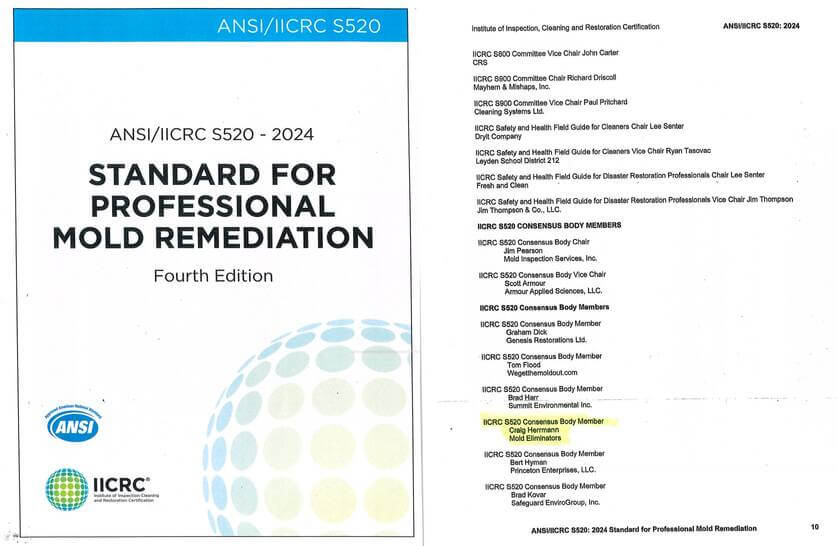
The order of operations is not optional, and it is not ours to invent. It comes from the ANSI/IICRC S520 standard, the national rulebook for professional mold remediation. The owner of Mold Eliminators, Craig Herrmann, is a co-author of that standard and an IICRC Master Certified expert, so on our jobs encapsulation sits exactly where the rulebook puts it: last, and only after the steps before it are documented and verified.
- Assess and contain. Identify the moisture source and the full extent of growth, then build negative-air containment so spores are not spread into clean areas during the work.
- Remove the unsalvageable. Porous, colonized materials are physically removed and bagged out under containment. Nothing here gets sealed; it gets disposed of.
- Clean the structural surfaces. The wood that stays is HEPA-vacuumed and treated with abrasive or blasting methods to lift growth out of the grain.
- Dry to standard. Air movers and dehumidifiers bring the assembly back to a documented dry moisture content, verified with meters, not guesses.
- Verify before sealing. Independent lab clearance confirms the area is genuinely clean. Encapsulation does not start until that clearance is in hand.
- Encapsulate. Only now does the coating go on the verified-clean structural wood, giving it a sealed, antimicrobial, inspectable finish.
Read that sequence again and the whole logic of this page falls into place. Encapsulation is step six of six. Five things have to be true before a single drop of coating is applied. A crew that leads with the seal has skipped steps one through five, and that is precisely the kind of work the standard exists to prevent.
Verification: how you know the seal is honest
The difference between honest encapsulation and a cosmetic cover-up is documentation. Because we use independent, third-party accredited labs rather than self-certifying our own results, the clearance that authorizes sealing comes from someone with no financial stake in the answer. That is the safeguard against the worst version of this service, where a crew seals an area and declares victory because the area now looks clean.
On a properly verified job you should expect to receive the moisture readings that prove the wood was dried to standard, the lab clearance results that confirm the surface was clean before sealing, and a record of what was removed versus what was encapsulated and why. If mold was found during a real estate transaction, that paper trail is what gives a buyer, seller, or agent confidence the issue is genuinely resolved and not just hidden behind a fresh coat.
We also do not charge homeowners to find out whether they have a problem in the first place. Our free inspection exists for exactly the situation this page describes: someone tells you to seal something, and you want an independent read on whether that is even the right call. Sometimes the honest answer is that the surface is fine and needs nothing at all, and we would rather tell you that than sell you a coating you do not need.
If your situation started with active water, the sealing question is premature until the emergency is handled. A burst pipe or flooded crawlspace needs a fast response before mold and drying even enter the picture, which is what our 24/7 emergency response is built for. Stabilize the water first; the encapsulation conversation comes much later in the job.
Common questions about mold encapsulation
- Is encapsulation cheaper than removal?
- On the right surface it can be, because sealing verified-clean structural wood is less labor than rebuilding it. But it is never a cheaper alternative to removing colonized drywall or insulation. Those still have to come out. If a quote is low because it skips removal entirely, the savings are an illusion that the next monsoon season tends to collect on. Start with our broader mold remediation overview to see the full scope a real job covers.
- Can you just paint over mold to seal it?
- No. Standard paint is not an encapsulant, and even a true antimicrobial coating must never go over active growth. The mold keeps feeding on the material underneath and eventually bleeds through. Sealing only happens after the growth is removed and the surface is verified clean by an independent lab.
- How long does an encapsulation finish last?
- When it is applied over a properly cleaned, dried, and cleared surface, and the original moisture source has been fixed, the seal holds for years and makes future inspections easier. When it is rushed onto a wet or still-contaminated surface, it can fail within a single season. Longevity is decided by the steps that come before the coating, not by the coating itself.
- Do I always need encapsulation after mold removal?
- Not always. It is most valuable on structural wood in crawlspaces, attics, and exposed framing that cannot be replaced. Many jobs on replaceable materials are fully resolved by removal and cleaning alone. A proper mold inspection determines whether sealing adds value on your specific surfaces or is unnecessary.
Standards, not shortcuts
Not sure if you need encapsulation, removal, or nothing at all?
We will tell you the truth, backed by independent lab testing and the S520 standard we helped write. Free mold inspection means you find out before you spend a dollar on a coating you may not need. We proudly serve homeowners across our Las Vegas service areas.