Crawlspace Mold Removal in Las Vegas
Knowledge · Mold
Most Las Vegas homes sit on a concrete slab, so when someone says “crawlspace,” what they usually mean is a sub-floor void, a raised pier-and-beam section, or the dark space under an addition. Wherever the framing meets moisture and stops drying out, mold follows. In the desert that sounds backward, but the water is almost always coming from inside the home, not the sky.
Crawlspace and sub-floor mold is one of the most under-diagnosed problems we see, because nobody goes down there. The first clue is rarely a visible colony. It is a musty smell drifting up through floor vents, a warped board near a kitchen sink, or a humidity reading that will not settle. By the time a homeowner notices, the wood framing has often been damp for months.
This page explains why desert crawlspaces grow mold, how to read the early signs, what a proper inspection and removal looks like, and how vapor barriers and ventilation keep it from coming back. It sits under our broader guide to mold remediation, which covers the full standard-based process across the whole home.

Why desert crawlspaces still grow mold
Las Vegas averages single-digit outdoor humidity for much of the year, so the instinct is that mold cannot survive here. The instinct is wrong in one specific place: any enclosed space that traps water and shields it from the dry air above. A crawlspace or sub-floor cavity is exactly that, a sealed pocket where a slow leak has nowhere to evaporate.
The water source is almost always plumbing. Supply lines, drain lines, and slab-routed pipes run under and through the floor system, and when one weeps, the moisture wicks into joists, subfloor sheathing, and insulation. A leak the size of a pinhole can keep wood above 16 percent moisture content for weeks, which is all mold needs to colonize. This is why crawlspace mold and a hidden water damage event are usually the same story told from two ends.
The common thread is trapped moisture, not desert weather. Identifying which of these sources is feeding the cavity is the entire point of the inspection, because removing mold without killing the water source guarantees it returns. Independent mold testing tells us what is growing and how far it has spread, but the moisture map tells us why.
Need help now?
Talk to a Las Vegas expert
In-house certified crews. One-hour emergency response across the valley, 24/7.
Signs your sub-floor or crawlspace has mold
Because the space is hidden, the symptoms show up everywhere except the mold itself. Learning to read them early can be the difference between a one-day cleanup and a structural repair. Here is what homeowners most often miss.
What you smell
A persistent musty or earthy odor that is strongest near floor registers, the lowest level of the home, or first thing in the morning. The smell is microbial volatile organic compounds, the byproduct of active growth, and it travels up through the floor system long before anything is visible.
What you see and feel
Cupped, warped, or springy flooring, especially near sinks, tubs, and exterior walls. Discoloration or staining on baseboards, peeling paint low on the wall, and floors that feel cool or damp underfoot all point to moisture in the framing below.
What your body notices
Allergy-style symptoms, congestion, or irritation that ease when you leave the house and return indoors. Mold spores from a sub-floor draw up through gaps and air returns, so the air you breathe carries the problem even when the source stays out of sight.
None of these signs prove mold on their own, which is exactly why we do not want you guessing. A musty smell can be a dry trap; warped flooring can be old water that already dried. The honest move is to confirm before anyone tears out a single board. A focused mold inspection settles it, and if the test comes back clean we will tell you so. We would rather lose a job than sell you a removal you do not need.
One thing not to wait on: if you find standing water, a flooded sub-floor, or an active leak, treat it as urgent. Wet wood crosses into mold territory in 24 to 48 hours, so our 24/7 emergency response exists for exactly this window, before a moisture problem becomes a microbial one.
The inspection and removal process
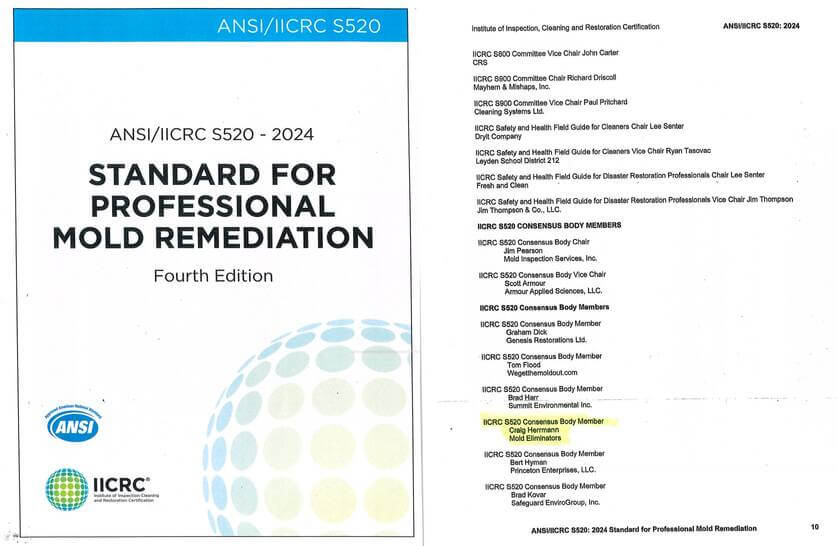
Every crawlspace job runs against the ANSI/IICRC S520 standard, the national rulebook for mold remediation that our owner, Craig Herrmann, co-authored. That matters here more than almost anywhere else in the home, because confined sub-floor work is where cutting corners is easiest and hardest to catch. The standard sets the floor; here is how it plays out under your house.
- Find the moisture source first. We map the cavity with moisture meters and thermal imaging to locate the leak, the grade fault, or the failed barrier feeding the growth. Removing mold without this step is wasted money, so it is non-negotiable.
- Test and document. We collect samples for an independent, third-party accredited lab, not our own. You get a clear picture of what is growing and how far it reaches, with no incentive for us to inflate the scope.
- Contain the work area. We build negative-air containment so spores do not migrate up into the living space during removal. This is the step most under-equipped crews skip, and it is why mold “spreads” after a botched cleanup.
- Remove affected materials. Mold-laden insulation, vapor barrier, and unsalvageable wood come out under containment. Structural framing is HEPA-vacuumed, treated, and sanded where surface growth allows it to stay.
- Dry the structure to standard. We bring the wood back below the threshold for growth with targeted drying. Proper structural drying is what actually stops mold from returning, far more than any spray or coating.
- Reinstall barriers and verify. A new vapor barrier and corrected ventilation go in, then a post-remediation verification confirms the space passes before we close it up. The lab signs off, not us.
The difference between this and a franchise crew is accountability. Every technician under your house is a certified W-2 employee, never a subcontractor, and the verification is done by a lab with no stake in the outcome. When the report says the cavity is clear, it is clear because an outside party measured it, not because we said so.
Crawlspaces also tend to hide the source rather than the symptom, so a thorough job often uncovers a plumbing or drainage fix that prevents the next event entirely. We would rather solve that root cause once than be back next year. That is the whole point of doing it to the standard.
Prevention: vapor barriers, ventilation, and drainage
Once a sub-floor is clean and dry, keeping it that way is mostly about controlling moisture before it ever reaches the wood. The fixes are unglamorous and durable, which is exactly what you want.
If you are weighing whether the work is worth it, the honest framing is that prevention costs a fraction of removal, and removal costs a fraction of structural repair. Our guide to mold removal cost breaks down what drives the number, and we will always tell you when the cheaper preventive route is the right one. We serve crawlspace and sub-floor projects across our full service areas, from Summerlin and Henderson to North Las Vegas and Paradise.
Crawlspace mold questions, answered
- How can a crawlspace grow mold in a dry desert climate?
- Because the moisture is almost never from the weather. It comes from plumbing leaks, slab-routed pipes, condensation on cold lines, or soil moisture rising through a missing vapor barrier. A sealed sub-floor traps that water away from the dry outdoor air, creating the one humid pocket mold needs. Confirming the source is the first job of any mold inspection.
- How do I know if the smell is really mold and not something else?
- You do not, with certainty, until it is tested, and you should not have to guess. A musty odor can be a dry P-trap or old, already-dried water. We use an independent third-party lab so the answer is verifiable. If testing comes back clean, we say so and you owe us nothing for finding out.
- Will removing the mold fix the problem for good?
- Only if the moisture source is corrected at the same time. Mold removal without fixing the leak or barrier guarantees regrowth. That is why our process locates the water first, then removes, then dries the framing with proper structural drying before reinstalling barriers and verifying with the lab.
- How long does crawlspace mold removal take?
- A contained sub-floor cleanup with drying often runs a few days, depending on how far the growth reached and how wet the wood is. If we find an active leak or standing water, the moisture fix and drying are urgent, which is why we keep emergency response available around the clock.
- What does it cost, and do you really do free inspection?
- Yes, the initial the on-site mold inspection is free, because we profit from solving a real problem, not from inventing one. Removal cost depends on the size of the affected area, the moisture source, and structural impact. Our cost guide walks through the factors, and you can start with free inspection to see whether you need work at all.
Free inspection · independent lab · no upsell
Think you have mold under your floor? Find out for free.
We will test before anyone tears out a board, and if the space is clean we will tell you so. Standards-based work led by the co-author of the national mold standard, with independent lab verification.
Get free inspection Call (702) 442-1126
Questions about your specific home? Contact our team and we will walk you through it.