Water Heater Leak Damage in Las Vegas
If you are seeing water heater leak damage, a puddle creeping out from under the tank, a rusty stain spreading on the garage floor, or a soft, swollen patch of drywall on the wall the heater backs onto, your first instinct is usually right: this is not just a plumbing nuisance. A leaking water heater is a slow, steady source of clean water that has very likely been feeding the surrounding materials for longer than the visible mess suggests.
The good news is that caught early, this is a very recoverable situation. The risk is not the puddle you can see, it is the water that has already wicked into the drywall, the wood framing, and the slab the tank sits on. That hidden moisture is exactly what mold needs to take hold. The right first step is a free on-site inspection that finds where the water actually went, not just where it pooled. Here is how to read what you are looking at and what a proper fix involves.
 Stained drywall and floor near a leaking residential water heater in a Las Vegas garage
What water heater leak damage usually means in a Las Vegas home
A water heater leaks for a handful of predictable reasons, and the source matters because it tells you how much water has been in the structure and for how long. The most common culprit in our valley is simple age and hard water. Las Vegas tap water is some of the hardest in the country, and the mineral scale it leaves behind sits in the bottom of the tank, accelerating internal corrosion until the steel finally seeps or splits. Most tanks here do not last as long as the sticker promises.
Before you assume the tank itself failed, though, it is worth ruling out the lookalikes, because the fix is different for each:
- A failed tank or fitting. Active rust at the base, water weeping from a seam, or a steady drip from the temperature and pressure relief valve points to the heater itself. This is the most common cause and usually means the unit is at or past end of life.
- A slow supply or drain line leak. Sometimes the heater is fine and a corroded connection, a sweating cold-water line, or the drain pan outlet is the real source. Desert pipe movement from extreme temperature swings can loosen fittings over years.
- AC condensation mistaken for a heater leak. In a hot garage or a closet that shares space with an air handler, summer condensate can run toward the heater and look like a tank leak. We see this constantly from June through September.
- A slab leak underneath. If the water seems to come up from the floor rather than down from the tank, you may have a slab leak, common in our slab-on-grade homes, that just happens to surface near the heater.
- Hidden water in the wall behind it. The most important point: by the time you see staining, water has often already traveled into the wall cavity and along the bottom plate, well past the spot that looks wet.
Telling these apart is the whole reason the inspection comes first. Drying out a tank leak while a slab leak keeps feeding the slab just guarantees the problem comes back. We diagnose the actual source before anyone talks about scope.
Need help now?
Talk to a Las Vegas expert
In-house certified crews. One-hour emergency response across the valley, 24/7.
Why it matters and how urgent it is
Here is the part most homeowners do not hear in time. Mold can begin to colonize wet organic materials, and most of your home is organic, from paper-faced drywall to the wood framing and bottom plate, within roughly 24 to 48 hours of getting wet. After about 72 hours, the conversation shifts from dry it and save it to remove it and remediate. A water heater that has been weeping slowly for weeks has often already crossed that line in the materials right around it, even if the puddle is small.
Water heaters also sit in some of the worst possible places for hidden damage. In a closet or a garage corner, the leak runs against a wall, soaks into the bottom plate, and wicks upward into drywall where you cannot see it. If the tank is in a pan that drains to the slab, the slab itself can stay saturated for weeks, because concrete holds water far longer than people expect and a slab that feels dry on top can still be wet underneath. None of this is visible to the eye, which is exactly why it needs to be measured rather than guessed.
The urgency is not about fear, it is about the window. The faster the source is stopped and a controlled drying environment is set up, the more material you save and the lower the mold risk drops. If water is actively spreading right now, this is a same-day matter, and our 24/7 emergency response exists for exactly this. If the leak has been slow and is already stopped, you still want eyes on the wall cavity soon, because the moisture left behind does not announce itself until mold does.
 Moisture meter reading the bottom plate of a wall next to a water heater in Las Vegas
What the proper fix actually involves
Done to the national standard, this is a measured process with a documented finish line, not a few fans and a hope. Mold Eliminators handles a water heater leak as one continuous job, from finding the source to proving the structure is dry and clean.
- Free on-site inspection first. We come out, find the real source, and map how far the water actually traveled with moisture meters and thermal imaging. No charge, no pressure, no scope quoted until we know what is wet.
- Stop and stabilize the source. The leak gets stopped or the unit isolated, because you cannot dry a structure that is still getting wet. We coordinate cleanly with your plumber when a tank needs replacing.
- Contain the area. If mold is already present, the affected zone is contained so spores do not spread to the rest of the home while we work.
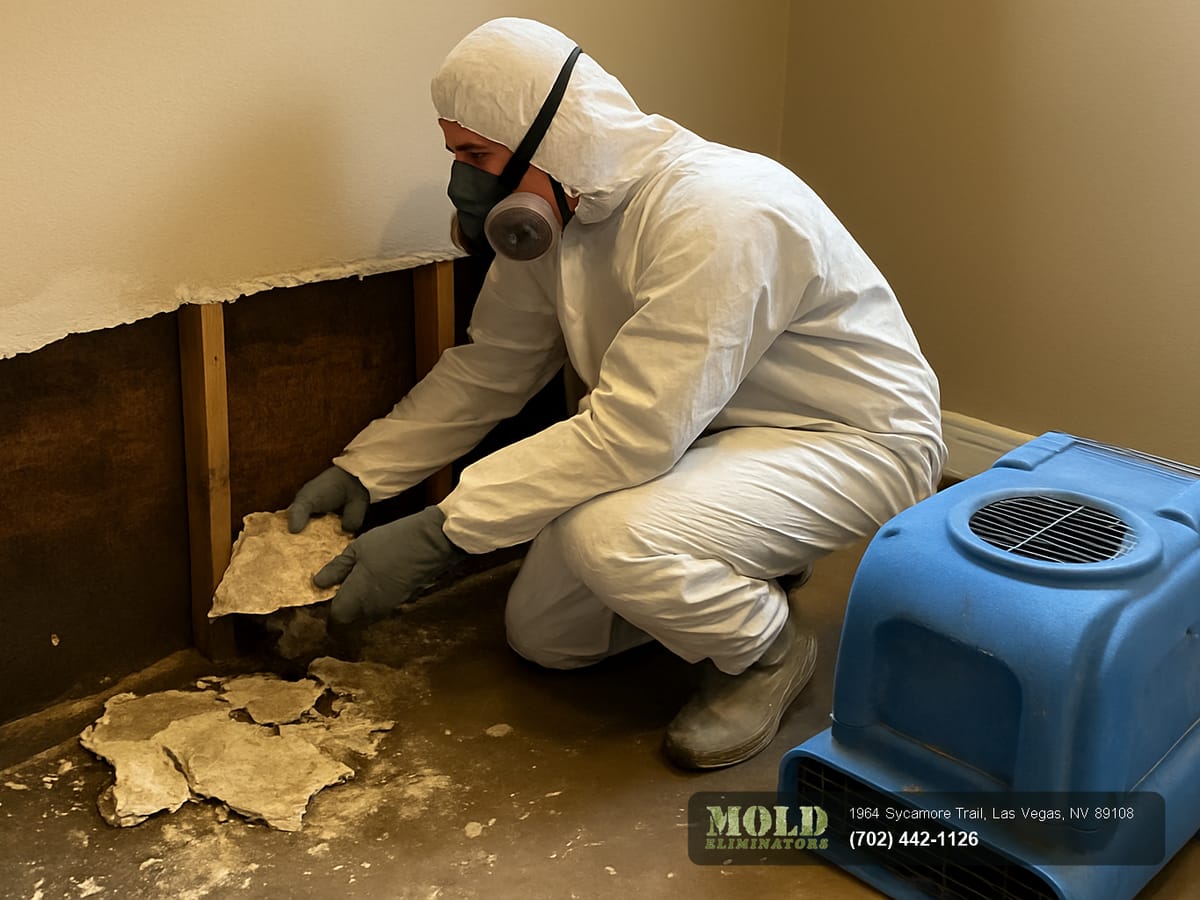
- Remove what cannot be saved. Saturated, contaminated, or already-colonized materials are removed to the standard rather than dried in place and left as a future problem.
- Dry to verified targets. Commercial dehumidification and air movement bring the framing, drywall, and slab back to a documented dry standard, confirmed by daily readings, not by feel.
- Independent lab clearance. When mold was involved, an independent third-party lab verifies the result, so dry and clean means proven, not promised.
This sequence follows the ANSI/IICRC S520 mold standard, the rulebook our founder Craig Herrmann co-authored. When the job overlaps with a sudden water event, it is full water damage restoration handled by the same crew, and when the leak is active, it starts with emergency water removal before drying begins.
Why Las Vegas homeowners call Mold Eliminators for this
No subcontractors
Every technician is a certified W-2 employee. One in-house crew owns the source, the drying, and the mold risk from the first reading to the final clearance, so no one points fingers when something gets missed.
Independent lab, not our word
When mold is involved, clearance is verified by an independent third-party lab. We do not grade our own homework, and you get documentation an adjuster, an HOA, or a buyer will accept.
Anti-upsell, 1-hour response
We tell you when you do not need us. If the damage is cosmetic and dry, we will say so. And when it is urgent, we are on site within about an hour, 24/7, across the valley.
That is the whole difference. Craig is IICRC Master Certified and has worked in this valley since 1996 on 255+ properties, so the diagnosis is honest and the drying is dried to a standard, not to a guess. If you would rather just talk it through first, you can reach us directly, no call center in between.
Water heater leak damage in Las Vegas, common questions
- My water heater leaked but the floor looks dry now. Am I in the clear?
- Not necessarily. The surface always dries first while the bottom plate, the drywall behind the tank, and the slab underneath can stay wet for days or weeks. The only way to know is to measure the materials, which is exactly what the free on-site inspection does. If a past leak was never verified, that is the calm, factual way to find out whether moisture left anything behind before it becomes a water damage restoration job.
- Is mold testing free too?
- The on-site inspection is free. If lab analysis is needed to confirm or clear mold, that independent third-party testing is a paid add-on, and we will tell you up front whether it is actually warranted. We would rather not run a test you do not need than pad an invoice. You can book the free inspection first and decide on lab work only if the situation calls for it.
- The tank is in my garage where it gets really hot. Could it be AC condensation instead?
- Often, yes. In a hot Las Vegas garage or a closet sharing space with an air handler, summer condensate can run toward the heater and mimic a tank leak. Telling a true tank leak apart from condensation, a slab leak, or a supply-line drip is the first thing we sort out on the inspection, because each one needs a different fix and drying the wrong source just lets the real one keep going.
Seeing water heater leak damage? Get a free on-site inspection.
We find the real source, measure what is actually wet, and tell you honestly what the fix involves. One-hour emergency response, 24/7, across the Las Vegas valley. No subcontractors, independent lab clearance, no upsell.