Mold After a Roof Leak in Las Vegas
If you are seeing mold after a roof leak, the stain on the ceiling or the dark speckling along a wall is rarely the whole story. By the time mold shows on the surface, water has usually been moving through the structure above it for a while, soaking insulation, sheathing, and framing you cannot see. The visible spot is the symptom. The wet cavity behind it is the actual problem, and it is the part that decides whether this ends now or comes back.
Here in Las Vegas, a roof leak does not always announce itself with a downpour. A single monsoon storm, a failed flashing detail, or a slow drip around a swamp cooler curb can put just enough water into an attic or wall to feed a colony. The good news is that mold after a roof leak is almost always fixable when it is diagnosed honestly and the source is stopped first. The wrong move is to paint over the stain and hope, because the moisture underneath keeps feeding it.
 Water-stained ceiling and corner mold growth beneath a roof leak in a Las Vegas home
What it most likely is in a Las Vegas home
When mold appears after a roof leak, the instinct is to assume the roof is the only culprit. Sometimes it is. Often it is one of several desert-specific moisture sources stacking up, and an honest diagnosis matters because the fix is different for each. Before assuming the worst, it helps to know what you are actually looking at.
An active roof or flashing leak. This is the obvious one. Flat and low-slope roofs are common across the valley, and they pond water during monsoon season. Cracked flashing, failed seals around vents, and aging coating let water in at the seams, then it travels along the deck and drips far from the entry point. The mold you see in a hallway can be fed by a leak two rooms away.
A swamp cooler that is really the source. Evaporative coolers sit on the roof and run a constant water supply. A stuck float, an overflowing pan, or a leaking supply line dumps water onto the roof deck and down into the ceiling, and homeowners blame the roof because that is where the stain is. The pattern looks identical to a roof leak, but the fix is the cooler.
Hidden water still trapped in the assembly. Even after a leak is patched, water wicks into paper-faced drywall, wood framing, and blown-in attic insulation and stays there. Insulation in particular holds moisture for a long time and gives mold a quiet, dark place to grow. A patched roof with wet insulation above the ceiling is a colony with a roof over its head.
Condensation and intrusion that mimic a leak. AC ductwork sweating in a hot attic, monsoon-driven wind that pushes rain under tiles, and the occasional slab or plumbing issue can all leave moisture in places that read as roof damage. This is why guessing is dangerous. The only reliable way to separate these is to find the actual moisture source and measure it, which is the first thing a proper inspection does.
Need help now?
Talk to a Las Vegas expert
In-house certified crews. One-hour emergency response across the valley, 24/7.
Why it matters and how urgent it is
Mold after a roof leak is not a cosmetic problem you can schedule for someday. Mold spores are present in every building, harmlessly, until they find a wet surface to feed on. Once a roof leak gives them that water, a colony can establish on organic materials within roughly 24 to 72 hours, and most of your ceiling and wall assembly is organic. Every day the moisture stays, the colony spreads further into materials you would rather save.
The urgency is higher when the water sits above your head. Attic and ceiling mold sheds spores downward into the living space, and a wet roof deck can lose structural integrity over time. In Las Vegas, the monsoon season from roughly June through September means a small, ignored leak gets recharged with every storm, so what looked like a minor stain in July can be a full assembly problem by September.
That said, this is not a reason to panic, and it is not a reason to let anyone scare you into a demolition you do not need. The right response is fast, measured action: stop the water, find out how far it traveled, and dry or remove only what the readings call for. If water is actively coming in right now, our 24/7 emergency response stabilizes the leak first, because you cannot remediate mold while the source is still feeding it.
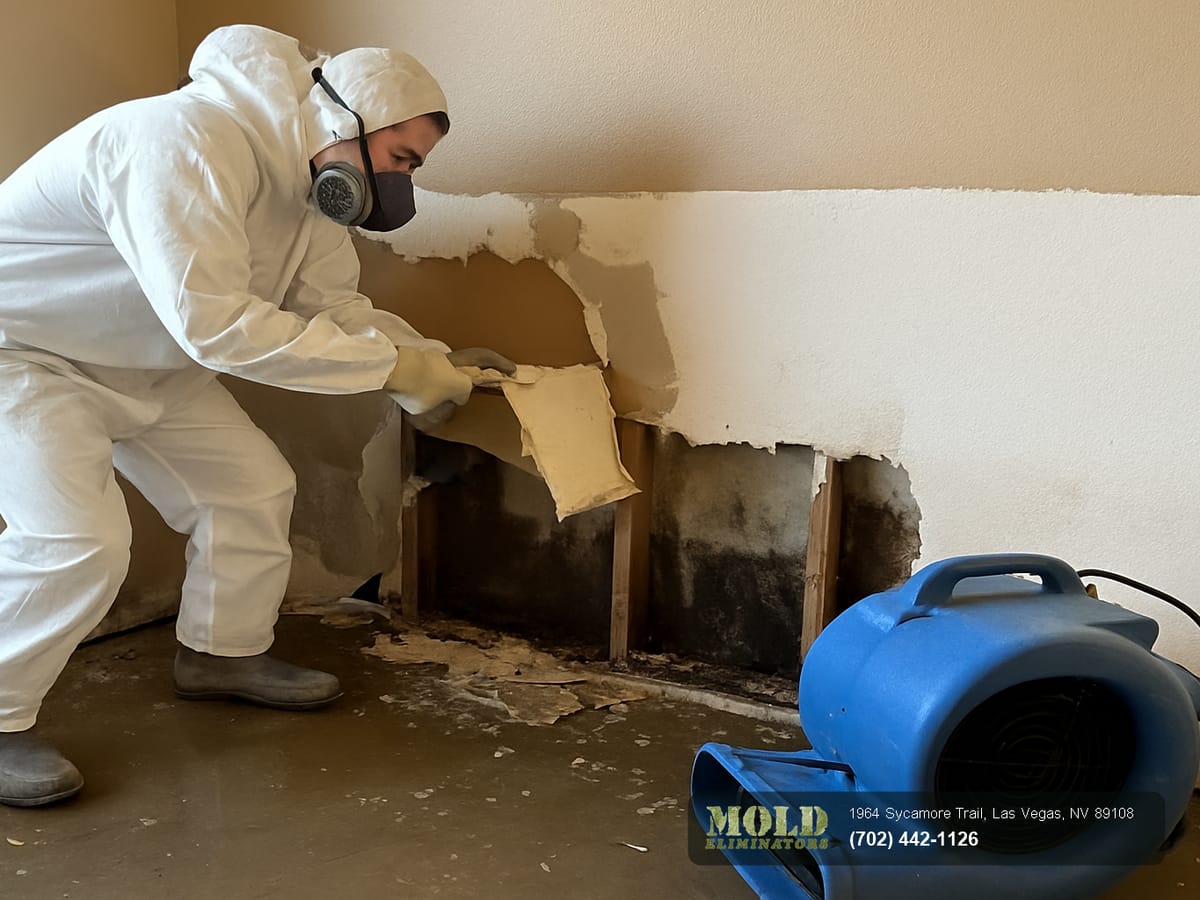
 Containment and moisture mapping during mold remediation after a roof leak in Las Vegas
What the proper fix involves
The right way to handle mold after a roof leak follows the ANSI/IICRC S520 standard, the national rulebook for mold remediation. Mold Eliminators handles it as one accountable job, from the first reading to independent lab clearance, with no hand-offs in between.
- Free on-site inspection first. We come out and look before anyone quotes a teardown. We trace the stain back to its real source, whether that is the roof, the flashing, a swamp cooler, or hidden plumbing, and we measure how far the water actually traveled.
- Find and stop the source. Remediation is pointless while water is still coming in. We confirm the leak is stopped, or coordinate so it is, before any mold work begins.
- Containment. We seal off the affected area so spores disturbed during removal do not spread into the rest of the home through the HVAC system or open doorways.
- Removal. Materials too far gone to save, soaked drywall, mold-laden insulation, are removed under containment using S520 methods. We remove what the readings call for, not more.
- Drying to verified targets. Salvageable framing and structure are dried with dehumidification and air movement to a documented dry standard, so moisture has nothing left to feed.
- Independent lab clearance. An independent third-party lab verifies the area is clean before we call it done. The pass comes from the lab, not from us, which is the proof the problem is actually gone.
Why Las Vegas homeowners call Mold Eliminators
Authored the standard
Craig Herrmann co-authored the ANSI/IICRC S520 standard and is IICRC Master Certified. When mold after a roof leak gets handled here, it is handled by the rulebook, not by a guess. Read more about Craig and the S520 standard.
No subcontractors, ever
Every technician is an in-house certified employee. One crew owns the diagnosis, the source, the removal, and the drying, start to finish, so nobody points fingers when something behind a wall gets missed.
Independent lab, anti-upsell
Clearance comes from an independent third-party lab, not our own say-so, and we tell you when you do not need us. With 1-hour response 24/7, serving the valley since 1996 across 255+ properties.
That is the whole difference. Where a franchise sells a package before it has measured anything, we map the moisture, fix the source, and let an independent lab confirm the result. If the leak turned out to be larger than a stain, the same crew handles the full roof leak water damage and the mold remediation together, under one chain of responsibility. When you reach a decision point, a free inspection tells you exactly where you stand before any work begins.
Mold after a roof leak in Las Vegas, common questions
- I patched the roof leak. Why is the mold still spreading?
- Because the water that already soaked into your insulation, drywall, and framing is still there feeding it. Patching the roof stops new water, but mold lives on the moisture already trapped in the assembly. Until that material is dried to a verified standard or removed, the colony keeps growing. This is exactly why a proper mold remediation measures moisture after the leak is stopped, not just paints over the stain.
- How fast do I need to act on ceiling mold after a leak?
- Quickly. Mold can colonize wet organic materials within roughly 24 to 72 hours, and a ceiling leak sheds spores down into your living space. During monsoon season a small leak also gets recharged with each storm. If water is still coming in, our 24/7 emergency response stabilizes the source first, then we diagnose the mold. Acting in days rather than weeks usually means saving more material and a smaller job.
- Will you tear out my whole ceiling?
- Only what the readings call for. Our approach is anti-upsell: we start with a free inspection, measure how far the water actually traveled, and remove only the materials that are too contaminated to save. Plenty of framing dries and stays. An independent third-party lab confirms the result, so the scope is driven by data, not by what fills a bigger invoice.
Seeing mold after a roof leak? Get a free on-site inspection.
We find the real source, stop it, and remediate to the S520 standard with independent lab clearance. One-hour emergency response, 24/7, across the Las Vegas valley. No subcontractors, no upsell, just an honest diagnosis first.