Air Scrubber vs. Dehumidifier
Equipment, explained
After a water event or a mold job, two machines tend to run side by side, and people understandably assume they do the same thing. They do not. An air scrubber and a dehumidifier solve different problems: one cleans the air, the other dries it. Understanding the difference is the difference between a room that looks handled and a structure that is actually safe.
The short version of air scrubber vs dehumidifier is this: a dehumidifier pulls water vapor out of the air so wet materials can release their moisture, and an air scrubber pulls airborne particles, mold spores, and dust out of the air through HEPA filtration. On most real jobs you need both, running together, because moisture and contamination are two separate hazards that have to be controlled at the same time. We use both daily as part of full structural drying and during every mold remediation, and the choice of which to run, and when, is driven by the readings, not by habit.
What each machine actually does
The cleanest way to keep these two straight is to remember what they capture. A dehumidifier captures water. An air scrubber captures particles. They share a footprint on a job site and they both move air, but the physics inside the box could not be more different, and so is the problem each one is there to fix.
A dehumidifier removes moisture from the air. Warm, humid air is drawn across a cold coil where the water vapor condenses into liquid and drains away, and drier air is returned to the room. The point is not comfort. The point is to keep the air drier than the wet drywall, framing, and subfloor around it, because moisture only leaves a material when the surrounding air can accept it. Without a dehumidifier holding the room dry, evaporated water just re-deposits somewhere else in the structure. This is the engine of drying, and it is why a commercial unit, not a household one, is what gets a soaked building back to a documented dry standard.
An air scrubber removes particles from the air. A scrubber pulls room air through a sequence of filters, ending in a true HEPA filter that traps fine particles down to 0.3 microns, the size range that includes mold spores, drywall dust, and other debris stirred up during demolition and cleaning. It then returns filtered air, or exhausts it outside the work zone to create negative air pressure so contaminated air cannot drift into clean parts of the home. A dehumidifier will do nothing for spore counts. A scrubber will do nothing for a wet wall. That is the whole distinction in one sentence.
Need help now?
Talk to a Las Vegas expert
In-house certified crews. One-hour emergency response across the valley, 24/7.
Air scrubber vs dehumidifier, side by side
Here is the honest breakdown of what each tool is for, where it shines, and where it does nothing at all. Neither one is the right answer to every problem, and any company that reaches for the same machine on every job is not reading the situation.
Dehumidifier
Job: remove water vapor from the air so wet materials can dry.
Use it when: the structure is wet, after a burst pipe, slab leak, swamp cooler failure, or any water intrusion that soaked materials.
It will not: remove mold spores, dust, or odor from the air. It is a drying tool, not an air-cleaning tool.
Air scrubber (HEPA)
Job: capture airborne spores, dust, and particles through HEPA filtration, and hold negative pressure.
Use it when: mold is being disturbed or removed, during demolition, sanding, or any work that puts particles into the air.
It will not: dry a wet wall or lower the structure’s moisture content. It cleans air, it does not dry materials.
Both together
Job: control moisture and contamination at the same time, which most jobs require.
Use it when: a water event has already started growing mold, or remediation and drying are happening in the same space.
The result: the structure dries to a verified target while the air stays clean and contained, start to finish.
Why most real jobs need both
On paper the two tools look like an either-or choice. In practice they are usually a pair, because the conditions that call for one tend to create the conditions that call for the other. A water event that wets the structure (the case for a dehumidifier) is also the event that, left long enough, grows the mold and stirs up the spores that call for an air scrubber. Treating them as separate decisions is how problems get half-solved.
Consider a typical sequence after a slab leak. The water has been extracted and the materials are wet, so dehumidifiers go in to dry the structure. But if that water sat past the roughly 24–72 hour window where mold begins to colonize, spores are now active, and the moment a technician opens a wall to dry the cavity, those spores go airborne. Now you need an air scrubber running HEPA filtration and negative pressure so removing the moisture does not spread the contamination through the rest of the home. The dehumidifier handles the water; the scrubber handles the air; neither one covers for the other. This is exactly why we run both during remediation and verify the outcome with an free inspection before anyone declares the room done.
The reverse is true too. Run only a scrubber and you have clean air over a structure that is still soaked, which simply schedules a mold problem for three weeks out. Run only a dehumidifier through an active mold removal and you dry the building while quietly seeding spores into the HVAC and the next room. The sequence, the placement, and the timing of each machine is the actual skill, and it is why proper structural drying and containment are treated as one continuous job rather than two rentals.
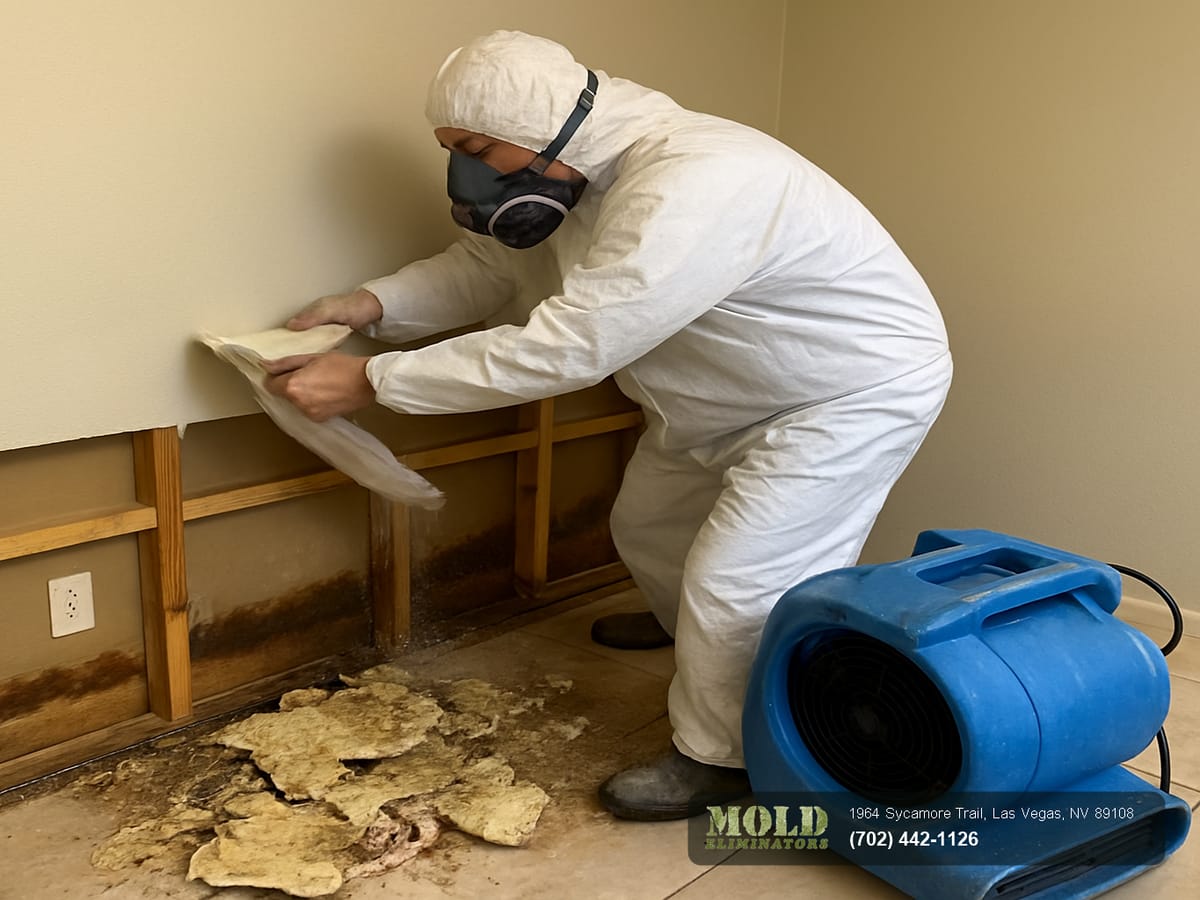 HEPA air scrubber and commercial dehumidifier running together on a Las Vegas water damage job
HEPA filtration vs moisture removal
The cleanest mental model is to separate the two hazards by what they are made of. Contamination is particles. Moisture is water. HEPA filtration is the answer to particles; dehumidification is the answer to water. You cannot filter water out of the air the way you filter a spore, and you cannot condense a spore out of the air the way you condense water vapor.
HEPA, which stands for high-efficiency particulate air, is a filter standard that captures at least 99.97 percent of particles at 0.3 microns. That size is not arbitrary; it is the hardest particle size to catch, so a filter that handles it handles everything larger and smaller too. Mold spores fall right in that capture range, which is why a true HEPA air scrubber is the tool for keeping spore counts down while contaminated materials are being disturbed. The negative pressure it creates is just as important: by pulling more air out of the work zone than leaks in, it keeps the dirty air contained so it cannot migrate.
Moisture removal is a different equation entirely. Drying is governed by psychrometrics, the relationship between air temperature, humidity, and the moisture content of materials. A dehumidifier shifts that balance so water keeps leaving the structure, and the only way to know it worked is to measure, with meters and daily readings, until each material hits a documented dry target. This measured, standards-based approach is exactly what the ANSI/IICRC S520 standard calls for, the national mold standard our founder Craig Herrmann co-authored. Air gets verified clean by an independent lab; structure gets verified dry by the numbers; the two verifications are separate, which is the final proof that these are two different jobs done by two different machines.
How we decide what to run, and when
Choosing equipment is not a guess and it is not a rental package. It follows the readings. Before anything is plugged in, we measure the moisture in the materials and assess whether contamination is present or about to be disturbed, then place equipment to match what the data shows. This is the anti-upsell part of the job: we run what the situation needs, and we tell you when it does not need more.
- Assess and measure. Moisture meters and thermal imaging map how wet the structure is, and we evaluate whether mold is present or will be disturbed by the work. The readings define the problem before any machine is chosen.
- Dehumidify if the structure is wet. If materials are above their dry standard, commercial dehumidifiers go in to hold the room drier than the structure so moisture keeps leaving it.
- Scrub the air if particles are in play. If mold is being removed or work will stir spores and dust, true HEPA air scrubbers run inside a contained, negative-pressure zone so the contamination stays put.
- Run both when both hazards are present. Most water-plus-mold jobs need moisture control and air control at once, with placement and sequencing set so neither machine undoes the other.
- Verify, then remove. Equipment comes out only when the structure hits its documented dry target and, where mold was involved, an independent lab confirms the air is clean. The data ends the job, not the calendar.
Why this gets done right in-house
Built to the standard
The drying targets and containment we work to come straight from the ANSI/IICRC S520 standard, which our founder helped author. The equipment runs to the rulebook, not to a hunch. Read more about Craig’s credentials.
Measured, not guessed
Moisture meters, thermal imaging, and daily readings decide what runs and for how long. The dehumidifiers pull out the moment the structure hits target, and the scrubbers run as long as the air needs them, never longer to pad a bill.
One accountable crew
No subcontractors. Every technician is a certified W-2 employee, with one-hour emergency response 24/7 across the valley. One in-house team owns the water, the air, and the result from the first reading to the last.
That is the difference between renting machines and solving a problem. We map the moisture, scrub the air, dry to a verified target, and prove the result, the same way our drying work is held to the standard from the first reading to the last. Control both hazards, and the room is not just clean-looking. It is clean and dry, on the record.
Air scrubbers and dehumidifiers, common questions
- Do I need an air scrubber or a dehumidifier?
- It depends on the hazard. If the structure is wet but there is no mold or particle issue, you need a dehumidifier to dry it. If mold is being disturbed or removed but the structure is dry, you need a HEPA air scrubber to keep spores contained. When water damage has started growing mold, which is common, you need both. The honest way to find out which case you are in is a measured assessment, and our free inspection tells you exactly where you stand before any equipment goes in.
- Can a dehumidifier remove mold spores from the air?
- No. A dehumidifier removes water vapor; it has no filtration for airborne particles. Spores, dust, and debris pass right through it. Removing those requires a true HEPA air scrubber, which captures particles down to 0.3 microns. The two machines solve different problems, which is why serious mold work runs them together rather than choosing one.
- Can an air scrubber dry out a wet wall?
- No. An air scrubber cleans the air but does nothing to lower the moisture content inside drywall, framing, or subfloor. Drying a wet structure requires dehumidification and air movement working together until daily readings confirm each material has hit its dry target. Running a scrubber over a soaked wall leaves you with clean air above a mold problem that has not been addressed. Proper structural drying is what removes the moisture.
- What does HEPA actually mean?
- HEPA stands for high-efficiency particulate air. A true HEPA filter captures at least 99.97 percent of particles at 0.3 microns, the hardest size to trap, which means it handles mold spores and fine dust as well. It is the filtration standard that makes an air scrubber effective during mold removal, and the negative pressure the scrubber creates keeps that contaminated air from migrating into clean parts of the home.
- Why run both machines at the same time?
- Because moisture and contamination are two separate hazards that often occur together. A water event soaks the structure, which calls for a dehumidifier, and if it sat long enough to grow mold, removing that mold puts spores in the air, which calls for an air scrubber. The dehumidifier dries the building while the scrubber keeps the air clean and contained, so neither hazard is left half-solved. This is standard practice on any combined water-and-mold job, verified before we call it done.
- How do you know when to shut the equipment off?
- By the data, not the clock. The dehumidifiers come out when daily moisture readings confirm every material has reached its documented dry target. Where mold was involved, the air scrubbers stay until an independent third-party lab confirms the air is clean. We do not pull equipment early to free a machine, and we do not leave it running to pad a bill. The verified result is the finish line.
Not sure which you need? Find out for free.
We measure the moisture, assess the air, and tell you exactly what the situation calls for, including when it calls for less than you expected. One-hour emergency response, 24/7, across the Las Vegas valley. The free offer is the on-site inspection; if lab analysis is warranted, samples go to an independent third-party lab, billed at cost.