Why Las Vegas Attics Get Mold, and How to Prevent It
Attic mold in Las Vegas almost never appears overnight. By the time you see a dark bloom across the underside of the roof sheathing or a black streak running down a rafter, moisture has usually been collecting up there for months, quietly feeding spores that are present in every home all the time. The growth is the symptom. Something is putting water into that space, and until that is found and corrected, cleaning the sheathing buys you one season.
The good news is that attic mold causes are well understood, and almost every one of them traces back to a single root problem: moisture that should have left the attic instead got trapped against cold wood. Fix the moisture, and you remove the food. This guide walks through how attic mold actually starts, the four conditions that drive it in a desert climate like ours, and the practical steps that keep it from coming back. If you already see growth and want it gone for good, our attic mold removal process pairs hands-on cleanup with the moisture correction that makes it permanent.
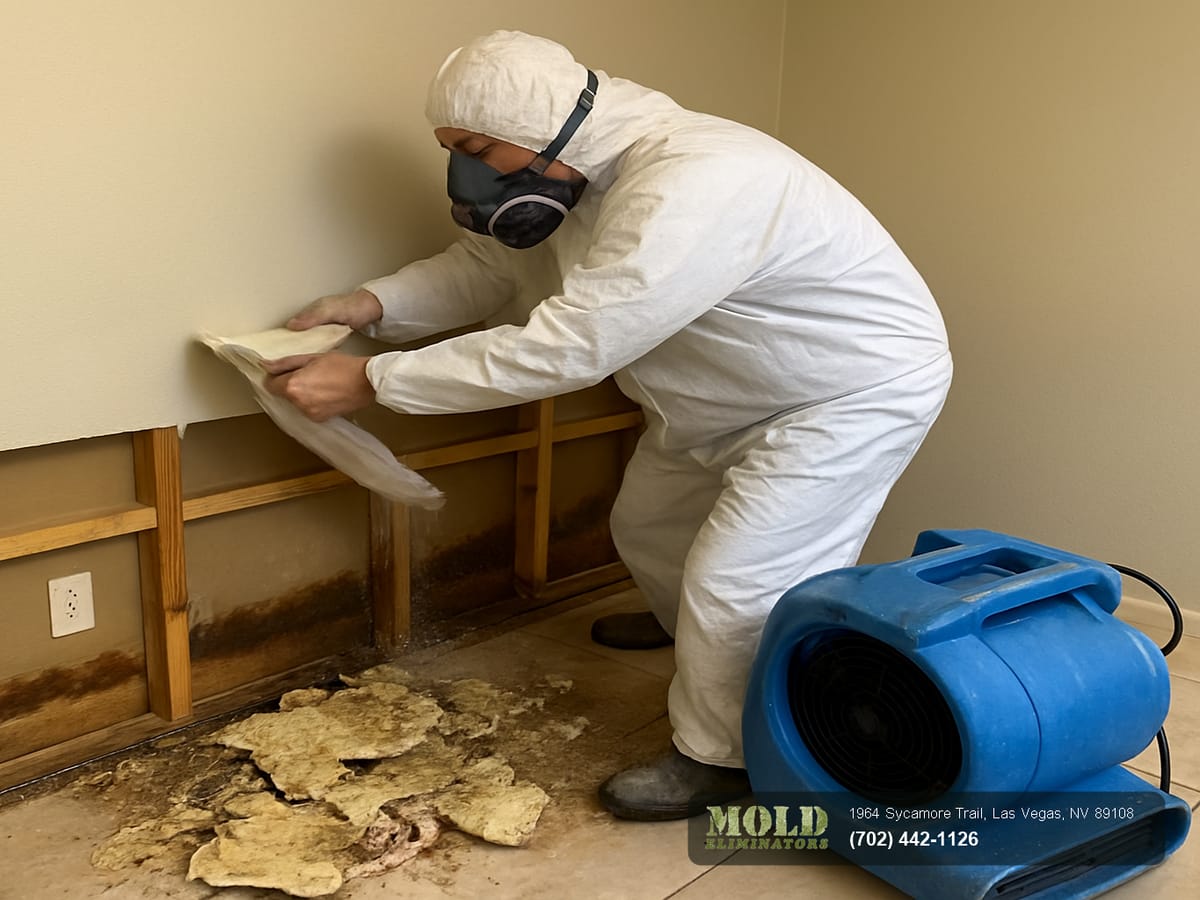 Mold growth on attic roof sheathing and rafters caused by trapped moisture
How attic mold actually starts
Mold is not an infestation that arrives from outside and invades your attic. Mold spores already drift through every building, harmlessly, all day long. They turn into a visible colony only when three things line up in one place: a food source, the right temperature, and, above all, moisture. An attic supplies the first two for free. The wood sheathing under your shingles, the paper facing on insulation, and the dust on the joists are all organic food, and an attic sits at comfortable mold-growing temperatures for much of the year.
That leaves moisture as the one variable you can actually control, which is why every serious case of attic mold is really a moisture problem wearing a mold costume. When humid air reaches cold roof sheathing and has no way to escape, it condenses into water droplets on the wood. Those droplets are the trigger. Within roughly 24–72 hours of a surface staying wet, dormant spores begin to colonize, and once a colony establishes itself on porous wood it will keep expanding as long as the moisture keeps coming.
So the entire prevention strategy comes down to a single question: where is the moisture coming from, and why is it not leaving? Four answers cover the vast majority of attic mold causes, and they often overlap. We will take each one in turn, because understanding the mechanism is what lets you fix the cause instead of just wiping the symptom.
Need help now?
Talk to a Las Vegas expert
In-house certified crews. One-hour emergency response across the valley, 24/7.
The four attic mold causes, and the mechanism behind each
Different homes fail in different ways, but trapped attic moisture almost always arrives through one of these four doors. Read them as a checklist: the cause that matches your symptoms is the one your prevention plan has to target first.
Notice how the last three feed each other. Bad ventilation traps humid air, weak insulation lets more humid air in, and condensation is the physical result when that trapped, humid air meets cold wood. Roof leaks are the one purely external cause, but even a small leak that would dry harmlessly in a well-ventilated attic can fester in a sealed, stagnant one. This is why a lasting fix usually addresses more than one cause at once.
Roof leaks: water coming in from above
A roof leak is the most intuitive attic mold cause, and often the most visible. When the watertight layer fails, water finds the path of least resistance and lands on whatever is below: the sheathing, a rafter, the top of the insulation. You will usually see a dark, irregular stain that traces back uphill to the actual entry point, which is rarely directly above the wettest spot because water travels along the wood before it drips.
In Las Vegas the danger is concentrated, not constant. We go long stretches with no rain at all, which lulls homeowners into ignoring the roof, and then monsoon season dumps a large volume of water in a short, violent window. A flashing gap or a lifted shingle that never mattered during the dry months suddenly takes on weeks of rain in an afternoon. Because the attic was bone dry the day before, the moisture has somewhere to soak in fast.
Fixing the leak is step one, but it is not the finish. Any sheathing or framing that got wet has to be dried back to a normal moisture content and checked for growth that may have already started. If water sat long enough to support a colony, sealing the roof simply traps the mold in the dark. This is the overlap point where a roofing repair and proper remediation have to work together, and where a documented moisture reading separates a real dry-out from a hopeful guess.
 Attic ventilation path showing soffit intake and ridge exhaust airflow
Ventilation: the air that has to keep moving
A healthy attic is in constant, quiet motion. Cool outside air enters low through the soffit vents under the eaves, rises as it warms, and exits high through ridge or gable vents, carrying humidity out with it. That circulation is the attic’s natural defense against moisture buildup, and when it stalls, everything else gets worse.
Ventilation fails in ordinary, fixable ways. Insulation gets pushed into the eaves and chokes off the soffit intake. A reroof covers over old vents and no replacements go in. A bathroom or kitchen exhaust fan that should run to the outside instead dumps warm, wet indoor air straight into the attic, which is one of the most common hidden moisture sources we find. Each of these turns the attic from a chimney into a sealed box where humidity has nowhere to go but onto the cold wood.
The same air-movement principle that drives attic ventilation also governs the rest of a building’s moisture, which is why we treat attic airflow as part of the whole home’s moisture picture rather than an isolated vent problem. When indoor humidity is feeding the attic, the duct system is often involved, and correcting HVAC and air duct mold issues is part of breaking the cycle for good.
Insulation and condensation: where warm meets cold
Insulation and condensation belong together because one causes the other. Insulation’s job is to keep the warm, moist air of your living space below from rising into the cold attic above. Where the insulation layer is thin, compressed, missing, or interrupted by a gap around a light fixture or attic hatch, that warm indoor air leaks upward. The moment it touches the cold underside of the roof sheathing, it cools past its dew point and the moisture it was carrying condenses into liquid water on the wood.
This is condensation, and it is the quiet engine behind most attic mold that has no obvious leak. There is no dramatic stain pointing to a single entry, just a fine, even dampness or frost-like film across the sheathing on cold mornings, often heaviest near the ridge or in corners where air stalls. Because it appears and disappears with the temperature, it is easy to miss until a colony is already established.
The desert makes condensation sneaky. Our daily temperature swings are large: an attic that bakes in the afternoon can plunge cold overnight, and any humid air trapped up there from a swamp cooler, a mis-vented bathroom fan, or daily household activity hits its dew point on the cooled wood. Swamp coolers in particular add real moisture to indoor air by design, and if that humidity is finding its way into the attic, condensation will follow. The fix is to seal the air leaks, restore full insulation coverage without blocking the vents, and make sure indoor moisture sources vent outside, not up.
How to prevent attic mold, step by step
Prevention is not complicated, but it is sequential. Each step removes one of the conditions mold needs, and together they take the moisture out of the equation for good.
- Keep the roof watertight. Inspect flashing, shingles, and valleys before and after monsoon season, and repair small failures before a storm turns them into a soaked attic. Most serious leaks start as minor, ignorable defects.
- Open up the ventilation. Make sure soffit intakes are clear and ridge or gable exhausts are present and unobstructed. Air has to enter low and leave high. A blocked soffit is one of the most common and most overlooked failures.
- Restore full, correct insulation. Fill thin spots and gaps so warm indoor air stops reaching the cold sheathing, but keep insulation out of the eave vents. Use baffles to hold the airflow channel open above the insulation.
- Vent indoor moisture to the outside. Confirm every bathroom, kitchen, and laundry exhaust terminates outdoors, never into the attic. Mis-vented fans are a leading hidden source of attic condensation.
- Control indoor humidity. In a swamp-cooler climate, watch how much moisture you are putting into the air, and make sure it has a path out of the house rather than up into the attic.
- Inspect once or twice a year. Look at the sheathing seasonally for stains, dampness, or a musty smell. Catching a wet spot at 24–72 hours is the difference between a wipe-down and a remediation.
Why getting the cause right matters more than the cleanup
Built on the standard
Our founder, Craig Herrmann, co-authored the ANSI/IICRC S520 mold standard, 4th Edition 2024, and is an IICRC Master Certified Flood Expert working in Las Vegas since 1996. Attic moisture is diagnosed by the rulebook. Read more about Craig’s credentials.
Cause first, not just cleanup
Scrubbing mold off sheathing without fixing the moisture source guarantees it returns. We find the leak, the blocked vent, or the condensation path and correct it, so the colony has nothing to grow back on.
In-house, no upsell
No subcontractors. Every technician is a certified W-2 employee, and we will tell you when you do not need us. If your attic just needs a vent cleared, we will say so. One-hour emergency response, 24/7, across the valley.
That last point is the heart of how we work. A company paid by the square foot of mold has every reason to find more of it. We would rather fix the moisture cause once and have you never need us again, which is why we start every attic with a no-pressure look at what is actually driving the problem. If you want certainty about what is up there before deciding anything, a free inspection puts real eyes and real readings on your attic at no cost.
What makes a Las Vegas attic different
Most attic mold advice is written for climates that have humid summers and cold winters. The valley has neither, and the mechanism here is genuinely different, so the generic checklist misses the causes that actually matter locally.
Start with the building itself. Homes here are built on slabs, so there is no basement and no crawlspace. The attic is the only large hidden cavity in the house, which means it is where every concealed problem eventually shows up, and it is the space almost nobody looks in between one December and the next.
Then there is the equipment. In a great many valley homes the air handler and the duct runs live in the attic. A condensate pan that has rusted through, a drain line that has blocked with dust, or duct joints sweating in a hot attic all put liquid water directly onto insulation and sheathing during the months when the system runs hardest. That is our single most common attic finding, and it has nothing to do with the roof.
Heat does the rest. An attic here runs far hotter than the outside air on a summer afternoon, then drops sharply overnight. Warm moist air that has drifted up from the living space meets sheathing that has cooled, and it condenses right where you least want it. Add a swamp cooler pushing humidity into a closed house with nowhere to exhaust it, and valley dust slowly blinding the soffit vents that were supposed to carry that moisture away, and you have the local recipe.
Monsoon season supplies the last piece. A roof detail can sit dry through twenty rainless weeks and then fail in a single storm cell, so the leak and the weather feel unrelated by the time anyone notices the stain. Tile roofs make it worse, because the underlayment doing the actual waterproofing is invisible from the ground.
Attic mold causes and prevention, common questions
- What is the most common cause of attic mold?
- Trapped moisture, almost always from poor ventilation or condensation rather than a dramatic leak. When humid air cannot escape the attic, it condenses on the cold roof sheathing and feeds the spores that are already present. Roof leaks are a close second, but a well-ventilated attic often dries a small leak before mold can start. The fix is to find which condition is feeding moisture and correct it, which our attic mold removal process is built around.
- Can attic mold spread into my living space?
- It can. Spores and the musty odor they produce travel on air currents, and if attic air is being pulled into the home through gaps, recessed lights, or the duct system, you can end up breathing what is growing overhead. Correcting duct and HVAC mold issues is often part of stopping that crossover, because the air path that carries spores down is frequently the same one that carried humidity up.
- Does poor ventilation alone cause attic mold?
- Yes, and frequently it does. Without a leak anywhere, an attic that cannot breathe will trap household humidity against the cold sheathing until it condenses and feeds a colony. This is why clearing blocked soffits and confirming ridge or gable exhausts is one of the highest-value prevention steps you can take. Air has to enter low and leave high, continuously.
- Is a little attic mold something I can ignore?
- Not safely. A small spot means the moisture condition that created it is still active, so it will keep expanding, and porous wood sheathing is hard to fully clean once a colony sets in. The honest move is to verify what you are looking at and find the moisture source early. Catching it in the first 24–72 hours of a wet surface is the difference between a simple cleanup and a structural job.
- How do I know if my attic mold is from a leak or condensation?
- A leak usually leaves a defined stain that traces uphill to an entry point and worsens with rain. Condensation shows up as a fine, even dampness or frost-like film across the sheathing on cold mornings, with no single source. The two can occur together. Because the cause determines the fix, the surest way to know is a measured look at the attic. A free inspection tells you which one you are dealing with before any work begins.
- Will fixing the roof get rid of the mold?
- Fixing the roof stops new water from entering, but it does not remove mold that already started, and sealing a wet attic can trap the growth in the dark. Any sheathing that got wet needs to be dried back to a normal moisture content and any existing colony removed and verified. Roof repair and proper remediation work together, not as substitutes.
See attic mold, or just want to be sure? Start with a free inspection.
A calm, no-pressure on-site inspection that finds the moisture cause, not just the stain. If lab analysis is warranted, samples go to an independent third-party lab, billed at cost. One-hour emergency response, 24/7, across the Las Vegas valley. We fix the cause so the mold has nothing to grow back on.