DIY vs. Professional Mold Removal
When to grab a sponge, and when to make a call
Somewhere on the internet there is a confident article telling you to spray bleach on that black spot behind the toilet and call it handled. Sometimes that advice is fine. Sometimes it turns a contained, harmless patch into a colony breathing through your whole house. The honest version of the diy vs professional mold removal question is not “are you brave enough” but “how big is it, where is it, and what is feeding it.” Get those three answers right and the decision makes itself.
We are Mold Eliminators, and we have cleaned up mold in Las Vegas homes since 1996. You might expect a mold company to tell you that every speck needs a pro. We do not. Plenty of the small surface mold we get called about is genuinely a do-it-yourself job, and we would rather tell you that over the phone than charge you to wipe down a window sill. The line between a weekend cleanup and a job that needs containment, negative air, and an independent lab is real, and this page lays it out plainly so you can stand on the right side of it.
When small surface mold is genuinely a DIY job
The mold standard our founder helped write draws a practical line at roughly ten square feet of contiguous growth. Under that, on a hard, non-porous surface, with a known and corrected moisture source, you are usually looking at a cleanup you can do yourself in an afternoon. Think of the dark speckling in grout around the shower, a ring of mildew on a window frame where condensation pools, or a small bloom on a tiled wall. These materials do not absorb the growth into their structure, so wiping the surface actually removes the problem rather than smearing it around.
If that describes what you are looking at, here is the short version. Ventilate the room and open a window. Wear an N95 mask, gloves, and eye protection so you are not breathing or touching what you disturb. Clean the surface with detergent and water, scrub the staining off, then dry it completely. Bleach is not required and is overrated for this; the point is physical removal, not bleaching the color out of a spot that is still alive underneath. Most importantly, fix whatever made it wet. A grout line will re-mold within weeks if the bathroom never gets a working exhaust fan.
That last point is the whole ballgame. Mold is not a stain, it is a symptom of water. We say it constantly: clean the spot and ignore the leak, and you have scheduled the exact same job for next month. If you can see the water source, reach it, and stop it, a small surface cleanup is well within reach.
Need help now?
Talk to a Las Vegas expert
In-house certified crews. One-hour emergency response across the valley, 24/7.
When it stops being a DIY job
The same standard that clears you for small jobs draws a hard stop in the other direction. Once growth crosses roughly ten square feet, or the moment porous materials are involved, the calculus changes from cleaning to professional mold remediation. Drywall, carpet, insulation, ceiling tile, and wood do not hold mold on their surface; the colony grows into the material. You cannot wipe that out. Cutting into it without containment releases millions of spores into air that the rest of your home then breathes.
There are a few situations where we ask people to stop and call before they touch anything. If the affected area is large, if mold is growing inside a wall cavity or under flooring, if it keeps coming back after you clean it, or if anyone in the home has asthma, allergies, or a compromised immune system, this is not a DIY afternoon. The same is true for a heavy, suspected black mold situation. The color alone does not prove toxicity, but a dark, slimy, spreading colony is exactly the kind of growth you do not want to disturb without the right equipment and the right answer from a lab.
Hidden mold tied to a water event is its own category. If the growth followed a slab leak, a roof leak, a burst supply line, or a swamp cooler that overflowed, the patch you can see is rarely the whole story. The water traveled, and so did the mold. That is a measurement problem before it is a cleanup problem, which is exactly why we start every one of those jobs with a free on-site inspection rather than a guess.
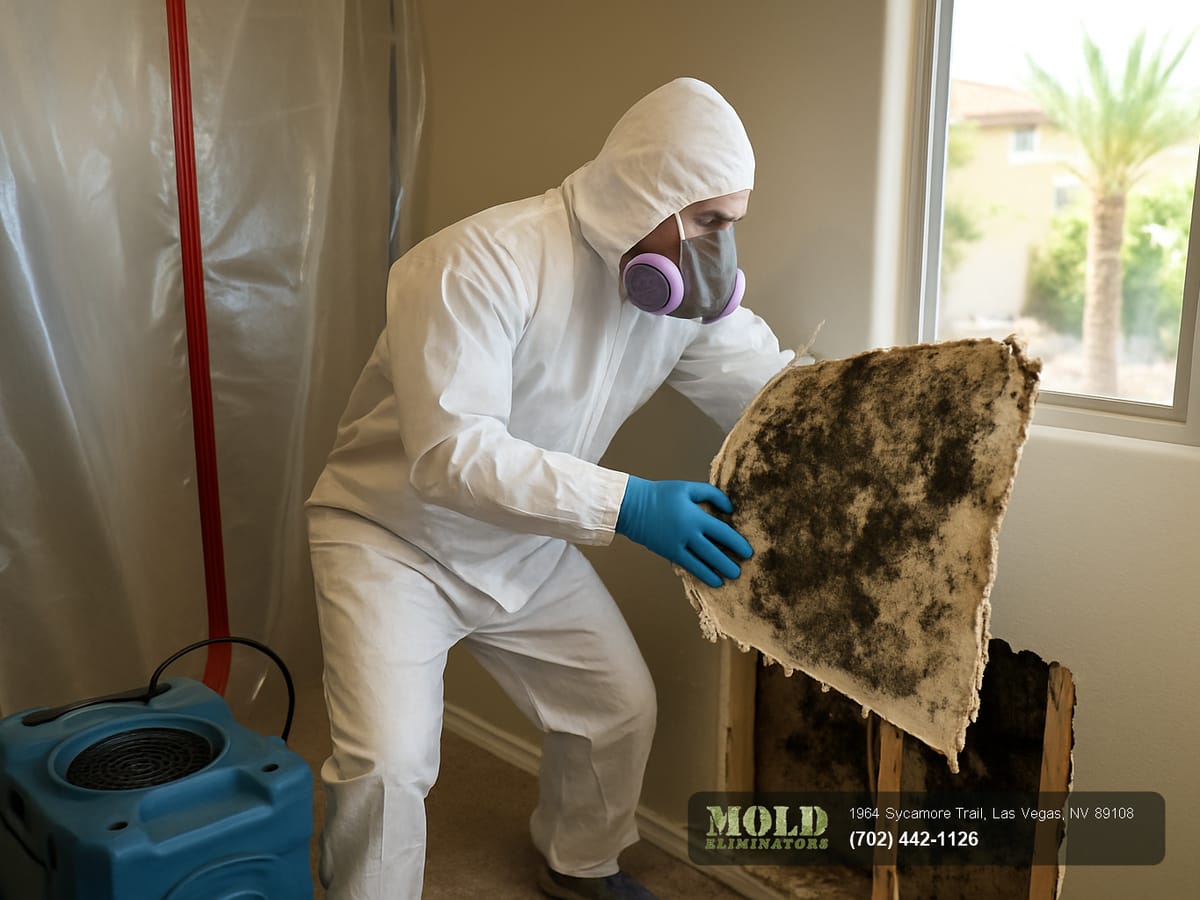 Professional containment setup around a wall opening during mold remediation
The real risk: disturbing mold the wrong way
The most common way a DIY job goes wrong is not failing to kill the mold. It is disturbing it. A settled colony is relatively contained; the spores are largely sitting where they grew. The instant you scrub aggressively, tear out drywall, or run a shop fan at it, you aerosolize those spores and send them everywhere the air goes, into bedrooms, into the HVAC return, into the lungs of everyone in the house. A small problem in one room becomes a spore load in five.
None of this is meant to scare you off a grout line. It is meant to explain why the size and material of the growth matter so much. Small and hard, you can safely remove it. Large or porous or hidden, the act of cleaning it is itself the hazard, and that is the moment to bring in equipment built to contain what you are about to disturb.
DIY vs. professional: an honest side-by-side
Neither column is the right answer for every job. The point is to match the job to the right approach, and to be honest about where each one wins.
DIY is the right call when
The growth is under about ten square feet, on a hard non-porous surface like tile, glass, or sealed metal. You can see and fix the water source. No one in the home is high-risk. It has not come back before. This is a sponge, an N95, and an afternoon, and paying a company for it would be a waste of your money.
Professional is the right call when
The area is large, the material is porous, the growth is inside walls or under floors, it keeps returning, it followed a water event, or a vulnerable person lives there. This needs containment, negative air, moisture mapping, and independent lab verification, the kind of full remediation that removes the problem instead of relocating it.
How we keep it honest
We do not subcontract; every technician is an in-house W-2 certified crew member. We tell you when you do not need us, and when you do, an independent third-party lab, not our own technician, confirms the result. If lab analysis is warranted, samples go to that lab and are billed at cost. No upsell, no theater.
The honest line, and who is drawing it
It is fair to ask why you should trust a mold company to tell you when you can skip the mold company. The answer is the standard the advice is built on. Our founder, Craig Herrmann, co-authored the ANSI/IICRC S520 standard, the document the entire industry uses to define what mold remediation actually requires. He is an IICRC Master Certified Flood Expert and has worked on more than 255 properties since 1996. When we tell you a ten-square-foot grout patch is a DIY job, that is not a casual opinion, it is the same line the national standard draws. You can read more about Craig and the S520 work if you want to see where the rulebook comes from.
That standard is also why we will not pretend a wall-cavity colony is a wipe-down. The same rulebook that frees you to handle small surface mold is unambiguous about containment, air management, and verification once a job crosses the line. We hold both ends of that honestly: we will talk you out of an unnecessary job, and we will not let you walk into a dangerous one underequipped.
When you are not sure which side of the line you are on, that uncertainty is exactly what an inspection resolves. Rather than guess from a photo, we come measure it. The on-site visit is a free inspection, and if lab analysis turns out to be warranted, samples go to an independent third-party lab and are billed at cost, with no markup. You get a clear, factual answer about whether this is your job or ours, before any money changes hands.
DIY vs. professional mold removal: common questions
- How much mold is safe to clean myself?
- The common industry line is about ten square feet of contiguous growth on a hard, non-porous surface, with a moisture source you can see and correct. Under that, with an N95 and gloves, a careful homeowner can usually handle it. Above that, or on porous material like drywall and carpet, or hidden in a wall, it becomes a job for professional remediation with proper containment.
- Does bleach kill mold?
- On a hard, non-porous surface bleach can remove the staining, but the point is physical removal, not bleaching a color out. On porous materials it is worse than useless: the water carries the bleach off, the mold roots stay, and the surface re-colonizes. Detergent, scrubbing, and complete drying do more than bleach, and fixing the water source does the most of all.
- Why is disturbing mold so risky?
- A settled colony keeps most of its spores where they grew. Scrubbing hard, cutting into drywall, or fanning it aerosolizes those spores and spreads them through the air and HVAC into the rest of the home. That is why professionals seal and depressurize the work area first. Disturbing a large or hidden colony without containment can turn one room’s problem into the whole house’s.
- Is black mold something I can remove myself?
- Treat a heavy, dark, spreading colony as a stop-and-call situation. Color alone does not prove toxicity, but the kind of growth people mean by black mold is usually large, often tied to a real water problem, and exactly the sort of colony you do not want to disturb without the right equipment and a lab result to tell you what you are dealing with.
- How do I know if there is hidden mold behind a wall?
- You measure for it. A persistent musty smell, a past water event, recurring growth after cleaning, or visible staining that bleeds through paint all point to moisture inside the assembly. A free inspection uses moisture meters and thermal imaging to find the water you cannot see, which is the only way to know whether the patch on the surface is the whole story or the tip of it.
- Will you tell me if I do not need you?
- Yes, and we do it regularly. We are an anti-upsell shop: we tell homeowners when a job is a safe DIY cleanup and send them off without a charge. The on-site visit is a free inspection, and our crews are in-house W-2 certified employees with one-hour emergency response, 24/7, across the Las Vegas valley. If you genuinely do not need remediation, that is the answer you will get.
Not sure which side of the line you are on? Find out for free.
Send us a photo or have us come measure it. The on-site inspection is free, and we will tell you honestly whether this is a weekend cleanup or a job for our crew. One-hour emergency response, 24/7, across the Las Vegas valley, with no subcontractors and no upsell.