Emergency Water Removal in Henderson, NV
A line lets go under a Green Valley slab at 2 a.m., a water heater fails in a Seven Hills garage, or a supply line splits behind a Water Street kitchen, and within minutes the floor is a pool. The water you can see is the smaller problem. The water already wicking into the wall cavity, the cabinet kicks, and the slab underneath is the part that decides whether this stays a water job or becomes a mold job in three weeks.
Emergency water removal in Henderson is about speed and measurement, not just a wet-vac and a few towels. At Mold Eliminators we extract the standing water, then dry the structure to the ANSI/IICRC S520 standard our founder Craig Herrmann helped write. We have served Clark County since 1996, restored more than 255 properties, and we answer the phone ourselves, with a one-hour emergency response, 24/7, to every Henderson neighborhood from Anthem to Lake Las Vegas.
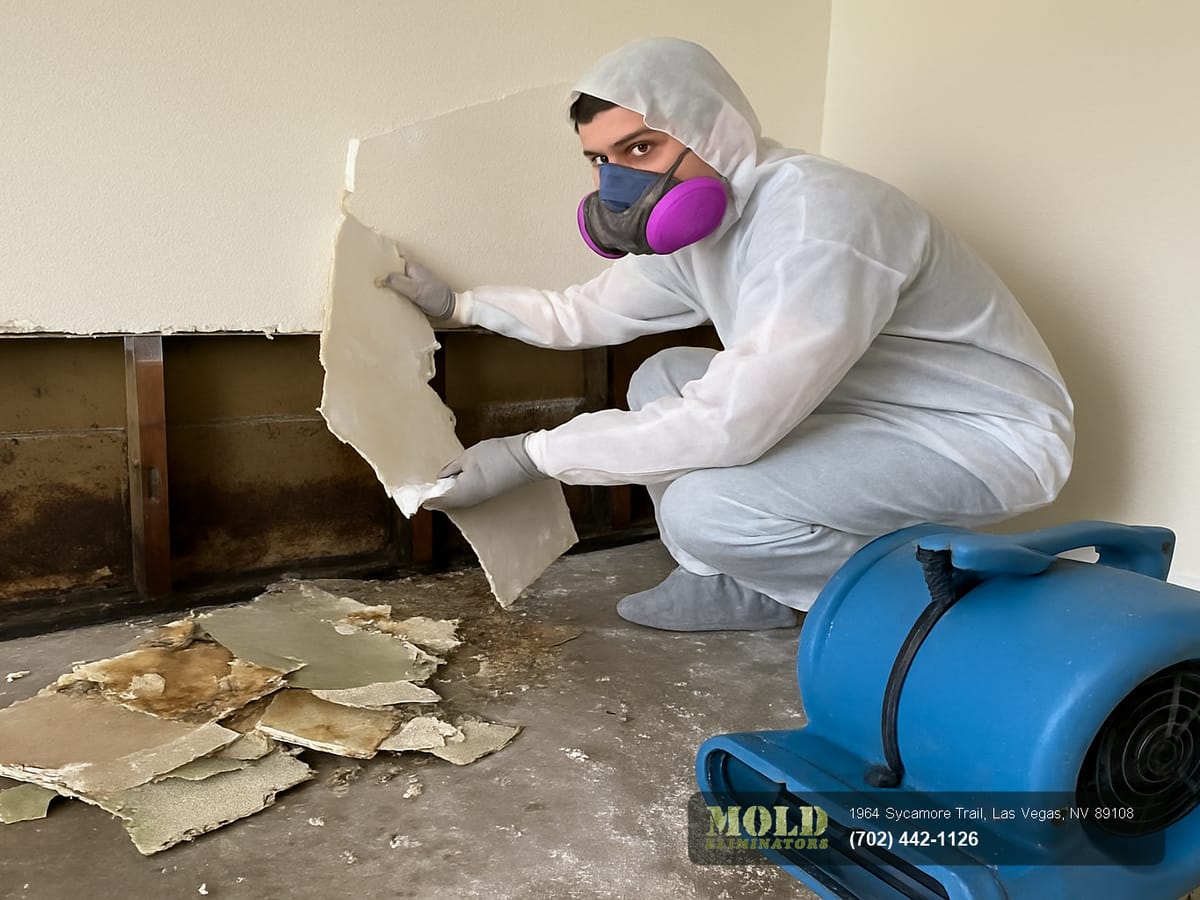 Emergency water extraction equipment running in a Henderson, NV home
What a water emergency looks like in Henderson
Henderson is not one kind of housing stock, and that changes how water shows up. The newer master-planned communities, Inspirada, MacDonald Ranch, and much of Anthem, are slab-on-grade builds where the most common emergency is a slab leak: a pinhole failure in the copper supply lines routed under the concrete. The first sign is rarely a visible flood. It is a warm spot on a tile floor, a water bill that jumped for no reason, or the sound of running water with every faucet off. By the time it surfaces through the slab, water has already been migrating sideways into the bottom plate of the walls for days.
The older core of the city tells a different story. The original Water Street townsite and the surrounding 89015 blocks include homes with aging galvanized and early copper plumbing, where a corroded joint or a failed angle stop can let go without warning. Up in Lake Las Vegas, the lake itself adds ambient humidity that the rest of the desert does not have, so a structure there holds moisture longer and dries slower once it gets wet. Seven Hills and the hillside Green Valley grades add another wrinkle: when a second-story line fails, gravity carries the water down through two floors before anyone notices, soaking ceilings, insulation, and the framing in between.
Across the 89002, 89011, 89012, 89014, 89015, 89052, and 89074 zips, the common thread is that the visible water is the tip of the iceberg. Concrete slabs hold moisture far longer than people expect, and a slab that feels dry on top can stay saturated underneath for weeks. That is why emergency water removal here is a measured job, not a mopping job, and why the first call matters more than most homeowners realize.
Need help now?
Talk to a Las Vegas expert
In-house certified crews. One-hour emergency response across the valley, 24/7.
Why the first 24 to 72 hours decide everything
There is a clock on water damage, and it is not generous. Mold can begin to colonize wet organic materials, and most of a Henderson home is organic, from paper-faced drywall to wood framing, within roughly 24 to 48 hours of getting wet. After about 72 hours the conversation shifts from “dry it and save it” to “remove it and remediate.” That window is the whole reason emergency water removal is treated as an emergency and not a scheduled appointment.
This is why the work cannot wait for business hours. The faster a controlled drying environment is set up, with extraction, dehumidification, and air movement working together, the more material is saved and the lower the mold risk drops. A supply-line break left sitting overnight in a vacant Inspirada rental because “we will deal with it tomorrow” can turn a salvageable subfloor into a tear-out. If water is actively spreading right now, the right move is our 24/7 emergency response, where we stabilize the source first and start extraction immediately. For the underlying engineering behind that response, see our full emergency water removal service.
Henderson’s climate cuts both ways on that clock. The dry desert air tempts people into thinking a structure will just air-dry, while the slab and the wall cavities stay soaked underneath. Near Lake Las Vegas the added humidity slows evaporation further. And in summer, extreme heat can drive moisture deeper into cool wall cavities through condensation. None of this is visible to the eye, which is exactly why drying has to be measured, not guessed.
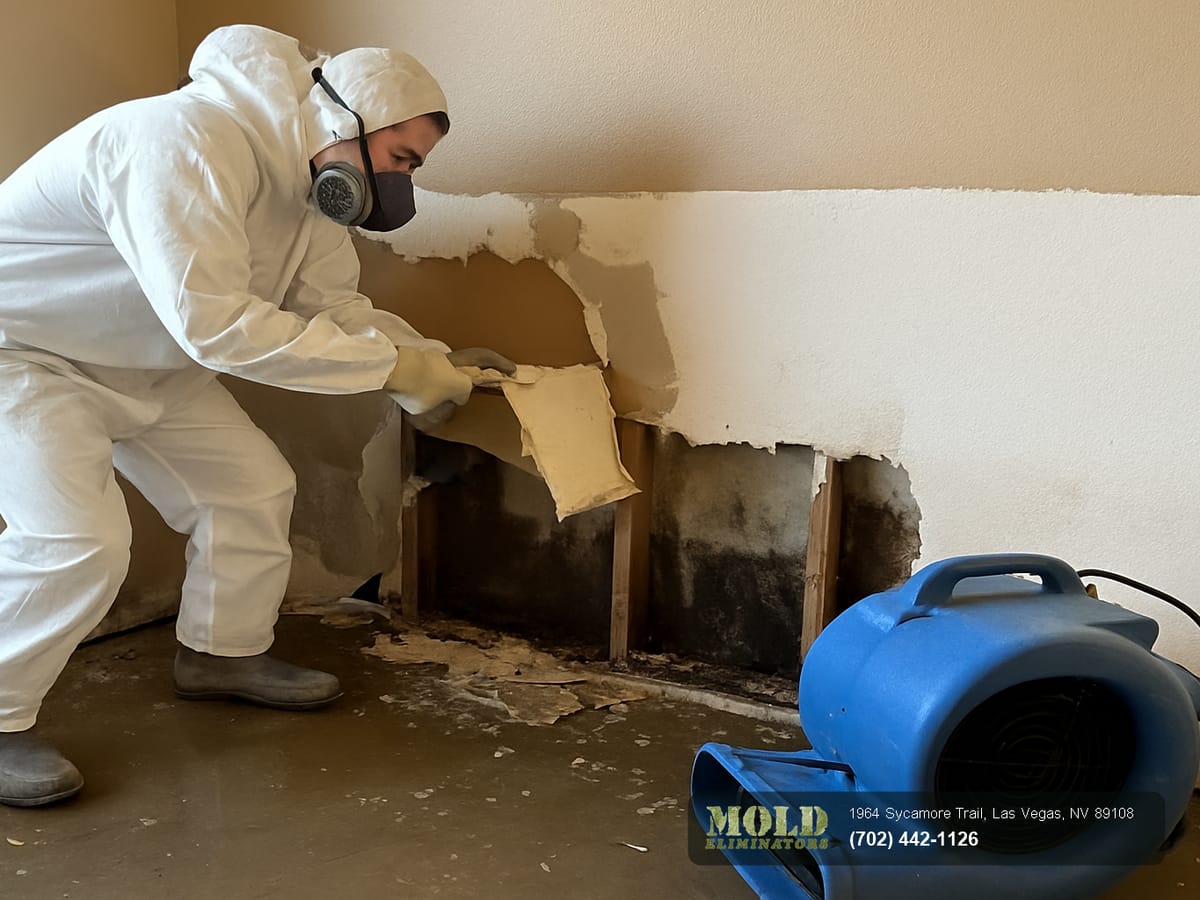 Technician taking moisture readings during a Henderson water emergency
How we handle it, to the S520 standard
Water removal done to standard follows a deliberate sequence, the same discipline Craig Herrmann co-authored into the national mold standard, from the first reading to the final verified-dry target.
- Stabilize and extract. We stop or isolate the source, then physically extract every bit of standing and absorbed water. Pulling water out is dramatically faster than evaporating it, and it protects the materials underneath.
- Moisture mapping. Before a single fan is placed, we map how far the water traveled with meters and thermal imaging, log starting moisture levels, and set a documented dry target for each material.
- Dehumidification. Commercial dehumidifiers pull water vapor out of the air so the room stays drier than the wet materials, the engine that actually keeps moisture leaving the structure.
- Air movement. High-velocity air movers are placed by design, not at random, to sweep moisture off surfaces and into the air where the dehumidifiers can capture it.
- Daily monitoring. Every day, moisture readings are taken and logged, and the equipment is adjusted to keep drying on pace. The data drives the schedule, not the calendar.
- Verify and document. Equipment comes out only when readings confirm every material has hit its dry standard, and the whole record is logged for you and your insurer.
Why local, in-house, and independently verified matters
A real Henderson response
We are not a national franchise routing your call to a dispatcher three states away. We answer the phone ourselves, with a one-hour emergency response across Henderson, 24/7, whether the call is from Anthem, Green Valley, or the Water Street core.
No subcontractors
Every technician on your home is a certified W-2 employee, never a subcontractor handed your job for the day. One in-house crew owns the water, the drying, and the mold risk from the first reading to the last.
Independent lab, not our say-so
When the question is whether something is truly clean or dry, samples go to an independent third-party lab, so the verdict is the lab’s, not ours. We are anti-upsell: we tell you when you do not need us.
That is the whole difference. Craig Herrmann is IICRC Master Certified and co-authored the ANSI/IICRC S520 standard, so your Henderson structure is dried by the rulebook, to documented targets, not to “feels dry.” You can read more about Craig’s credentials and the S520 standard, and you can see every neighborhood we cover on our Henderson service hub.
Insurance, documentation, and the free inspection
Emergency water removal after a sudden, accidental event, a burst pipe, a failed water heater, a slab leak that let go, is frequently covered by homeowners insurance, and the documented moisture map is exactly what an adjuster wants to see. We log readings, photos, and scope from the first visit and work directly with your carrier. Because we dry fast and prove it with data, we are also documenting the very thing that keeps a covered water claim from becoming a disputed mold claim later.
The on-site inspection is free. A certified technician comes to your Henderson property, assesses the intrusion, and gives you a straight read on what got wet and what it will take to dry it. If lab analysis is warranted, samples go to an independent third-party lab and are billed at cost. There is no charge to find out where you stand, and we will tell you plainly if the right answer is to dry and monitor rather than tear out. If you want that calm, factual baseline, the free inspection is the place to start, or you can reach us directly with no call center in between.
Emergency water removal in Henderson: common questions
- How fast can you get to my Henderson home?
- We run a one-hour emergency response, 24/7, across Henderson, from the Water Street townsite to Anthem, Inspirada, Seven Hills, and Lake Las Vegas. When water is actively spreading, call us first and stop the source if you safely can, because every hour inside the 24 to 72 hour window matters. Our 24/7 emergency line reaches a real technician, not a message service.
- I think I have a slab leak in Green Valley. What now?
- Slab leaks are one of the most common emergencies in Henderson’s slab-on-grade communities like Green Valley, MacDonald Ranch, and Inspirada, where pinhole copper failures under the concrete are routine. Warm spots on tile, a jump in your water bill, or running water with no faucet open are the early signs. We locate the intrusion, extract, and dry the slab and surrounding framing to a verified target, then document it for your insurer.
- Is the inspection really free?
- Yes. The on-site inspection is free for Henderson homeowners and property owners. A certified technician evaluates the intrusion and tells you what got wet and what it will take to dry it. If lab analysis is warranted, samples go to an independent third-party lab and are billed at cost. We are anti-upsell, so if you do not need full remediation, we will say so. See the free inspection for details.
Water spreading in your Henderson home? We remove it right, before mold gets its chance.
Free on-site inspection, no pressure, and a one-hour emergency response, 24/7, across Henderson. We extract, dry to verified targets, and document it, so the water problem ends here, not in three weeks.