Bubbling Paint in Las Vegas
If you are seeing bubbling paint, blisters lifting off the wall like little domes, or a patch that feels soft and spongy when you press it, your home is trying to tell you something. Paint does not bubble on its own. Almost every time, those blisters mean moisture is trapped behind the surface, pushing the paint film away from the wall. The bubble is the symptom. The water, and sometimes the mold feeding on it, is the real story underneath.
The good news is that catching it now, while it is still just bubbling paint, is far better than catching it later as a spreading stain or a musty smell that will not leave. The hard part is that the surface almost never tells you how far the moisture has traveled. This page walks you through what bubbling paint usually means in a Las Vegas home, how urgent it is, and what a proper fix actually involves, the kind done to the national mold standard rather than painted over and forgotten.
 Close-up of bubbling, blistering paint lifting away from an interior wall in a Las Vegas home
What bubbling paint usually means in a Las Vegas home
Paint blisters when something breaks the bond between the paint film and the wall behind it. In the dry desert, the most common culprit by far is moisture pushing from the inside out. Heat and humidity can also lift paint that was applied over a dirty or damp surface, but when blisters appear on a wall that was fine for years, trapped water is usually the cause. Here is what tends to be behind it in this valley, honestly ranked from most to least common.
Hidden water inside the wall. A slow plumbing leak, a supply line behind a vanity, or a drain that weeps a little with every use can soak the back of the drywall for weeks before anything shows on the surface. By the time paint bubbles, the cavity has often been wet long enough for mold to start. This is the scenario behind most mold growing behind walls, and it is the one you least want to ignore.
AC condensation and ductwork sweat. Las Vegas air conditioners run hard for half the year. When a condensate line clogs or backs up, or when cold ductwork sweats inside a hot wall cavity, that water has to go somewhere. It collects in the drywall, and the first sign is often a soft, bubbling patch on a ceiling or an upper wall near a vent.
A slab leak. Many valley homes sit on slab-on-grade foundations, and a pinhole leak in a pipe running through that slab can wick moisture up through the bottom of a wall. Bubbling paint low on a wall, near the floor, paired with warm spots underfoot, is a classic slab leak signature.
Swamp cooler overflow. Evaporative coolers add a lot of moisture to a home by design, and an overflowing pan, a stuck float, or a leaking supply line can run water down through a ceiling or an interior wall, lifting paint as it goes.
Monsoon and roof intrusion. When the summer monsoon dumps a year of rain in an afternoon, water finds tired flashing, a cracked parapet, or a failed seal around a vent. It travels along framing and shows up as a bubble far from where it actually got in.
The honest truth is that the bubble itself rarely tells you which of these you have. The only way to know is to find the source, and that is exactly where a proper diagnosis starts.
Need help now?
Talk to a Las Vegas expert
In-house certified crews. One-hour emergency response across the valley, 24/7.
Why it matters and how urgent it is
Bubbling paint is not an emergency the way a burst pipe is, but it is a warning you should not sit on. The reason is simple. Moisture that has been present long enough to lift paint has very likely been present long enough to start mold. Mold spores live in every home harmlessly until they find a wet surface to feed on, and the back of a soaked piece of drywall is an ideal meal. Most of a home is organic material, from the paper face of drywall to the wood framing behind it, and once moisture sits, colonization can begin within 24 to 72 hours.
That means the clock that matters already started when the wall first got wet, not when you noticed the bubble. The longer the source keeps feeding moisture into the cavity, the more material has to be removed rather than dried and saved. A small, quickly caught leak might be a modest repair. The same leak left running behind a wall for two months can mean opening the wall, removing soaked insulation, and a full water damage restoration job. Acting while it is still bubbling paint is how you keep a small problem small.
There is a health angle too, and it deserves a calm, honest mention rather than fear. A hidden, actively growing mold colony can put spores into the air you breathe. That is a real reason to identify what is behind the paint, not a reason to panic. The right response is to find out what is actually there, and the only reliable way to do that is to look behind the surface.
 Technician using a moisture meter to trace the source of water behind a bubbling wall in Las Vegas
What the proper fix actually involves
Painting over a bubble hides the symptom and guarantees it comes back, because the water is still there. A fix done to the ANSI/IICRC S520 standard, the national mold remediation rulebook our founder Craig Herrmann helped co-author, follows a deliberate order. Here is how Mold Eliminators handles a bubbling paint call.
- Free on-site inspection. We come out and look at the actual wall, free of charge. Lab testing and analysis are a separate paid add-on you choose only if it is warranted, never an automatic upsell.
- Find the source. Using moisture meters and thermal imaging, we trace where the water is coming from and how far it traveled. You cannot fix what you have not found, and the source is what makes the bubble come back.
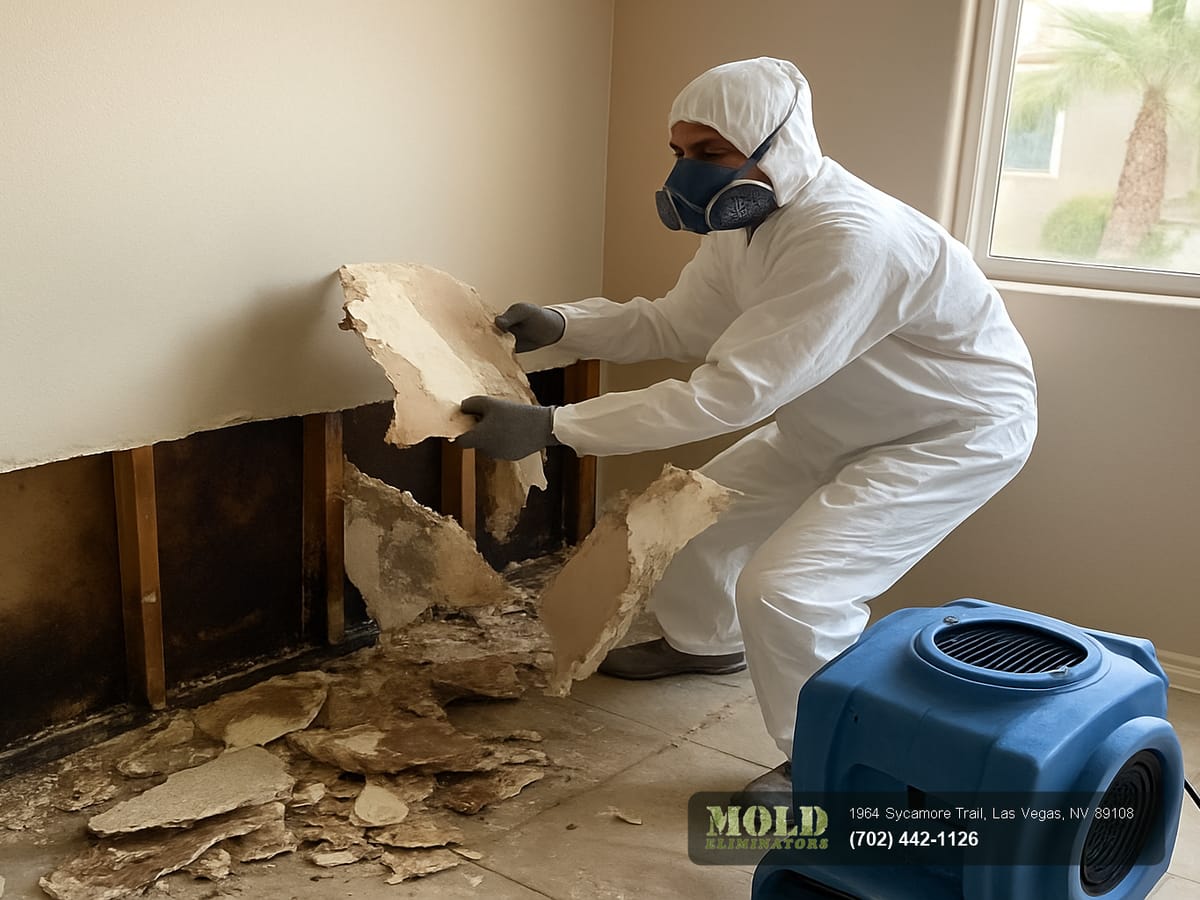
- Contain the area. If mold is present, we seal off the work zone so spores are not spread through the rest of the home while we open the wall.
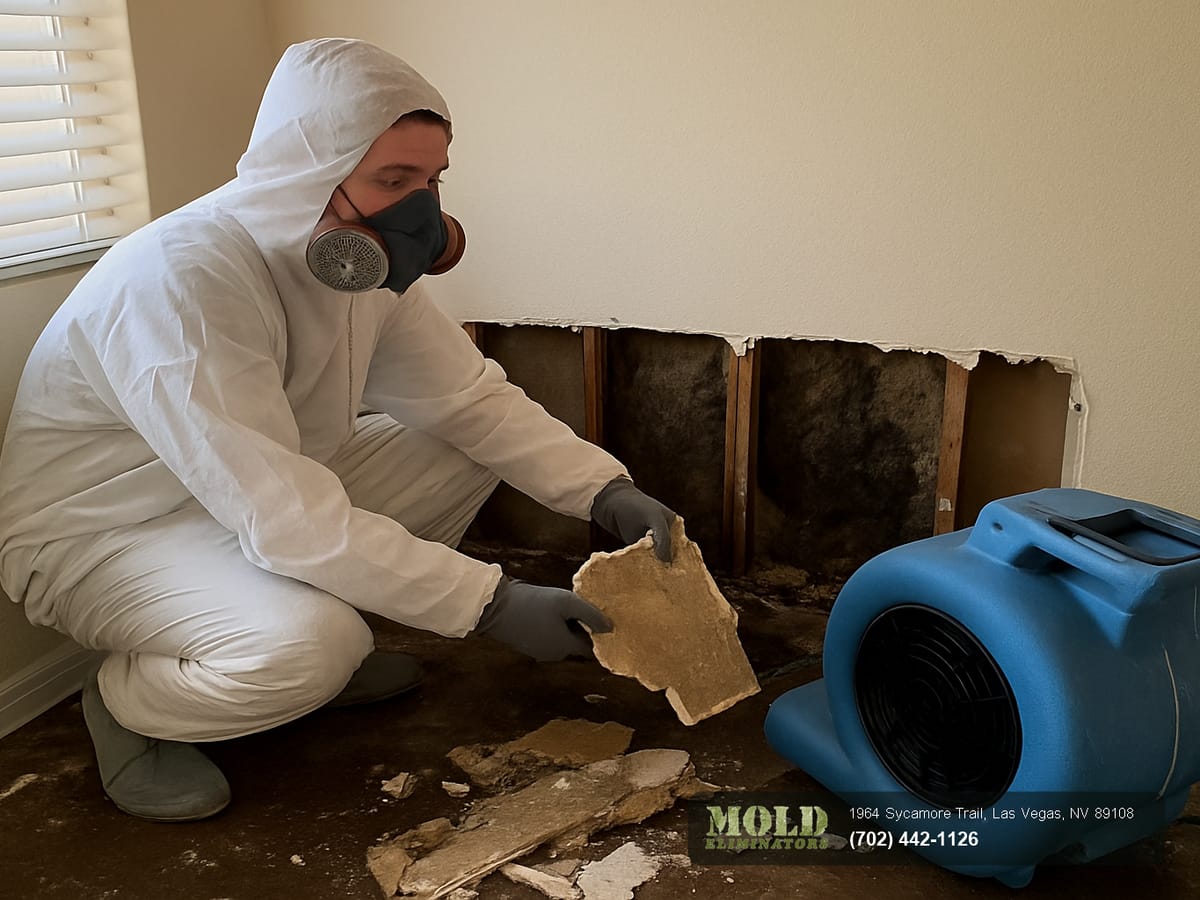
- Remove what cannot be saved. Soaked, contaminated drywall and insulation come out. Materials that can be salvaged stay.
- Dry to a verified target. Commercial dehumidification and air movement bring the structure back to a documented dry standard, measured with daily readings, not guessed by touch.
- Independent lab clearance. When the work is done, an independent third-party lab verifies the result, so you have data showing it is clean rather than our word for it.
Why Las Vegas homeowners call Mold Eliminators
No subcontractors
Every technician is a certified W-2 employee of Mold Eliminators. One crew owns the diagnosis, the removal, the drying, and the result, with no finger-pointing between companies. We have been doing this in the valley since 1996 across 255+ properties.
Independent third-party lab
We do not grade our own homework. Clearance is verified by an independent third-party lab, so the proof your home is clean comes from data, not from the person you paid to do the work.
Anti-upsell, fast response
We tell you when you do not need us. The on-site inspection is free, testing is optional, and our emergency line answers with one-hour response, 24/7, when a leak is actively running.
That is the whole difference. Where a franchise might scrape the bubble, slap on new paint, and leave the water in the wall, we find the source, fix the cause, and document the result to the standard. If you want the calm, factual version of what is behind your paint, the first step is a free inspection with no pressure attached.
Bubbling paint in Las Vegas, common questions
- Does bubbling paint always mean mold?
- Not always, but it almost always means moisture, and moisture trapped long enough to lift paint has often been there long enough to start mold. The only way to know for certain is to find the source and look behind the surface. That is exactly what a free inspection is for, and it carries no obligation to do any work.
- Can I just scrape it, dry it, and repaint?
- If the water source is fixed and the wall is genuinely dry, a cosmetic repair can hold. The problem is that the bubble is usually downstream of an active leak, a slab issue, or a condensation problem you cannot see. Repaint without fixing the cause and the new paint bubbles too, often worse. Finding the source first is what makes a repair last.
- Why does this keep happening on the same wall in summer?
- In Las Vegas, summer is when air conditioners, swamp coolers, and the monsoon all add moisture at once. A wall that bubbles every summer usually has a recurring water path, a sweating duct, an overflowing cooler, or seasonal roof intrusion. Tracing that path with moisture meters is how we tell a one-time spill from a returning problem, and it often ties back to moisture hiding behind the walls.
Seeing bubbling paint? Find out what is behind it, free inspection.
Free, no-pressure on-site inspection across the Las Vegas valley. We find the source, fix the cause to the S520 standard, and verify the result with an independent lab. One-hour emergency response, 24/7, when water is actively running.