Sagging Ceiling in Las Vegas
If you are seeing a sagging ceiling, the part of you that wants to wait and see is wrong, and your instinct to look up and worry is right. A ceiling that bows, dips, or droops is almost never a cosmetic flaw. It is the surface telling you that something heavy is sitting above it, and in a Las Vegas home that something is almost always water, plus the mold that water tends to bring with it.
Drywall is strong in tension only while it is dry. Once it absorbs moisture from above, the paper face softens, the gypsum core loses its grip on the fasteners, and gravity does the rest. So a sag is really a moisture story with a deadline attached. The good news is that catching it at the sag stage, before the ceiling lets go, gives you the widest set of options and the lowest cost. The honest first step is a free on-site inspection to find the source, not a guess and a patch.
What a sagging ceiling usually means in a Las Vegas home
A ceiling sags because water has been collecting above it long enough to overcome the drywall and its fasteners. The drywall is the symptom. The job is finding the source, and in the desert there is a short list of usual suspects.
A roof or attic leak after a monsoon. Our summer monsoon storms are brief but violent, and a flat or low-slope roof that handles 50 dry weeks a year can fail in one afternoon. Water pools, finds a seam or a flashing gap, and travels along the joists until it pools over a ceiling panel and bows it.
AC condensation and a failed drain pan. This is the quietest cause and one of the most common here. Many Las Vegas homes have the air handler in the attic, with a condensate line and an overflow pan. When the line clogs or the pan rusts through, conditioned air keeps producing water that drips onto the ceiling below, day after day, until it sags. There may be no storm and no obvious plumbing fixture above, which is why people are baffled.
A second-floor or slab-adjacent plumbing leak. A supply line, a drain, or a toilet flange on the floor above can weep slowly into the ceiling cavity. In single-story homes built on a slab, a pressurized line in the attic or a water heater in a closet can do the same.
Swamp cooler overflow. If you run an evaporative cooler, the float, the bleed line, or the supply line can overflow onto the roof deck and migrate inside, soaking the ceiling from above with a steady summer drip.
Whatever the source, a ceiling that has been wet long enough to sag has very likely been wet long enough to grow mold inside the cavity, where you cannot see it. That is why a sag and a hidden mold problem are usually the same call. Proper ceiling water damage work treats both at once: stop the water, then deal with what the water started.
Need help now?
Talk to a Las Vegas expert
In-house certified crews. One-hour emergency response across the valley, 24/7.
Why it matters and how urgent it is
There are two clocks running, and they move at different speeds. The first is structural. Wet drywall gets heavier as it absorbs water, and a sag that looks stable today can become a collapse tomorrow when one more storm or one more night of dripping pushes the load past what the softened fasteners can hold. A falling ceiling panel is heavy enough to injure someone and is the kind of failure that tends to happen at the worst moment, with no warning sound.
The second clock is biological, and it is faster than most people expect. Mold can begin colonizing wet, paper-faced drywall and wood framing within roughly 24 to 72 hours of the materials getting wet. By the time a ceiling has visibly sagged, that window is usually long past, which means there is a real chance an active colony is already growing in the cavity above the bow. That hidden growth is what turns a simple water repair into a remediation job if it is ignored.
So the urgency is real, but it is not a reason to panic. It is a reason to act this week rather than next month, and to find out what is actually happening above the ceiling before the situation makes the decision for you. If the ceiling is actively dripping, bulging, or shedding material right now, that is an emergency and worth a same-day call.
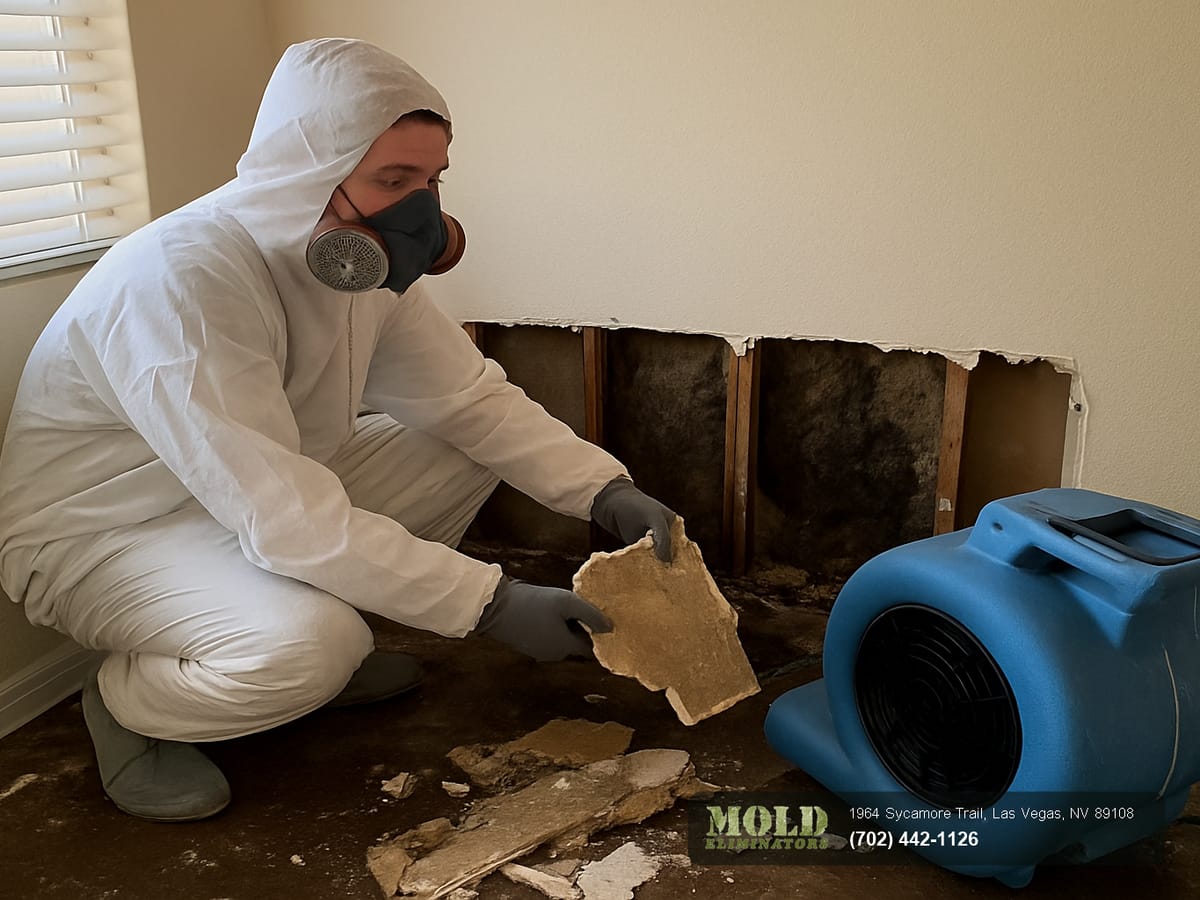 Technician inspecting a bowed, water-stained ceiling in a Las Vegas home
What the proper fix involves
A sagging ceiling done right is not a patch. It is a sequence built to the ANSI/IICRC S520 mold standard, the standard our founder Craig Herrmann helped co-author, and it follows the same logic every time.
- Free on-site inspection and source diagnosis. We come out and find why the ceiling is wet, using moisture meters and thermal imaging to trace the water back to its actual origin in the roof, the attic, the AC system, or the plumbing, before anyone opens a wall.
- Stop the source. Drying a ceiling while it is still being fed is pointless. We make sure the leak, the overflow, or the condensation problem is stopped first.
- Containment. If mold is present, we seal the work area so spores are not pushed through the rest of the home while the ceiling is opened.
- Remove and remediate. Drywall and insulation that are saturated or colonized come out. Framing that can be saved is cleaned and treated to the standard rather than demolished needlessly.
- Structural drying. The cavity, the framing, and the surrounding materials are dried to documented targets with commercial equipment, not left to air-dry in a climate that hides moisture in cool cavities.
- Independent lab clearance. Before we rebuild, an independent third-party lab verifies the area is clean. We do not grade our own work.
Because the cause is so often water above the ceiling, this work usually overlaps with full water damage restoration: extract, dry to verified targets, and document the result for your records and your insurer.
Why homeowners call us for this
No subcontractors
Every technician on your ceiling is a certified W-2 Mold Eliminators employee. One crew owns the source, the drying, and the mold from the first reading to the last, with no finger-pointing between trades.
Independent lab clearance
We do not declare the job done on our own say-so. An independent third-party lab verifies the cavity is clean before we close it up, so what is above your ceiling is proven, not assumed.
Anti-upsell, fast response
If the ceiling only needs drying and a small repair, that is what we tell you. We have served Las Vegas since 1996 across 255+ properties, with one-hour emergency response, 24/7, when a ceiling cannot wait.
That is the whole difference. We find the water, fix the cause, and verify the result to the same standard Craig helped write, instead of patching over a problem that will come back through the new paint in a month.
Sagging ceiling in Las Vegas, common questions
- Is a sagging ceiling always mold?
- Not always, but it is almost always water, and water in a ceiling cavity for more than a day or two is the exact condition mold needs. By the time drywall visibly sags, it has usually been wet long past mold’s 24-to-72-hour window, so we treat both the water and the mold risk as one job. A free inspection tells you which you are dealing with before any work starts.
- Why is my ceiling sagging when it has not rained?
- In Las Vegas the most common no-rain cause is AC condensation. An attic air handler with a clogged condensate line or a rusted overflow pan drips on the ceiling all summer, sagging it with no storm in sight. A swamp cooler overflow or a slow plumbing leak above can do the same. The source is rarely where the stain appears, which is why we trace it with thermal imaging during the inspection.
- How fast do I need to act?
- Soon. A sag means the drywall is already losing its hold, and one more soaking can turn it into a collapse. If it is dripping or bulging now, treat it as an emergency and call right away. If it is a slow sag, this week rather than next month, because the longer the cavity stays wet, the more likely hidden mold turns a simple repair into a full remediation.
Seeing a sagging ceiling? Start with a free inspection.
We find the source, check for hidden mold, and tell you honestly what your ceiling needs, with no pressure. One-hour emergency response, 24/7, across the Las Vegas valley. On-site inspection is free; lab analysis, if you want it, is an independent paid add-on.