How to Find a Hidden Water Leak in Your Home
Your water bill jumped, the floor near the hallway feels faintly warm, and there’s a musty edge in a room that has no business smelling that way. Nothing is dripping where you can see it, so it’s easy to talk yourself out of worrying. That instinct is exactly how a small hidden leak becomes a wall full of mold.
Learning how to find a hidden water leak is mostly about knowing where desert homes fail and how to read the small clues before they turn into a tear-out. In Las Vegas, the usual culprits are slab supply lines, pinhole pipe failures, and slow drips inside walls that the dry air masks for months. This guide walks through the signs, a free meter test you can run tonight, the spots that leak most often in valley homes, and the point where you stop guessing and bring in moisture meters and thermal imaging. We build it the way our founder Craig Herrmann built his career since 1996: measure first, then act, and tell you honestly when you do not need us.
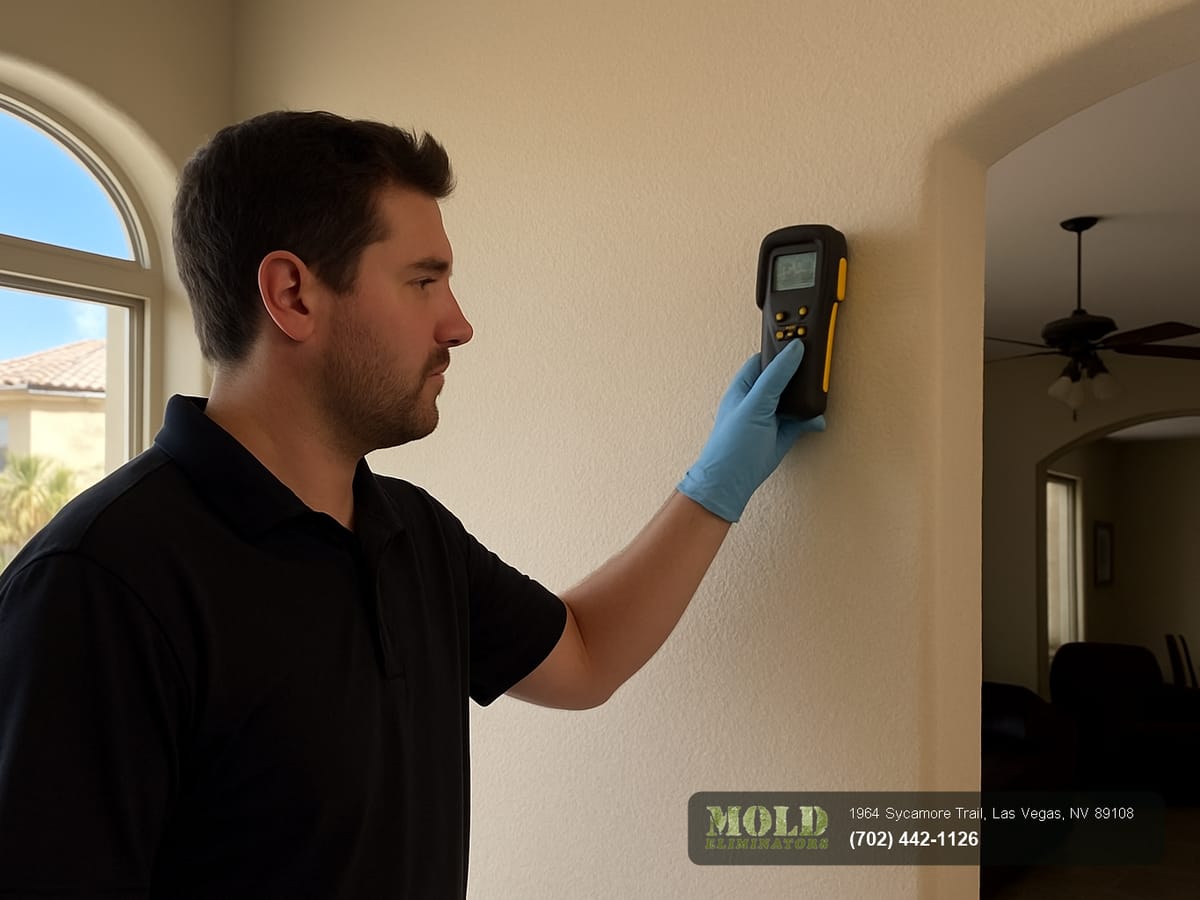
 Technician using a moisture meter on a baseboard to locate a hidden water leak
The signs of a hidden water leak
A hidden leak rarely announces itself with a puddle. It shows up sideways, in small changes you can easily explain away one at a time. The trick is noticing when two or three of them line up, because that pattern is the leak talking. None of these signs are proof on their own, but together they tell you where to look.
A water bill that climbed for no reason. If your usage jumped and your habits did not, water is going somewhere you cannot see. A continuous slab leak can waste hundreds of gallons a day, and on a Las Vegas bill that adds up fast. This is one of the most reliable early signals, because it measures the whole system at once.
A musty or earthy smell. That damp-basement odor in a desert home almost always means moisture is sitting somewhere it should not, feeding the first stages of microbial growth inside a cavity. The smell is the problem starting, not just stale air. When an odor like this lingers, a professional mold inspection is the calm way to find the source before it spreads.
Warm spots on the floor. A patch of tile or slab that feels noticeably warmer than the rest of the room is a classic sign of a hot-water supply line leaking under the slab. Cold-water slab leaks can do the opposite and feel cool or damp.
Stains, bubbling paint, or soft drywall. A faint yellow ring on a ceiling, paint that bubbles or peels along a wall base, or drywall that feels soft and spongy near the floor all mean water has been wicking through the material for a while. By the time it surfaces cosmetically, the assembly behind it is already wet.
The sound of running water with everything off. Shut off every fixture and appliance, stand still in a quiet house, and listen. A faint hiss or trickle inside a wall or under the floor is often the first thing people notice with a pressurized supply leak.
If several of these line up, you are not imagining it. The next step is to confirm there is a leak at all, and you can do that yourself in about an hour for free.
Need help now?
Talk to a Las Vegas expert
In-house certified crews. One-hour emergency response across the valley, 24/7.
The water meter test: how to confirm a leak yourself
Before anyone opens a wall, you want to know whether water is genuinely escaping the system or whether the smell and the stain are leftovers from an old event. Your water meter is a free, surprisingly precise leak detector, and the test takes about an hour of mostly waiting. This is the single most useful thing a homeowner can do, and it costs nothing.
- Shut off all water use. Turn off every faucet, the dishwasher, the washing machine, the irrigation timer, and any ice maker. Make sure no one flushes a toilet or runs water for the duration of the test. A single running fixture invalidates the result.
- Find and read your meter. In most valley homes the meter sits in a covered box near the front curb or sidewalk. Lift the lid, note the exact reading, and look for the small low-flow indicator, often a tiny triangle or dial that spins even when a trickle of water moves through.
- Watch the leak indicator. With all water off, that low-flow dial should be completely still. If it is creeping or spinning, water is moving through your system right now, which means a leak somewhere past the meter.
- Wait and re-read. Leave everything off for one to two hours, then read the meter again. Any change in the numbers with zero usage confirms water is escaping. Write down both readings so you have a record.
- Isolate indoor versus outdoor. If your home has a main shutoff valve where the line enters the house, close it and repeat. If the meter still moves, the leak is between the meter and the house, often the underground main or an irrigation line. If it stops, the leak is inside, which is where slab and wall leaks live.
This test tells you that there is a leak and roughly which side of the house it lives on. What it cannot tell you is the exact spot inside a wall or under a slab, and that is where guessing gets expensive. A confirmed positive on the meter test is the right moment to stop opening walls on a hunch and bring in someone with the tools to pinpoint it. Our on-site free inspection exists for exactly this, so you are not paying to chase a leak you cannot see.
Where Las Vegas homes leak most
Desert construction has its own failure points, and knowing them narrows the search dramatically. Most valley homes sit on a concrete slab, the water is hard, and the temperature swings are brutal on plumbing. Those three facts explain the majority of hidden leaks we trace back across Clark County.
Slab leaks deserve special attention because of how the desert hides them. Concrete holds water far longer than people expect, and our extreme summer heat can drive that trapped moisture deeper into cool wall cavities through condensation. A slab that feels dry on top can stay saturated underneath for weeks, which is exactly the buffet mold needs. That is why a confirmed slab leak is never just a plumbing fix: once the line is repaired, the structure still has to be dried and verified as part of full water damage restoration, or the mold problem outlives the leak.
 Thermal imaging camera revealing a cool wet zone behind a wall from a hidden leak
When to bring moisture meters and thermal imaging
There is a clear line between what a homeowner can find and what needs instruments. You can confirm a leak exists with the meter test and narrow it to a region with your eyes and nose. Pinpointing the exact wet path inside a wall or under a slab, without demolishing half the room to look, is where professional tools earn their place.
Two tools do the heavy lifting, and they work together:
- Moisture meters. Pin and pinless meters read the actual moisture content inside drywall, wood, and subfloor, giving each material a real number instead of a guess. We compare wet spots against an unaffected reference area, so a reading is meaningful rather than just a beep.
- Thermal imaging. Infrared cameras reveal the cool, evaporating zones where hidden water sits behind a wall or under a floor. They trace how far moisture migrated from the source, which is often well beyond where the visible stain stops, and they do it without a single hole.
Bring these in the moment the meter test reads positive, the smell will not quit, or a stain keeps coming back after you painted over it. Trying to dry or repair before you have mapped the actual wet area is how people fix the wrong wall and miss the leak entirely.
This measure-first discipline is not a sales pitch, it is the standard. Craig Herrmann co-authored the ANSI/IICRC S520 mold standard, 4th Edition 2024, and is an IICRC Master Certified Flood Expert, so the same instrument-driven approach that defines the rulebook is what we bring to a leak hunt. You can read more about Craig’s credentials. The honest version of leak finding has a number behind every conclusion, which is also what keeps an insurance adjuster satisfied later.
What to do once you find it
Stop guessing, start measuring
A confirmed meter test plus a moisture map tells you exactly where the water is and how far it traveled. We pinpoint the source before anyone opens a wall, so the repair is aimed, not exploratory.
Repair, then dry to verified targets
Fixing the leak is half the job. The saturated slab, framing, and drywall still have to be dried to a documented standard, or the mold the leak fed never actually leaves.
One accountable in-house crew
No subcontractors. Every technician is a certified W-2 employee, with one-hour emergency response, 24/7. One crew owns the find, the dry-out, and the mold risk from first reading to verified-dry.
If a leak has been quietly running long enough to leave a smell or a stain, there is a real chance it already left moisture behind for mold to use. The calm, factual way to know is to measure, which is exactly what an on-site free inspection does. If lab analysis is warranted, samples go to an independent third-party lab, billed at cost, so the result is data you can trust rather than a technician’s opinion. And true to our anti-upsell promise, if your structure is genuinely dry, we tell you that you do not need us.
Hidden water leaks: common questions
- How do I find a hidden water leak without tearing into walls?
- Start with the free meter test: shut off all water, watch the low-flow indicator, and re-read the meter after an hour. If it moved with everything off, you have a leak. Then narrow the region by sign and smell, and bring in moisture meters and thermal imaging to pinpoint the exact spot without demolition. The instruments find the wet path so you only open the wall that matters, which is the heart of proper water damage restoration.
- Why is my floor warm in one spot?
- A warm patch on a slab almost always means the hot-water supply line running under the concrete is leaking. This is a classic Las Vegas slab leak, and it can saturate the slab for weeks before any stain appears. It needs prompt slab leak repair followed by drying, because a repaired line over a still-wet slab is a mold problem waiting to bloom.
- Can a slow leak really cause mold in the desert?
- Yes. Dry desert air masks surface moisture, but trapped water inside a slab or wall cavity does not evaporate on its own fast enough to matter, and summer heat can actually push it deeper through condensation. Mold spores are present everywhere and only need a wet surface to feed on. That is why a slow leak that ran for weeks warrants a mold inspection even after the plumbing is fixed.
- Will my insurance cover a hidden leak?
- Damage from a sudden, accidental leak such as a burst pipe or failed connection is frequently covered, and a documented moisture map is exactly what an adjuster wants to see. We log readings, photos, and scope from the first visit and work directly with your carrier. The same documentation helps keep a covered water claim from turning into a disputed mold claim later.
- How fast do I need to act?
- Quickly. Mold can begin colonizing wet organic materials within roughly 24–72 hours of getting wet, so once a leak is confirmed the clock is running. If water is actively spreading, our crews offer one-hour emergency response, 24/7, across the valley. The faster the source is found and the structure dried, the more material is saved and the lower the mold risk drops.
- What does it cost to have you find the leak?
- The on-site inspection is free. We confirm and locate the moisture problem at no charge, and if lab analysis is warranted, samples go to an independent third-party lab, billed at cost. You get an honest read on what is actually wrong, and if nothing needs doing, we say so. Booking a free inspection is the no-pressure way to find out where you stand.
Suspect a hidden leak? Find it before mold does.
Free, no-pressure on-site inspection across the Las Vegas valley. One-hour emergency response, 24/7. We measure first, pinpoint the source, and tell you honestly when you do not need us.