National Franchise vs. Local Expert
When water or mold hits your home, the first search result is usually a familiar national brand: a franchise name you have seen on a truck or a billboard. The second is a local company you have never heard of. The honest question is not which logo is bigger, it is who actually shows up, who does the work, and who stands behind the result.
A national franchise vs local mold company decision comes down to ownership of the outcome. A franchise is a brand license: a national name, a national marketing budget, and a local operator who bought the rights to use it. A local expert is the operator. At Mold Eliminators we are the second kind, owned and run in Las Vegas since 1996, and we think the difference matters most on the details a billboard never mentions: who is on your crew, who grades the finished work, and whether anyone in the building has ever read the standard the job is supposed to meet.
Franchise vs local expert
National franchise vs local expert, side by side
Need help now?
Talk to a Las Vegas expert
In-house certified crews. One-hour emergency response across the valley, 24/7.
What you are actually hiring
The word “franchise” sounds like scale and reliability, and sometimes it delivers exactly that. But it is worth being precise about what the model is. A national restoration franchise sells the same brand to independent owners in different cities. Headquarters provides the name, the call center, the software, and the lead flow. The local franchisee provides the trucks, the people, and the actual work in your house. Two trucks with the same logo, three states apart, can be run very differently, because they are different businesses that happen to share a sign.
A local expert removes that layer. There is no franchisee between you and the owner, because the owner is the local expert. When you call Mold Eliminators, the person accountable for the standard of the work is the same person who helped write the standard. That is not marketing language, it is the structure of the company. You can read the story of how the company was built and decide for yourself whether that ownership matters to you.
Neither model is automatically right. A franchise can be a sensible call when you need a single vendor across many states, or when an insurer steers you to a preferred network. A local expert is the better call when the work is technical, the property is yours, and you want one named person answerable for the result. The rest of this page is about telling those situations apart honestly, and about the three places where the gap between the two models shows up most: the crew, the grading, and the local knowledge.
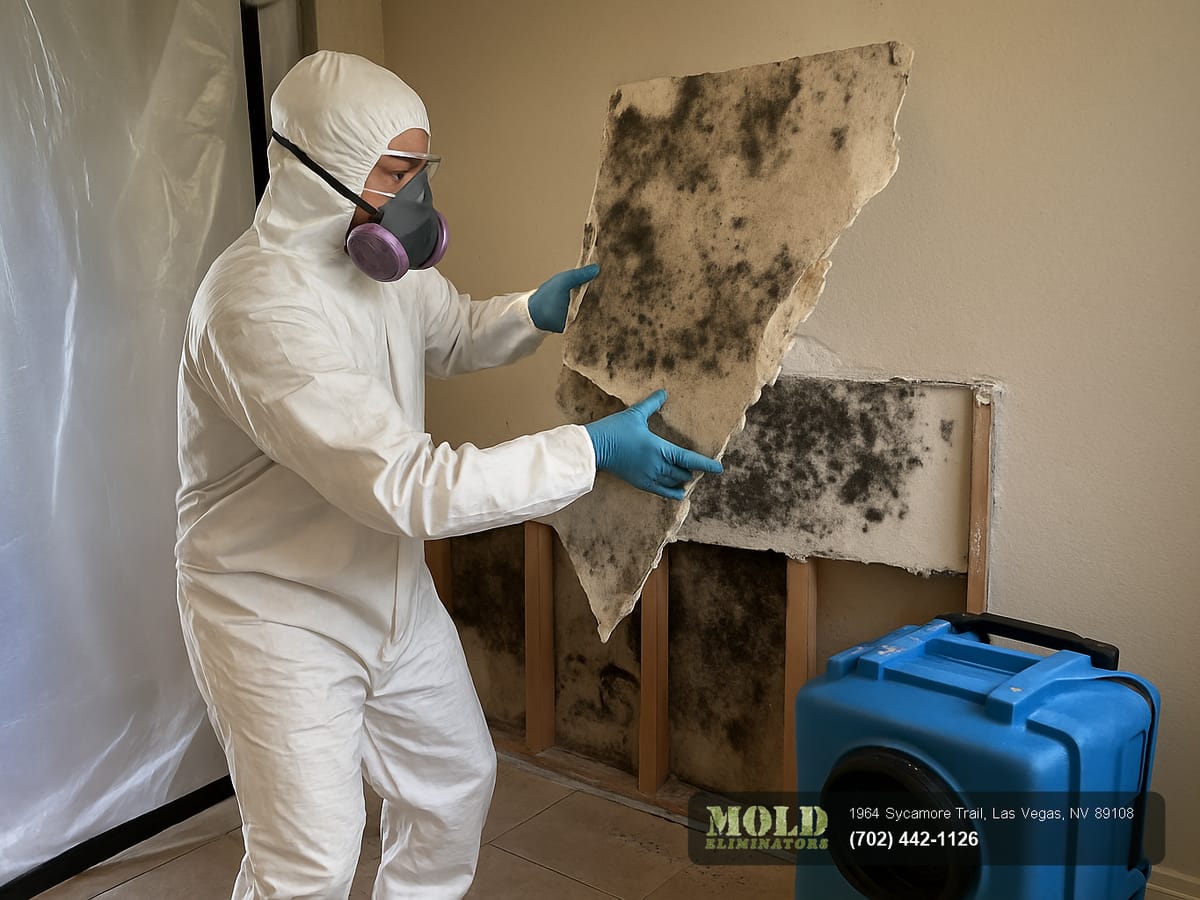
 Certified in-house crew setting containment inside a Las Vegas property
Who is actually on your crew
This is the difference most homeowners never think to ask about, and it is the one that changes the work the most. Many franchises, and plenty of local outfits too, run on subcontractors. The brand sells the job, then hands it to a crew of day-labor contractors who are paid by the job and gone by Friday. The people in your home may have no certification, no loyalty to the brand on the truck, and no reason to slow down and do the tedious parts right when nobody is watching.
We do not subcontract, ever. Every technician on a Mold Eliminators job is a W-2 employee on our own payroll, trained in-house and certified to the standard we work to. That is a deliberate cost we carry so that the person sealing your containment and the person taking the final readings is accountable to the same company that signed your contract. When mold work is done wrong, it is almost always done wrong in the parts nobody sees: a containment that was not sealed, an air scrubber that ran too short, a cavity that was never opened. A paid-by-the-job sub has every incentive to cut those corners. A certified employee whose name is on the file does not.
This is also why our process stays honest. Our remediation work follows the same in-house chain from inspection to clearance, and the same crew owns the water side too, so a job that starts as water damage restoration and turns into a mold problem never gets handed off to a stranger. One company, one crew, one chain of responsibility.
Who grades the finished work
Here is a question that separates a serious restorer from a marketing brand: when the job is done, who decides it passed? On too many jobs, the answer is the same company that did the work and wants to send the invoice. That is the equivalent of letting a student grade their own exam. If the crew that sealed the containment is also the crew that declares it clean, “done” can mean “we ran out of days,” not “the structure is actually clear.”
We separate those two roles on purpose. When lab analysis is warranted, samples go to an independent third-party lab, billed at cost, and the lab grades the work, not us. We do not own the lab, we do not mark up the samples, and we do not get to argue with the result. That independence is the whole point. It means a clearance is a fact you can hand an adjuster, a buyer, or an HOA board, not an opinion from the company that wants to be paid.
To be clear about what is free and what is not: the on-site free inspection is genuinely free, and it is where we look, measure, and tell you what we find. If lab analysis is warranted, that analysis is a paid add-on, billed at the lab’s cost with no markup. We would rather tell you plainly than bury it. You should never accept a clearance from a company that both did the work and graded its own homework, whether that company is a national franchise or the guy down the street.
An honest side-by-side
Neither column is a villain. The goal here is to match the model to your situation, not to pretend one always wins.
When a national franchise fits
You are managing properties in several states and want one vendor and one invoice across all of them. An insurer has steered you to a preferred network. The job is straightforward, and brand-level paperwork and a national call center matter more to you than knowing who walks in the door. In those cases a reputable franchise can be a clean, defensible choice.
When a local expert fits
The property is yours, the work is technical, and you want one named person answerable from the first reading to the final clearance. You care that the crew is certified and on staff, that the grading is independent, and that whoever shows up actually understands a desert building. For most homeowners and local property owners, this is the stronger fit.
What to ask either one
Are your technicians W-2 employees or subcontractors? Who performs the final clearance, and is the lab independent? What standard do you work to, and who on your team is certified to it? Ask both columns the same questions. The answers, not the logo, tell you who you are really hiring. A company that welcomes those questions is usually the safer bet.
Desert knowledge a national playbook misses
Mold behaves differently in the Mojave than it does in a humid coastal market, and a national training binder written for the average American city does not always account for that. Las Vegas mold is usually a moisture problem hiding behind a dry climate, which is exactly the kind of thing local experience catches and a one-size playbook walks past.
Swamp coolers are the clearest example. Evaporative coolers push large volumes of humid air through a home all summer, and a unit that drips or a duct that sweats can feed a hidden colony in an attic or a ceiling for months. A crew trained in Phoenix-style realities knows to look there. A crew running a coastal-region checklist may never open the cooler. Monsoon season brings sudden roof and window intrusion, and our slab-on-grade construction holds water under concrete far longer than people expect, so a floor that feels dry on top can stay wet underneath for weeks. High-rise condos add their own twist, where intrusion crosses unit lines and the question of whose responsibility it is depends on a credible, documented account of what got wet.
None of this is exotic, it is just local. It is the difference between a crew that has worked thousands of desert properties and a crew following a national template. When you are weighing a national franchise vs local mold company, the desert knowledge is not a tiebreaker, it is often the whole game. You can see where we work across the valley, or simply reach us directly with no call center in between.
The author of the standard, not just a reader of it
Most mold companies, franchise or local, work to a standard called the ANSI/IICRC S520. It is the national rulebook for how mold remediation should be done. The honest truth is that the vast majority of technicians have never read it cover to cover, and many have never read it at all. They follow a process their employer handed them and hope it lines up.
Our owner, Craig Herrmann, co-authored that standard. He sat on the body that wrote the ANSI/IICRC S520, 4th Edition, 2024, the document the rest of the industry is supposed to follow. He is also an IICRC Master Certified Flood Expert, one of a small handful in Southern Nevada, and he has been doing this work here since 1996 across more than 255 properties. You can read the full account on Craig’s credentials page.
This is the part a national brand cannot franchise. A logo can be licensed, a call center can be staffed, a marketing budget can be spent. The person who helped write the rulebook cannot be cloned into every city. When the question is who actually understands the standard the work is graded against, the answer at Mold Eliminators is the same person who answers your phone. That is also why we can afford to be anti-upsell: we will tell you when you do not need us, because our reputation does not depend on selling you a job you do not have.
 Owner Craig Herrmann reviewing the ANSI IICRC S520 mold remediation standard
How to actually decide
You do not need to take anyone’s word for which model is better, including ours. You need a short, honest checklist and the willingness to ask the same questions of everyone you call.
- Confirm who does the work. Ask directly whether the technicians are W-2 employees or subcontractors. A company comfortable putting certified staff in your home will say so plainly. If the answer is vague, that is your answer.
- Ask who grades it. Find out who performs the final clearance and whether the lab is independent. A clearance from an independent third-party lab, billed at cost, is worth far more than a thumbs-up from the crew that did the work.
- Test the local knowledge. Ask how they handle swamp coolers, monsoon intrusion, and slab-on-grade moisture. A real desert restorer answers instantly. A national template stumbles.
- Check the standard. Ask what standard they work to and who on the team is certified to it. The honest measure of a mold company is how close it sits to the people who actually wrote the rules.
- Start with a free inspection. Before any of this turns into a contract, get eyes on the actual problem. A no-pressure free inspection tells you what you are really dealing with, and a company that gives one without strings is showing you its character before you spend a dollar.
National franchise vs local expert, common questions
- Is a national franchise always more reliable than a local company?
- No. A franchise is a brand license, so reliability depends entirely on the local owner who bought it, not on the national name. A well-run local expert can be more accountable, because the owner is the operator and there is no franchisee layer between you and the person responsible for the work. Ask both the same questions about crews, grading, and certification, and judge by the answers rather than the logo.
- What does “no subcontractors” actually change for me?
- It changes who is in your home and who is accountable. A subcontractor is paid by the job and gone by Friday, with no certification required and no loyalty to the brand on the truck. Our crews are W-2 employees, trained in-house and certified, so the person sealing your containment answers to the same company that signed your contract. The tedious, unseen parts of mold remediation are exactly where that accountability matters.
- Who should grade a mold job when it is finished?
- Not the company that did the work. When lab analysis is warranted, samples should go to an independent third-party lab, billed at cost, so the result is a fact you can hand an adjuster or a buyer rather than an opinion from the crew that wants to be paid. We never grade our own homework, and you should not accept it from anyone who does, franchise or local.
- Is the inspection free, or is the lab testing free too?
- The on-site inspection is free, with no strings. That is where we look, measure, and tell you what we find. If lab analysis is warranted, that analysis is a paid add-on, billed at the independent lab’s cost with no markup. We keep that distinction clear on purpose. You can book the free inspection any time, and you will know exactly what is free before anything is sent to a lab.
- Does it really matter that the owner co-authored the S520?
- It matters for the same reason it matters who grades the work. Most technicians have never read the ANSI/IICRC S520 cover to cover. Our owner helped write it. That means the standard your job is held to is understood at the top of the company, not handed down as a process nobody questions. You can read the full background on Craig Herrmann’s page, including his IICRC Master Certified Flood Expert credential.
- Why pick a local expert in a city like Las Vegas specifically?
- Because desert mold is its own animal. Swamp coolers, monsoon intrusion, and slab-on-grade construction create moisture problems a national checklist written for a humid coastal market can miss. A crew that has worked thousands of valley properties knows where to look. If you want to weigh the full case, our reasons to choose us lay it out plainly.
Hire the people who own the result, not just the logo.
Certified in-house crews, independent third-party grading, and an owner who co-authored the national standard. One-hour emergency response, 24/7, across the Las Vegas valley. Start with a free on-site inspection and decide for yourself.