Post-Remediation Clearance Testing: A Guide
The remediation crew has packed up, the plastic is down, and the air smells clean. The natural question follows: is it actually done? Post remediation clearance testing exists to answer that with evidence instead of opinion. It is the independent, measured check that confirms a mold job worked, and it is the one step you should never let the company that did the work grade for itself.
This guide explains why an independent lab has to verify the work, what a genuine pass actually means, and why self-grading is the single most common way a remediation goes quietly wrong. Clearance is not a formality you sign to close out a project. It is the proof that the structure is back to a normal, healthy condition, and that proof only counts when someone with nothing to gain from the result puts their name on it.
 Independent lab technician analyzing air samples for post remediation clearance testing
What post remediation clearance testing actually is
Post remediation clearance testing is the final, objective verification that a completed mold remediation has returned the work area to a normal fungal condition. It happens after the containment is still up but the cleaning is finished, and it answers one question with data: did the remediation accomplish what it set out to do? A real clearance combines a careful visual inspection with sampling, typically air samples taken inside the cleaned area and compared against an outdoor baseline, so the results have a reference point rather than floating in a vacuum.
The standard that governs this is the ANSI/IICRC S520, the national consensus document for professional mold remediation. Its criteria for a successful project are specific: the area must be free of visible mold and settled dust, free of a musty odor, and returned to a condition where the indoor fungal ecology resembles a normal, unaffected environment rather than the colonized one you started with. Our owner, Craig Herrmann, co-authored the S520 standard in its 4th Edition, which is exactly why we treat clearance as the rulebook intends: a defined finish line, not a vibe.
Clearance is the natural bookend to the inspection and sampling that opened the job. The same discipline you bring to mold testing at the start, identifying what is present and how much, is what you bring at the end to confirm it is gone. The numbers at the end have to make sense against the numbers at the beginning. That is the whole point of clearance testing: it closes the loop between the problem you found and the result you can prove.
Need help now?
Talk to a Las Vegas expert
In-house certified crews. One-hour emergency response across the valley, 24/7.
Why an independent lab has to verify the work
Here is the conflict of interest in plain terms. The company that performed the remediation has a financial reason to declare the job complete. If their own technician collects the samples, reads the results, and signs the clearance, the same party that profits from saying yes is the party deciding whether the answer is yes. That is not verification. That is a company grading its own homework, and no one should accept it.
Real clearance separates the work from the judgment. The samples should be collected against a documented protocol and sent to an independent, third-party laboratory with no stake in whether the job passes or fails. The lab analyzes the air or surface samples under the microscope, counts and identifies what it finds, and reports the spore types and concentrations back without knowing or caring who did the remediation. That separation is what makes the result trustworthy.
This is how we run every project. We are an in-house, W-2 certified crew with no subcontractors, but we deliberately do not grade our own remediation. When a clearance sample needs lab analysis, it goes to an independent third-party lab, billed at cost, so the verdict on our work is never ours to write. The same independence governs the remediation itself: we measure, we clean, and then we let an outside lab tell the truth about the result.
What a pass actually means, and what it does not
A passing clearance is more specific than most people assume, and understanding it protects you from accepting a hollow one. Under the S520 framework, a project clears when several conditions are met together, not just when one box gets checked.
The area is visibly clean. Before any sample is taken, the work area must pass a visual inspection: no visible mold growth, no remaining water damage, and no settled dust or debris on surfaces. Clearance sampling on a visibly dirty area is meaningless, because the visual standard comes first.
There is no remaining musty odor. A persistent musty smell signals microbial activity that has not been fully resolved, so an honest clearance does not pass an area that still smells of mold regardless of what a single sample says.
The sampling supports a normal condition. Air samples taken inside the cleaned, still-contained area are compared against the outdoor baseline. A pass means the indoor spore types and concentrations are consistent with that normal outdoor reference, indicating the elevated, colonized condition has been corrected.
The moisture source is resolved. Clearance assumes the underlying cause, the leak, the flood, the humidity, has been fixed. Passing the air while leaving the water problem in place simply schedules the next colony, which is why a credible clearance is tied to a corrected moisture condition.
And here is what a pass does not mean. It is not a lifetime warranty against mold ever returning, because new water intrusion can start a new problem. It is not a guarantee about areas outside the defined scope of work. And a single passing air sample, on its own, with no visual clearance and no baseline, is not a real pass at all. A genuine clearance is the whole picture lining up, which is why we treat it with the same rigor as the opening assessment.
 Containment still in place during post remediation clearance inspection
How a proper clearance is done, step by step
Clearance done to the standard follows a deliberate sequence. The order matters: skip a step and the result stops meaning anything.
- Containment stays up. The clearance happens while the containment barriers are still in place. Tearing them down first lets outside air mix in and invalidates the test, so the area is held sealed until it passes.
- Independent assessor, not the remediator. The person performing clearance should be separate from the crew that did the work. This separation is the heart of the whole process, and it is what self-grading throws away.
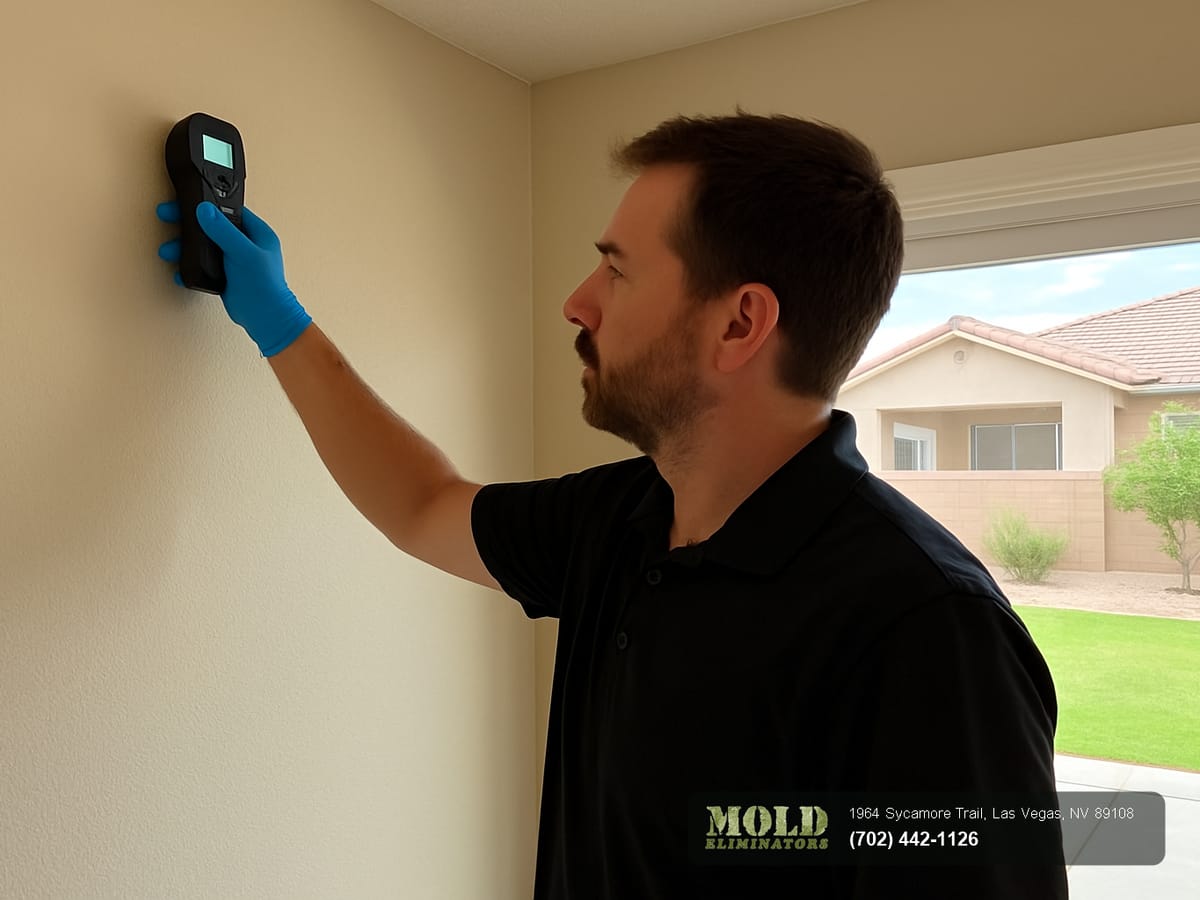
- Visual inspection first. The assessor confirms there is no visible mold, no water damage, no settled debris, and no musty odor. If the area fails the visual, sampling does not even begin.
- Outdoor baseline sample. An air sample is collected outside, on the same day, to establish the normal fungal background the indoor results will be measured against.
- Indoor clearance samples. Air, and sometimes surface, samples are taken inside the contained area under documented protocol, then sealed and labeled for the lab.
- Independent lab analysis. Samples go to a third-party laboratory that counts and identifies the spores without any stake in the result. If lab analysis is warranted, samples go to an independent third-party lab, billed at cost.
- Pass, or remediate and retest. If the indoor results align with the baseline and the visual is clean, the project clears. If not, the area is re-cleaned and re-tested. The standard, not the schedule, decides when it is done.
Why you should never accept self-grading
The most expensive mistake in mold work is letting the company that did the remediation also certify it. It sounds efficient. It is, in practice, how unfinished jobs get signed off and how problems resurface months later, after the warranty conversation has gone cold.
Think about the incentives. A crew that is behind schedule, over budget, or simply ready to move to the next job has every reason to read a borderline sample generously. An independent lab has no such reason, because the lab is paid to measure, not to please. When the grader and the worker are the same party, the result is only as honest as that party’s worst day, and you have no way to tell a real pass from a convenient one.
This is also why the loudest red flag in the industry is a contractor who offers free clearance as part of the package. If verification comes from the same hand that did the work, it is not verification, and free does not fix that. The same logic applies to lab testing in general: at Mold Eliminators the on-site mold inspection is free, but lab analysis, when it is genuinely warranted, goes to an independent third-party lab and is billed at cost, precisely so the result stays honest. We would rather tell you that you do not need us than hand you a clearance we graded ourselves.
If a past remediation closed out on a self-graded clearance and you are not sure it held, the calm way to find out is a fresh look from someone with no stake in the original job. Start with a free inspection, and if the building tells us sampling is warranted, an independent lab, not us, reports the result. That is how you replace a question mark with a fact.
Who relies on clearance, and why it has to hold up
Homeowners and buyers
A documented clearance is the difference between hoping a house is clean and proving it. For a sale, a buyer’s agent or lender will want a record that an independent lab, not the seller’s contractor, signed off.
Insurers and adjusters
A clearance backed by third-party lab analysis and a chain of custody is what closes a claim cleanly. A self-graded sign-off is exactly the kind of document an adjuster is trained to question.
Property managers and HOAs
When mold crosses unit lines in a condo or apartment, the question of liability rides on credible, independent documentation. Clearance that holds up keeps a remediation from becoming a dispute.
In every one of these cases the value of the clearance is its independence. A result that an outside party can trust is worth far more than one your own crew wrote, which is why our verification is anchored to an independent lab and to the S520 standard Craig helped write. The proof has to survive scrutiny, or it is not proof.
Post remediation clearance testing: common questions
- What is the difference between mold testing and clearance testing?
- Mold testing at the start identifies whether a problem exists and how severe it is. Clearance testing at the end verifies that the completed remediation corrected it. The first defines the job; the second proves it worked. Both rely on independent lab analysis rather than a field opinion, and both compare indoor results against an outdoor baseline so the numbers mean something.
- Can the remediation company do its own clearance?
- It should not. The company that did the work has a financial reason to declare it finished, so letting that same party grade the result is a conflict of interest. A credible clearance uses an independent third-party lab that has no stake in whether the job passes. If a contractor offers to clear their own work for free, treat that as a warning, not a bargain.
- What does a passing clearance actually require?
- Under the S520 standard, the area must be visibly clean with no remaining mold, water damage, or settled dust, free of any musty odor, and its indoor air samples must align with the outdoor baseline. The moisture source has to be fixed too. A single passing air sample with no visual inspection and no baseline is not a real pass.
- How much does clearance testing cost?
- Our on-site mold inspection is free. If the situation warrants lab analysis, the samples go to an independent third-party laboratory and are billed at cost, with no markup, so the result stays honest and the price stays transparent. Start with a free inspection and we will tell you, plainly, whether sampling is even warranted.
- What happens if the clearance fails?
- A failed clearance means the area is re-cleaned and then re-tested, not signed off anyway. That is the entire reason independence matters: an outside lab will report a fail honestly, where a self-grading contractor has an incentive to wave it through. The standard decides when a project is done, and re-testing until it genuinely passes is the correct, honest outcome.
- Does a clearance guarantee mold will never come back?
- No. A clearance verifies the area was returned to a normal condition at the time of testing and that the original moisture source was resolved. It cannot prevent a new leak or flood from starting a new problem later. What it does guarantee is that the remediation you paid for actually worked, documented by an independent lab rather than declared by the people who did the remediation.
Make sure the job is really done. Start with a free inspection.
If a past remediation never got an independent clearance, or you are about to start one and want it verified the right way, we will look first and tell you the truth. The on-site inspection is free, the lab is independent, and one-hour emergency response is available 24/7 across the Las Vegas valley.