Slab Leak Warning Signs
Your water bill jumped for no reason, one patch of floor feels strangely warm under your feet, and somewhere in the house you can hear water running even though every faucet is off. Those small signals are easy to shrug off, but together they are the classic slab leak warning signs, and in a slab-on-grade Las Vegas home they often point to a pipe failing underneath the concrete you walk on every day.
A slab leak is a break in one of the water lines running through or beneath the foundation slab. Because the leak is hidden under solid concrete, it can run for weeks before anyone notices, quietly soaking the slab, the subfloor, and the framing above it. Caught early, it is a contained repair. Left alone, that constant moisture becomes the perfect feeding ground for hidden mold, which is why we treat slab leaks as both a plumbing problem and a mold problem from the very first reading.
 Concrete slab floor in a Las Vegas home showing a warm wet spot from a hidden slab leak
What a slab leak actually is, and why Las Vegas homes are prone to them
Most homes here are built slab-on-grade, meaning the house sits on a single poured concrete slab rather than over a crawlspace or basement. Water supply lines and sometimes drain lines run through or beneath that slab. When one of those pressurized lines develops a pinhole, a crack, or a corroded joint, water escapes directly into the ground and the concrete around it. That is a slab leak, and because the failure point is sealed under inches of concrete, the only thing you ever see is the symptoms it creates elsewhere.
Several things make slab leaks common in the valley. Our water is hard and mineral heavy, which scales and corrodes copper supply lines from the inside over the years. The desert’s expansive soils swell and shrink with every monsoon and dry spell, shifting the slab and stressing the pipes locked inside it. Older copper installed decades ago, and even some early plastic fittings, simply reach the end of their service life. None of this is visible from the living room, which is exactly why learning to read the warning signs matters so much.
The reason a plumbing leak lands on a mold company’s website is simple physics. A supply line under pressure can release dozens of gallons a day into a structure that has no way to drain or dry. That water wicks up through the slab into the subfloor, the baseboards, and the wall cavities, and it stays there. Concrete holds moisture far longer than people expect, so a slab that feels dry on the surface can stay saturated underneath for weeks. That trapped, hidden moisture is precisely the condition mold needs, which ties a slab leak directly to the kind of water damage restoration work we do every day.
Need help now?
Talk to a Las Vegas expert
In-house certified crews. One-hour emergency response across the valley, 24/7.
The slab leak warning signs to watch for
No single clue proves you have a slab leak, but several appearing together build a strong case. The earlier you catch them, the smaller and cheaper the repair, and the less time mold has to take hold. Here are the signals that most reliably point under the slab.
Two more clues round out the picture. You may notice damp or discolored carpet and baseboards with no spill to explain them, or a hot water heater that runs almost constantly because it is endlessly reheating water that is leaking away. If you are seeing two or three of these at once, do not wait to see whether they get worse. The honest move is to verify, and a free inspection is the calm, factual way to confirm whether moisture is collecting under your slab before it turns into a larger problem.
Why a slab leak quietly feeds hidden mold
This is the part most homeowners never hear. Mold spores are present in every building, harmlessly, all the time, and they only bloom into a colony when they find a wet surface to feed on. A slab leak supplies exactly that: a continuous, hidden source of moisture soaking into porous building materials that have no way to dry on their own. The leak does not have to be dramatic. A slow, steady seep is often worse than a fast one, because it stays under the radar long enough for a colony to establish.
The path is predictable. Water escapes the line, saturates the slab, and wicks upward into the subfloor, the carpet pad, the baseboards, and the bottom plates of your walls. Drywall is paper faced and wood framing is organic, so both are food once they are wet. Within roughly 24 to 72 hours of materials staying damp, mold can begin to colonize, and a slab leak keeps them damp indefinitely. By the time a musty smell reaches the living room, growth is usually well underway inside a wall cavity you cannot open.
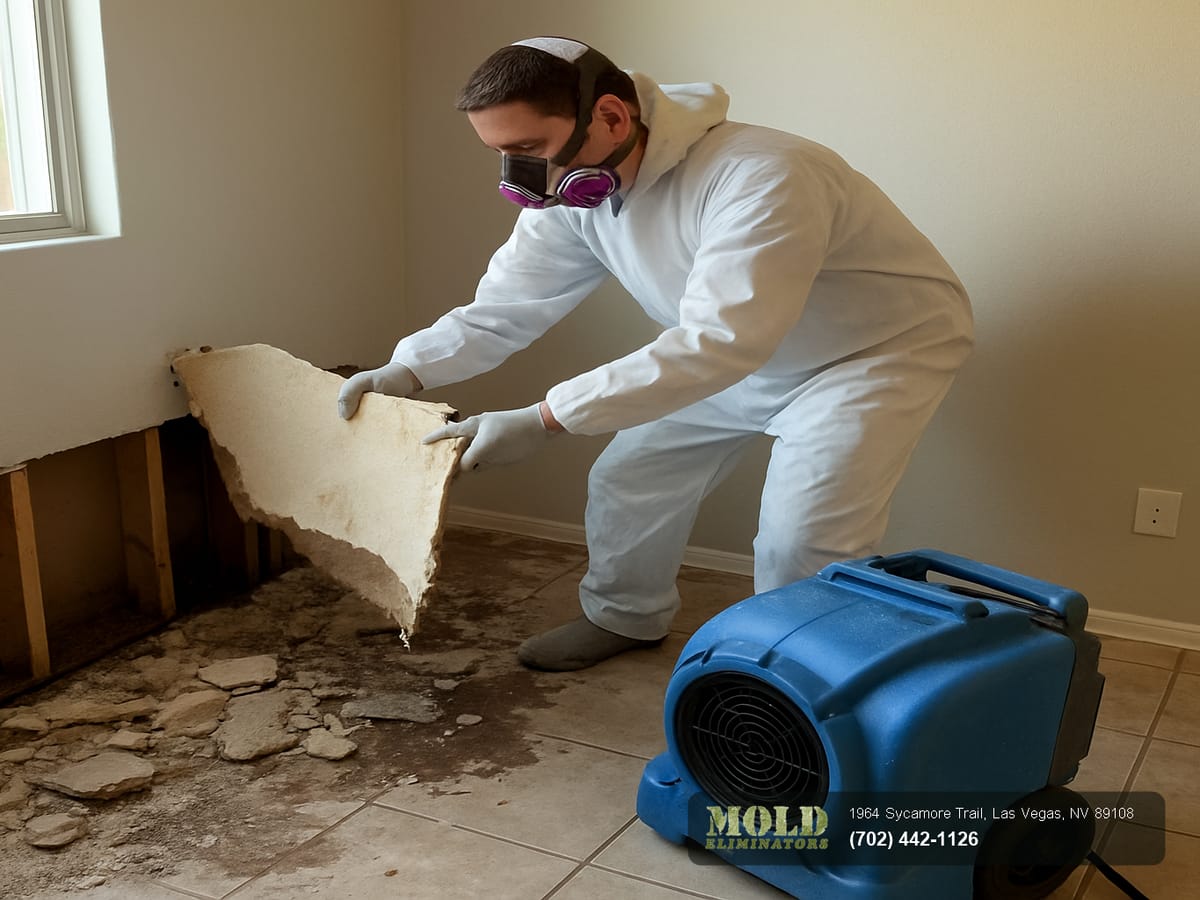
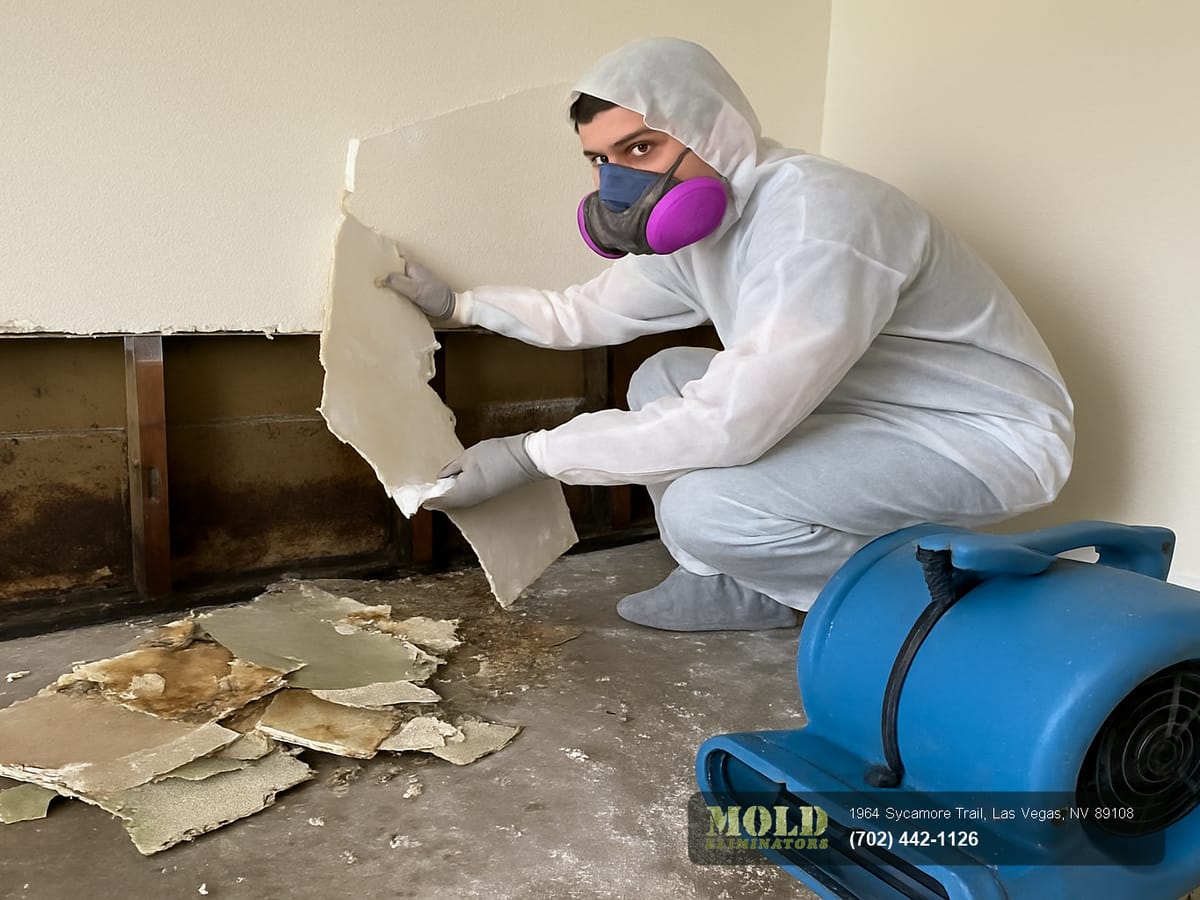
That is why we never treat the plumbing fix as the finish line. Stopping the leak ends the water source, but it does nothing about the moisture already trapped in the structure or any mold that has started. The materials still have to be dried to a verified standard, and any growth has to be contained and removed properly. When a slab leak has been running long enough to cause real saturation, the job often crosses into full restoration and drying, and sometimes into mold remediation if a colony has already established. We map all of it as one continuous problem, because physically that is what it is.
 Mold Eliminators technician using a moisture meter on a concrete slab floor in Las Vegas
What to do when you spot the signs
If the warning signs are stacking up, a clear sequence keeps a slab leak from becoming a mold problem. The goal is to stop the water, find out how far it spread, and dry and verify the structure before anything has a chance to grow.
- Shut off the water if you can. If you are watching active flooding or pressure loss, closing the main valve stops the source and limits how far the water travels into the structure.
- Get the leak located, not guessed. Acoustic listening gear, thermal imaging, and pressure testing pinpoint the leak under the slab so the repair is targeted instead of tearing up the whole floor.
- Repair the line. A licensed plumber addresses the failed pipe through a spot repair, a reroute, or a repipe depending on the condition of the line. Our partners handle the plumbing side of slab leak repair while we own the moisture.
- Map the moisture. Before any drying, we read the slab, subfloor, baseboards, and walls with meters and thermal imaging to map exactly how far the water migrated and set a documented dry target.
- Dry to a verified standard. Commercial dehumidifiers and air movers pull the trapped water out of the structure, with daily readings confirming progress until every material hits its target.
- Verify and document. We log readings by location and date so you, and your insurer, can see the structure going from wet to verified dry on the record, not on our say so. If growth was present, an independent third-party lab confirms the cleanup worked.
Held to the rulebook, start to finish
The reason we can speak so plainly about drying targets and verified results is that we work to a written standard rather than to habit. Our founder, Craig Herrmann, co-authored the ANSI/IICRC S520 standard, the national rulebook for mold remediation, in its 4th Edition released in 2024. He is also one of a small handful of IICRC Master Certified Flood Experts in southern Nevada and has worked the valley since 1996, on more than 255 properties. When we tell you a structure is dry or a colony is gone, it is measured against that standard, not declared by feel.
Just as important is how we are staffed. There are no subcontractors on our jobs. Every technician is a certified W-2 employee, so one in-house crew owns the moisture mapping, the drying, and any remediation from the first reading to the final verified dry target. That is one chain of responsibility and one standard, which matters a great deal when a slab leak crosses into hidden wall cavities and the question becomes how thoroughly the hidden moisture was actually found and removed.
We are also anti-upsell, which in this context is a real promise. If your warning signs turn out to be condensation, a swamp cooler issue, or a surface spill rather than a slab leak, we will tell you, and we will tell you when you do not need us at all. The point of an inspection is to give you the facts, not to manufacture a project. When water is actively spreading, our crews respond within one hour, 24 hours a day, across the valley.
Slab leak warning signs, common questions
- What is the most common first sign of a slab leak?
- For most homeowners it is either an unexplained spike in the water bill or the sound of running water when every fixture is off. A warm spot on the floor is another early giveaway when the leak is on a hot water line. Any one of these on its own is worth checking, and two or three together strongly suggest a leak under the slab.
- Can a slab leak really cause mold?
- Yes, and it is one of the most common hidden causes we see. A slab leak supplies a continuous, concealed source of moisture that wicks up into the subfloor, baseboards, and wall cavities, and mold can begin colonizing damp materials within roughly 24 to 72 hours. Because the water is hidden, growth is often well established before any musty smell reaches the living space, which is why prompt drying and restoration matters so much.
- How do you find a slab leak without tearing up the whole floor?
- Leaks are located with acoustic listening equipment, thermal imaging, and pressure testing, which pinpoint the failure under the slab so the repair can be targeted to one spot. On our side, moisture meters and infrared cameras map how far the water spread through the structure, so we dry only what is wet and verify the result rather than guessing.
- Is fixing the leak enough to prevent mold?
- No. Stopping the leak ends the water source, but the moisture already trapped in the slab, subfloor, and walls still has to be dried to a verified standard, and any growth that started has to be contained and removed. That is why we treat the plumbing fix and the drying as one continuous job, and bring in remediation when a colony has already taken hold.
- Does insurance cover slab leak damage?
- It depends on your policy, but the water damage from a sudden, accidental slab leak is frequently covered even when the pipe repair itself is not. The documented moisture map an adjuster wants to see is exactly what we produce: readings, photos, and scope logged from the first visit. We work directly with your carrier and keep a covered water claim from turning into a disputed mold claim later.
- What should I do right now if I suspect a slab leak?
- Shut off your main water valve if you are seeing active flooding, then get the structure looked at before moisture spreads further. The fastest, lowest pressure way to find out where you stand is a free inspection, which tells you whether moisture is collecting under the slab and whether anything has started to grow, before any work begins.
Why slab leaks happen so often here
A slab leak is a leak in one of the water lines that runs underneath or within the concrete foundation slab your house sits on. Las Vegas is full of slab-on-grade homes, where the structure is poured directly onto a concrete pad rather than over a basement or crawlspace, so the supply and drain lines are routed through or beneath that slab. When one of those buried pipes fails, the water has nowhere to go but into the slab and up into your flooring and walls.
Several desert-specific factors make these failures more common in the valley than in many other parts of the country. Our municipal water is famously hard, carrying a heavy load of dissolved minerals that scour and corrode copper pipe from the inside over time. Many homes built from the 1980s through the early 2000s used copper supply lines that are now reaching the age where pinhole corrosion leaks become likely. Water pressure in parts of the valley runs high, which stresses aging joints and thin spots. And the expansive, shifting soils common across Clark County can move a slab just enough to abrade or crack a pipe running through it.
The result is a leak that often goes unnoticed for weeks or months, because it is happening out of sight beneath the concrete. That slow, hidden saturation is exactly the condition that leads to trapped moisture and, eventually, mold. A concrete slab holds water far longer than people expect, and a slab that feels dry on top can stay damp underneath for a long time, which is why a slab leak is as much a moisture problem as a plumbing one.
How to recognize a slab leak
Because the pipe is buried, the warning signs usually show up indirectly. A water bill that climbs for no obvious reason is one of the most common first clues, since a slab leak runs continuously. You might hear the faint sound of running water when every fixture is off, or notice a spot on the floor that feels warm to the touch when a hot-water line is leaking. Cracks appearing in flooring or drywall, tile that loosens, baseboards that swell, or a section of carpet that stays damp can all point to water moving under the slab.
The signs that matter most to your health tend to come later: a persistent musty or damp odor, or visible discoloration along the base of a wall. Those are the early signatures of microbial growth getting started in a cavity you cannot see. To be clear, and to avoid any fear-mongering, a brief exposure to a small amount of dampness is not a medical emergency, and we do not diagnose health conditions. But sustained moisture from an unaddressed slab leak is precisely the kind of condition that lets mold establish itself, and that is worth catching early.
The honest truth is that none of these signs are guaranteed to appear. Plenty of slab leaks give almost no surface clue until significant damage has accumulated. The only reliable way to confirm whether moisture has settled into your structure is to measure it, which is where a professional inspection earns its keep. When water has already spread, the response follows the same disciplined approach as full water damage restoration: find the moisture, define how far it traveled, and verify the result.
What to do next
If you suspect a slab leak, the first step is to confirm and stop the source of water, then deal with what the water left behind. Stopping the leak itself is plumbing work, but the moisture, the building materials, and the mold risk are our domain. Time matters here: mold can begin to colonize wet organic materials within roughly 24 to 72 hours of getting wet, so a long-running slab leak may already have created conditions that need attention.
Start with a free on-site inspection. We come out, measure the actual moisture content in your slab, flooring, and walls with meters and thermal imaging, and tell you plainly what we find, including whether you need any work at all. This is where our anti-upsell promise matters: if the structure is dry and there is no mold issue, we will tell you so. If you would like laboratory confirmation of what is or is not growing, independent third-party lab analysis is available as a paid add-on, but the inspection that finds the problem costs you nothing. To schedule, request your free inspection or call us directly.
Where moisture has already taken hold, the path forward is professional mold remediation done to standard, with containment, removal of unsalvageable porous materials, controlled drying, and independent verification that the area is clean. Because Craig Herrmann co-authored the ANSI/IICRC S520 standard that governs how that work is done, the job is held to the rulebook from the first reading to the final verified result. You can read more about Craig’s credentials, or see exactly where we serve across the Las Vegas valley.
Related questions
- Does a slab leak always cause mold?
- No. Mold needs sustained moisture to grow, so a slab leak caught and dried quickly may never produce a colony. The risk rises the longer water sits in the structure, which is why prompt detection and proper drying matter so much. A measured inspection tells you whether moisture has reached the point where mold is a concern, rather than leaving you to guess.
- Is the inspection to find a slab leak really free?
- Yes. The on-site inspection, where we measure your slab and surrounding materials for trapped moisture and assess any mold risk, is free for homeowners and property owners. Laboratory analysis of samples is a separate, optional paid add-on if you want third-party confirmation, but it is never required to get a clear answer about your situation. You can request a free inspection anytime.
- What happens if a slab leak floods my home?
- A significant slab leak that releases a large volume of water is handled like any other water intrusion: stabilize the source, extract the water, then dry the structure to a verified dry standard as part of full water damage restoration. If the water was contaminated or sat long enough for mold to take hold, drying becomes one part of a larger, fully documented job rather than the whole answer.
Spotting the warning signs? Find out before mold gets its chance.
A calm, no-pressure inspection tells you whether a slab leak is feeding hidden moisture under your floor. One-hour emergency response, 24/7, across the Las Vegas valley. We map it, dry it to verified targets, and tell you straight when you do not need us.