AC Causing Mold in Las Vegas
If you are seeing ac causing mold in your Las Vegas home, dark speckling around the supply vents, a musty smell that kicks on the moment the system runs, or fuzzy growth on the ceiling near a register, you are not imagining it. An air conditioner that makes mold worse is one of the most common calls we get in the valley, and it almost always points to the same root cause: moisture is condensing somewhere it should not, and the system is then blowing those spores through every room.
Here is the honest version. Your AC is not the disease, it is usually the messenger. A unit running 110-degree summers in a desert house creates cold surfaces, condensation, and humidity swings that mold loves, and the ductwork turns a small damp spot into a whole-home distribution network. The good news is that this is a solvable, diagnosable problem. The first step is finding the actual moisture source, which is exactly what a free inspection is for, before anyone tears anything out.
 Mold growth around an air conditioning supply vent in a Las Vegas home
What ac causing mold usually means in a Las Vegas home
When an air conditioner appears to be causing mold, the cooling itself is rarely the problem. Cold air does not grow mold, water does. What an AC system reliably produces, especially in a desert climate that runs it hard for six months a year, is condensation, and condensation is just water arriving on a surface where it can sit. Once you understand that, the likely sources sort themselves into a short, diagnosable list.
A clogged or overflowing condensate line. This is the most common culprit by far. Every cooling system pulls humidity out of the air and drains it away as water. When that drain line clogs with dust and algae, the pan overflows, and the water ends up in the air handler closet, the ceiling below an attic unit, or the wall cavity behind it. A slow overflow can soak drywall for weeks before anyone notices the stain.
Mold inside the ductwork or on the evaporator coil. The coil is cold, wet, and dark, the perfect breeding ground. Dust collects on it, condensation keeps it damp, and growth takes hold. Then every cycle blows spores out through the vents, which is why the musty smell shows up the instant the system starts. This is a classic case for HVAC and air duct mold remediation rather than a surface wipe-down.
Oversized or short-cycling equipment. A unit that is too large for the home cools the air fast but shuts off before it removes much humidity. The house feels cold and clammy, indoor humidity stays high, and that elevated moisture lets mold grow on walls, in closets, and around the vents even though nothing is visibly leaking.
Hidden water that has nothing to do with the AC. Sometimes the timing is a coincidence. A slab leak, a monsoon roof intrusion, or a swamp cooler line that was never fully capped can be the real moisture source, and the AC simply circulates the resulting spores so you notice them near the vents first. An honest diagnosis rules these in or out instead of assuming, and that is the difference between fixing the problem and chasing a symptom. When growth is widespread, full mold remediation may be needed regardless of the trigger.
Need help now?
Talk to a Las Vegas expert
In-house certified crews. One-hour emergency response across the valley, 24/7.
Why it matters, and how urgent it is
The reason ac causing mold deserves a quick response is mechanical: a vent system is a delivery service. A spot of mold on a coil or in a duct is not staying in one place. Every time the unit cycles, it aerosolizes spores and pushes them into bedrooms, living rooms, and closets across the whole house. A localized problem becomes a whole-home exposure, and the people most affected are the ones sleeping in the path of a supply vent all night.
Las Vegas adds a real twist here. Our outdoor air is famously dry, which lulls people into thinking mold cannot survive in the desert. Inside a cooled, sealed, condensation-prone HVAC system, the microclimate is the opposite of the desert outside, damp and stable, which is exactly why duct and coil mold thrives here even when the patio thermometer reads single-digit humidity.
On urgency, the practical rule is this. If you are seeing visible growth at the vents and smelling it when the system runs, the moisture source is active right now and it is spreading on every cycle, so it should be looked at within days, not months. If water is actively pouring from an overflowing condensate pan or a leak, that is an emergency, and our 1-hour 24/7 emergency response exists for exactly that moment. The longer the structure stays wet, the more material has to be removed instead of saved.
 Technician inspecting an air handler and condensate line during a mold source investigation
What the proper fix involves, to the S520 standard
Fixing AC-related mold the right way is not a fogger and a feel-good spray. It follows the ANSI/IICRC S520 standard, the national rulebook for mold remediation that our founder Craig Herrmann helped co-author. The sequence is deliberate, and it always starts by finding and stopping the water.
- Free on-site inspection. We come out, find the actual moisture source with meters and thermal imaging, and tell you honestly what is going on, whether that is a clogged condensate line, coil growth, a humidity problem, or something unrelated to the AC entirely.
- Fix the source first. Mold removed without correcting the moisture is mold that returns in weeks. The clogged drain, the leak, the humidity, or the equipment issue gets identified and addressed before remediation begins.
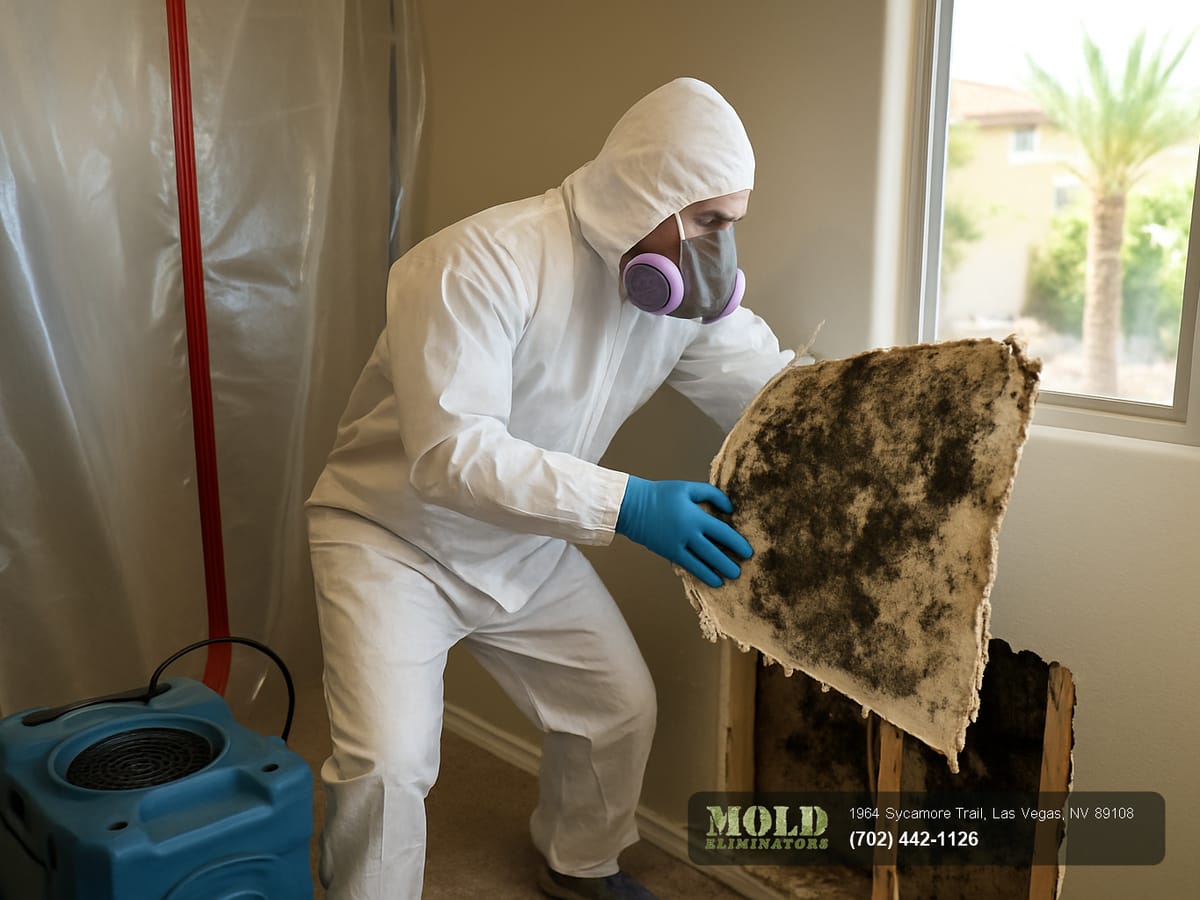
- Contain the work area. We isolate the affected zone with containment and negative air so the cleanup itself does not spread spores into clean parts of the home through the very duct system that caused the problem.
- Remove and clean to standard. Affected materials are removed or HEPA-cleaned per S520, coils and accessible ductwork are addressed, and porous materials that cannot be saved come out rather than getting painted over.
- Dry to verified targets. Any wet structure is dried with proper equipment to documented moisture levels, so nothing is left damp for mold to feed on again.
- Independent lab clearance. When we are done, an independent third-party lab verifies the result. We do not grade our own homework, and you get data showing the air and surfaces are clear.
Why Las Vegas homeowners call Mold Eliminators for this
No subcontractors
Every technician is a certified W-2 employee, never a subcontractor. One in-house crew owns the diagnosis, the fix, and the verification, so nobody points fingers when something gets missed in the ductwork.
Independent third-party lab
We do not certify our own work. An independent lab tests the result, so clearance is data you can trust, not a salesman’s word that the AC mold is gone.
Anti-upsell, 24/7
If the fix is a thirty-dollar condensate line and a coil cleaning, we tell you that. We have built since 1996 by telling people when they do not need full remediation, with 1-hour emergency response any hour.
That is the whole difference. Craig Herrmann is IICRC Master Certified and co-authored the very S520 standard the rest of the industry follows, and we have brought that standard to 255+ properties across the valley. Where a franchise sells you a duct package, we find the water first, fix it, and prove the result, the same way our full remediation work is verified by an independent lab from start to finish.
AC and mold in Las Vegas, common questions
- Can my air conditioner really cause mold in the dry Las Vegas air?
- Yes. The desert air outside is dry, but inside a cooled HVAC system the coil and ducts stay cold and damp from condensation, which is the ideal environment for mold. Add a clogged condensate line or an oversized unit that leaves the house humid, and you have everything mold needs even in June. The fix starts with a free inspection to find the moisture source.
- Is cleaning the air ducts enough to fix it?
- Only if the ducts are the actual source and the moisture problem is corrected too. Cleaning ducts while a condensate line still overflows or a coil keeps sweating just resets the clock. Proper HVAC and air duct mold work corrects the moisture first, then cleans and verifies, so it does not grow back next cooling season.
- How fast should I deal with vent mold I can see right now?
- Within days. A vent system spreads spores on every cycle, so visible growth at the registers means the whole home is being exposed each time the unit runs. If water is actively leaking from the unit, treat it as an emergency and use our 24/7 line so the structure does not keep soaking.
Seeing AC mold at your vents? Start with a free inspection.
We find the real moisture source first, fix it, remove the mold to the S520 standard, and verify the result with an independent lab. No subcontractors, anti-upsell, 1-hour emergency response 24/7 across the Las Vegas valley.