Toxic Black Mold (Stachybotrys) Explained
Mold Knowledge
“Toxic black mold” is one of the most searched, most feared, and most misunderstood phrases in home health. The science behind Stachybotrys chartarum is real, but most of what circulates online is fear, not fact. Here is the calm, measured version, including what the species actually is, what the genuine risk is, and why the response to it is far less dramatic than the headlines suggest.
This page sits under our broader guide to professional mold remediation. If you have already found dark staining in your home and you want to know whether you are looking at the species behind all the headlines, the honest answer is that you cannot tell by sight alone, and that the species name matters less than you have been led to believe. We will explain why throughout this article.
Our position is simple and it does not change with the species: contain the affected area, remove the contamination to the recognized standard, and verify the result with independent testing. Whether a sample comes back as Stachybotrys, Aspergillus, Penicillium, or Cladosporium, the corrective work is governed by the same rulebook. We will get to that rulebook, because the person who co-authored it answers our phone.
What Stachybotrys actually is
Stachybotrys chartarum is a greenish-black mold that grows on cellulose-rich materials: drywall paper, ceiling tile, wood, cardboard, and wallpaper. It is not exotic. It is a normal part of the outdoor environment that becomes a problem indoors only when one specific condition is met: chronic moisture. Stachybotrys is a slow grower and a late arrival. It needs material that has stayed wet for days or weeks, not hours.
That single fact reframes the entire conversation. Stachybotrys does not bloom from a one-time spill that gets dried quickly. It signals a sustained water problem: a slow plumbing leak behind a wall, a roof that has been weeping for a season, a swamp cooler that has been overflowing, or flooding that was never dried properly. In the desert, where homes are not built for standing water, that often means a slab leak or a monsoon intrusion that sat too long. The mold is the symptom. The water source is the disease.
Because it favors hidden, chronically wet cavities, Stachybotrys is frequently discovered during a mold inspection rather than spotted on an open wall. You smell it before you see it: a heavy, musty, earthy odor that does not fade with cleaning. If that describes your situation, the moisture has likely been present long enough to warrant a closer look.

Need help now?
Talk to a Las Vegas expert
In-house certified crews. One-hour emergency response across the valley, 24/7.
“Toxic black mold” hype versus the measured risk
The phrase “toxic black mold” took hold in the late 1990s after a cluster of infant illnesses was loosely linked to Stachybotrys in news coverage. The link was later found to be far weaker than first reported, but the label stuck. Two decades of marketing, viral photos, and worst-case anecdotes have since hardened a single mold species into a household monster.
Here is the calmer, evidence-based picture. Stachybotrys is not uniquely lethal. It is not the only mold that can affect health, and color is not a reliable danger signal. Plenty of dark molds are harmless, and several lighter-colored molds can be more irritating to sensitive people than Stachybotrys. Major public health bodies are consistent on this point: any significant indoor mold growth, of any color or species, should be removed, and no one needs a species name to justify cleaning up a chronic moisture problem.
So the danger is real but it is also routine and manageable. Mold in a wet building is a condition to correct, not a catastrophe to panic over. We refuse to use the species as a scare lever. We have watched competitors weaponize the words “toxic black mold” to push frightened homeowners into oversized invoices, and that practice is exactly what our free inspection exists to counter. If your dark spot turns out to be soap scum, mildew on grout, or a cosmetic surface stain, we will tell you, and you will not pay us to find that out.
Mycotoxins, explained in plain terms
The word doing most of the scaring is “mycotoxin.” Here is what it actually means. Some molds, under certain conditions, can produce mycotoxins, which are natural chemical compounds. Stachybotrys can produce a group of these compounds. That is true and it is the kernel of fact at the center of the hype.
Now the context the headlines leave out. A mold having the capacity to produce mycotoxins is not the same as those compounds being present in your air at a level that affects you. Production depends on the growth surface, the moisture, the temperature, and the colony’s stage. Mycotoxins are not gases; they are mostly bound to spores and mold fragments, which means meaningful exposure generally requires disturbing the growth, breathing the dust, or sustained contact, not simply living in the same building as a small, contained patch.
The practical takeaway is reassuring. You do not need to identify, measure, or fear specific mycotoxins to make the right decision, because the right decision is the same either way: stop the moisture, contain the area so spores and fragments are not spread, and remove the growth properly. Done correctly, the mycotoxin question resolves itself, because you have removed the material that could carry them. This is why our methodology, described in our guide to black mold removal, focuses on containment and verified removal rather than on chasing a lab number that does not change the work.
Who is more sensitive
Mold affects people unevenly, and honesty about that range is part of taking it seriously without overselling it. Most healthy adults exposed to a modest amount of indoor mold experience little or nothing. Others, particularly within certain groups, react more strongly and deserve a faster, more cautious response.
If someone in your household falls into one of these groups, that raises the urgency of correcting the problem, not the species you happen to have. It is also the clearest case for keeping occupants away from the area and the dust until the work is complete. When a leak or flood is actively ongoing and a vulnerable person is in the home, that is a moment to call our 24/7 emergency response rather than wait. We can be on site within an hour anywhere across the valley.
Why only lab testing identifies the species
You cannot look at a wall and know you are dealing with Stachybotrys. Dozens of molds present as dark patches, and Stachybotrys itself can look unremarkable. Color, texture, and location offer hints, never proof. The only way to name the species is to put a physical sample under a microscope or culture it, which means a trained eye and a lab, not a phone photo or a home test strip.
That is exactly why we send samples to an independent, third-party accredited lab with no financial stake in the result. When the company doing the inspection also owns the lab and quotes the cleanup, the incentive to find a frightening species is obvious. We separate those roles on purpose. Our mold testing tells you what is actually present and how much, and because the lab does not profit from the remediation, the number you get is the number that exists.
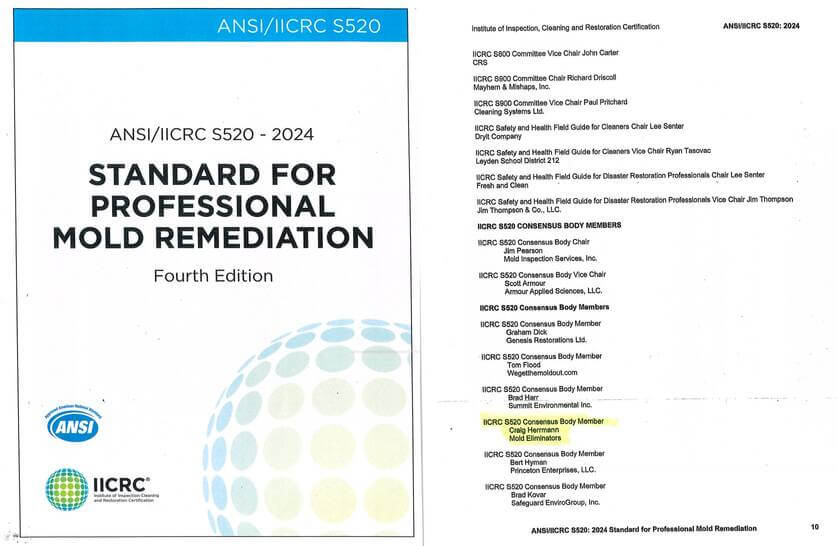
Here is the part competitors will not tell you: in most cases the species name does not change the remediation plan. We test to confirm there is a real problem, to map its extent, and later to verify the job worked. We do not test so we can attach a scary Latin name to an invoice. The standard governing the cleanup, ANSI/IICRC S520, was co-authored by our owner, Craig Herrmann, and it does not prescribe different work for different “scary” species. It prescribes thorough work for visible and concealed growth, full stop.
The response is the same: contain, remove, verify
This is the calm center of the entire topic. Whatever the species, whatever the color, whatever the lab spore count, the corrective process follows the same three-part logic written into the S520 standard. Knowing these steps is the best antidote to fear, because it shows the problem has a defined, repeatable solution.
- Contain. We isolate the affected area with physical barriers and negative-air pressure so spores and fragments cannot spread to clean parts of the home during the work. The moisture source is identified and stopped first, because removing mold without fixing the water guarantees it returns.
- Remove to standard. Contaminated porous materials, such as soaked drywall and ceiling tile, are removed rather than painted over. Salvageable surfaces are cleaned using S520 methods. Our technicians are all certified W-2 employees, never subcontractors, so the people doing the work are accountable to the standard and to us.
- Verify. After cleaning and drying, we confirm the result with independent post-remediation testing. We do not certify our own success. The lab does, against measured criteria, so “it looks clean” is replaced by “it tested clean.”
Notice what is missing from that list: panic, demolition of the whole house, and a premium charged for a frightening species name. The process is deliberate and bounded. Because chronic mold so often traces back to a water event, this work frequently overlaps with the moisture correction discussed across our remediation services, and the two are planned together so the fix actually lasts.
Frequently asked questions
- Is black mold going to make my family seriously ill?
- For most healthy people, a contained patch of indoor mold is an irritant and a building problem to fix, not a medical emergency. Sensitive groups, including people with asthma, infants, older adults, and the immunocompromised, warrant a faster and more cautious response. The honest summary: take it seriously, correct it properly, but do not let the “toxic” label send you into panic. If you want certainty about what is actually present, start with a professional inspection.
- Do I need to know the exact species before cleaning it up?
- No. Significant indoor mold growth of any species should be removed, and the S520 process does not change based on a scary Latin name. We identify species through lab testing to confirm a genuine problem and to map its extent, not to justify the work. The cleanup is the same: contain, remove, verify.
- Can I test for it myself with a home kit?
- Home kits cannot reliably identify a species or tell you whether a level is meaningful, and they often grow something on the plate regardless, which fuels false alarms. Species identification requires a microscope or culture and a trained analyst. Because we offer free inspection through an independent lab, there is little reason to rely on a guesswork kit.
- What if the mold came from a flood or ongoing leak?
- Then the water is the priority. Active or recent water intrusion needs to be stopped and dried fast, before chronic growth establishes. If you are dealing with that right now, call our emergency team, available 24/7 with one-hour response across the valley.
Next steps
If you have found dark growth or a musty smell that will not quit, the calm path forward is not to panic about a species name and it is not to scrub it away and hope. It is to confirm what is there, contain it, remove it to standard, and verify the result with an independent lab. That is the same answer whether or not the word “Stachybotrys” ever appears on a report.
We serve homeowners, property managers, and realtors across Las Vegas, North Las Vegas, Spring Valley, Paradise, Henderson, and Summerlin. You can see where we work on our service areas page, or simply contact us to schedule testing. If your “mold” turns out to be nothing, we will tell you, and the inspection was free.
No fear tactics. Just the facts, measured.
Find out what is really on your wall, for free.
Independent lab testing, no upsell, and a calm expert who co-wrote the national standard. We profit from fixing the problem, not from inventing one.