24/7 Emergency Water Removal in Las Vegas
Emergency Response · Las Vegas
When water is moving through your home at 2 a.m., you do not need a sales pitch. You need a certified crew on the way and a clear answer to one question: what do I do right now? This page is that answer, written by the people who actually arrive.
At Mold Eliminators, our emergency water removal line runs 24 hours a day, every day, with a one-hour response target across Las Vegas, North Las Vegas, Spring Valley, Paradise, Henderson, and Summerlin. A burst supply line, a failed water heater, a slab leak under the foundation, or a monsoon backup does not wait for business hours, so neither do we. Emergency water removal is the first and most urgent stage of water damage restoration, and getting it right in the first hour decides how much of your home you keep and how much you replace.
Craig Herrmann has run this company since 1996 and has stood in more than 255 flooded Las Vegas properties. He is one of three IICRC Master Certified Flood Experts in Southern Nevada and a co-author of the ANSI/IICRC S520 standard, the national rulebook the rest of the industry follows. That matters at 2 a.m. because the crew arriving at your door is not a stranger from a franchise call center. It is an in-house, W-2 certified technician trained against the standard our owner helped write.
Stabilize the water first: the principle that saves your home
Most homeowners instinctively reach for towels and start mopping the visible puddle. That helps, but it is not the principle that protects your house. The principle is this: stabilize the water source and stop the spread before you worry about the water already on the floor. A floor full of water is a known, contained problem. Water that keeps arriving, or quietly wicks into walls, cabinets, and subfloor, is the problem that turns a one-room incident into a whole-home loss.
Water travels faster and farther than people expect. Within minutes it spreads across flooring and is drawn up into drywall by capillary action. Within an hour it is under baseboards and into wall cavities. In the dry Las Vegas climate it is easy to assume things will simply air out, but trapped moisture inside a wall or under a tile floor does not evaporate on its own. It sits, and after 24 to 48 hours it becomes the perfect feeding ground for mold. Stabilizing first, then removing, then drying, is the sequence that keeps a bad night from becoming a bad month.
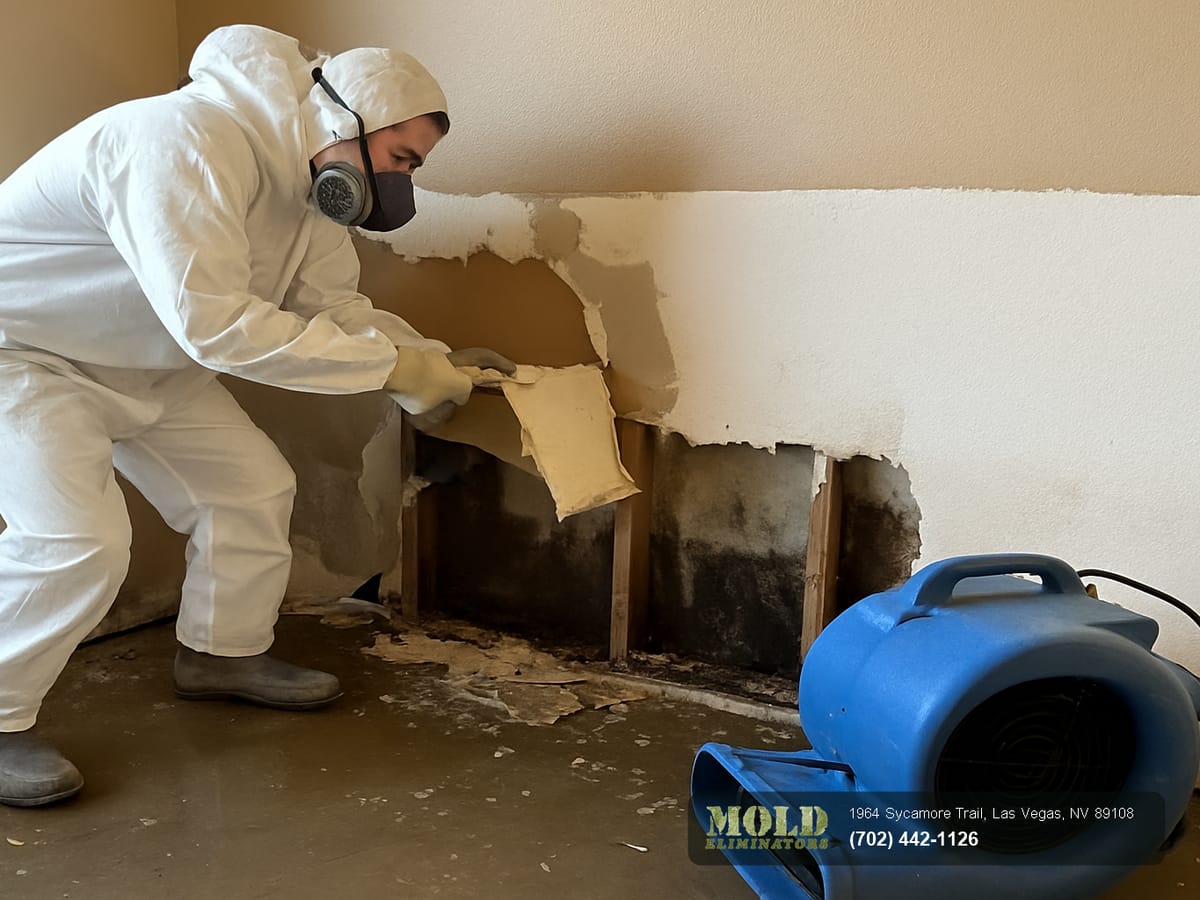
Why the first hour decides everything
The longer water sits, the more it migrates and the more material it ruins. Fast, professional extraction is the difference between drying a structure in place and demolishing it. Our one-hour response is built around this reality, not around marketing. Rapid 24/7 emergency service exists because the clock, not the customer, sets the schedule.
It also protects your wallet. Material saved is material you do not replace. A wood floor extracted and dried within hours often survives. The same floor left overnight usually does not.
Need help now?
Talk to a Las Vegas expert
In-house certified crews. One-hour emergency response across the valley, 24/7.
What to do while you wait for the crew
From the moment you call us to the moment our truck arrives, there are a handful of calm, safe steps that genuinely protect your home. None of them require special tools, and none of them put you at risk. If any step feels unsafe, skip it and wait for us. Your safety is worth more than any floor.
- Stop the source if you safely can. Shut off the main water valve, usually near the front of the house or at the street meter. For a water heater leak, close the valve on the cold inlet line. Stopping the supply is the single most valuable thing you can do before we arrive.
- Kill the power to affected areas. If water is near outlets, appliances, or the panel, turn off the relevant breakers, but only if you can reach the panel without standing in water. Water and electricity together are the one hazard we ask you to never gamble on.
- Lift what you can. Move furniture, rugs, electronics, and anything with sentimental or financial value out of the wet zone and onto a dry surface. Slip foil or wood blocks under furniture legs that must stay put.
- Document everything. Photograph and video the damage before you move much. This record helps your insurance claim and helps us confirm what was wet versus what was already there.
- Soak up standing water if it is safe. Towels and a wet vacuum on clean water are fine. Stay out of any water that may be contaminated by sewage or that has reached electrical sources.
- Keep air moving, gently. Open windows and run ceiling fans if the weather allows. Do not, however, run your central HVAC if water may have reached the ducts, since that can spread moisture and contaminants through the whole house.
One thing to avoid: do not assume a small visible leak is the whole story. The water you see is almost always less than the water you cannot. A confident reading of how far moisture has actually traveled needs a moisture meter and a thermal camera, which is exactly what our crew brings through the door.
Extraction: pulling the water back out
When our crew arrives, the first job is fast, thorough water extraction. We map the full extent of the moisture with meters and thermal imaging, then pull standing water with truck-mounted and portable extraction units that move far more volume than any shop vacuum. For carpet, we use weighted extraction tools that press water up out of the pad and backing rather than just skimming the surface.
Category matters here, and it is judged against the S520 standard. Clean water from a supply line is handled one way. Gray water from an appliance or a flood event, and black water from sewage, are handled with full containment and very different safety protocols. Our technicians are trained to classify the water correctly the moment they arrive, because the category sets everything that follows. This is where having a crew schooled in the standard our owner co-authored stops being a slogan and starts being the reason the job is done right.
Drying: where most companies cut corners
Extraction removes the water you can pull out. Drying removes the water you cannot, the moisture absorbed deep into framing, subfloor, and drywall. This is the stage where the difference between a real restoration firm and a quick mop-up job becomes permanent. Proper structural drying uses calculated placement of air movers and commercial dehumidifiers, sized to the actual cubic footage and moisture load, to drive the structure back to a documented dry standard.
We do not pack up because the floor feels dry to the touch. We monitor moisture readings daily and dry until the materials reach their pre-loss benchmark, verified with instruments. The S520 standard exists precisely so drying is measured, not guessed. When a job involves credentials and method this specific, it helps to know the work is overseen by Craig Herrmann, who helped write the rules being applied to your home.
 Commercial air movers and dehumidifiers drying a structure after water extraction
Las Vegas adds its own wrinkles. Slab construction means water often spreads horizontally under tile and laminate before you ever see it surface. Swamp coolers and rooftop units can introduce water from above. And the very dryness of the desert air fools people into thinking a wall has dried when the cavity behind it is still saturated. We account for all of it, because we dry Las Vegas homes specifically, not a generic house in a textbook.
Mold prevention: the reason the clock matters
Everything above, the speed, the stabilization, the verified drying, exists to prevent one outcome: mold. Given moisture and 24 to 48 hours, mold begins to colonize wet building materials. Once it takes hold inside walls and under floors, you are no longer dealing with a water problem. You are dealing with a remediation problem, which is slower, costlier, and more disruptive than the original flood.
This is why our emergency response is aggressive about drying to a documented standard rather than to a feeling. A structure dried correctly and promptly rarely needs mold remediation at all. That is the goal every single time: get in fast, dry it right, and make the mold conversation unnecessary. And because we profit from solving the problem rather than inventing one, we will tell you plainly if your home is dry and out of danger.
If there is any doubt, you do not have to take our word for it. We offer a free inspection for homeowners and property owners, and when mold is a question, we use independent third-party labs rather than self-grading our own work. If you want that peace of mind in writing, our free mold inspection settles it with lab results, not opinions.
Why homeowners call Mold Eliminators first
One-hour response, any hour
Our emergency line runs 24/7 with a one-hour response target across the valley. The clock sets our schedule, because water damage gets worse by the minute.
In-house certified crews
No subcontractors. Every technician is a W-2 employee certified to the IICRC standard, so the people who show up are accountable to our name.
The standard, written here
Owner Craig Herrmann co-authored the ANSI/IICRC S520 standard. Your home is judged against the rulebook, verified by an independent lab.
Frequently asked questions
- How fast can you actually get here?
- Our target is one hour, 24 hours a day, across Las Vegas, North Las Vegas, Spring Valley, Paradise, Henderson, and Summerlin. Because we run in-house crews rather than dispatching subcontractors, our 24/7 emergency team is genuinely on call, not a number that takes a message until morning.
- Should I just wait until morning if the water has stopped?
- No. Even after the source stops, water keeps migrating into walls and subfloor, and mold can begin within 24 to 48 hours. The faster we extract and begin structural drying, the more of your home we save. Waiting almost always costs more than calling.
- Will my floor and walls have to be torn out?
- Often, no. Material caught and dried quickly can frequently be saved in place. Demolition becomes necessary mainly when water has sat too long or when it is contaminated. Fast extraction and verified drying are exactly how we keep teardown to a minimum.
- What if I am not sure how bad it is?
- That is what the free inspection is for. We bring moisture meters and thermal imaging to show you the real extent, including the water you cannot see, and we tell you honestly whether you need full water damage restoration or simply a dry-out. We profit from fixing problems, not inventing them.
- Do you handle sewage and flood backups too?
- Yes. Contaminated water from sewage or a major flood is handled with full containment and the safety protocols the S520 standard requires. We classify the water category on arrival and treat each one correctly.
Water moving right now?
Call before the water spreads. We answer 24/7.
Get a certified, in-house crew on the way with a one-hour response target, plus a free inspection that tells you the truth about what is wet and what is safe.