Wet Insulation in Las Vegas
If you are seeing wet insulation, whether it is sagging batts in the attic, damp fiberglass behind a wall, or dark, matted material around a duct, your home is telling you that water has been somewhere it should not be. Insulation does not get wet on its own. By the time it shows, moisture has usually been moving through the structure for a while, and the wet material itself has stopped doing its job and started becoming a problem.
Wet insulation almost always signals a hidden moisture source, and in a Las Vegas home that source is rarely obvious. The calm, factual move is to find where the water is coming from before anything gets torn out. That starts with a free on-site inspection, and it usually ties into broader water damage restoration once the source is identified.
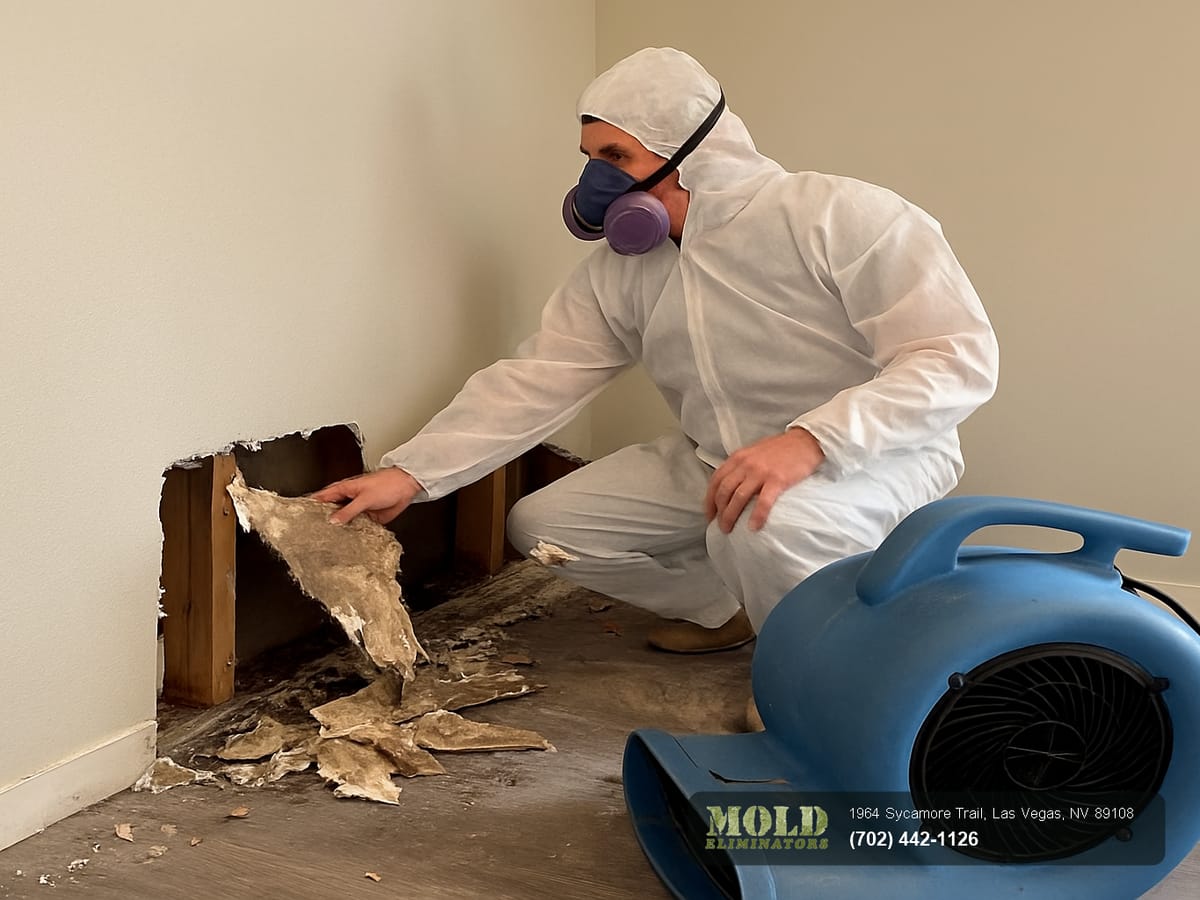 Damp, sagging attic insulation in a Las Vegas home revealing a hidden moisture source
What wet insulation usually means in a Las Vegas home
Insulation is a sponge by design. It traps air to slow heat transfer, which means it also traps water and holds it for a long time once it gets soaked. So the wet material you are looking at is a symptom, not the cause. The real question is where the moisture came from, and in the desert there are a handful of usual suspects.
Air conditioning condensation. This is one of the most common causes here. A clogged condensate drain line, a cracked drain pan, or an undersized system sweating in the summer can drip steadily onto insulation near the air handler or along duct runs. Because so much equipment sits in Las Vegas attics, that water lands directly on attic insulation and soaks in before anyone notices.
Swamp cooler problems. Evaporative coolers add a lot of moisture by nature, and a leaking unit, a stuck float valve, or an overflowing pan can saturate the insulation around the roof penetration and the surrounding ceiling. A swamp cooler running with a leak can keep insulation continuously damp.
Hidden plumbing or slab leaks. A slow supply line leak inside a wall, or a slab leak under the foundation, can wick moisture up and out into wall cavities and the insulation in them. Slab-on-grade construction is common in the valley, and a slab leak can stay quiet for weeks while it spreads.
Roof and monsoon intrusion. During monsoon season, wind-driven rain finds tired flashing, failed roof seals, and tiny gaps that are bone dry the other ten months of the year. A single hard storm can push water into the attic and onto the insulation, where it lingers long after the sky clears.
Active mold growth. If the insulation has been wet for a while, what you are seeing may already be feeding a colony. Mold spores are present in every building harmlessly, and they bloom only when they find a wet surface to feed on. Wet insulation is exactly that surface, which is why this symptom and a mold problem so often arrive together.
Need help now?
Talk to a Las Vegas expert
In-house certified crews. One-hour emergency response across the valley, 24/7.
Why it matters and how urgent it is
Wet insulation is not a cosmetic issue you can paint over. There is a real clock on it. Mold can begin to colonize wet organic and paper-faced materials within roughly 24 to 48 hours of getting wet, and after about 72 hours the conversation shifts from drying and saving to removing and remediating. Insulation that stays damp keeps the surrounding framing, drywall, and ductwork wet too, so the problem quietly spreads outward from the source.
There is a performance cost as well. Wet fiberglass loses most of its insulating value, so your cooling bills climb in the summer while the air handler works harder. Compressed, water-logged batts do not recover their R-value even after they dry, which is one reason soaked insulation usually has to be removed rather than simply dried in place.
The desert adds its own twist. Our extreme summer heat can drive moisture deeper into cool wall and attic cavities through condensation, and the dramatic day-night temperature swings make the assumption that it will just air-dry a dangerous one. A slab or attic that feels dry on the surface can stay saturated underneath for weeks. None of this is visible from the room, which is exactly why the wet insulation you can see deserves a real look behind it. If water is actively spreading right now, the right move is our 24/7 emergency response, where we stabilize the moisture first and start the assessment immediately.
What the proper fix involves, to the S520 standard
Fixing wet insulation correctly is a sequence, not a single step, and it follows the national mold standard. Mold Eliminators founder Craig Herrmann co-authored the ANSI/IICRC S520 standard, so the work here is done by the rulebook rather than by guesswork. You can read more about Craig and the S520 standard behind every job.
- Free on-site inspection and source diagnosis. We come out and find where the water is actually coming from before anything is removed. Moisture meters and thermal imaging trace how far the water traveled, often well beyond where the visible damage stops, so we fix the cause and not just the symptom.
- Containment. Before any wet, possibly contaminated insulation is disturbed, the area is contained so spores and debris do not spread into clean parts of the home through the HVAC system or the open attic.
- Removal of unsalvageable material. Soaked, compressed, or mold-affected insulation is bagged and removed rather than dried in place, because wet batts rarely recover their value and porous material that grew mold has to go.
- Structural drying. The framing, drywall, and subfloor the water touched are dried to documented targets with proper dehumidification and air movement. Done right, this is the step that stops mold from returning, and it is a core part of full structural drying rather than a few fans pointed at a wet wall.
- Independent lab clearance. When the work is done, an independent third-party lab verifies the result. You get data showing the area is clean and dry, not a technician’s say-so.
Why Las Vegas calls Mold Eliminators for this
No subcontractors
Every technician is a certified W-2 employee, so one in-house crew owns the source diagnosis, the removal, the drying, and the mold risk from start to finish. One chain of responsibility, one standard.
Independent third-party lab
We do not grade our own homework. An independent lab verifies that the area is clean and dry, so the result is proven by data rather than declared by the company that did the work.
Anti-upsell, fast response
We tell you when you do not need us, and we quote the real scope before work begins. One-hour emergency response, 24/7, across the valley, with a free on-site inspection up front, since 1996.
That is the whole difference. Where a franchise tears out insulation and moves on, we find the source, dry to a verified standard, and document the result the same way our broader restoration work is held to the rulebook. Find the cause, fix it once, and prove it is right.
Wet insulation in Las Vegas, common questions
- Can wet insulation just be dried out instead of replaced?
- Rarely. A small, quickly caught spill on rigid insulation can sometimes dry, but soaked fiberglass batts compress and lose most of their R-value permanently, and any insulation that has started growing mold has to be removed. We assess each case honestly during the free inspection and only remove what genuinely needs to go.
- Is wet attic insulation in summer usually the AC or the roof?
- In Las Vegas it is most often the air conditioning, a clogged condensate line, a cracked drain pan, or a sweating system dripping onto the insulation near the air handler. Roof and monsoon intrusion is the other common cause, especially after a hard summer storm. The only way to know for sure is to trace the moisture to its source, which is the first thing we do.
- How fast do I need to deal with this?
- Quickly. Mold can begin to colonize wet materials within 24 to 48 hours, and after roughly 72 hours the job shifts from drying to remediation. If the water is still active, our 24/7 response stabilizes it first. Either way, a free on-site inspection tells you exactly where you stand before anything is torn out.
Seeing wet insulation? Find the source before mold gets its chance.
Start with a free on-site inspection. We trace the moisture to its cause, contain and remove what needs to go, dry to verified targets, and confirm the result with an independent lab. One-hour emergency response, 24/7, across the Las Vegas valley.