Wet Drywall in Las Vegas
If you are seeing wet drywall, a soft, darkened patch on a wall or ceiling, a bubbling line of paint, or a spot that feels cool and spongy when you press it, your home is telling you that water has gotten into a place it was never meant to reach. That is unsettling, and it is right to want a straight answer fast. Here is the honest version: the wet spot you can see is almost never the whole story. Drywall is a sponge with a paper face, and by the time moisture shows on the surface, the water has usually traveled farther inside the wall than the stain suggests.
The good news is that wet drywall, caught early, is a manageable problem with a clear path: find the source, confirm how far the moisture spread, dry the structure to a measured standard, and verify there is nothing left feeding mold. The thing to avoid is the assumption that it will simply dry on its own. In a Las Vegas home, with our slab construction, our cooling systems, and our short monsoon season, the cause is often hidden plumbing or condensation, and the inside of the wall stays wet long after the surface looks fine. This page walks you through what wet drywall usually means here, how urgent it is, and exactly how a proper fix works.
What wet drywall usually means in a Las Vegas home
Drywall does not get wet on its own. Something is putting water into it, and the location of the wet spot is the first clue to where that water is coming from. In a desert valley like ours, a handful of causes account for the overwhelming majority of calls, and most of them are not the dramatic burst pipe people picture. They are slow, quiet, and easy to miss until the drywall finally gives the moisture away.
The most common culprit is a hidden plumbing leak. A pinhole in a supply line, a weeping fitting inside a wall, or a failing shower pan can release a small, steady amount of water that the drywall absorbs day after day. Because the leak is behind the surface, the first thing you notice is the symptom, not the cause. Wet drywall low on a wall, near a bathroom, kitchen, or laundry, often points here, and finding the exact source is the part that takes real diagnostic work rather than a guess.
Air conditioning condensation is the desert special. Our AC systems run hard for months, and a clogged condensate drain line or a sweating, poorly insulated duct in an attic or wall cavity can drip water onto drywall for weeks. Ceiling stains under an attic air handler and damp drywall near interior vents frequently trace back to this. Evaporative swamp coolers add their own risk: a leaking unit or a saturated pad can send water down through a roof penetration and into the ceiling drywall below.
Then there are the structural sources. A slab leak, water escaping from a pressurized line run under the concrete slab, can wick up into the base of the walls and show as wet drywall along the floor with no obvious source above it. Slabs hold water far longer than people expect, so a slab issue can stay wet for weeks. And during our brief but intense monsoon storms, wind-driven rain finds gaps around windows, roof flashing, and parapet walls, soaking drywall from the outside in. Any of these can also be the trigger behind a developing mold problem, because wet drywall is exactly the kind of paper-faced organic surface mold colonizes first.
Need help now?
Talk to a Las Vegas expert
In-house certified crews. One-hour emergency response across the valley, 24/7.
Why it matters and how urgent it is
Wet drywall is not a cosmetic issue you can repaint over, and the urgency is higher than most people assume. The reason is a clock. Mold can begin to colonize wet organic materials, and paper-faced drywall is about as organic and inviting as it gets, within roughly 24 to 48 hours of getting wet. After about 72 hours, the conversation shifts from drying and saving the material to removing and remediating it. That window is why a damp wall is treated as a time-sensitive problem, not a someday repair.
There is also the matter of what you cannot see. By the time the surface shows a stain, the moisture has usually spread into the wall cavity, the insulation behind it, and sometimes the framing and the subfloor at the base of the wall. Drywall that feels soft or bowed at the bottom, baseboards that swell, and a faint musty smell that builds over a few days are all signs the assembly is wet well past the visible mark. Painting over it traps the moisture and feeds whatever is starting to grow inside.
The cause matters for urgency too. If the source is an active plumbing or slab leak, water is still being added every hour, and the longer it runs the more material gets soaked and the larger the eventual repair. If water is actively spreading right now, that is the moment to use our 24/7 emergency response, where we stabilize the water first and stop the structure from getting wetter while we trace the source. Acting inside the first day or two is the single biggest factor in whether wet drywall stays a small, dry-it-and-save-it job or grows into a tear-out and remediation.
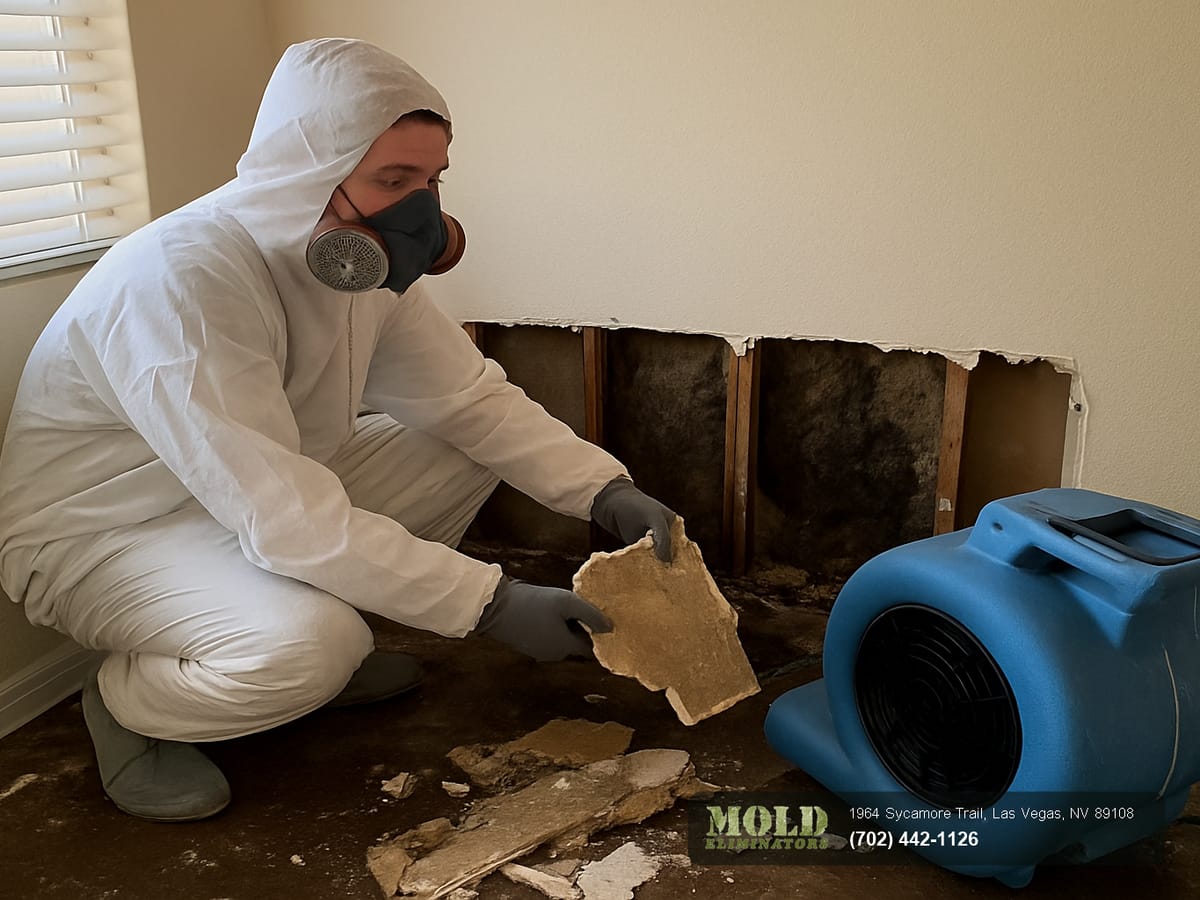 Technician using a moisture meter to check wet drywall inside a Las Vegas home
What the proper fix involves, to the S520 standard
A wet drywall job done correctly is a measured process with a documented finish line, not a fan pointed at a wall. Mold Eliminators handles it to the ANSI/IICRC S520 standard, the national mold remediation standard that our founder Craig Herrmann helped author. The sequence is deliberate, and it starts before anything gets opened up.
- Free on-site inspection first. We come out and look at the actual wall, not a photo. The on-site inspection is free, and it is where we read the moisture and figure out what we are dealing with before anyone talks about scope or cost.
- Find the source. Drying a wall while water is still leaking into it is pointless. We trace the cause, plumbing, condensate line, slab, or exterior intrusion, using moisture meters and thermal imaging, and confirm the water is stopped first.
- Contain the area. If mold is present or likely, we set containment so spores and dust do not spread into clean parts of the home while the wet drywall is opened and handled.
- Remove what cannot be saved. Drywall and insulation that are soaked through or already showing growth are removed, not dried in place. Materials that are only damp at the edge of the affected area can often be dried and kept.
- Dry the structure to a measured target. Commercial dehumidifiers and air movers bring the framing, subfloor, and remaining materials down to a documented dry standard, with daily moisture readings driving the schedule.
- Independent lab clearance. When mold was involved, the result is verified by an independent third-party lab, not declared by the technician who did the work, so you have data showing the area is clean and dry before anything is closed back up.
This is where wet drywall overlaps with full water damage restoration: the water, the drying, and the mold risk are physically one problem, so we treat them as one job. Because Craig helped write the rulebook, the work is held to it from the first reading to the final clearance. You can read more about Craig and the S520 standard if you want to understand exactly what that benchmark means for your home.
Why homeowners call Mold Eliminators for wet drywall
No subcontractors
Every technician is a certified W-2 employee of Mold Eliminators. One in-house crew owns the source, the drying, and the mold risk from start to finish, so no one points fingers when something was missed.
Independent lab verification
When mold is involved, clearance comes from an independent third-party lab, not from us. You get data showing the area is dry and clean, not a technician’s word, before the wall is closed.
Anti-upsell, fast response
We tell you when you do not need us. If a small spot just needs drying, we will say so. And when water is actively spreading, our one-hour emergency response runs 24/7 across the valley.
Mold Eliminators has worked Las Vegas homes since 1996 and handled 255 plus properties, and Craig Herrmann is IICRC Master Certified. The point of all of it is simple: diagnose wet drywall honestly, fix only what needs fixing, dry it to a verified standard, and prove the result. If you would rather just talk to a person, reach us directly, with no call center in between.
Wet drywall in Las Vegas, common questions
- Can I just let wet drywall dry out on its own?
- Usually not safely. The surface dries first while the wall cavity, insulation, and framing stay wet, and that hidden moisture is what mold needs. Our dry desert air cannot pull water out of a soaked cavity fast enough to beat mold’s 24 to 72 hour clock. The bigger issue is that if a leak is still feeding the wall, drying the surface accomplishes nothing. The right first step is a free inspection to read the actual moisture and find the source.
- How do I know if there is mold behind my wet drywall?
- A musty smell, a stain that keeps coming back, or drywall that is soft at the base are warning signs, but none of them are required for mold to be growing inside the cavity. The only way to know is to measure and, if needed, test. We start with a free on-site inspection, and where mold is suspected an independent third-party lab confirms it, so you get a factual answer rather than a guess before any work begins. See our approach to mold remediation for what happens if mold is found.
- Is wet drywall covered by insurance?
- Often, when the water came from a sudden, accidental event like a burst pipe or a failed water heater, the drywall repair and drying are frequently covered as part of water damage restoration. We document moisture readings, photos, and scope from the first visit, which is exactly what an adjuster needs, and that same documentation helps keep a covered water claim from turning into a disputed mold claim later.
Wet drywall in your home? Start with a free inspection.
We come out, read the moisture, find the source, and tell you honestly what the wall needs. The on-site inspection is free, with one-hour emergency response, 24/7, across the Las Vegas valley. Lab analysis, when it is needed, is verified by an independent third-party lab.