Emergency Water Removal in North Las Vegas, NV
A supply line lets go in an Aliante two-story at 2 a.m., or a slab leak quietly saturates a Craig Ranch hallway for a week before anyone notices the warm spot underfoot. By the time the water is obvious in North Las Vegas, it has usually already traveled into the wall cavities, under the tile, and down into the subfloor. Emergency water removal is the first hour that decides whether this stays a water problem or becomes a mold problem.
Mold Eliminators runs emergency water removal across North Las Vegas as the opening move of full emergency water removal and restoration, and we are minutes away. Our HQ at 1964 Sycamore Trail sits just south of the city line, so a crew reaches Aliante, Eldorado, or central NLV fast. We extract the water, then dry the structure to the ANSI/IICRC S520 standard our founder Craig Herrmann helped write. No subcontractors, in-house W-2 certified technicians, and an independent third-party lab when verification is warranted.
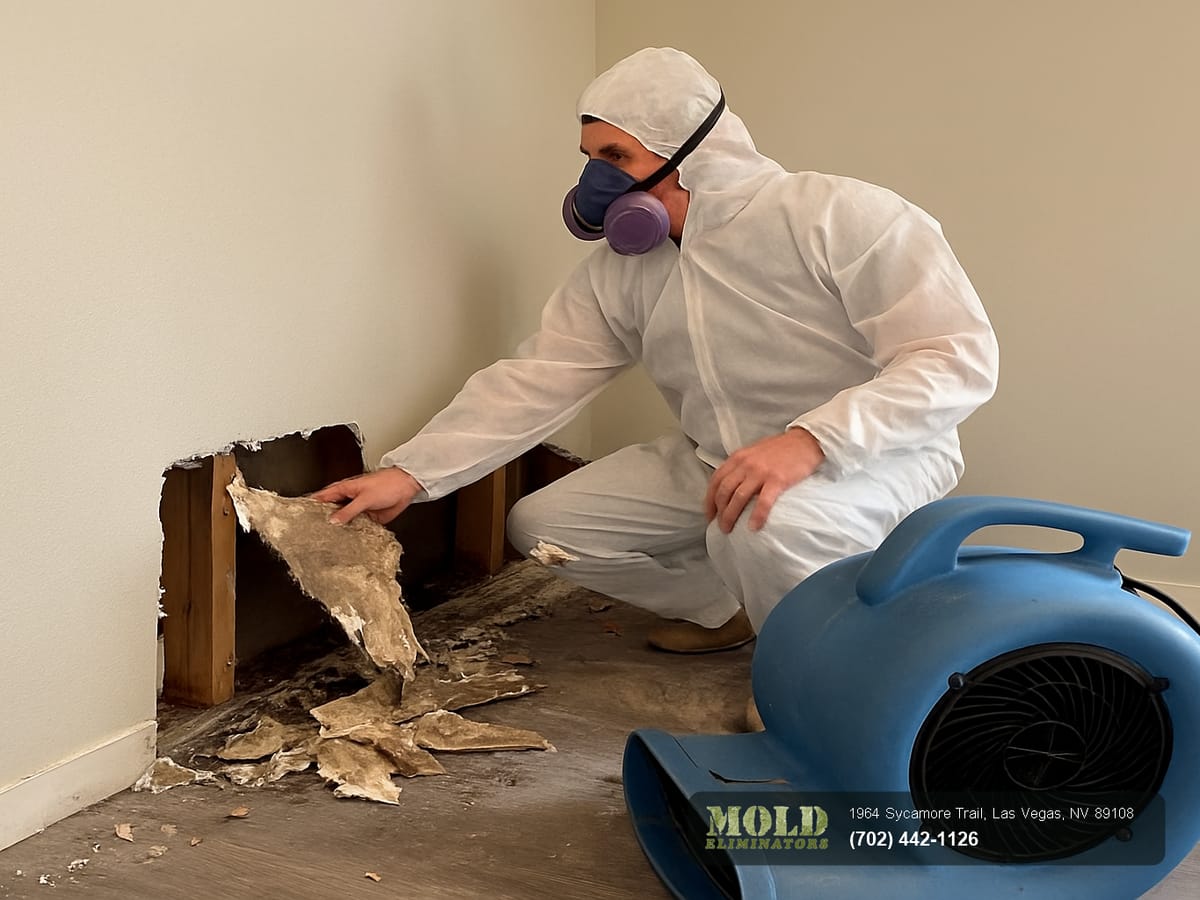 Emergency water extraction equipment staged in a North Las Vegas home
How water emergencies actually show up in North Las Vegas
North Las Vegas is really two cities stacked into one ZIP-code spread, and the water emergencies look different depending on where you are. The newer master-planned builds out in Aliante and along the Tropical Parkway and Centennial corridors (89084, 89085, 89086) are mostly slab-on-grade construction from the 2000s boom. That construction era brought a specific failure pattern: pinhole copper failures and slab leaks. Hot and cold copper runs cast into or under the slab develop tiny corrosion pinholes, and the first sign a homeowner gets is a warm patch of floor, a spike on the water bill, or the soft hiss of water moving where no fixture is running. By then the slab is already wet underneath.
Older central North Las Vegas tells the opposite story. The neighborhoods around the original downtown core and the Eldorado area (89030, 89032) carry aging plumbing: galvanized supply lines, original cast iron drains, and water heaters well past their service life. Here the emergency is usually sudden and loud, a burst line or a failed heater dumping dozens of gallons across a floor in minutes. Both scenarios end the same way if the response is slow, with water wicked deep into materials that will start growing mold inside 24–72 hours.
Then there is the weather. North Las Vegas sits near the Las Vegas Wash and its monsoon drainage zones, and the summer storms that funnel down those wash corridors can push runoff into garages, low-lying yards, and ground-floor units fast. Desert homes are not built for standing water, and a single monsoon cell can do in an afternoon what a slow leak does in a month. Whatever the source, the physics of removal are the same, and so is the clock.
Need help now?
Talk to a Las Vegas expert
In-house certified crews. One-hour emergency response across the valley, 24/7.
Why the first hours decide everything
There is a clock on every water emergency, and it is not generous. Mold can begin to colonize wet organic materials, and most of a North Las Vegas home is organic from paper-faced drywall to wood framing, within roughly 24 to 48 hours of getting wet. After about 72 hours the conversation shifts from dry it and save it to remove it and remediate. That window is the whole reason water removal is an emergency and not a scheduled appointment.
This is why removal cannot wait for business hours, and why the first call matters so much. The faster a controlled extraction and drying environment goes in, the more material we save and the lower the mold risk drops. A flood left sitting overnight because we will deal with it tomorrow can turn a salvageable floor into a tear-out. If water is actively spreading in your home right now, the right move is our 24/7 emergency line, where we stabilize the water first and start drying immediately, with a one-hour response target across the valley.
North Las Vegas adds its own wrinkles to that clock. Slab-on-grade construction is common here, and concrete holds water far longer than people expect: a slab that feels dry on top can stay saturated underneath for weeks. Our extreme summer heat can drive moisture deeper into cool wall cavities through condensation, and the desert day-night temperature swings make the assumption that it will just air-dry a dangerous one. None of this is visible to the eye, which is exactly why removal and drying have to be measured, not guessed.
What happens when our crew arrives
Emergency water removal is more than running a wet-vac. You cannot dry what you have not found, and you cannot prove something is dry without a baseline. Before a single fan goes down, we map exactly how far the water traveled and how wet each material is, then aim the equipment at the data.
This is the part a company chasing a quick invoice skips, because it takes equipment, training, and time. It is also the part that makes the work honest. When we say a wall is dry, we can show you the number, the location, and the day it got there. This is the Applied Structural Drying discipline that lives inside the S520 standard, and it is why we treat the water and the mold risk as one continuous job, because physically they are.
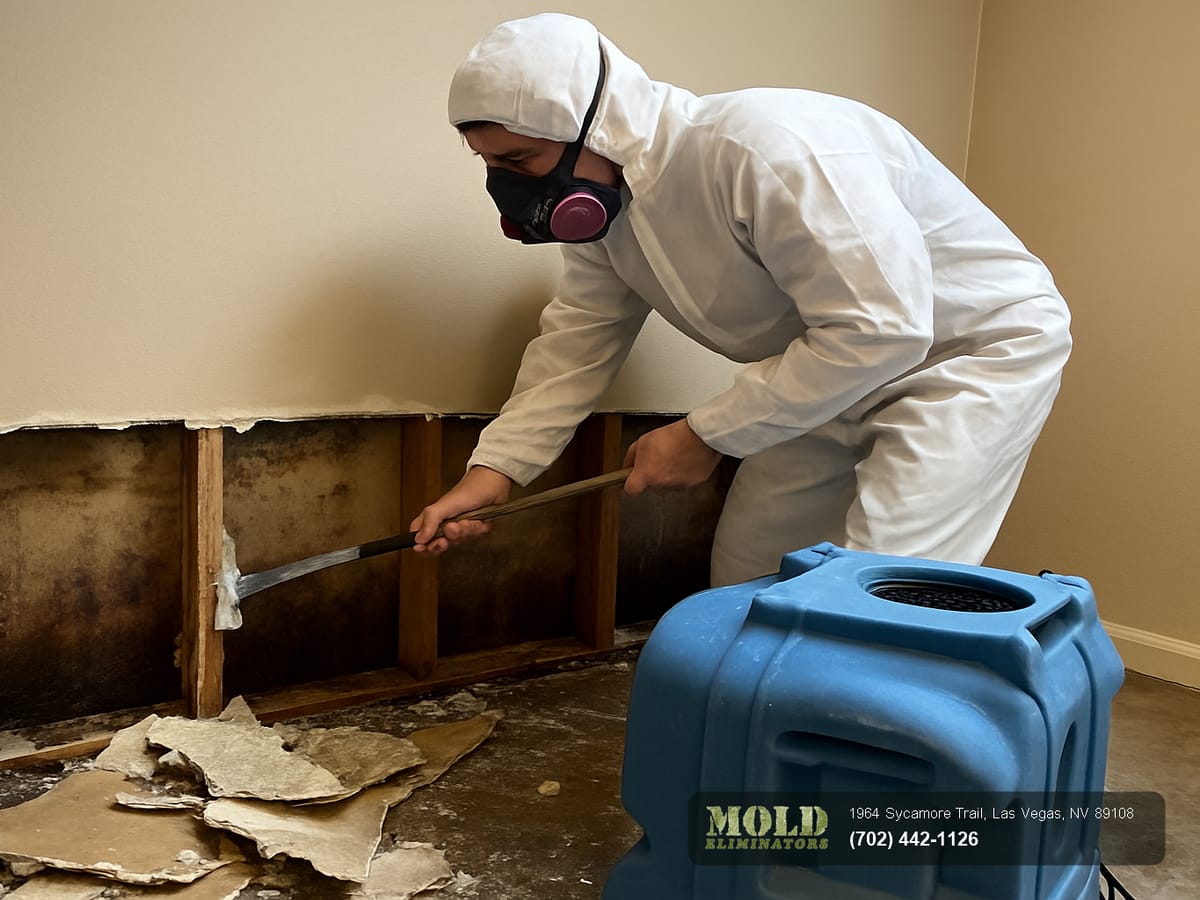 Technician logging moisture readings during a North Las Vegas water removal job
Removal and drying to the S520 standard, step by step
Water removal done to standard follows a deliberate sequence, the same one Craig Herrmann helped codify when he co-authored the ANSI/IICRC S520 standard. It runs from the first reading to the final verified dry target.
- Stabilize the source. Active water is stopped first, whether it is a pinhole copper leak under a slab or a failed heater, so the structure stops getting wetter.
- Extraction. Standing and absorbed water is physically extracted, which beats evaporation by a wide margin and protects the materials beneath.
- Moisture mapping and baseline. We map the affected area with meters and thermal imaging, log starting moisture levels, and set a documented dry target for each material.
- Dehumidification. Commercial dehumidifiers pull vapor out of the air so the room stays drier than the wet materials, the engine that keeps moisture leaving the structure.
- Air movement. High-velocity air movers are placed by design to sweep moisture off surfaces and into the air where the dehumidifiers capture it.
- Daily monitoring. Every day, readings are taken and logged and the equipment is adjusted to keep drying on pace toward the target. The data drives the schedule, not the calendar.
- Drying to verified targets. Equipment comes out only when readings confirm every material has hit its dry standard. That verified-dry result is the finish line, and the proof that mold has nothing left to feed on.
Why local, in-house, and independent matters in North Las Vegas
When water is spreading, distance is time and time is damage. We are not dispatching from across the valley or routing your call through a national franchise queue. Our HQ on Sycamore Trail is minutes from the North Las Vegas line, so a crew gets to Aliante, Craig Ranch, Eldorado, or the older central neighborhoods quickly, which is exactly what the 24–72 hour mold clock demands.
The crew that arrives is ours. No subcontractors, every technician an in-house W-2 certified employee, which means one chain of responsibility from the first extraction to the final verified-dry reading. We do not remove your water and then hand you off to a separate mold company that points fingers when something was missed. One crew owns the water, the drying, and the mold risk, start to finish.
And when the question of whether mold took hold actually matters, an independent third-party lab settles it, not a technician with an invoice to grow. We are anti-upsell by design: we tell you when you do not need us. If a past water event in your home was never properly verified, a free inspection is the calm, factual way to find out whether moisture left anything behind. Lab analysis is a separate paid step: if it is warranted, samples go to that independent third-party lab and are billed at cost, never bundled in to pad a number.
North Las Vegas property managers, HOAs, and Realtors reach us for the same reason homeowners do. When water intrusion crosses unit lines in a multi-unit building, or a past event needs a clean on-the-record dry-out before a sale closes, the answer is a credible, documented account of what got wet and what got dried. You can see the full North Las Vegas service area we cover, or just reach us directly, no call center in between.
Emergency water removal in North Las Vegas: common questions
- How fast can you reach North Las Vegas in an emergency?
- Our HQ sits just south of the North Las Vegas line on Sycamore Trail, so we are minutes from Aliante, Craig Ranch, Eldorado, and central NLV. We target a one-hour response, 24/7, on our emergency line. With water spreading, that speed is the difference between a salvageable floor and a tear-out.
- My Aliante home has a warm spot on the floor and a high water bill. Is that an emergency?
- Very likely a slab leak, a common failure in the master-planned builds across Aliante and the Tropical Parkway corridor where copper runs under the slab develop pinhole corrosion. The water is already saturating the slab and wicking into materials, so yes, treat it as urgent. We stop the source, extract, and dry to verified targets before mold gets its 24–72 hour window.
- Is the inspection really free, and what about lab testing?
- The on-site inspection is genuinely free for homeowners and property owners. Lab analysis is a separate paid step: if it is warranted, samples go to an independent third-party lab and are billed at cost. We never bundle testing into the inspection to inflate a number. A free inspection tells you exactly where you stand before any work begins.
Water spreading in North Las Vegas? We are minutes away.
Free on-site inspection, no pressure. One-hour emergency response, 24/7, from our HQ minutes south of the North Las Vegas line. We extract, dry to verified S520 targets, and document it, so the water problem ends here, not in three weeks.