Washing machine or dishwasher leak, what to do?
Shut off the water and the power to the appliance, soak up what you can, and get air moving on the wet area within minutes, not hours. A small washing machine or dishwasher leak that is dried within 24–48 hours rarely becomes a mold problem. The danger is the water you cannot see, the moisture that wicks under cabinets, into the subfloor, and behind the kickplate, so the real job is finding and drying that hidden water before mold has anything to feed on.
An appliance leak feels minor because the puddle is small and easy to wipe up. The trouble is that the visible water is almost never the whole story. Dishwashers and washing machines sit against cabinets and over subfloor seams, so water runs to the lowest hidden point and stays there. The surface dries, everyone relaxes, and three weeks later a musty smell starts building behind the cabinet. This page walks through exactly what to do, what most people miss, and when a quick dry-out is no longer enough.
What to do right now
The first few minutes matter more than anything else, because stopping the source and starting to dry is what keeps a small leak small. Work through these steps in order.
- Stop the water. For a dishwasher, turn off the supply valve under the sink. For a washing machine, shut the hot and cold valves behind the unit, or the main if you cannot reach them. This ends the leak before you worry about anything else.
- Kill the power. Standing water plus an electrical appliance is a shock and fire risk. Switch off the breaker for that circuit before you reach behind or under the unit.
- Remove the water. Towel up the puddle, then mop and blot until the surface feels dry. The faster trapped water comes up, the less it wicks into materials around it.
- Open it up and get air moving. Pull the unit out if you safely can, open the cabinet under the sink, and run fans on the wet zone. Moving air is what actually pulls moisture out of materials.
- Check the hidden edges. Feel the cabinet kickplate, the flooring seams, and the wall base. Cool, damp, or soft spots mean water already traveled where a towel cannot reach.
- Document it. Photograph the source and the wet area before you clean up. If a claim or a verification is needed later, this record is exactly what an adjuster wants to see.
Need help now?
Talk to a Las Vegas expert
In-house certified crews. One-hour emergency response across the valley, 24/7.
Why the hidden water is the real problem
Here is the part most homeowners never hear. Mold spores are present in every building, harmlessly, all the time, and they only bloom into a colony when they find a wet surface to feed on. A wiped-up floor that is still damp underneath is exactly that surface. Paper-faced drywall, particleboard cabinet bottoms, and wood subfloor are all organic, and they can begin to grow mold within roughly 24–48 hours of staying wet. After about 72 hours the question shifts from “dry it and save it” to “remove it and remediate.”
Dishwasher and washing machine leaks are especially good at hiding water because of where the appliances live. A slow dishwasher leak runs under the cabinet base and along the subfloor, often surfacing several feet from the leak itself. A washing machine overflow soaks the flooring and the wall behind it, and in a second-floor laundry it can travel into the ceiling below. The surface you toweled is dry, but the assembly underneath can stay saturated for days. That is why a leak that “looked handled” so often turns into a callback weeks later, and why simply mopping up is not the same as drying out.
Las Vegas adds its own wrinkle. People assume the dry desert air will finish the job, but our extreme summer heat can drive moisture deeper into cool cabinet cavities through condensation, and slab-on-grade floors hold water far longer than expected. A slab that feels dry on top can stay damp underneath. None of this is visible to the eye, which is exactly why drying has to be verified with a moisture meter, not guessed by touch. Proper structural drying is the step that decides whether your leak ends here or quietly becomes a mold problem.
What to do next
Once the source is off and the surface is dry, the next decision is whether you have actually dried the structure or just the surface. A few honest checkpoints help you tell.
If it was a small, quickly caught leak on a hard surface and the area is genuinely dry within a day, you are likely fine. Keep fans running for another 24 hours, check the hidden edges again, and watch for any musty smell or staining over the following week. If nothing appears, the fast response did its job.
If the water sat for a while, soaked into the cabinet or subfloor, or you cannot tell whether it is dry, get it measured. The only way to know a structure is dry is to read the moisture content of the materials, not to feel the surface. This is where a professional moisture map matters: meters and thermal imaging show how far the water traveled and whether anything is still wet behind the cabinet or under the floor. If a past leak was never properly verified, a free inspection for property owners is the calm, factual way to find out whether moisture left anything behind. The on-site inspection is genuinely free. If the readings suggest lab analysis is warranted, samples go to an independent third-party lab and are billed at cost, so you only pay for testing if there is a real reason to test.
If you are dealing with clean supply-line water caught early, drying is usually the whole answer. If the water came from a backed-up drain or sat long enough that materials are saturated, drying becomes one part of a larger job that falls under full water damage restoration, and in the worst cases a ground or category-three intrusion handled as flood restoration. An honest restorer tells you which situation you are in rather than selling a package you do not need.
Why measured drying beats hoping it dried
The difference between a leak that ends and a leak that returns is rarely effort, it is verification. At Mold Eliminators the work is held to the national standard for a reason: our founder, Craig Herrmann, co-authored the ANSI/IICRC S520 standard and is IICRC Master Certified, with no subcontractors on any job. Every technician is an in-house W-2 certified employee, so one crew owns the water, the drying, and the mold risk from the first reading to the final verified-dry target.
That also means no upselling. If a moisture reading shows your floor is dry, we tell you so and you are done. If it shows water hiding under the cabinet, we show you the number, the location, and the day it got there. Measure first, dry to the data, then prove it. With one-hour emergency response, 24/7, across the valley, the fast call after a leak is what keeps a small appliance problem from becoming a remediation job.
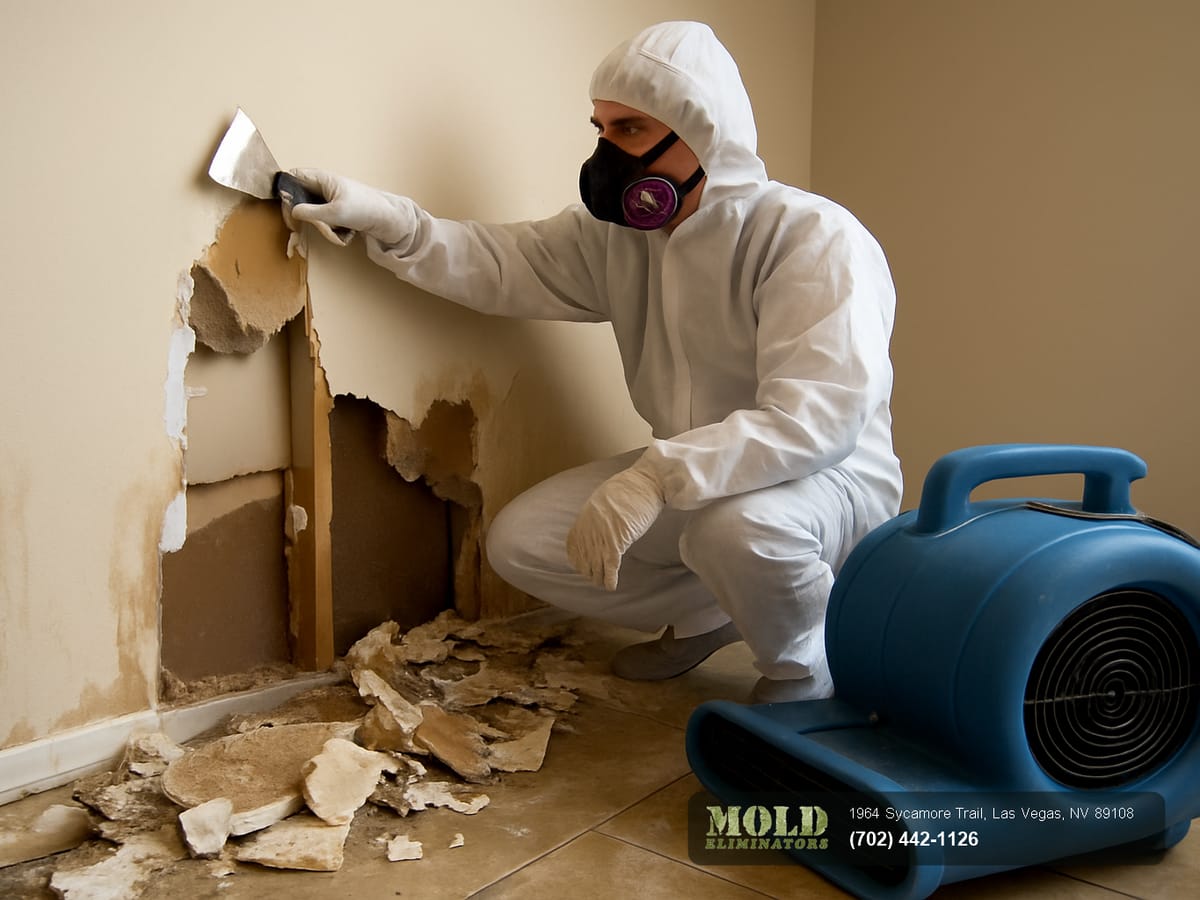 Moisture meter reading the subfloor under a kitchen cabinet after an appliance leak
Related questions
- Is mold testing free after a leak?
- The on-site inspection is free. A certified technician comes out, reads the moisture in your materials, and tells you honestly whether you have a problem, at no cost. Lab testing is a separate, paid add-on: if the inspection suggests that analysis is warranted, samples go to an independent third-party lab and are billed at cost. That keeps the offer honest, you get a free, factual answer about whether you even need testing before anyone spends money on it. You can start with a free inspection.
- How long do I have before a leak turns into mold?
- Roughly 24–48 hours of staying wet is enough for mold to begin colonizing organic materials like drywall, cabinet board, and subfloor, and after about 72 hours the conversation shifts from drying and saving to removing and remediating. That window is why an appliance leak is treated as a same-day matter, not a “deal with it this weekend” chore. The faster the structure is dried to a verified standard, the lower the mold risk drops.
- Can I just dry it myself with fans and a towel?
- For a tiny leak caught immediately on a hard floor, often yes, keep fans on the area for a day and watch for any smell or staining. But household fans cannot pull water out of a soaked cabinet base or subfloor fast enough to beat the clock, and the dry desert air can lull you into thinking it dried when moisture is still sitting in the assembly. Without a moisture reading you are guessing, and guessing is how a small leak becomes a hidden mold colony. If you cannot tell whether it is truly dry, proper structural drying measures and verifies it.
Caught a leak? Find out if it is really dry, with a free inspection.
A free, no-pressure on-site inspection tells you whether moisture is still hiding under your cabinets or floor, before mold gets its chance. One-hour emergency response, 24/7, across the Las Vegas valley. No subcontractors, no upselling, just the honest reading.