Asbestos in an Older Las Vegas Home
If you are seeing what you think is asbestos in an older Las Vegas home, a crumbling popcorn ceiling, cracked floor tiles, frayed wrap on old ductwork or pipes, the first thing to know is this: do not disturb it, and do not panic. Asbestos that is intact and left alone is usually not an immediate danger. The risk starts when it is broken, sanded, torn, or soaked by water and the fibers go airborne. What you are really looking at is a question, not yet an emergency, and the honest answer almost always starts with finding out what the material actually is.
Most of the homes in the valley where this comes up were built before the mid-1980s, in neighborhoods like the older parts of Charleston, the Huntridge district, or the early ranch tracts near Nellis. In that era, asbestos was common in ceiling texture, vinyl floor tile and its black mastic, pipe and duct insulation, and roofing. Seeing a suspect material is not proof, and the only way to be sure is a sample sent to an independent asbestos lab. We offer a free on-site inspection to look at what you have, tell you whether it is even worth testing, and tell you straight if it is nothing.
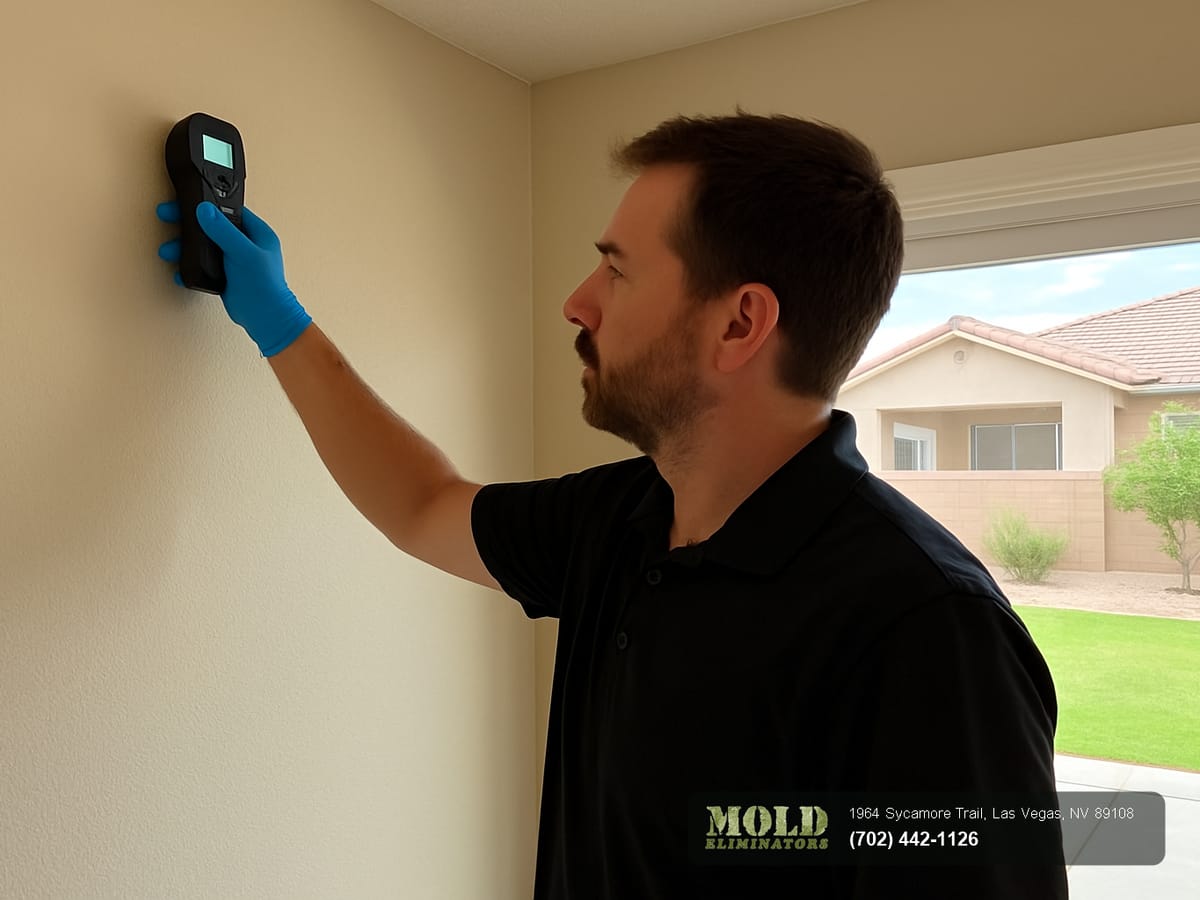 Aging ceiling texture and old pipe wrap in a 1970s Las Vegas home being assessed for asbestos
What that suspect material most likely is in an older Las Vegas home
In a home built here before about 1985, the materials people most often mistake for, or correctly suspect to be, asbestos fall into a short list. Knowing which one you are looking at changes how urgent it is and what the fix should be.
Popcorn or textured ceilings. The sprayed acoustic texture on so many valley ceilings from the 1960s through the early 80s frequently contained asbestos. Intact and painted, it is generally stable. The trouble starts when a roof leak, a swamp cooler overflow, or an upstairs plumbing failure soaks it and it begins to sag, flake, or fall, which is both an asbestos question and a hidden water question at once.
Old floor tile and black mastic. Nine-inch vinyl or asphalt floor tiles and the dark adhesive under them are classic asbestos-containing materials. Cracked, lifting, or being scraped up during a remodel is when they become a concern.
Pipe and duct insulation. The chalky white or gray wrap on old heating ducts, water lines, and the air handler is a common source. In Las Vegas, the bigger surprise is often what is hiding behind it: a slow slab leak or condensation off an aging AC line can keep that wrap damp, and damp insulation is both a fiber risk and a mold risk.
What looks like asbestos but is mold or water damage. This is the honest part. A gray, fuzzy, or stained patch on a ceiling, in a closet, or behind a baseboard is very often not asbestos at all. It is mold growing on a surface that has been wet, sometimes from monsoon-season intrusion through an old roof, sometimes from a swamp cooler line, sometimes from a slab leak wicking up a wall. The two problems look alike to the eye and travel together, which is exactly why a real inspection beats a guess.
Need help now?
Talk to a Las Vegas expert
In-house certified crews. One-hour emergency response across the valley, 24/7.
Why it matters and how urgent it really is
Asbestos is only a health hazard when its fibers become airborne and are breathed in. That is the single fact that should guide everything you do next. A sealed, painted, undamaged popcorn ceiling is not releasing fibers into your air. The danger arrives when someone scrapes, sands, drills, or demolishes that material without knowing what it is, or when water damage breaks it down and it crumbles on its own. The worst thing you can do right now is start chipping at it to get a closer look.
So the honest urgency depends on the condition. If the material is intact and dry, you have time to do this correctly: get it identified, then decide. If it is already friable, meaning it can be crumbled by hand, or if water has gotten into it and it is falling apart, that is when you keep people and pets out of the room and get a professional eye on it promptly.
There is a second clock that is easy to miss. When the trigger was water, a leaking roof, a swamp cooler, a slab leak, the moisture that disturbed the suspect material is also growing mold inside the wall or ceiling cavity, often within 24 to 72 hours. We treat the moisture and the suspect material as one connected problem, because in an older Las Vegas home they almost always are. Stopping the water source early is what keeps a single repair from turning into both an asbestos abatement and a mold remediation job.
 Containment and air control setup for safely handling suspect asbestos material in a Las Vegas home
What the proper fix involves, and how we handle it
Done correctly, this is a measured process, not a demolition. We work to the same containment and verification discipline that the ANSI/IICRC S520 standard sets for microbial work, the standard our founder Craig Herrmann helped co-author, so the air you breathe afterward is proven clean, not assumed clean.
- Free on-site inspection first. We come out, look at the actual material and its condition, and tell you whether it even needs testing. If it is intact and harmless, we tell you to leave it alone.
- Identify the material. A sample goes to an independent third-party lab to confirm whether asbestos is present. Lab analysis is a paid add-on, and we explain the cost before any sample is taken, never a surprise.
- Find the source. If water disturbed the material, we locate the leak, the swamp cooler line, the slab leak, or the roof intrusion, because fixing the cause is what stops the problem from returning.
- Contain. The work area is sealed and put under controlled air so fibers and any mold spores cannot spread to the rest of the home.
- Remove and dry. Affected materials are removed or stabilized under containment, and any wet structure is dried to a documented standard so mold has nothing left to feed on.
- Independent lab clearance. Before we call it done, a third-party lab verifies the result. You get data showing the area is clean, not our word for it.
Why older-home owners across the valley call us
No subcontractors
Every technician is a certified W-2 employee on our own crew. One team owns the inspection, the source repair, the removal, and the drying, start to finish, with one chain of accountability and no finger-pointing.
Independent third-party lab
We do not grade our own homework. Identification and final clearance run through an independent lab, so what you get is verified data, not a technician declaring the job clean.
Anti-upsell, fast response
If the material is intact and safe, we tell you to leave it alone and walk away. When it is urgent, our one-hour emergency response is available 24/7 across the Las Vegas valley.
Mold Eliminators has worked older Las Vegas homes since 1996, more than 255 properties, and the approach has not changed: tell the truth, find the real cause, fix it to the standard, and prove the result. If water is actively coming in right now and breaking down old material, our 24/7 emergency response stabilizes it first. If you simply want a calm, factual read on what you are looking at, a free inspection is the place to start.
Asbestos in an older Las Vegas home, common questions
- Is my popcorn ceiling dangerous if I just leave it alone?
- Usually not. Intact, painted, undisturbed ceiling texture is generally stable and is not releasing fibers into your air. The danger comes from scraping, sanding, or drilling it, or from water damage that makes it crumble. If it is dry and undamaged, the safest move is to have it identified and then decide, not to start chipping at it. A free on-site inspection tells you where you stand.
- How can I tell if it is asbestos or just mold and water damage?
- You often cannot tell by looking, which is the honest answer. A gray or stained patch on an old ceiling could be asbestos texture, or it could be mold growing on a surface a roof leak or swamp cooler soaked. The two look alike and frequently occur together in older valley homes. The only reliable way to know is an inspection and, where needed, an independent lab analysis.
- Do you charge for the inspection?
- The on-site inspection is free. We come out, look at the material and its condition, and give you a straight read, including telling you when it is nothing and you should leave it alone. Lab testing to confirm whether a material actually contains asbestos is a paid add-on, and we explain that cost up front before any sample is taken. To set it up, just reach us directly.
Not sure what you are looking at? Start with a free inspection.
We come out, identify the real problem, and tell you straight whether it needs work or can be left alone. No subcontractors, independent third-party lab verification, one-hour emergency response 24/7 across the Las Vegas valley.