Discolored Walls in Las Vegas
If you are seeing discolored walls, a spreading brown ring, a yellow halo, a grey shadow, or a patch that just keeps getting darker, your home is telling you something. Wall discoloration is almost never a paint problem. It is a moisture problem showing its face. A wall changes color because water has moved through it, and where water moves, mold follows. The good news is that a stain caught now is far easier to solve than the hidden growth it can become if it is painted over and ignored.
The honest first step is not to repaint and hope. It is to find out what put the moisture there, because the discoloration is a symptom, not the disease. Below is a calm, straight read on what discolored walls usually mean in a Las Vegas home, how urgent yours is likely to be, and what a proper fix to the national standard actually involves. No fear-mongering, no upsell. Just what we would tell a neighbor.
What discolored walls usually mean in a Las Vegas home
The color and pattern of a stain are real clues. None of them are a diagnosis on their own, but together they point toward a source. In the desert, the usual suspects look a little different than they would in a wetter climate, so here is how we read them.
Brown or yellow rings and tide marks. A stain with a defined edge, like a coffee ring, almost always means water came and went. The ring is the high-water line where dissolved minerals and tannins were left behind as the wall dried. This is the classic signature of a roof leak, a window that took on monsoon rain, or a plumbing line that wept and then stopped. The wall looks dry now, but the cavity behind it may not be.
Grey, green, or black mottled patches. When discoloration is fuzzy, blotchy, or spreading rather than a clean ring, you are likely looking at actual microbial growth rather than just a mineral stain. This is the point where the problem stops being cosmetic. Growth like this behind drywall is a job for mold behind the walls, and painting over it only feeds it.
Discoloration low on the wall, near the floor. Staining that starts at the baseboard and climbs upward usually means water is coming from below or wicking up through the wall. In our slab-on-grade homes, that points to a slab leak under the foundation or a long-running supply line, both of which keep the base of the wall quietly wet.
Stains around an AC closet, vent, or interior wall. A discolored patch near an air handler, a return vent, or a ceiling register is very often condensation. Las Vegas runs its air conditioning hard for half the year, and a clogged condensate drain or a sweating, under-insulated duct can drip into a wall cavity for weeks before the stain appears on the surface.
Discoloration near a swamp cooler or its ducting. Evaporative coolers move a lot of water through the roof and into the home. A leaking cooler pan, a corroded line, or oversaturated pads can stain a ceiling and the wall below it, and because the unit sits up top, the water travels down through the structure before you ever see it.
So the same symptom, a discolored wall, can trace back to a roof, a window, a pipe, a slab, an AC system, or a swamp cooler. The only way to know which one is yours is to find the moisture source and follow it, which is exactly where a proper fix begins.
Need help now?
Talk to a Las Vegas expert
In-house certified crews. One-hour emergency response across the valley, 24/7.
How urgent is it, and why it matters
The honest answer is that it depends on whether the source is still active, and you usually cannot tell by looking. A stain that has stopped growing may be from a leak that was already fixed, in which case the urgency is moderate but the hidden moisture still needs checking. A stain that is darkening, spreading, or coming back after you paint it means water is still arriving, and that is the situation that turns a cosmetic mark into a structural and health problem.
Here is why the clock matters. Mold can begin to colonize damp drywall and framing within roughly 24 to 48 hours of those materials getting wet, and Las Vegas walls hold a quiet trap: the surface dries fast in our arid air while the cavity behind stays soaked, so the outside looks fine while growth gets started inside. A discolored wall is often the first and only outward sign that a wet pocket has been sitting in your structure long enough to matter. Left alone, what started as a yellow ring can become widespread growth that affects air quality and eats into the drywall, insulation, and framing behind it.
If the discoloration is spreading right now, if there is a musty smell with it, or if you can see active dripping or wet drywall, treat it as urgent and call. Water that is actively moving through a wall is the situation our 24/7 emergency team is built for, and stabilizing the source quickly is what keeps a small repair from becoming a full tear-out.
 Technician inspecting a discolored interior wall with a moisture meter in a Las Vegas home
What the proper fix involves
A discolored wall is fixed correctly when the moisture source is gone, the affected materials are clean and verified dry, and an independent test confirms the air is safe again. Painting over the stain is not a fix. It is a cover-up that lets the underlying problem keep growing. Here is the sequence we follow, built on the ANSI/IICRC S520 mold standard.
- Free on-site inspection first. We come out, look at the stain, and use moisture meters and thermal imaging to trace where the water is and where it came from. The inspection is free. Any lab work is a separate, optional step we only recommend when it answers a real question.
- Find and stop the source. A stain cannot be permanently fixed while water is still arriving. We identify the roof leak, the slab leak, the condensate line, the swamp cooler, or whatever is feeding it, so the repair holds.
- Contain the area. Before anything is opened up, we seal the work zone so spores and dust do not spread to the rest of the home during the work.
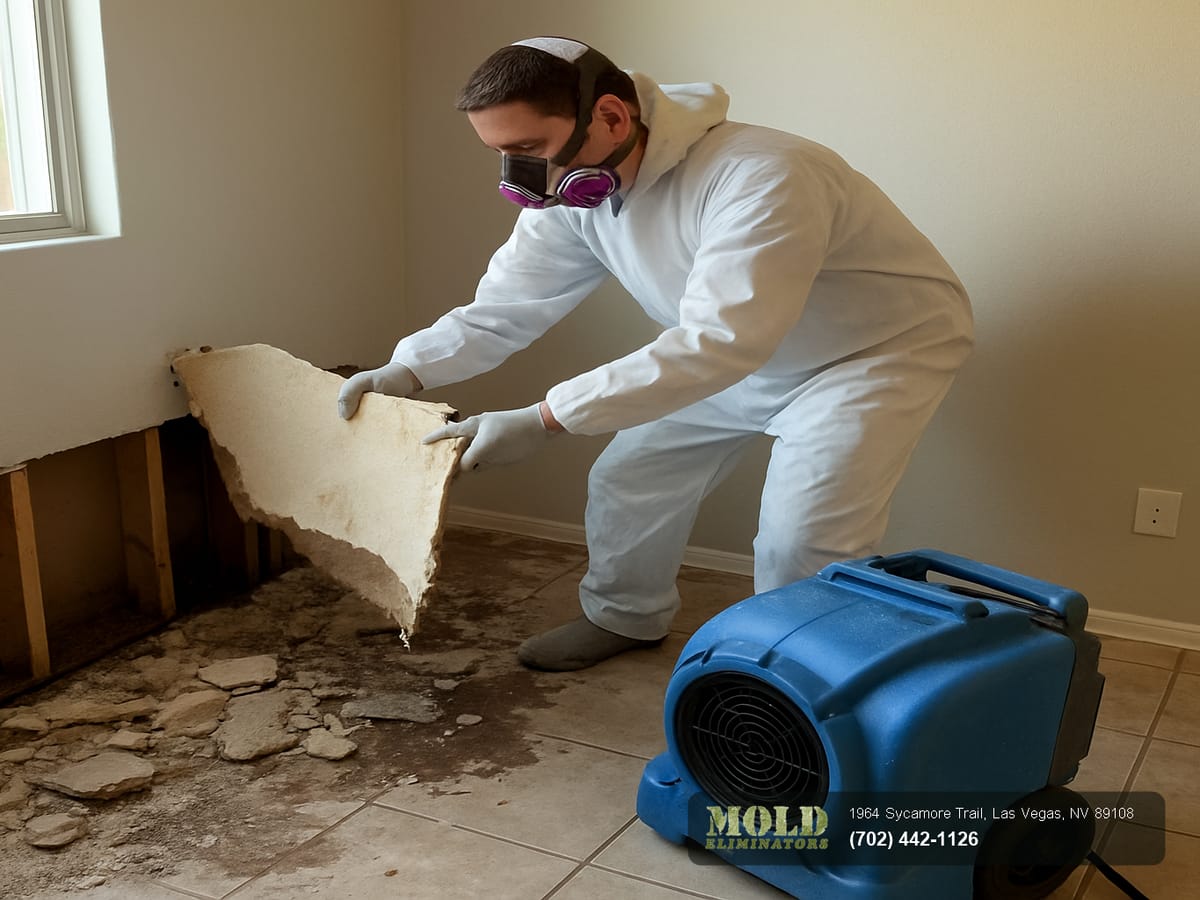
- Remove what cannot be saved. Drywall and insulation that are colonized or water-ruined come out. Materials that can be salvaged are cleaned and treated.
- Dry the structure to verified targets. We dry the framing and cavity with monitored equipment until moisture readings hit a documented dry standard, so growth has nothing left to feed on.
- Independent lab clearance. When the work is done, an independent third-party lab verifies the result. You get proof the problem is gone, not just our word that the stain is painted over.
Why Las Vegas homeowners call Mold Eliminators
We wrote the standard
Our founder Craig Herrmann is IICRC Master Certified and co-authored the ANSI/IICRC S520 standard the whole industry follows. Your wall is diagnosed and fixed by the rulebook, not by guesswork. Read more about Craig and the S520 standard.
No subcontractors, ever
Every technician is our own certified, in-house employee. One accountable crew owns the job from the first reading to the final clearance, with one-hour emergency response, 24/7, across the valley since 1996.
Independent lab, anti-upsell
We verify results with an independent third-party lab, not an in-house one, and we tell you when you do not need us. If a stain is just an old mineral mark and nothing is growing, we will say so.
That is the whole difference. A discolored wall is a moisture diagnosis, and we have spent since 1996 and more than 255 properties getting that diagnosis right. The right first move costs you nothing: a free inspection tells you what your stain actually is, what is behind it, and what, if anything, needs to be done.
Discolored walls in Las Vegas, common questions
- My wall stain stopped growing. Can I just paint over it?
- Not yet. A stain that stopped spreading may mean the leak is fixed, or it may mean the wall simply dried on the surface while the cavity behind stays wet. In our arid climate that is common. Paint will not stop mold, and a stain-blocking primer only hides the symptom. The right move is to verify the cavity is dry and clean first. A free inspection tells you whether it is safe to paint or whether something behind the wall needs attention.
- Could my discolored wall just be from the AC?
- Very possibly. In Las Vegas, condensation from a clogged AC condensate drain, a sweating duct, or an under-insulated air handler is one of the most common causes of interior wall staining, especially near closets, vents, and ceilings. The fix involves correcting the source as part of the larger picture. Hidden AC moisture can still feed growth in the wall cavity, which is why we trace it with moisture mapping rather than guessing.
- Is there mold behind a discolored wall?
- Sometimes, and a fuzzy grey, green, or black patch is a strong sign of it, while a clean brown or yellow ring is more often a mineral stain from past water. Neither answer is certain from the surface, because growth can sit inside the cavity with only a faint stain showing. Finding out is exactly what our inspection and, if needed, mold behind the walls assessment is for. If you would rather talk it through first, you can always reach us directly.
Seeing a discolored wall? Find out what it really is, free.
A free, no-pressure on-site inspection tells you whether your stain is cosmetic or a moisture problem behind the wall, and what, if anything, to do about it. One-hour emergency response, 24/7, across the Las Vegas valley.