Mold Behind Baseboards in Las Vegas
If you are seeing mold behind baseboards, dark staining at the bottom of a wall, or a musty edge that follows you from room to room, your house is trying to tell you something specific: there is more water in that wall than there should be. Mold at the floor line is almost never a surface problem. It is the visible end of moisture that has been wicking up from the slab or down through the wall cavity, and the baseboard is simply the first place it finally shows.
The good news is that this is a known, fixable pattern, and in a Las Vegas home it usually points to a short list of causes. The important thing is not to scrub it and repaint over it, because that traps the moisture and the mold returns within weeks. This page walks you through what mold behind baseboards usually signals here in the desert, how urgent it is, and exactly what a proper fix looks like when it is done to the national standard rather than painted over.
What mold behind baseboards usually means in a Las Vegas home
Baseboards sit at the exact junction where the wall meets the floor, which is also where water collects when it has nowhere else to go. When mold shows up there, it is telling you that the bottom plate of the wall, the drywall edge, or the slab underneath has been damp long enough for spores to colonize. In a desert climate where the air is bone dry, that is not normal evaporation, it means a source is feeding moisture into the assembly faster than it can leave. Here are the causes we find most often behind baseboards in this valley.
A slab leak. Most Las Vegas homes are built slab-on-grade, with water lines running through the concrete. A pinhole leak in a hot or cold line under the slab pushes moisture up through the concrete and into the bottom of the wall, where it surfaces as mold behind the baseboard. A warm spot on the floor, an unexplained jump in the water bill, or the sound of running water with everything off all point this direction.
Hidden water from a plumbing or appliance failure. A slow drip under a sink, a sweating supply line, a dishwasher or water heater that seeped rather than burst, all of these run along the floor and soak the bottom of the nearest wall. The leak can be small enough that you never saw a puddle, yet the baseboard tells the story.
AC condensation and a clogged condensate line. In our long cooling season, an air handler with a blocked condensate drain or a poorly sealed line can quietly release water into a wall or near a closet, feeding mold at the floor line for months before anyone notices.
Swamp cooler overflow. Evaporative coolers are common here, and an overflowing pan or a leaking water line in the ductwork can send moisture down interior walls. The mold often appears at the baseboard of a room nowhere near the cooler itself.
Monsoon intrusion and exterior grading. During monsoon season a hard, brief storm can drive water against the foundation, under a door threshold, or through a stucco crack. If the grading slopes toward the house, that water wicks into the bottom plate and shows up inside as baseboard mold weeks later.
Honest diagnosis matters here, because the fix for a slab leak is nothing like the fix for a clogged AC line. That is the entire reason we start with a free on-site inspection rather than a quote over the phone. Finding the real source is half the job, and it overlaps directly with full water damage restoration when an active leak is involved.
Need help now?
Talk to a Las Vegas expert
In-house certified crews. One-hour emergency response across the valley, 24/7.
Why it matters and how urgent it is
Mold behind baseboards is not a cosmetic blemish you can live with. The colony you can see is feeding on the paper face of the drywall and the wood of the bottom plate, and what is visible at the edge is usually the smaller part of what is growing inside the cavity. Left alone, it spreads up the wall behind the paint, into the framing, and along the floor to the next stud bay. The musty smell that comes with it is the gas the colony gives off, which means by the time you smell it, the growth is already established.
There is also a health dimension that deserves a calm, factual mention rather than fear. Mold at the floor line releases spores into the room every time air moves past it, and for anyone in the home with asthma, allergies, or a weakened immune system, that ongoing exposure is the part worth taking seriously. We do not say that to alarm you, we say it because it is the reason this is worth fixing properly the first time instead of repainting and hoping.
On urgency: this is not usually a same-night emergency the way an active flood is, but it is a this-week problem, not a someday problem. The longer the source feeds the wall, the more material has to be removed and the larger the job becomes. If you also have active water spreading right now, a burst line or a flooding slab leak, that crosses into our 24/7 emergency response, where we stabilize the water first and start drying immediately. Either way, the moisture source has to be stopped before any cleanup can hold.
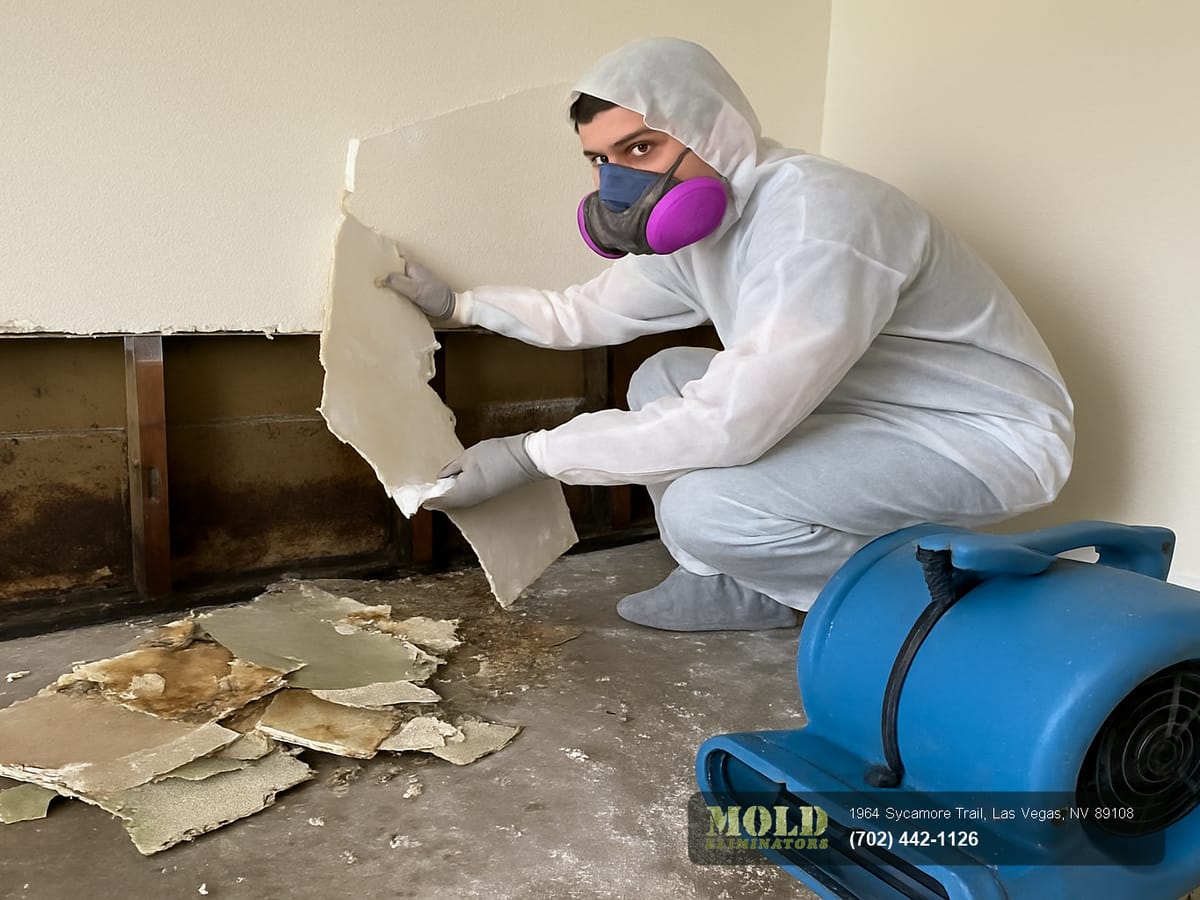 Technician inspecting the floor line and baseboard of a Las Vegas wall for hidden moisture and mold
What the proper fix involves, to the S520 standard
Removing mold behind baseboards correctly is a measured sequence, not a scrub-and-repaint. It follows the ANSI/IICRC S520 standard, the national rulebook for mold remediation that our founder Craig Herrmann helped write. You can read more about Craig and the S520 standard, but here is what the work itself looks like in your home.
- Free on-site inspection first. We come out, look at the actual wall, and use moisture meters and thermal imaging to find where the water is and where it is coming from. The inspection is free. Lab analysis, if you want spores identified, is an optional paid add-on, never something we slip into the bill.
- Find and stop the source. A remediation that does not fix the moisture source is guaranteed to fail. Whether it is a slab leak, a condensate line, or grading, the water has to be stopped before anything else, often alongside water damage repair.
- Containment. We seal the work area so spores disturbed during removal cannot drift into the rest of the home. This is the step franchises skip to save time, and it is why their jobs spread mold instead of removing it.
- Removal. The contaminated baseboard and the affected drywall and material are physically removed, bagged, and taken out, not bleached and hidden. Mold growth on porous material is removed, not painted over.
- Drying to verified targets. The bottom plate, the slab edge, and the remaining structure are dried with dehumidification and air movement until daily moisture readings confirm the materials are back to a documented dry standard.
- Independent lab clearance. When the work is done, an independent third-party lab verifies the area is clean, not us. That separation is the whole point: the people who did the work do not get to grade their own homework.
Why Las Vegas homeowners call Mold Eliminators for this
No subcontractors
Every technician who works in your home is a certified W-2 employee of Mold Eliminators, not a day crew. One in-house team owns the source, the removal, and the drying from the first reading to the final clearance, with one-hour emergency response, 24/7, across the valley.
Independent third-party lab
We do not certify our own work. An independent lab confirms the area is clean before we call it done, so the clearance you get is real verification, not a salesperson telling you it looks fine.
Anti-upsell, since 1996
Craig Herrmann is IICRC Master Certified and co-authored the S520 standard, and has worked on 255+ properties since 1996. If a problem is smaller than it looks, we tell you. We will say when you do not need us.
If you would rather know exactly what you are dealing with before committing to anything, the calm first step is a free inspection. We come out, find the source, and tell you honestly whether this is a quick fix or a real remediation. Mold behind walls and baseboards is a problem we handle every week, and you can read more about how we approach mold behind walls when the growth has spread up into the cavity.
Mold behind baseboards in Las Vegas, common questions
- Can I just remove the baseboard, clean it, and put it back?
- For a tiny, freshly caught spot on a non-porous surface, sometimes. But if mold is growing on the drywall paper or the wood bottom plate, cleaning the surface leaves the colony in the wall and the moisture source still feeding it, so it comes back within weeks. The fix that holds is stopping the water, removing the affected material, drying to a verified standard, and confirming the result, which is what proper restoration and remediation involves.
- Is mold behind my baseboards a sign of a slab leak?
- It often is, here. Most Las Vegas homes are slab-on-grade with water lines run through the concrete, and a slow under-slab leak pushes moisture up into the bottom of the wall, surfacing as baseboard mold. Other common causes are AC condensate lines, swamp cooler overflow, and monsoon intrusion. The only way to know which one you have is to measure it, which is why our on-site inspection is free.
- Do you charge for testing the mold?
- The on-site inspection, where we come out, find the source, and tell you what is going on, is free. Sending samples to an independent third-party lab to identify the specific spores is an optional paid add-on, and we will tell you honestly whether you actually need it. We do not bundle lab fees into a quote to inflate the price.
Seeing mold behind your baseboards? Get a free inspection.
We come out, find the source, and tell you honestly what it will take to fix it, with no pressure and no upsell. One-hour emergency response, 24/7, across the Las Vegas valley. Free on-site inspection, independent lab clearance, no subcontractors.